Author: Castle Labs
Compiled by: TechFlow
TechFlow Introduction: The total revenue of crypto protocols in the first half of this year reached $7.42 billion, but most tokens have underperformed relative to their fundamental metrics. Investors are beginning to shift from speculation to genuinely examining product revenue distribution and token value capture mechanisms, rather than blindly chasing price pumps. This article breaks down the revenue sources, distribution methods, and token release pressures of six leading protocols, revealing why high revenue does not equal token appreciation – a crucial issue every token holder should understand.
So far this year, crypto protocols have collectively generated $7.42 billion in revenue.
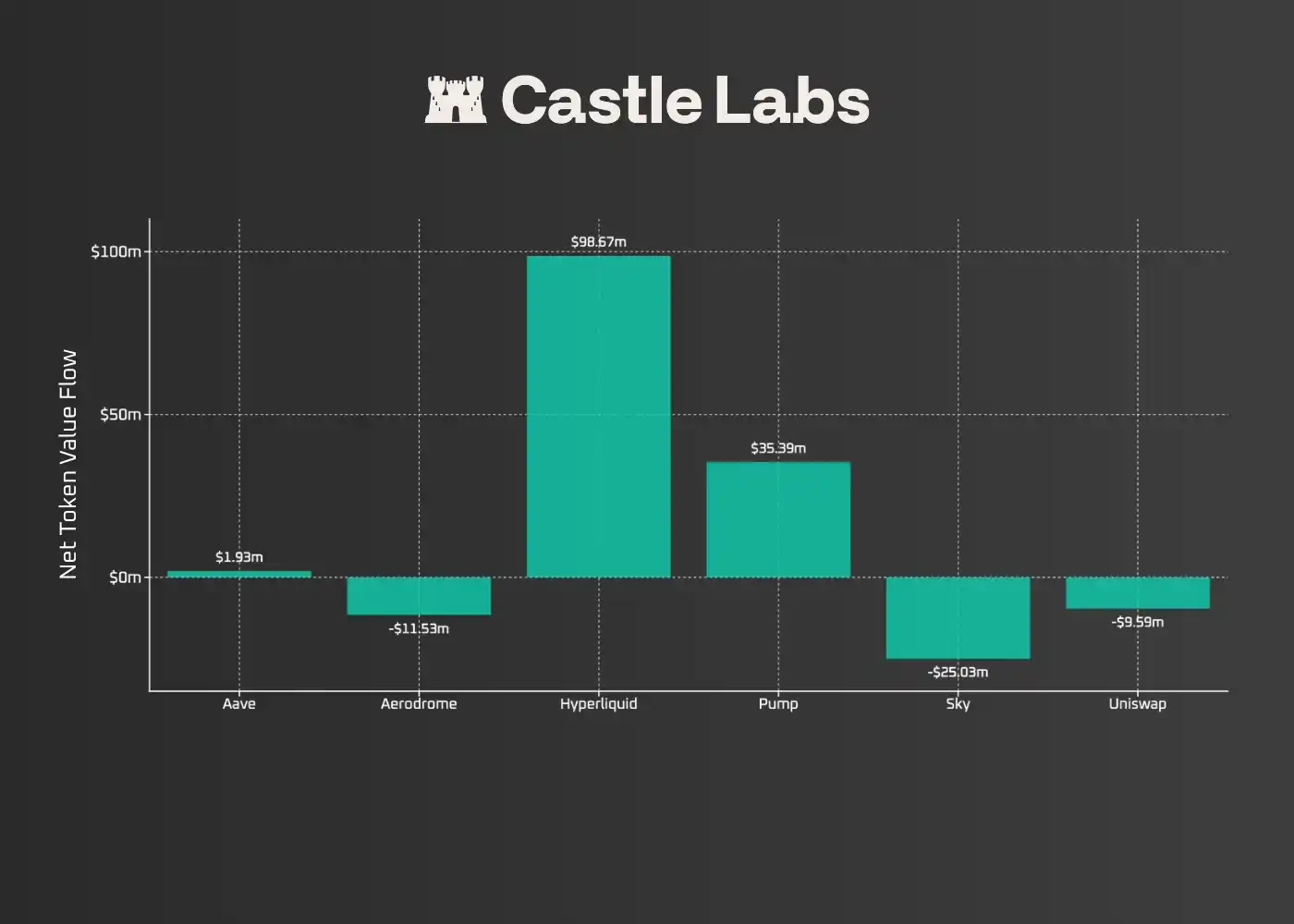
Chart: Net token value flow (Holder Revenue minus Token Release) for six leading protocols in the first half of 2026, Hyperliquid with a net inflow of $98.67 million, Sky with a net outflow of $25.03 million. Source: Castle Labs.
Even with these staggering numbers, most tokens in the crypto space still fail to reflect the success of their protocols.
Not all revenue is created equal.
This is a problem inherent to the industry from the start, but things are changing, and the questions investors ask when evaluating tokens are evolving. They are beginning to focus on how products generate revenue, spend it, and capture value for holders, marking a shift from speculative gambling to genuine investing.
Most of the time, token holders want answers to the following questions:
How does the protocol generate revenue, and is it sustainable?
How do they allocate revenue? Can token holders capture value from it?
How much token value is dedicated to releases, including inflation, unlocks, and incentives?
Is there an equity structure that grants more rights than existing holders?
Answering these four questions determines a project's weight in investors' eyes, but most projects cannot provide clear answers. Each token has a different value capture mechanism; some have none at all. Even where direct value sharing exists, token performance may still fall short of expectations.
Take PumpFun as an example: Since the token launch, the protocol has generated approximately $450 million in revenue (over a one-year timeframe), yet the token has fallen endlessly. Reasons include token unlock rates, unmet airdrop expectations, among other factors.
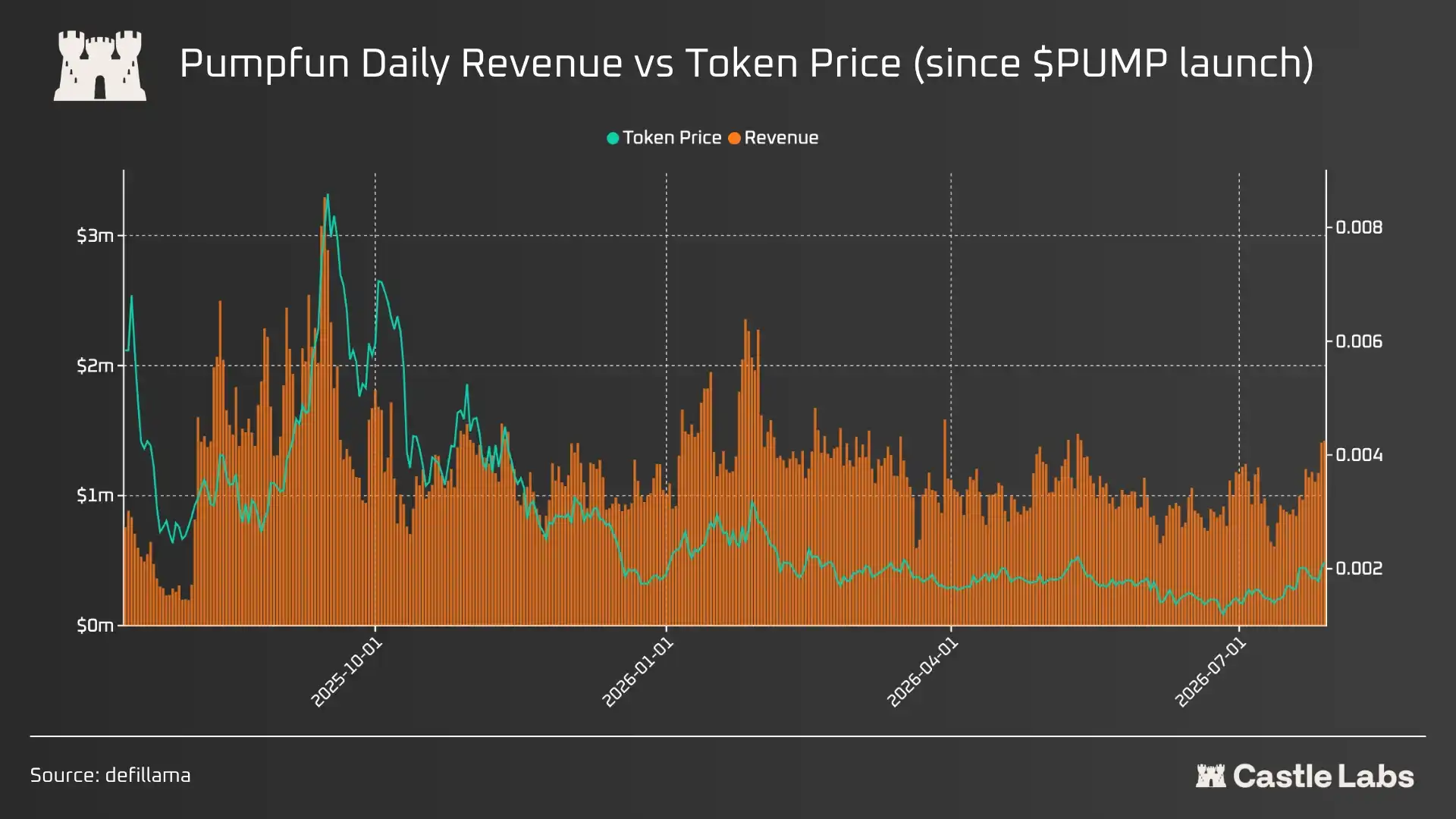
Chart: Daily revenue (orange) vs. token price (cyan) trend for Pumpfun since the PUMP token launch, showing a persistent divergence between revenue and price. Source: Castle Labs.
This article focuses on the different ways leading protocols generate and distribute revenue, also considering release and incentive factors, to illustrate the details investors should note when evaluating a protocol or token.
Cryptocurrency Revenue Sources and Distribution
Before discussing holder value capture, the fundamental question is quantifying the revenue generated by major products and how it is distributed. This analysis examines six protocols (Aave, Aerodrome, Hyperliquid, Pump, Sky, Uniswap), which collectively generated $726 million in revenue in the first half of 2026.
While higher revenue may signal a sustainable business, looking at this number alone is insufficient. First, to account for short-term volatility, it's better to measure revenue across different timeframes to assess its sustainability. Therefore, below we also compare revenue from Q1 and Q2 2026 and measure the change between them. For most protocols, the change was negative, reflecting a weaker performance in Q2 due to overall market conditions.
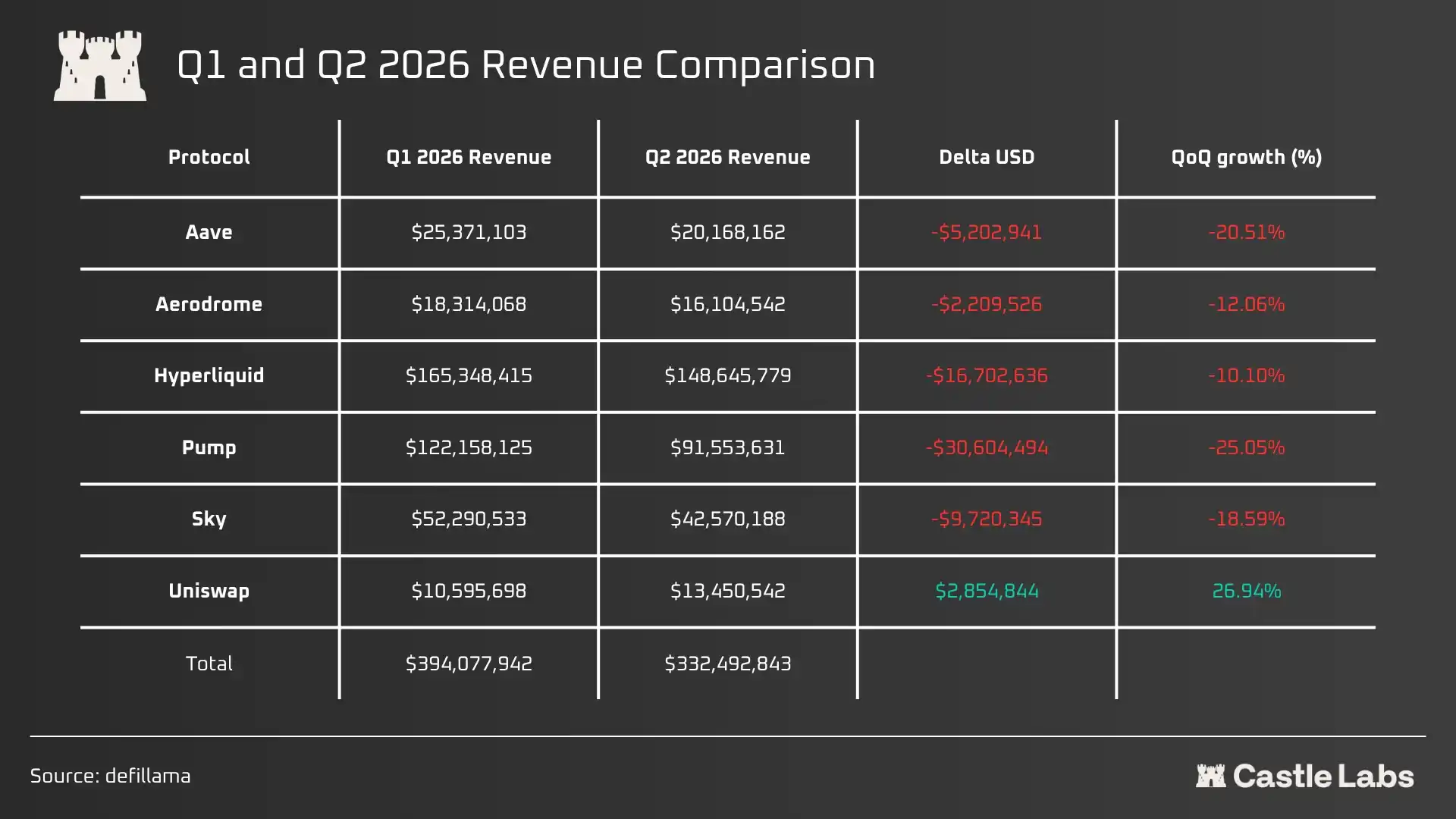
Chart: Revenue comparison for six protocols between Q1 and Q2 2026, only Uniswap achieved quarter-over-quarter growth (+26.94%), overall revenue dropped from $394 million to $332 million. Source: Castle Labs.
Moving to revenue sources, Hyperliquid's revenue comes from trading fees on its perpetuals exchange (native + HIP-3), spot markets, code auctions, priority fees, and HyperEVM gas fees.
Aerodrome is a decentralized exchange (DEX) generating revenue through trading fees and external voting incentives (bribes). Similarly, Uniswap charges fees on trades as its revenue source.
Sky generates revenue through different products: stable fees on collateralized DAI/USDS loans, liquidation penalties, Peg Stability Module (PSM) trading fees, and interest from the Direct Deposit Module (D3Ms) and Real-World Assets (RWAs).
Continuing the list, Aave generates revenue from interest rate spreads (paid by borrowers), flash loans, liquidation penalties, and stable fees from its native GHO stablecoin. Pumpfun generates revenue from trading fees and graduation fees charged when a newly created token reaches its target market cap.
Having clarified these protocols' revenue sources, we now compare them to token releases to explore whether and how they balance. While a protocol's holder revenue may be high, if token releases are even higher, the significance of the value capture process diminishes. A protocol might have $100 million in revenue, but if it achieves that by minting $200 million in tokens annually, the number means something entirely different. Furthermore, token releases are also important as they show how much value flows towards inflation, team or investor token unlocks, and most importantly, incentives.
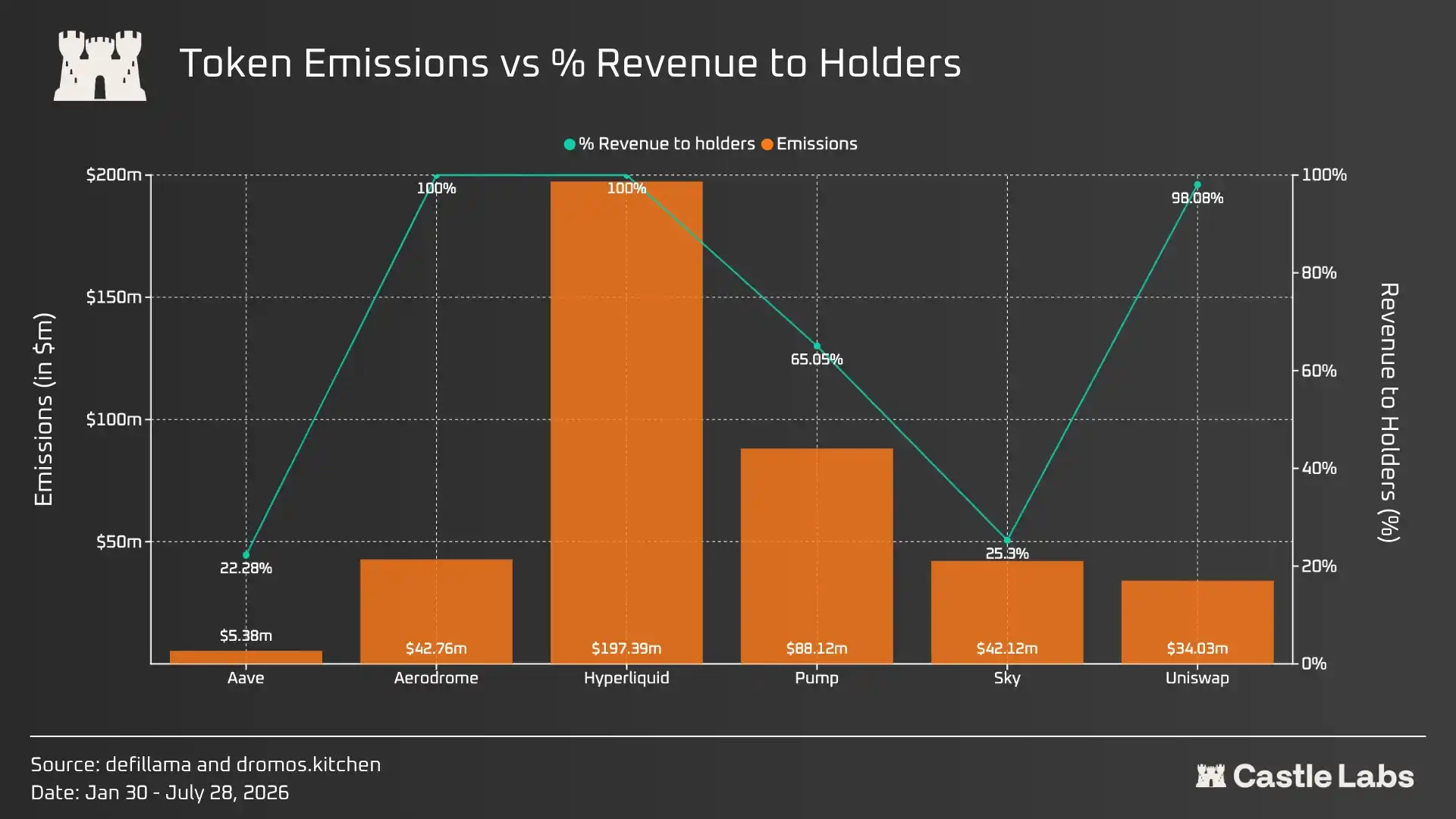
Chart: Comparison of token release (orange bars) vs. proportion of revenue allocated to holders (cyan line) for six protocols, Hyperliquid allocates 100% of revenue to holders. Source: Castle Labs.
Most protocols' revenue allocation is typically split between token holders and the treasury. The specifics depend on the particular protocol mechanism and the governance that handles this distribution.
To show how releases impact the token, we subtract releases from holder revenue. For Aerodrome, Sky, and Uniswap, the net token flow becomes negative after this, even with revenue allocated to holders, indicating these protocols released more tokens to sustain current revenue levels, reducing the net value flowing to holders.
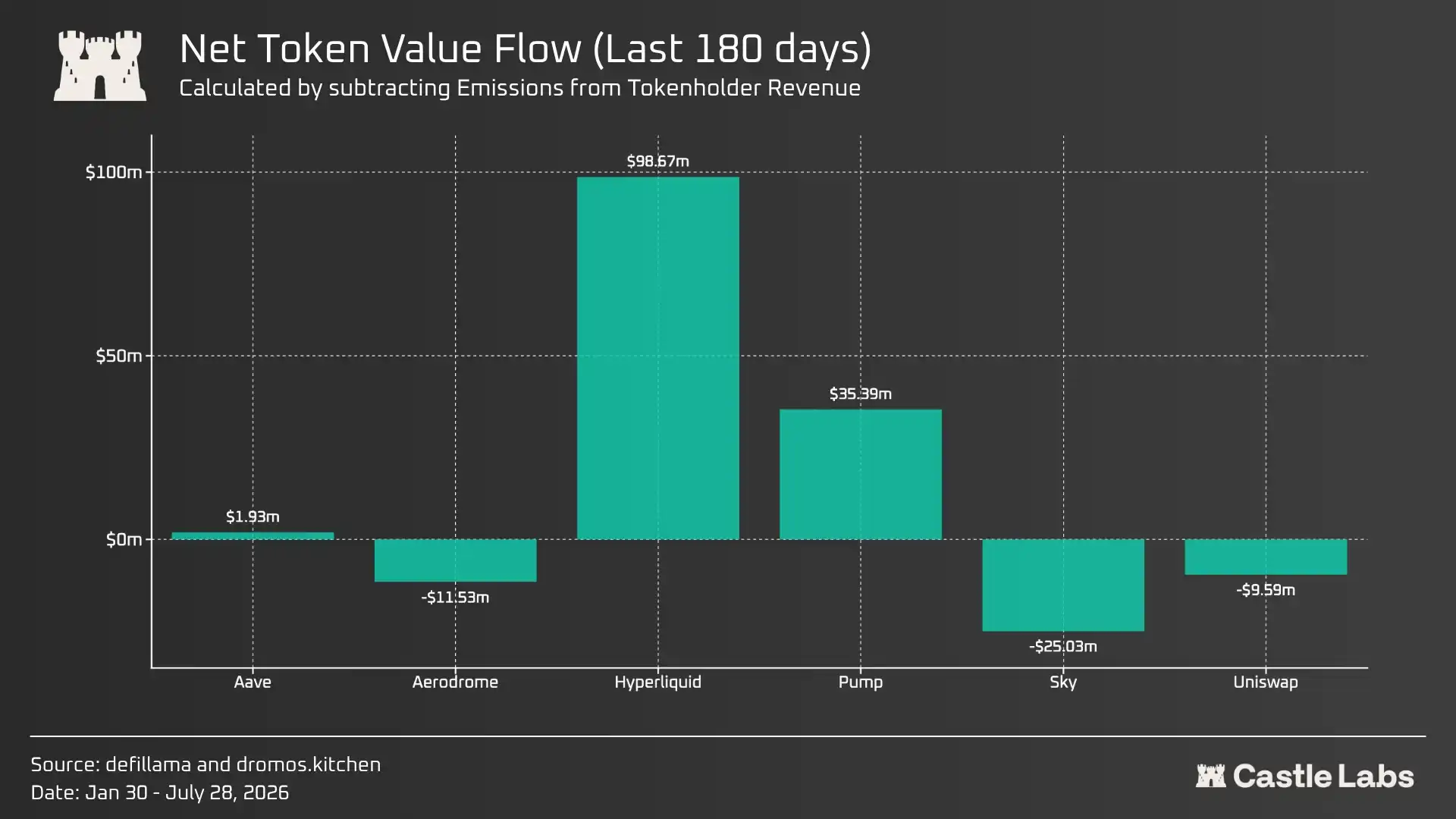
Chart: Net token value flow for six protocols over the past 180 days, calculated as Holder Revenue minus Token Release. Source: Castle Labs.
Currently, token holders capture value primarily in two ways: buybacks and fee distribution.
Buybacks are one of the simplest, albeit indirect, ways projects allocate value to token holders, by using revenue to purchase tokens and burn them.
Buybacks often return tokens to the protocol treasury for future incentives or staking rewards; for example, Aave transfers repurchased tokens to its treasury.
For more consistency, most protocols burn these assets, reducing supply. For instance, Lighter burned approximately 15.6387 million LIT tokens (6.6% of supply) obtained via revenue, worth $36.125 million.

Chart: On-chain record of Lighter transferring 15,638,700 LIT (~$36,125,000) from treasury to a burn address. Source: Castle Labs.
Hyperliquid executes buybacks and burns programmatically, having burned over 47 million HYPE tokens to date, about 4.72% of its supply. Uniswap executed a 100 million UNI token burn in December 2025, accumulating a burn of 107 million UNI tokens to date (about 11% of total supply), sourced from its enabled fees.
Burns aren't available for all tokens, and their execution is highly nuanced. For example, BNB used to conduct quarterly burns. However, these were often less effective than users expected because they burned non-circulating tokens, thus having no practical impact on market dynamics. Users must look at the fine print of the burn: Where are the tokens being burned from? Circulating supply or non-circulating supply?
Each project executes buybacks differently. Maple Finance holders recently voted for a buyback program that scales with revenue, allocating increasingly more to token holders as income grows. This is an update to its MIP-019, which previously allocated 25% of revenue to buybacks. Based on average H1 2026 revenue of $1.15 million, the buyback would scale down to 10%, not the best news for holders, but the proposal passed with 99.97% approval.
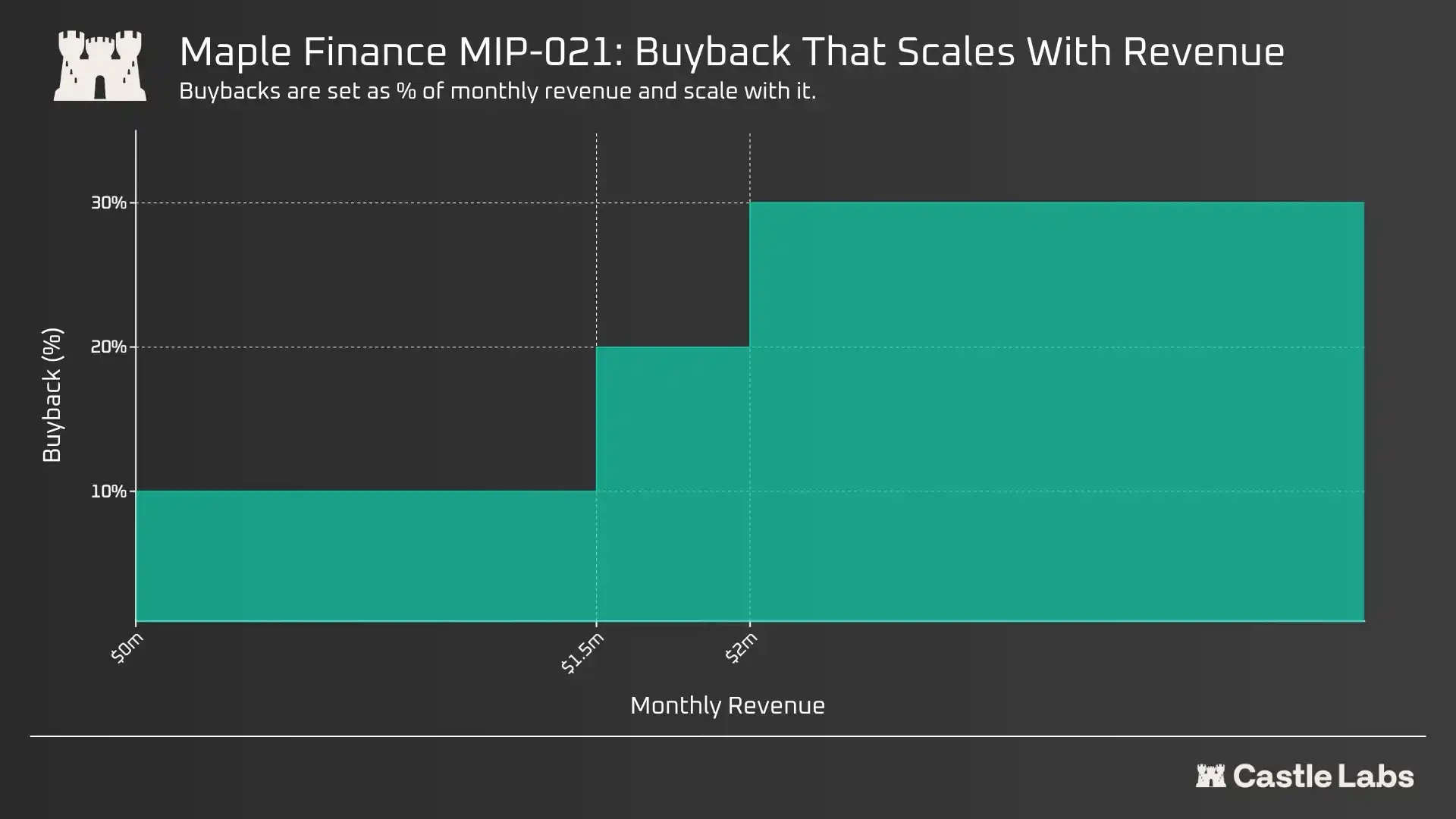
Chart: Maple Finance MIP-021 proposal for tiered buyback percentage based on monthly revenue, increasing to 30% when monthly revenue exceeds $2 million. Source: Castle Labs.
Additionally, token holders can choose to stake their tokens into the protocol and earn staking yields from the treasury. After recent tokenomics updates, Lighter aims for a target staking yield of 6%, distributing 7.5 million LIT tokens annually based on the current staking level of 125 million tokens.
Similarly, over 430 million HYPE is staked, earning yield from future release reserves, estimated at 2.1%.
Buybacks and burns alone cannot save a project from poor tokenomics or declining revenue; they should be considered within the broader framework of each protocol's buyers and sellers. However, they can be used to drive ecosystem growth and bootstrap liquidity while slowly reducing over time, leaving room for organic growth. Burns have similar mechanisms that can leverage platform activity to counter inflationary tokenomics.
Fee Distribution
Other protocols, like Aerodrome and Curve Finance, use the ve tokenomics (Vote-Escrowed) model to directly distribute fees. In this model, holders stake their tokens and convert them into vote-escrowed tokens (e.g., veAERO or veCRV).
It creates economic value for holders through different mechanisms:
Protocol Trading Fees: These protocols allocate 50-100% of fees to ve token holders.
Boosted Yields: Holding these tokens also increases yields for liquidity providers (LPs) in pools on these exchanges.
Bribes: Protocols pay cash incentives to ve holders in exchange for their governance votes directing future rewards to specific liquidity pools.
Ve protocols are practically characterized by inherent design driving strong releases, partly explaining their high fee distribution growth achieved through inflation.
Using these methods, these protocols have generated over $2.75 billion in holder income to date, primarily driven by Hyperliquid and Uniswap (due to the December 2025 100 million UNI burn).
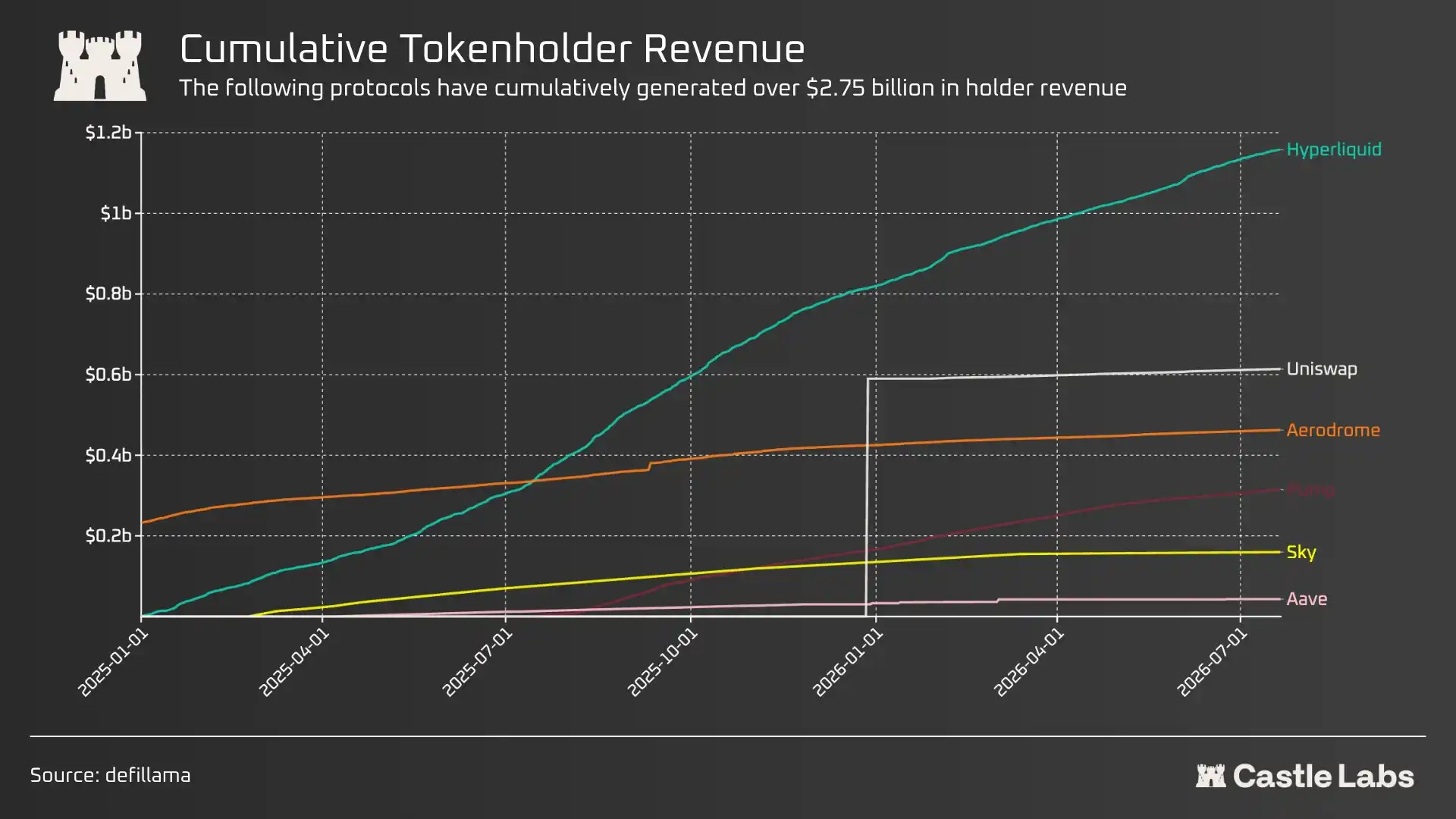
Chart: Cumulative revenue distributed to holders by six protocols exceeds $2.75 billion, with Hyperliquid and Uniswap contributing the majority. Source: Castle Labs.
But as we mentioned, value capture alone is insufficient; releases also need to be balanced.
In the next part, we explore other reasons beyond holder revenue and releases that may hinder token growth.
The Beautiful Trap of Tokens
Over time, crypto products have grown and generated substantial revenue, but revenue doesn't necessarily mean the token will perform better.
Most revenue-generating products have underperformed token-wise for reasons including:
Revenue Doesn't Flow to the Token: Even if a protocol generates meaningful revenue, this value often stays in the treasury rather than flowing to token holders. How buybacks are used matters. Treasury retention is discretionary, dependent on the protocol. With no contractual obligation, the protocol can pause, adjust, or cancel buybacks at any time. While governance is behind these decisions, most voting power is controlled by the project team.
Equity-Token Separation Makes Holders Second-Class Citizens: An increasing number of companies now adopt a dual-structure of equity and tokens. A classic example of such a token is XRP. Ripple Labs stock has performed well since 2025, up 105%, while the XRP token has fallen 45% over the same period. They issue both token and equity, but since holders have no specific right to company revenue, there is no value capture. In contrast, equity holders receive this value and perform well.
Higher Unlock Rates Add Expected Sell Pressure: Even with revenue sharing, higher-rate supply unlock schedules suppress the token, as explained earlier when discussing token releases. Another aspect is the low circulating float and high FDV nature of tokens, as a large portion of supply remains to be unlocked and absorbed by the market. This can effectively lower a protocol's P/S ratio, making it look "cheap," but the circulating supply shock is expected in the future as part of releases.
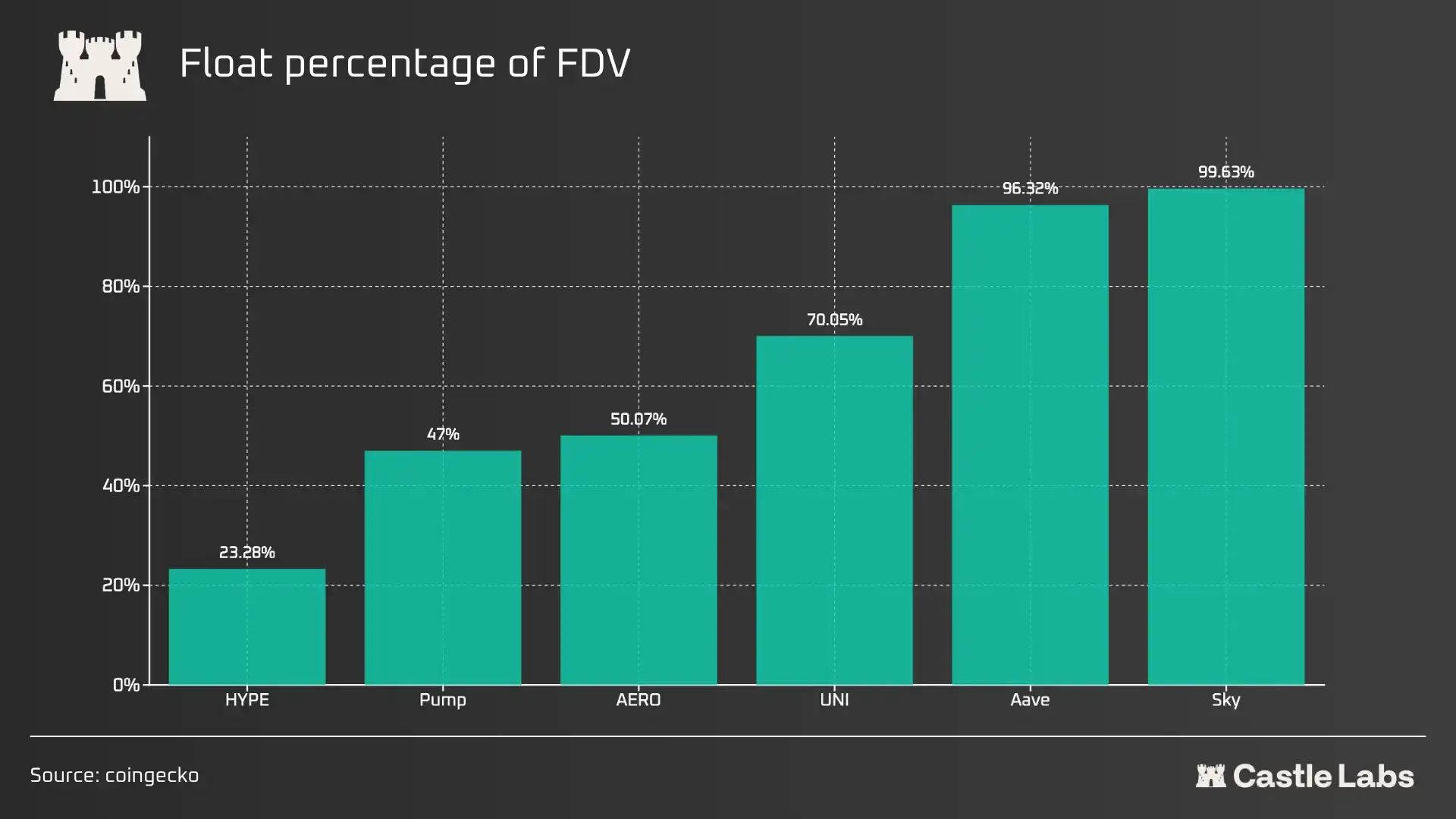
Chart: Circulating float as a percentage of Fully Diluted Valuation (FDV) for six tokens, HYPE at only 23.28%, Sky as high as 99.63%. Source: Castle Labs.
Combining these factors reflects the true nature of tokens and, in most cases, explains price movements, though other factors may also influence their performance.
The PUMP token has fallen 60% since launch, despite the project completing over $315 million in buybacks. On the other hand, HYPE is up 1400% since launch and has returned $1.2 billion to shareholders via buybacks. Both consistently conduct buybacks, but PUMP price performance is unsatisfactory due to lack of communication from the team, no airdrop, rapid unlocks, and market selling of the token.
The AAVE token has been struggling since the beginning of the year. Since the buyback program began in April 2025, it has completed $45 million in buybacks (currently paused due to the Kelp DAO incident). This is due to multiple factors, including the departure of DAO service providers like BGD Labs and ACI, the impact of the Kelp DAO incident on Aave, and increased institutional competition from Morpho.
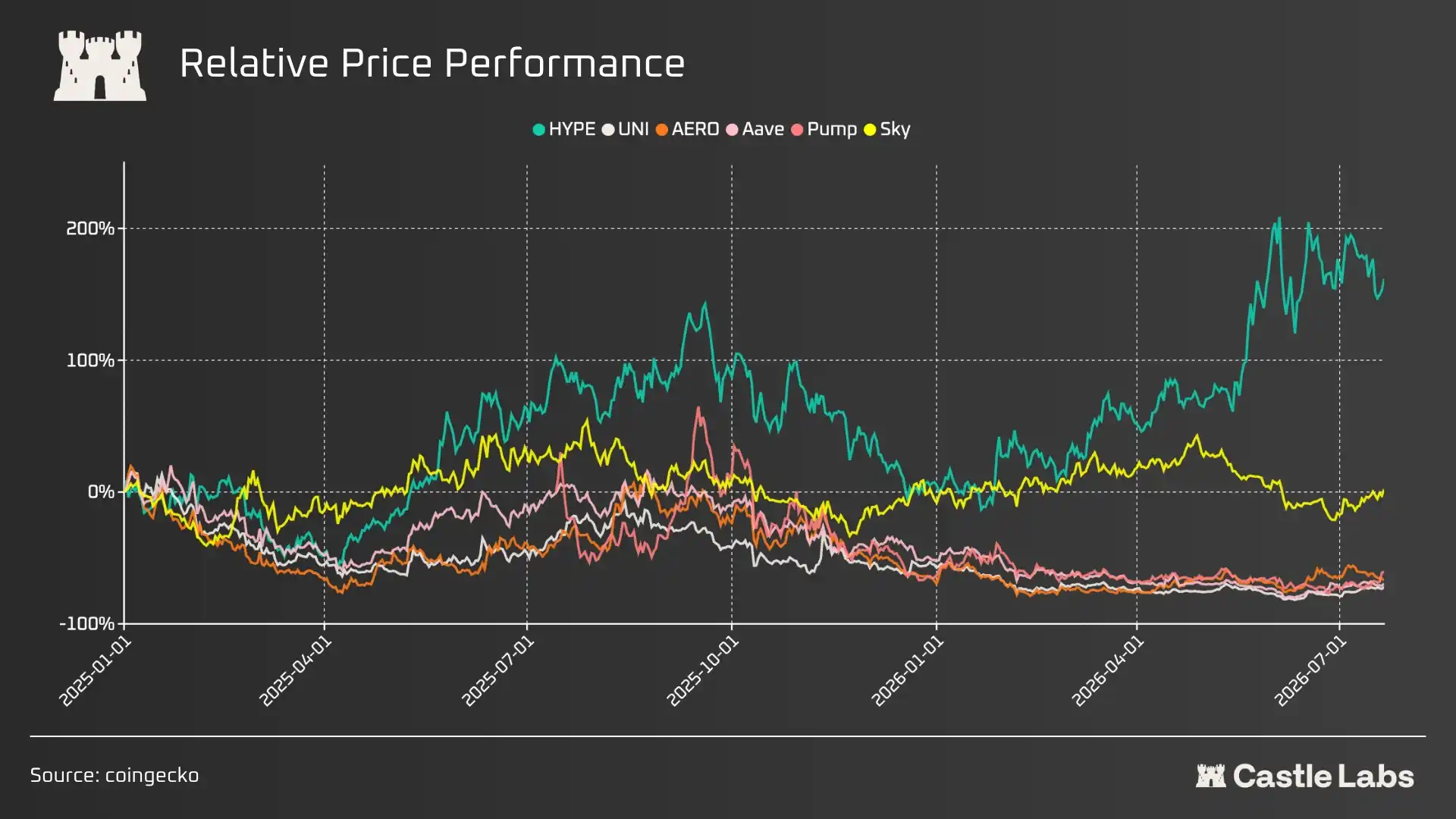
Chart: Relative price performance of HYPE, UNI, AERO, Aave, Pump, Sky; HYPE significantly outperforms, most others are near or below launch levels. Source: Castle Labs.
In Aave's case, they also lost over $23 million executing these buybacks due to falling asset prices. Their average purchase price for AAVE was $182, while it currently trades around $90, suggesting buybacks may not have been optimal.
However, buybacks remain one of the most consistent solutions for accumulating value in a token, as they can be tracked on-chain, and the protocol must purchase assets from the market, creating buy pressure supported by revenue. Thus, it establishes a direct positive link between the protocol's successful growth (more revenue) and improved, more deflationary tokenomics (lower inflation). For cryptocurrency holders, this might be the most optimal way to ensure alignment between protocol and token. But as Aave's case shows, their purchases lost 50%, eroding the value created through the project's success.
On the surface, dividends seem like a better option, as users earn stablecoins tied to their holdings and can use them freely. However, unlike buybacks, this has no direct impact on token price, making the choice between them somewhat difficult and highly context-dependent. If a protocol distributes fees, then its token may become useless (unless it has other value or utility). The counterargument is that more people would want to invest in a token because dividends exist.
As of today, most projects are doing buybacks, indicating they perceive them as more valuable.
Conclusion
Multiple protocols are earning substantial revenue, but not all accumulate value for their tokens in the same way. Even when they do, it doesn't necessarily lead to asset price appreciation, as there's often enough selling pressure from unlocked tokens held by insiders, negative news, incentives, the overall sentiment towards the project, and the competitive landscape.
Looking at these different nuances in isolation only tells a small story. Instead, investors should conduct broader analysis, including how a protocol generates revenue, how it allocates it, and how it balances that with eventual releases and incentives.
The first step for any protocol should be to become a successful business and generate revenue. Then, it should ensure value is accumulated to token holders in some way, whether through buybacks, dividends, or automated fee distribution.
In the case of Hyperliquid, we've witnessed how a protocol with strong tokenomics and a value accumulation process excels when alignment is embedded from genesis. It allocates most of its revenue to holders, and other projects like Aerodrome and Uniswap are following suit.
Protocols are increasingly aware that good tokens need good distribution, so we expect more alignment between protocol and users, and token holders will win more.
The broken chain between protocol revenue and token performance ultimately points to a simple conclusion: A good protocol does not equal a good token. Only when revenue, distribution, and releases are all seriously examined can holders truly share in the growth dividends.