NYSE parent in talks to invest in crypto company MoonPay: Report

cointelegraphPubblicato 2025-12-18Pubblicato ultima volta 2025-12-18

Introduzione

Intercontinental Exchange (ICE), parent company of the New York Stock Exchange, is reportedly in talks to invest in cryptocurrency payments firm MoonPay, which is seeking a $5 billion valuation in its latest funding round. This follows ICE’s recent $2 billion investment in prediction platform Polymarket. MoonPay provides infrastructure for buying and selling crypto using traditional payment methods. The move reflects growing convergence between Wall Street and crypto, as seen in ICE's earlier partnership with Circle to explore stablecoin integration and the DTCC’s approval to offer tokenized bonds and stocks. These developments highlight the increasing institutional adoption of blockchain and tokenization technologies.

Intercontinental Exchange (ICE), the parent company of the New York Stock Exchange (NYSE), is in talks to invest in crypto payments company MoonPay as part of the company’s latest funding round.

MoonPay is seeking to raise funds at a $5 billion valuation, according to Bloomberg, which cited sources familiar with the deal and did not disclose the dollar amount of the potential investment.

In October, ICE invested $2 billion in prediction platform Polymarket, in a funding round that brought the company’s valuation to $9 billion.

MoonPay is a financial technology company that provides infrastructure for buying, selling and using cryptocurrencies through fiat on-ramps and off-ramps. Founded in 2019, it enables users to purchase crypto using traditional payment methods such as debit and credit cards, while offering services to wallets, exchanges and enterprises seeking to integrate crypto payments.

Polymarket founder Shayne Coplan (left) and Intercontinental Exchange CEO Jeffrey Sprecher (right) in front of the New York Stock Exchange after the $2 billion deal. Source: Shayne Coplan

Cointelegraph reached out to ICE and MoonPay but had not received a response at time of publication.

The investment deals reflect the growing ties between crypto and Wall Street, as traditional financial institutions adopt blockchain technology and form partnerships with crypto companies.

Related: Acting CFTC chair to join MoonPay after leaving agency

Wall Street and Crypto continue to converge, blurring the lines between both worlds

Stablecoin company Circle and ICE began exploring a stablecoin integration with ICE’s various clearing and data services in March.

The products being tested for possible integrations include Circle’s USDC (USDC) dollar-pegged stablecoin and its tokenized money market fund, US Yield Coin (USYC), an onchain yield-bearing product backed by short-term US Treasurys.

In December, the US Securities and Exchange Commission (SEC) gave the green light to the Depository Trust and Clearing Corporation (DTCC), a financial settlement and clearing infrastructure company, to begin offering tokenized bonds and stocks.

Real-world asset (RWA) tokenization is a way of representing physical or traditional assets on a blockchain, which allows for faster settlement times, cross-border transactions and the ability to use assets as collateral in decentralized finance (DeFi) applications.
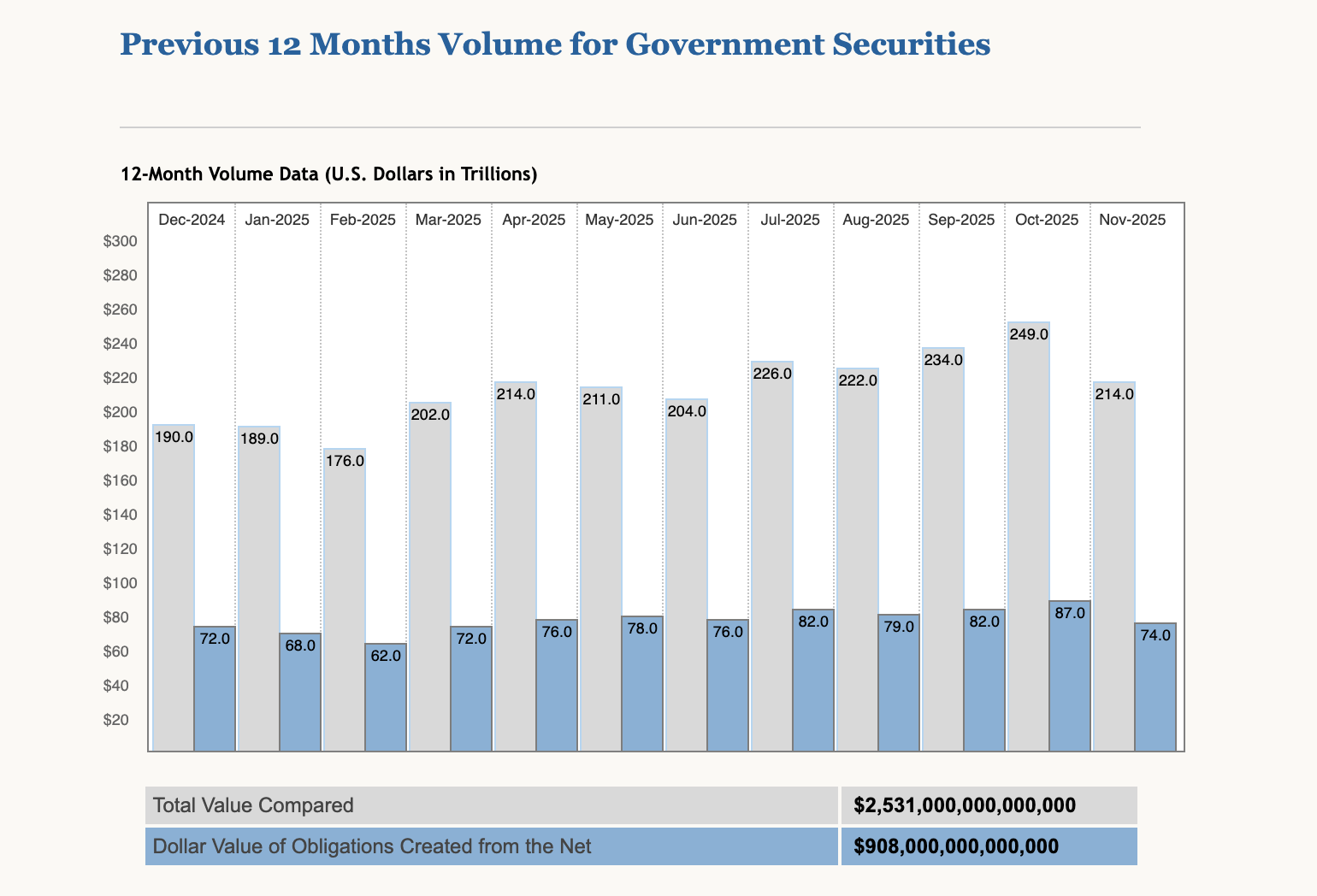
Volume of 12-month government securities settled using the DTCC’s infrastructure. Source: DTCC

DTCC handled about $3.7 quadrillion in settlement volume in 2024 and is considered the backbone of the traditional financial system, clearing transactions across the equity, bond, fixed income and financial derivatives markets.

The DTCC is expected to launch its tokenized trading services in the second half of 2026 and will mint some US Treasurys onchain using the Canton Network, a permissioned network of blockchain infrastructure geared toward financial institutions.

Magazine: Unstablecoins: Depegging, bank runs and other risks loom

Domande pertinenti

QWhat is the parent company of the New York Stock Exchange (NYSE) and which cryptocurrency firm is it reportedly in talks to invest in?

AIntercontinental Exchange (ICE), the parent company of the NYSE, is in talks to invest in the cryptocurrency payments company MoonPay.

QAt what valuation is MoonPay seeking to raise funds in its latest funding round, as reported by Bloomberg?

AMoonPay is seeking to raise funds at a valuation of $5 billion.

QWhat was the size of ICE's previous investment in Polymarket and what was the resulting valuation of that company?

AICE invested $2 billion in Polymarket, which brought the company's valuation to $9 billion.

QWhat specific services does MoonPay provide in the cryptocurrency space?

AMoonPay provides infrastructure for buying, selling, and using cryptocurrencies through fiat on-ramps and off-ramps. It enables users to purchase crypto using traditional payment methods like debit and credit cards, and offers services to wallets, exchanges, and enterprises.

QWhat major traditional financial infrastructure company received SEC approval to begin offering tokenized bonds and stocks, and what network will it use to mint some US Treasurys onchain?

AThe Depository Trust and Clearing Corporation (DTCC) received SEC approval to offer tokenized bonds and stocks. It will mint some US Treasurys onchain using the Canton Network.

Letture associate

Sui Transfers $65 Billion for Free. Its Co-founder Is Confident Even Grander Things Are Ahead

Sui's co-founder Evan Cheng makes a radical prediction: within four years, digital payment volume on the Sui blockchain will rival that of traditional card networks and banking systems. This claim is ambitious for an L1 blockchain whose token trades just above $0.60. Cheng, CEO of Sui's developer Mysten Labs, frames Sui's roadmap as an infrastructure play, not a trading platform. He believes current Web3 infrastructure is stuck in an "era of dial-up access." Founded by ex-Meta engineers behind the Diem blockchain and Move programming language, Mysten Labs envisions Sui as a "communication system" for stablecoin settlements, remittances, and future AI-to-AI commerce. Co-founder Adeniyi Abiodun adds that the internet will soon enable free, private, large-scale payments as privacy features roll out on Sui. The vision is backed by data. Since Mysten Labs eliminated gas fees for stablecoin transfers at the protocol level in June, Sui has processed over $65 billion in stablecoin transfers. Having handled $2.27 trillion in stablecoin volume since early 2024, this move removes a major barrier by not requiring merchants to hold a second asset for fees. Sui is also encroaching on Bitcoin's territory with the Hashi testnet, allowing Bitcoin to be used as DeFi collateral on Sui without converting to a synthetic token. Furthermore, a default privacy feature for stablecoin transactions is in development, cited by institutions as crucial for moving real payment volume to public blockchains. Skeptics point to Sui's token facing sell pressure from unlock schedules and its $2.8B market cap being a fraction of the payment volumes Cheng cites. Whether Sui becomes the "rail for every internet payment" or captures a smaller but significant share of stablecoin and cross-border settlements remains to be seen. The coming year's gas-free transaction data and Hashi bridge adoption will test if Cheng's four-year forecast is realistic or founder-driven optimism.

cryptonews.ru14 min fa

Sui Transfers $65 Billion for Free. Its Co-founder Is Confident Even Grander Things Are Ahead

cryptonews.ru14 min fa

Analysts Have Announced Signs of a Bear Cycle Ending on the Crypto Market

Analysts at Wintermute suggest the cryptocurrency market is showing signs of a bear cycle ending, despite tough macroeconomic conditions and ongoing uncertainty around US monetary policy. They noted that digital assets displayed relative resilience last week against several negative events that typically pressure risk assets, including an unchanged Fed rate, a multi-decade high in 30-year US Treasury yields, and a major AI fund liquidating assets. Bitcoin and Ethereum fell less than 4% for the week, which analysts interpret as a sign of nearly exhausted selling pressure, with excessive optimism now leaving the stock market instead. While a rapid shift to a sustained bull run is not expected, low open interest and summer liquidity could set the stage for a short-term technical rally. However, this scenario would be invalidated if the market breaks last week's lows on high volume, signaling the return of active sellers. The report also highlighted a shift in institutional demand: US spot Bitcoin ETFs saw outflows in late July, while Ethereum funds posted a fourth consecutive week of inflows. Furthermore, a major corporate buyer, Strategy, has resumed periodic Bitcoin sales to fund dividends, becoming an occasional seller during weak demand periods. Near-term catalysts include upcoming US ISM Services data and the jobs report, which will shape Fed policy expectations. The upcoming Jackson Hole symposium, where Fed Chair Kevin Warsh may signal future policy direction ahead of the September meeting, is also seen as a key event that will influence the crypto market's next move.

cryptonews.ru21 min fa

Analysts Have Announced Signs of a Bear Cycle Ending on the Crypto Market

cryptonews.ru21 min fa

Trading

Spot
活动图片