NYSE-listed NovaBay pivots to crypto, rebrands as Stablecoin Development Corporation

ambcryptoPubblicato 2026-04-03Pubblicato ultima volta 2026-04-03

Introduzione

NovaBay Pharmaceuticals, listed on the NYSE, is fully pivoting to cryptocurrency and rebranding as Stablecoin Development Corporation (ticker: SDEV). The company will shift its focus to on-chain treasury and staking activities, moving away from its legacy pharmaceutical business. As of March 16, NovaBay disclosed holdings of approximately 2.06 billion SKY tokens and is actively staking them to generate yield, adopting a DeFi-aligned strategy rather than passive crypto investment. SKY has traded in a stable range between $0.055 and $0.08, reflecting its role as a governance and yield-generating asset. This transition highlights a broader trend of public companies moving beyond Bitcoin holdings to actively participate in on-chain ecosystems.

NovaBay Pharmaceuticals is moving deeper into crypto, announcing a full strategic pivot that includes a rebrand to Stablecoin Development Corporation and a shift toward on-chain treasury and staking activities.

In a Form 8-K filing, the company said it will adopt the new name and begin trading under the ticker SDEV on the NYSE American on 3 April. The move marks a significant transition from its legacy pharmaceutical business toward a crypto-focused operating model.

From pharma to on-chain strategy

The filing shows that the company is no longer experimenting with digital assets but actively restructuring around them. NovaBay disclosed holdings of approximately 2.06 billion SKY tokens as of 16 March, alongside accumulated staking rewards.

Rather than holding crypto passively, the firm said it is engaging in “SKY-related on-chain activities,” including staking. This model allows token holders to earn yield by participating in network operations.

The shift effectively positions the company as an on-chain holding entity, aligning its treasury strategy with the mechanics of decentralized finance [DeFi].

A yield-focused crypto treasury

Unlike corporate Bitcoin strategies that focus on long-term price appreciation, NovaBay’s approach centers on yield generation. By staking its SKY holdings, the company is tapping into a recurring reward mechanism native to blockchain networks.

This structure suggests a different risk and return profile—one tied not only to token price movements but also to network activity and participation incentives.

The company did not provide detailed disclosures on how its SKY position was accumulated. Still, the scale of the holdings signals a high-conviction allocation.

SKY price reflects steady, range-bound behavior

Recent market data shows that SKY has traded within a relatively stable range compared to more volatile crypto assets.

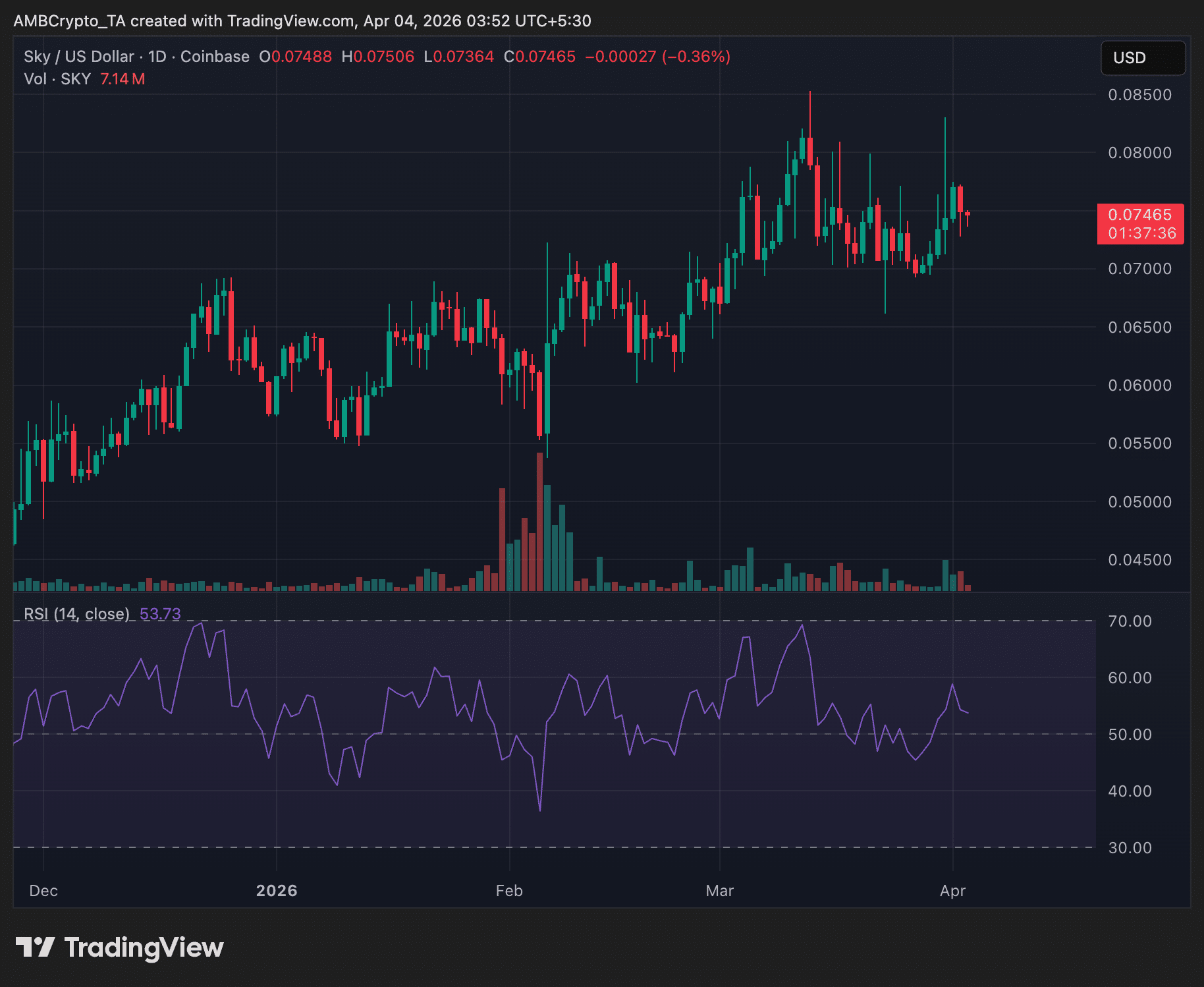
The token has largely fluctuated between $0.055 and $0.08 in recent months, with its Relative Strength Index [RSI] hovering near neutral levels around 50–55. This suggests balanced momentum rather than speculative overheating.
Source: TradingView

The relatively stable price action aligns with SKY’s role as a governance and yield-generating asset, rather than a purely narrative-driven token.

This may also underpin the company’s strategy, which appears focused on long-term participation and reward generation rather than short-term trading gains.

A broader shift in corporate crypto adoption

NovaBay’s transformation reflects a growing trend of publicly listed firms integrating crypto more directly into their core business models.

While earlier corporate adoption focused on holding Bitcoin as a treasury reserve, newer strategies are emerging that involve active participation in on-chain ecosystems — including staking, liquidity provision, and governance.

By rebranding and aligning its identity with stablecoin and DeFi infrastructure, the company is signaling a deeper commitment to this evolving model.

The transition also highlights how traditional corporate structures are increasingly intersecting with decentralized financial systems.


Final Summary

  • NovaBay is rebranding as Stablecoin Development Corporation and shifting to an on-chain treasury model built around staking and token holdings.
  • The move signals a broader evolution in corporate crypto adoption, with firms increasingly engaging in yield-generating DeFi strategies rather than passive exposure.


Domande pertinenti

QWhat is the new name and ticker symbol for NovaBay Pharmaceuticals after its rebranding?

AThe new name is Stablecoin Development Corporation and it will trade under the ticker SDEV on the NYSE American.

QWhat significant change is NovaBay making to its core business model?

ANovaBay is making a full strategic pivot from its legacy pharmaceutical business to a crypto-focused operating model, centering on on-chain treasury and staking activities.

QWhat specific crypto asset does the company hold a large amount of, and how many?

AThe company disclosed holdings of approximately 2.06 billion SKY tokens as of 16 March.

QHow does NovaBay's crypto strategy differ from a typical corporate Bitcoin strategy?

AUnlike corporate Bitcoin strategies that focus on long-term price appreciation, NovaBay’s approach centers on yield generation through staking its SKY holdings to earn recurring rewards.

QWhat does the recent price action and RSI of the SKY token suggest about its market behavior?

ASKY has traded in a relatively range-bound manner between $0.055 and $0.08, with its RSI near neutral levels around 50–55, suggesting balanced momentum rather than speculative overheating.

Letture associate

a16z: AI's 'Amnesia', Can Continuous Learning Cure It?

The article "a16z: AI's 'Amnesia' – Can Continual Learning Cure It?" explores the limitations of current large language models (LLMs), which, like the protagonist in the film *Memento*, are trapped in a perpetual present—unable to form new memories after training. While methods like in-context learning (ICL), retrieval-augmented generation (RAG), and external scaffolding (e.g., chat history, prompts) provide temporary solutions, they fail to enable true internalization of new knowledge. The authors argue that compression—the core of learning during training—is halted at deployment, preventing models from generalizing, discovering novel solutions (e.g., mathematical proofs), or handling adversarial scenarios. The piece introduces *continual learning* as a critical research direction to address this, categorizing approaches into three paths: 1. **Context**: Scaling external memory via longer context windows, multi-agent systems, and smarter retrieval. 2. **Modules**: Using pluggable adapters or external memory layers for specialization without full retraining. 3. **Weights**: Enabling parameter updates through sparse training, test-time training, meta-learning, distillation, and reinforcement learning from feedback. Challenges include catastrophic forgetting, safety risks, and auditability, but overcoming these could unlock models that learn iteratively from experience. The conclusion emphasizes that while context-based methods are effective, true breakthroughs require models to compress new information into weights post-deployment, moving from mere retrieval to genuine learning.

marsbit1 h fa

a16z: AI's 'Amnesia', Can Continuous Learning Cure It?

marsbit1 h fa

Can a Hair Dryer Earn $34,000? Deciphering the Reflexivity Paradox in Prediction Markets

An individual manipulated a weather sensor at Paris Charles de Gaulle Airport with a portable heat source, causing a Polymarket weather market to settle at 22°C and earning $34,000. This incident highlights a fundamental issue in prediction markets: when a market aims to reflect reality, it also incentivizes participants to influence that reality. Prediction markets operate on two layers: platform rules (what outcome counts as a win) and data sources (what actually happened). While most focus on rules, the real vulnerability lies in the data source. If reality is recorded through a specific source, influencing that source directly affects market settlement. The article categorizes markets by their vulnerability: 1. **Single-point physical data sources** (e.g., weather stations): Easily manipulated through physical interference. 2. **Insider information markets** (e.g., MrBeast video details): Insiders like team members use non-public information to trade. Kalshi fined a剪辑师 $20,000 for insider trading. 3. **Actor-manipulated markets** (e.g., Andrew Tate’s tweet counts): The subject of the market can control the outcome. Evidence suggests Tate’sociated accounts coordinated to profit. 4. **Individual-action markets** (e.g., WNBA disruptions): A single person can execute an event to profit from their pre-placed bets. Kalshi and Polymarket handle these issues differently. Kalshi enforces strict KYC, publicly penalizes insider trading, and reports to regulators. Polymarket, with its anonymous wallet-based system, has historically been more permissive, arguing that insider information improves market accuracy. However, it cooperated with authorities in the "Van Dyke case," where a user traded on classified government information. The core paradox is reflexivity: prediction markets are designed to discover truth, but their financial incentives can distort reality. The more valuable a prediction becomes, the more likely participants are to influence the event itself. The market ceases to be a mirror of reality and instead shapes it.

marsbit2 h fa

Can a Hair Dryer Earn $34,000? Deciphering the Reflexivity Paradox in Prediction Markets

marsbit2 h fa

Trading

Spot
Futures
活动图片