Nvidia Rack Disassembly Reveals New Growth Opportunity, MLCC Value Surges 182%

marsbitPubblicato 2026-06-01Pubblicato ultima volta 2026-06-01

Introduzione

Supply bottlenecks in AI infrastructure have expanded to fundamental hardware components like multilayer ceramic capacitors (MLCCs), crucial for stabilizing power and filtering noise in AI servers. Both Goldman Sachs and Morgan Stanley highlight MLCCs as entering a historic "volume-price dual increase" supercycle driven by AI. Goldman forecasts the AI server MLCC market to surge over fourfold from ~$1.4B in FY2025 to ~$5.8B in FY2030, a 34% CAGR. The core driver is a structural supply-demand imbalance. While AI server demand is projected to grow ~4.3x by 2030, industry capacity expands at only ~10% annually, constrained by internal production of equipment and materials. This is compounded by strong demand from electric vehicles. The shortage is evident, with lead times for high-end MLCCs exceeding 20 weeks. The price cycle has officially begun. Japanese leaders Murata and Taiyo Yuden have raised prices by 15-35% for AI server and automotive MLCCs since April, citing material costs. Japan's April export data confirms the trend, with MLCC export value up 28% year-over-year. Profit leverage is significant: Goldman estimates a mere 5% price increase could boost Murata's FY2027 operating profit by ~13% and Taiyo Yuden's by up to 37%. Morgan Stanley's teardown of Nvidia's upcoming Vera Rubin AI rack reveals another catalyst: the MLCC value per rack has skyrocketed 182% from the previous generation to ~$4,320, highlighting the component's growing importance. With demand set to ...

Editor's Note: Supply bottlenecks in AI infrastructure are spreading from GPUs, memory, data centers, and power systems to even more fundamental hardware components. Goldman Sachs and Morgan Stanley have now turned their attention to MLCCs — the multilayer ceramic capacitors long regarded as ordinary passive components.

In AI servers, MLCCs are responsible for stabilizing current and filtering noise, serving as critical components to ensure high-speed chip operation. As Nvidia's new-generation rack architecture increases MLCC usage per rack, their value is rising rapidly. Goldman Sachs expects the AI server MLCC market to grow more than fourfold between 2025 and 2030, while industry capacity is increasing at an annual rate of just over 10%. This supply-demand mismatch is becoming the core variable driving the current market cycle.

More importantly, the price cycle has already begun. Japanese leaders Murata and Taiyo Yuden have initiated price hikes, and Japanese export data are also beginning to validate demand strength. For capital markets, the MLCC logic is not complex: demand comes from AI servers and high-end automobiles, supply expansion is constrained, and price increases can significantly amplify profit elasticity.

From chips to capacitors, pricing power within the AI supply chain is shifting to more segmented and hidden links. Whether MLCCs will become the "next memory chip" still depends on whether AI server demand continues to materialize. However, it is certain that this once-overlooked fundamental component has now reached the starting point of a new cycle of simultaneous volume and price growth.

Original Article:

Supply bottlenecks in the artificial intelligence (AI) arms race are sequentially igniting opportunities across various hardware sectors. After data centers, energy infrastructure, and memory chips became focal points for capital, Wall Street giants Goldman Sachs and Morgan Stanley simultaneously pointed in their latest reports to a long-underestimated fundamental component: multilayer ceramic capacitors (MLCCs). Both institutions expect MLCCs to become the next key battleground for "volume and price growth," and this AI-driven growth cycle could be the largest in history.

Goldman Sachs analyst Daiki Takayama noted in the report that the AI server MLCC market is expected to surge from approximately ¥215 billion (about $1.4 billion) in FY2025 to about ¥920 billion (about $5.8 billion) in FY2030, an increase of over fourfold, representing a compound annual growth rate (CAGR) of 34%. Goldman Sachs stated bluntly that the current AI-driven MLCC cycle "will be the largest and longest-lasting in history, and we believe it is still in its early stages."

MLCC: The 'Invisible Heart' Keeping AI Servers Running

An MLCC (Multi-layer Ceramic Capacitor) can be understood as an extremely miniaturized, ultra-fast-response charge/discharge unit. Unlike ordinary batteries that store large amounts of energy and release it slowly, MLCCs store very little energy but can complete charging and discharging within milliseconds or even shorter timeframes. Their core function is to smooth power fluctuations and filter noise: absorbing instantaneous voltage spikes or rapidly replenishing current during voltage dips, thereby providing stable current to sensitive chips and blocking electrical interference that could disrupt digital signals.

The operating characteristics of AI servers make MLCCs indispensable. When an AI model performs massive calculations, the processor's power consumption can spike dramatically within microseconds and then drop rapidly to near zero after the computation ends. The power supply system itself struggles to respond promptly to such drastic fluctuations. MLCCs are typically placed directly near AI chips, releasing energy instantaneously when power peaks occur to prevent server crashes. As Nvidia GPUs and other AI chips need to handle billions of tasks simultaneously, a top-tier AI server rack may require up to 600,000 MLCCs working in concert to maintain system stability.

Goldman Sachs analyst Nelson Armbrust further pointed out that MLCCs have become the third-most expensive component in the AI server bill of materials (BOM), trailing only GPUs and memory. The overall MLCC market is currently about $15 billion, with the server-related market at around $1.3 billion, expanding at a CAGR of 80%. In contrast, demand growth in other application areas like automobiles and smartphones has noticeably slowed. Daiki Takayama expects MLCCs' cost share in the AI server BOM to gradually rise from about 0.5% currently to about 1%.

Structural Supply-Demand Imbalance: Annual Capacity Growth of Just 10%, Unable to Withstand Fourfold Demand Shock

The core factor sparking market attention is the severe structural supply-demand imbalance facing the MLCC industry. Goldman Sachs analyst Allen Chang explicitly stated that the annual capacity growth rate for the entire MLCC industry is only slightly above 10%. Moreover, as equipment and materials rely heavily on in-house production, expansion progress is constrained by internal engineering resources, making it difficult to accelerate significantly. However, the demand shock from AI servers is on a completely different scale. Goldman Sachs estimates that MLCC demand driven by AI servers will grow by approximately 4.3 times between FY2025 and FY2030.

Adding to market concerns, demand for high-voltage, high-capacitance MLCCs driven by automotive electrification remains robust, with per-vehicle MLCC usage continuing to rise. These two demand pillars—AI servers and electric vehicles—are jointly consuming the limited new capacity. This situation has led consumer electronics clients, despite a downturn in demand, to actively seek long-term supply agreements to hedge against future shortage risks.

Signals of current market tightness are emerging on multiple fronts: lead times for high-end MLCCs (high-capacity, high-voltage specifications) exceed 20 weeks; prices for low-capacity and consumer-grade MLCCs in spot and distribution channels have risen 20% to 40% due to stockpiling and double-ordering; prices for key raw materials like nickel and silver remain elevated, putting pressure on costs across various products.

Price Increase Cycle Officially Begins: Japanese Leaders Initiate Hikes, Official Data Confirms Trend

Price signals are intensifying rapidly. Price hike actions by Japan's two leading companies, Murata Manufacturing and Taiyo Yuden, mark the official start of the MLCC price increase cycle. Effective April 1 this year, Murata increased prices for MLCC products used in AI servers and high-end automotive applications by 15% to 35%. Taiyo Yuden has also notified customers of price adjustments across multiple product lines starting in May, involving MLCCs, inductors, RF devices, FBAR/SAW devices, and aluminum electrolytic capacitors, citing continuously rising costs of precious metals and other raw materials.

Trade statistics released by Japan's Ministry of Finance on May 28th verify this price trend at a macro level. The data shows that the average export price of MLCCs in April rose 3% month-over-month and 16% year-over-year; export volume increased 10% year-over-year; and export value surged 28% year-over-year. Goldman Sachs believes this data confirms signals from recent financial reports of Japanese MLCC manufacturers: all companies affirmed that order momentum remains strong.

Examining the timeline of the entire AI supply chain, Goldman Sachs's analytical framework shows that MLCC price increases lag significantly behind other AI core components like DRAM, NAND memory, ABF substrates, and copper-clad laminate (CCL). Therefore, Goldman Sachs judges that among all AI components and materials, MLCCs have the longest runway and strongest sustainability for price increases. Goldman Sachs has revised its forecast for the year-over-year MLCC price change in 2026 from approximately 0% previously to 0% to +5%, emphasizing that actual future increases could far exceed this level.

Remarkable Profit Elasticity: 5% Price Hike Could Boost Operating Profit Up to 37%

For investors, the profit elasticity resulting from the MLCC supply-demand mismatch should not be underestimated. Daiki Takayama estimates that a mere 5% product price increase could theoretically boost Murata's FY2027 operating profit by about 13% and Taiyo Yuden's operating profit by up to 37%.

Goldman Sachs expects Murata's FY2027 sales to reach ¥10.5 trillion (about $66 billion), a 13% year-over-year increase, and Taiyo Yuden's sales to reach ¥286 billion (about $1.8 billion), also a 13% year-over-year increase. Goldman Sachs maintains a "Buy" rating on Murata, Taiyo Yuden, and TDK. Its constructed Asia MLCC thematic stock portfolio has recently started to strengthen but still shows significant catch-up potential compared to other popular AI themes.

Morgan Stanley Disassembles Nvidia's New Rack: Rising Importance of Peripheral Components, MLCC Usage Soars 182%

Another major catalyst comes from Nvidia's next-generation Vera Rubin AI rack. Morgan Stanley, upon disassembling Nvidia's latest VR200 rack, found that the importance of peripheral components in the latest BOM is rapidly increasing.

The MLCC value within a single rack has increased from about $1,530 in the previous-generation GB300 era to about $4,320, a surge of 182%. Although the absolute dollar amount of MLCCs remains lower than that of GPUs, memory, and PCBs, their growth rate among peripheral components is exceptionally prominent.

Morgan Stanley's channel checks further reveal that MLCC usage has increased significantly on both compute boards and switch boards, with the increase being more pronounced on compute boards. Additionally, the newly introduced BlueField and ConnectX modules will further boost the total MLCC usage per rack. This partly explains why current demand for high-end AI server MLCCs is so strong, prompting multiple ODM manufacturers to actively stockpile in preparation for the mass production and delivery of Rubin racks in the second half of 2026.

Morgan Stanley's disassembly of the Nvidia Vera Rubin rack shows the following changes in key component values:
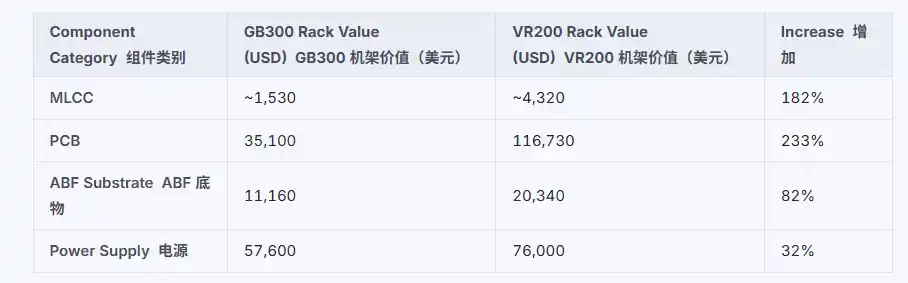
Market intelligence indicates that in the infrastructure arms race of the AI supercycle, the sequential rotation of supply bottlenecks has already spawned wave after wave of market winners. Goldman Sachs's latest assessment describes MLCCs as the "new memory chip"—a passive component sub-industry standing at the starting point of a cycle of simultaneous volume and price growth.

As exponential demand shocks from AI servers and Nvidia Rubin racks emerge, lead times for high-end MLCCs exceed 20 weeks, Japanese industry leaders initiate price hikes, and official export data remain robust. All signals point to the same conclusion: this AI-driven MLCC supercycle has only just begun.


Domande pertinenti

QAccording to the Goldman Sachs report, what is the projected growth of the AI server MLCC market from FY 2025 to FY 2030?

AAccording to Goldman Sachs, the AI server MLCC market is projected to grow more than fourfold, from approximately ¥215 billion in FY 2025 to about ¥920 billion in FY 2030.

QWhat is the primary function of MLCCs in AI servers, and why are they so critical?

AThe primary function of MLCCs in AI servers is to smooth power fluctuations and filter electrical noise. They provide stable power to sensitive chips by absorbing voltage spikes and rapidly supplementing current, which is critical for preventing system failures during the microsecond-level power surges characteristic of AI computation.

QWhat are the two main factors causing the structural supply-demand imbalance in the MLCC industry highlighted by Goldman Sachs?

AThe two main factors are: 1) A limited annual MLCC industry capacity growth rate of just over 10%, constrained by internal engineering resources for production equipment and materials. 2) Surging demand from two major pillars: AI servers (projected 4.3x growth from FY2025-2030) and the automotive electrification sector, which are jointly consuming the limited new capacity.

QBased on the Morgan Stanley analysis of Nvidia's new Vera Rubin VR200 rack, what was the percentage increase in MLCC value per rack compared to the previous generation?

AAccording to Morgan Stanley's teardown analysis, the MLCC value per rack in the new Nvidia Vera Rubin (VR200) rack increased by 182% compared to the previous generation (GB300 era), rising from about $1,530 to approximately $4,320.

QWhich companies were mentioned as leading the MLCC price increase cycle, and what profit elasticity does a 5% price hike potentially bring for one of them?

AThe Japanese companies Murata Manufacturing and Taiyo Yuden were mentioned as leading the MLCC price increase cycle. According to Goldman Sachs estimates, a 5% price hike could theoretically increase Murata's FY2027 operating profit by about 13% and Taiyo Yuden's operating profit by up to 37%.

Letture associate

A Nation Blocks Chips, a Giant Buys a Nuclear Power Plant: Why It's Time to Seriously Consider DeAI

**Title: Great Powers Blockade Chips, Giants Buy Nuclear Plants: Why It's Time to Seriously Consider DeAI** In May 2026, the US closed loopholes for Chinese firms to acquire advanced NVIDIA chips via overseas subsidiaries. That same month, Kenya halted a $1B geothermal data center project involving Microsoft, fearing its immense energy consumption. Meanwhile, Huawei announced mass production of its Ascend AI chip. These disparate events underscore a new reality: the competition for computing power ("compute") has escalated beyond the tech industry, becoming a geopolitical and infrastructural battleground. A new era of oligopoly is forming, with control over the AI stack—from GPU chips (NVIDIA) and cloud platforms (AWS, Azure, Google Cloud) to foundational models (OpenAI, Anthropic)—concentrating in a few Western "AI Octopus" corporations. This centralization creates systemic risks: pricing power and platform lock-in for users, infrastructure fragility, and a widening "compute divide" that threatens to marginalize nations without independent AI capacity. An "AI Iron Curtain" is deepening through export controls. In response, some nations like Saudi Arabia and the UAE are investing heavily to buy compute power, aiming to transition from oil to AI economies. The EU seeks to triple its compute capacity by 2030 to reduce dependency. However, the spending gap is vast, with four US tech giants alone planning ~$750B in AI capex for 2026. The race is increasingly constrained by energy, with AI tasks consuming up to 1000x more power than web searches, pushing firms to even acquire nuclear plants. This landscape is fueling interest in Decentralized AI (DeAI). It proposes a third way: using open protocols to coordinate a global network of idle GPUs, independent developers, and data centers, creating an AI infrastructure without a single controlling entity. Leveraging blockchain and cryptographic verification, DeAI aims to break market concentration, disperse energy demands, reduce geopolitical dependencies, and enhance transparency. While still nascent in performance and stability, DeAI's core promise is not immediate superiority but providing a crucial alternative architecture to resist monopoly, censorship, and centralized power. As specialized AI hardware costs fall and open-source models flourish, the window to build this foundation is open. The very existence of such competition serves as a vital check against the inevitable abuse of concentrated power.

marsbit34 min fa

A Nation Blocks Chips, a Giant Buys a Nuclear Power Plant: Why It's Time to Seriously Consider DeAI

marsbit34 min fa

Outpoll Review: A Prediction Market Platform Built for Active Traders

Outpoll Review: A Prediction Market Platform Built for Active Traders In recent years, prediction markets have grown from a niche sector to a mainstream arena, attracting billions in trading volume and institutional capital. However, the user experience and tools for traders have not kept pace. Outpoll, a new global prediction market platform, aims to fill this gap by providing enhanced trading infrastructure for active and professional traders. Built on standard prediction market principles, Outpoll allows users to trade on the outcome of specific events. It uses fully collateralized contracts with USDC settlement, charges a competitive 0.1% fee per trade, and provides clear settlement rules upfront to minimize disputes. A key focus for Outpoll is its professional-grade trading tools. The platform supports limit and market orders, as well as take-profit and stop-loss orders for open positions—features uncommon in prediction markets. For automated trading, Outpoll offers comprehensive REST and WebSocket APIs, enabling portfolio management, price arbitrage, and integration with existing tools. The platform also features a creator-led market model, where approved experts and community leaders can create and manage markets for niche topics under platform supervision. Its integrated interface combines news feeds directly with trading functions, allowing users to monitor events and manage positions seamlessly. Outpoll launched with a native Android app (available on Google Play) and plans an iOS version later this year. In summary, Outpoll distinguishes itself with trader-focused tools, practical APIs, transparent and collateralized markets, integrated news, and an expanding creator program. For active traders, its advanced order types and API access alone make it a platform worth watching. Outpoll is now globally accessible via outpoll.com and Google Play.

marsbit42 min fa

Outpoll Review: A Prediction Market Platform Built for Active Traders

marsbit42 min fa

Bitwise: Crypto Becomes a Contrarian Investment, Three Logics to Understand the Current Market

**Summary** Matt Hougan, Bitwise's CIO, analyzes the current crypto market through three key lenses, arguing it has shifted from a momentum-driven to a contrarian investment. **1) Crypto Becomes a Contrarian Play:** The market is weak, with major assets like Bitcoin and Ethereum down significantly. Capital has moved to hot sectors like AI, leaving crypto as an "unloved" asset class. This transforms crypto investing from trend-following to a test of patience and fundamental analysis. Investors now favor projects with solid fundamentals (e.g., Hyperliquid) over speculative ones. **2) Regulatory Overhang:** The uncertain fate of the U.S. CLARITY Act, a major crypto regulatory framework, is a key headwind. With its passage in 2024 seen as far from guaranteed (estimates range from 30-55%), institutional capital remains on the sidelines, choosing less risky alternatives like AI stocks. The market needs clarity—whether the bill passes or fails—more than any specific outcome to move decisively. **3) Capital Rotates to New Fundamentals:** This cycle differs from past bear markets where money fled to Bitcoin. Now, capital seeks smaller assets with strong use cases. While major cryptos fell in May 2024, tokens like Hyperliquid (+72%), Zcash (+50%), and XLM (+44%) rallied on their specific fundamentals. This rotation confirms the new contrarian, fundamentals-driven logic and signals the bear market may be in its later stages. **Conclusion:** Short-term pressure persists due to regulatory uncertainty and competition from AI narratives. Investing in crypto now requires a contrarian mindset—acting against the crowd and focusing on fundamental value. Patience and targeting high-quality projects based on their merits are essential for capturing long-term gains.

marsbit1 h fa

Bitwise: Crypto Becomes a Contrarian Investment, Three Logics to Understand the Current Market

marsbit1 h fa

ChatGPT Might Be Disappearing Soon

OpenAI announced at its "Intelligence at Work" event that its coding assistant, Codex, will be fully integrated into the ChatGPT app within weeks. This move marks a strategic shift from a conversational AI (Chat) towards a unified "agentic" platform capable of execution. Codex, originally launched to compete with Anthropic's Claude Code, has grown rapidly to 5 million weekly active users, with 20% being non-developers like analysts and designers. Its enterprise revenue now constitutes 40% of OpenAI's total. The integration is the first step in creating a super-app combining ChatGPT (interface), Codex (execution engine), and the Atlas browser (web access). OpenAI also unveiled new Codex features: specialized Agent plugins for six professional roles, an "Annotations" tool for direct document editing, and a "Sites" function to turn work into shareable web apps. Internally, this reflects a power shift; the Codex team now leads core product strategy. While the ChatGPT brand remains for its vast user base, the platform's future is focused on autonomous agents that perform tasks, not just chat. The article notes that competition with Claude Code pushed OpenAI's development, with Codex competing on cost-effectiveness and accessibility rather than raw coding quality. It concludes that the essence of "ChatGPT" is evolving from a chatbot into an AI agent platform, with the name potentially becoming a legacy symbol of its original function.

marsbit1 h fa

ChatGPT Might Be Disappearing Soon

marsbit1 h fa

Trading

Spot
Futures
活动图片