Number of Tokenized Stock Holders Hits Record High at 766,000, Surges 93% in 30 Days

cryptonews.ruPubblicato 2026-07-30Pubblicato ultima volta 2026-07-30

Introduzione

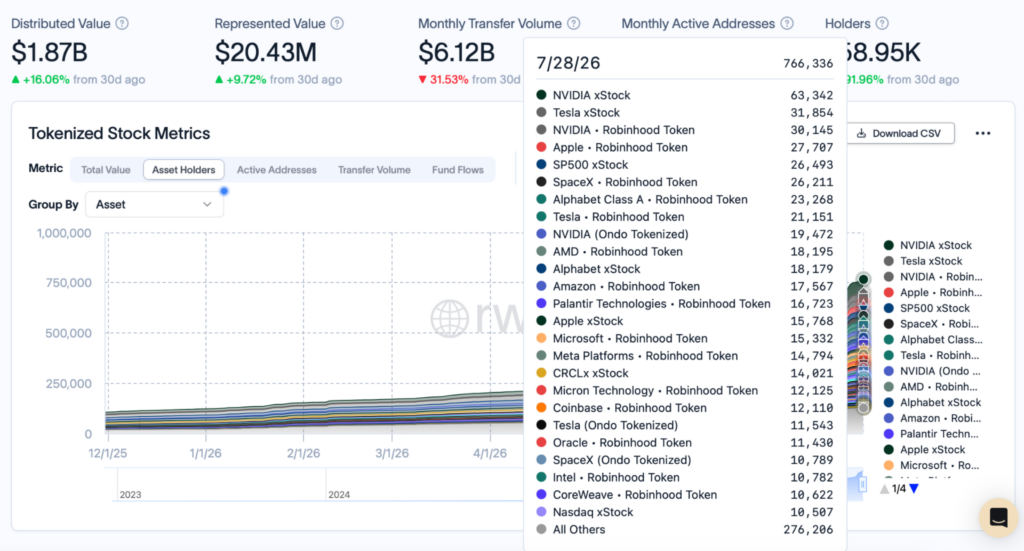
The number of tokenized stock holders has reached a record 766,366, surging 93% in 30 days and 527% year-to-date, according to rwa.xyz. This sharp increase is largely driven by the launch of Robinhood Chain, whose tokens now occupy 15 of the top 25 slots and account for over a third of all holders. Top holdings include NVIDIA, Apple, SpaceX, Alphabet, and Tesla. However, the data reveals significant concentration and duplication. For instance, NVIDIA is held across three different issuers, totaling 112,959 holders (~15% of the total). Similarly, the top five names combined represent 39% of all holders, while broad market index tokens constitute less than 5%. Notably, SpaceX tokens remain popular despite the company's recent public listing. Supporting metrics show a mixed picture: while the distributed value grew 16% to $1.87B, monthly transfer volume fell 31.5% to $6.12B, indicating more wallets but less activity per position.

According to data from rwa.xyz, the number of tokenized stock holders currently stands at 766,366 people. The number of asset holders in this sector appears to be increasing day by day. Particularly impressive was July. Over the last 30 days, the number of tokenized stock holders grew from approximately 396,000 to the current level. This corresponds to roughly a 93% increase. Looking at the situation in a broader context, the growth becomes even more striking. Since the beginning of the year, the number of tokenized stock holders has increased by approximately 527%.
Source: rwa.xyz

The growth observed over the last 30 days can be attributed to one source and one issuer. The launch of Robinhood Chain and, in less than a month, the increase in token holders for 15 out of the 25 positions on this list has resulted in these tokens occupying 15 places.

July was undoubtedly a huge month for the tokenized stock market, but there's a catch in the discussed metric, and it's worth breaking down.

Robinhood Accounts for One-Third of All Token Holders on the Blockchain

These 15 names collectively account for 268,162 owners. This constitutes 55% of the top 25 and just over one-third of the entire owner base.

Among Robinhood tokens, the largest holder is NVIDIA with 30,145 holders, followed by Apple with 27,707, SpaceX with 26,211, Alphabet Class A with 23,268, and Tesla with 21,151. The remaining ten companies range from AMD (18,195) to CoreWeave (10,622).

One Stock, Three Tokens, 112,959 Slots

NVIDIA is the largest stock on this list, making the counting issue quite obvious. In this list, we see NVIDIA represented as xStock with 63,342 holders, as a Robinhood token with 30,145 holders, and as an Ondo version with 19,472 holders. Doing the math results in 112,959 holders of the same stock from three different issuers. This accounts for about 15% of the entire list.

Similarly, Tesla has 64,548 stock holders distributed among the same three issuers, while Apple and Alphabet have two each.

The data presented here does not show how many of these are attributed to a single trader counted twice or three times. A wallet holding NVIDIA on Robinhood and another wallet holding it via xStock are registered separately, and there is nothing in the dataset that allows them to be distinguished.

Six Weeks After Listing, SpaceX Shares Still Attract More Investors Than Stocks of Index Companies

The concentration issue goes beyond mere duplication. NVIDIA, Tesla, Apple, Alphabet, and SpaceX collectively account for 299,429 holdings, or 39% of the total base.

The share of index stocks is practically unnoticeable. The SP500 xStock index accounts for 26,493, and the Nasdaq xStock accounts for 10,507, together not exceeding 5%.

SpaceX is a company worth noting. Its tokenized versions were created when the shares were unavailable, and the company went public on Nasdaq under the ticker SPCX on June 12. Nevertheless, there are still about 37,000 holders across two token issuers, which is more than all the companies in the SP500 and Nasdaq xStock indices combined. On the Robinhood platform alone, SpaceX has 26,211 token holders, surpassing Microsoft (15,332), Amazon (17,567), and Meta (14,794).

What Calculations Await the Next 300,000 Stock Holders?

Supplementary data points to an ambiguous situation. The distributed value is $1.87 billion, which is 16.06% higher than in the same month when the number of holders nearly doubled. Monthly transfer volume decreased by 31.53% to $6.12 billion.

More wallets, fewer positions, less activity on them.

It is precisely this imbalance that will be rectified in the next growth phase. An influx of stock holders accompanied by an increase in trading volume and the average position size would indicate market formation. An influx of stock holders, as happened in this case, via registration with brokers, distributed across duplicate versions of the same five names, would mean the metric is growing faster than the underlying traction.


Crypto di tendenza

Domande pertinenti

QWhat was the percentage increase in tokenized stock holders over the last 30 days, and what was the key driver behind this growth?

AThe number of tokenized stock holders increased by approximately 93% over the last 30 days. This dramatic growth was primarily driven by the launch of the Robinhood Chain, which, in less than a month, contributed 15 out of the top 25 tokens in terms of holders.

QWhat company holds the largest number of tokenized stock holders, and how many different issuer tokens represent it?

ANVIDIA is the largest tokenized stock by number of holders. It is represented by tokens from three different issuers: xStock (63,342 holders), Robinhood (30,145 holders), and Ondo (19,472 holders). Combined, these represent about 15% of all tokenized stock holders.

QHow does the number of token holders for SpaceX compare to major index-tracking tokens like SP500 and Nasdaq?

AThe tokenized versions of SpaceX have approximately 37,000 holders across two issuers. This number is greater than the combined holders of the SP500 xStock token (26,493) and the Nasdaq xStock token (10,507). On the Robinhood platform alone, SpaceX's token (26,211 holders) outperforms tokens for Microsoft, Amazon, and Meta.

QDespite the near-doubling of holders, what contradictory trends are observed in the market's financial activity according to the supporting data?

AWhile the number of holders grew by 93%, the distributed value increased by only 16.06% to $1.87 billion, and the monthly transfer volume actually decreased by 31.53% to $6.12 billion. This indicates a scenario of more wallets, but with smaller average positions and less trading activity.

QWhat are the two potential scenarios described for the next phase of market growth for tokenized stocks?

AThe next phase could develop in one of two ways: 1) A healthy market formation, indicated by an influx of holders combined with growing trading volume and an increase in the average position size. 2) A scenario where the holder count metric grows faster than genuine traction, if growth continues primarily through broker registrations concentrated in duplicate versions of the same few popular stocks.

Letture associate

The Turning Point of the AI Bull Market: Leverage Blow-ups, Overcapacity in Compute, Why This Macro Analyst is Fully Bearish

AI Bull Market Reaches Inflection Point: Analyst Turns Bearish Due to Leverage, Chinese Competition, and Overcapacity Fidenza Macro analyst Geo Chen explains his decision to sell all AI semiconductor and infrastructure holdings in June, offering a comprehensive bearish thesis. He argues the AI-driven bull market has peaked, citing several key factors. First, unsustainable buying pressure: a massive influx of "low-quality" capital from Korean retail investors using highly leveraged ETFs on stocks like SK Hynix created a parabolic, fragile rally. Recent liquidations have wiped out billions and impacted over a million accounts, removing a key market driver. Second, a competitive threat: the rapid rise of powerful, cost-effective open-source AI models from China, such as MoonShot AI's Kimi K3 and Alibaba's Qwen 3.8, is commoditizing intelligence. This undermines the pricing power and high-valuation financing prospects of closed-source leaders like OpenAI and Anthropic, potentially creating a "single point of failure" for the ecosystem. Third, an impending capacity glut: while AI compute and components are currently in shortage, Chen warns this is typical of a cycle top. Massive, committed capex from cloud providers will likely lead to a supply overhang within 1-2 years. Data shows token spending has already peaked and declined since June, while bond spreads for data center companies are widening, signaling rising credit risk. Chen also highlights broader macro headwinds: the protracted Iran conflict acts as a persistent stagflationary force, and the Federal Reserve under Chair Kevin Warsh is losing credibility in its inflation fight. Long-term Treasury yields breaking above 5.2% present a new challenge for equities. In summary, Chen believes the convergence of speculative excesses, competitive disruption, looming overcapacity, and adverse macroeconomic conditions marks a significant turning point for the AI investment theme.

marsbit15 min fa

The Turning Point of the AI Bull Market: Leverage Blow-ups, Overcapacity in Compute, Why This Macro Analyst is Fully Bearish

marsbit15 min fa

Saeed Al-Marri: How Tokenization Unlocks New Opportunities for Shipping Funds

Said Al-Marri: How Tokenization Opens New Opportunities for Shipping Funds For centuries, commercial shipping has been a capital-intensive asset class limited to institutional funds and shipping dynasties. Said bin Saleh Al-Marri, CEO of Ethra Invest and Ethra Ship, aims to break down these barriers by combining Real World Asset (RWA) tokenization with conservative private equity principles. This bridges decentralized finance (DeFi) with the physical realities of global trade. Tokenization allows fractional ownership of ships on a blockchain, giving smaller investors access to previously inaccessible markets. However, Al-Marri warns it is not a regulatory loophole or a cure for asset illiquidity. The core physical risks are isolated in Special Purpose Vehicles (SPVs) for qualified investors. While tokenization enhances transparency and ownership record-keeping, Al-Marri stresses that a liquid secondary market depends on transparent asset valuation and must not interfere with ship operations managed by professionals. Regarding legal enforcement, smart contracts cannot physically seize a ship. Legal recourse still relies on traditional maritime courts, ship mortgages, and flag state laws, with blockchain records needing to mirror legal ownership in the SPV perfectly. Beyond ownership, the industry faces administrative hurdles like paper-based bills of lading. Al-Marri argues the bottleneck is legal and operational standardization, not technology. He advocates for a hybrid model combining digital trade documents and programmable settlements with support from regulated financial institutions, rather than a full crypto replacement for tools like Letters of Credit. A major challenge is decarbonizing the global fleet by 2050. Transitioning to green fuels requires massive upfront investment. Al-Marri emphasizes a conservative, holistic approach to underwriting these projects, evaluating technology, fuel availability, safety, and resale value. Investments must be justified under conservative forecasts, not just optimistic ones. By combining pragmatic risk management with digital infrastructure, leaders like Al-Marri show that the evolution of maritime finance is about mobilizing capital to build a modernized and sustainable global fleet, not just putting ships on a blockchain.

cryptonews.ru30 min fa

Saeed Al-Marri: How Tokenization Unlocks New Opportunities for Shipping Funds

cryptonews.ru30 min fa

Trading

Spot

Articoli Popolari

Come comprare DATA

Benvenuto in HTX.com! Abbiamo reso l'acquisto di DATA Network (DATA) semplice e conveniente. Segui la nostra guida passo passo per intraprendere il tuo viaggio nel mondo delle criptovalute.Step 1: Crea il tuo Account HTXUsa la tua email o numero di telefono per registrarti il tuo account gratuito su HTX. Vivi un'esperienza facile e sblocca tutte le funzionalità,Crea il mio accountStep 2: Vai in Acquista crypto e seleziona il tuo metodo di pagamentoCarta di credito/debito: utilizza la tua Visa o Mastercard per acquistare immediatamente DATA NetworkDATA.Bilancio: Usa i fondi dal bilancio del tuo account HTX per fare trading senza problemi.Terze parti: abbiamo aggiunto metodi di pagamento molto utilizzati come Google Pay e Apple Pay per maggiore comodità.P2P: Fai trading direttamente con altri utenti HTX.Over-the-Counter (OTC): Offriamo servizi su misura e tassi di cambio competitivi per i trader.Step 3: Conserva DATA Network (DATA)Dopo aver acquistato DATA Network (DATA), conserva nel tuo account HTX. In alternativa, puoi inviare tramite trasferimento blockchain o scambiare per altre criptovalute.Step 4: Scambia DATA Network (DATA)Scambia facilmente DATA Network (DATA) nel mercato spot di HTX. Accedi al tuo account, seleziona la tua coppia di trading, esegui le tue operazioni e monitora in tempo reale. Offriamo un'esperienza user-friendly sia per chi ha appena iniziato che per i trader più esperti.

184 Totale visualizzazioniPubblicato il 2026.07.01Aggiornato il 2026.07.01

Come comprare DATA

Discussioni

Benvenuto nella Community HTX. Qui puoi rimanere informato sugli ultimi sviluppi della piattaforma e accedere ad approfondimenti esperti sul mercato. Le opinioni degli utenti sul prezzo di DATA DATA sono presentate come di seguito.

活动图片