Number of Active XRP Addresses Reaches Two-Month High Amid Worsening Market Sentiment

cryptonews.ruPubblicato 2026-08-16Pubblicato ultima volta 2026-08-16

Introduzione

On August 14th, activity on the XRP Ledger surged to a two-month high, with 49,929 active addresses recorded in a 24-hour period. This spike occurred despite market sentiment towards XRP hitting a three-month low, as the token traded below $1, highlighting a sharp divergence between on-chain activity and retail investor mood. The data from Santiment shows that average daily active addresses had already risen to around 35,700 by August 12th, up from approximately 26,400 in July—a nearly 35% increase. However, the number of new addresses remained flat, suggesting the surge was driven by existing addresses becoming more active rather than an influx of new users. Analysts caution that while high address activity indicates increased network participation, it doesn't specify whether the activity stems from new investors, institutional moves, exchange transactions, or existing holders. Concurrently, the bearish sentiment, tracked from social platforms like X and Reddit, reflects crowd psychology rather than fundamental network health. The report notes that the XRP Ledger's validator-based consensus allows for such on-chain activity to grow independently of short-term price pessimism. Furthermore, broader ecosystem development, including Ripple's reported $550 million in investments since 2017 into grants and institutional infrastructure for tokenized assets, provides a long-term context separate from current price trends. The key question is whether the elevated address activity...

On August 14th, activity on the $XRP Ledger surged to a two-month high: analytics firm Santiment recorded 49,929 active addresses in 24 hours, despite sentiment towards $XRP reaching a three-month low. This increase occurred as $XRP traded below the $1 mark, leading to a sharp divergence between on-chain activity and retail investor sentiment.

Santiment stated:

"Throughout this week, negative sentiment towards $XRP has intensified sharply as prices (so far) have failed to rise. User sentiment is now at a three-month low on X, Reddit, Telegram, and other crypto channels."

The latest spike continued an upward trend observed earlier in August, when the average number of daily active addresses was around 35,700 as of August 12th, compared to roughly 26,400 in July. The number of active $XRP addresses increased by nearly 35%, while new addresses averaged about 2,260 per day, virtually unchanged from July's figure of 2,270, indicating more active use of existing addresses rather than clear evidence of rapid user growth.

Santiment reported:

"The $XRP Ledger, on the other hand, is not so inactive. $XRP just recorded 49,929 active addresses in a single 24-hour period – the highest level of activity in over 2 months, after activity fell to near 2026 lows earlier in July."
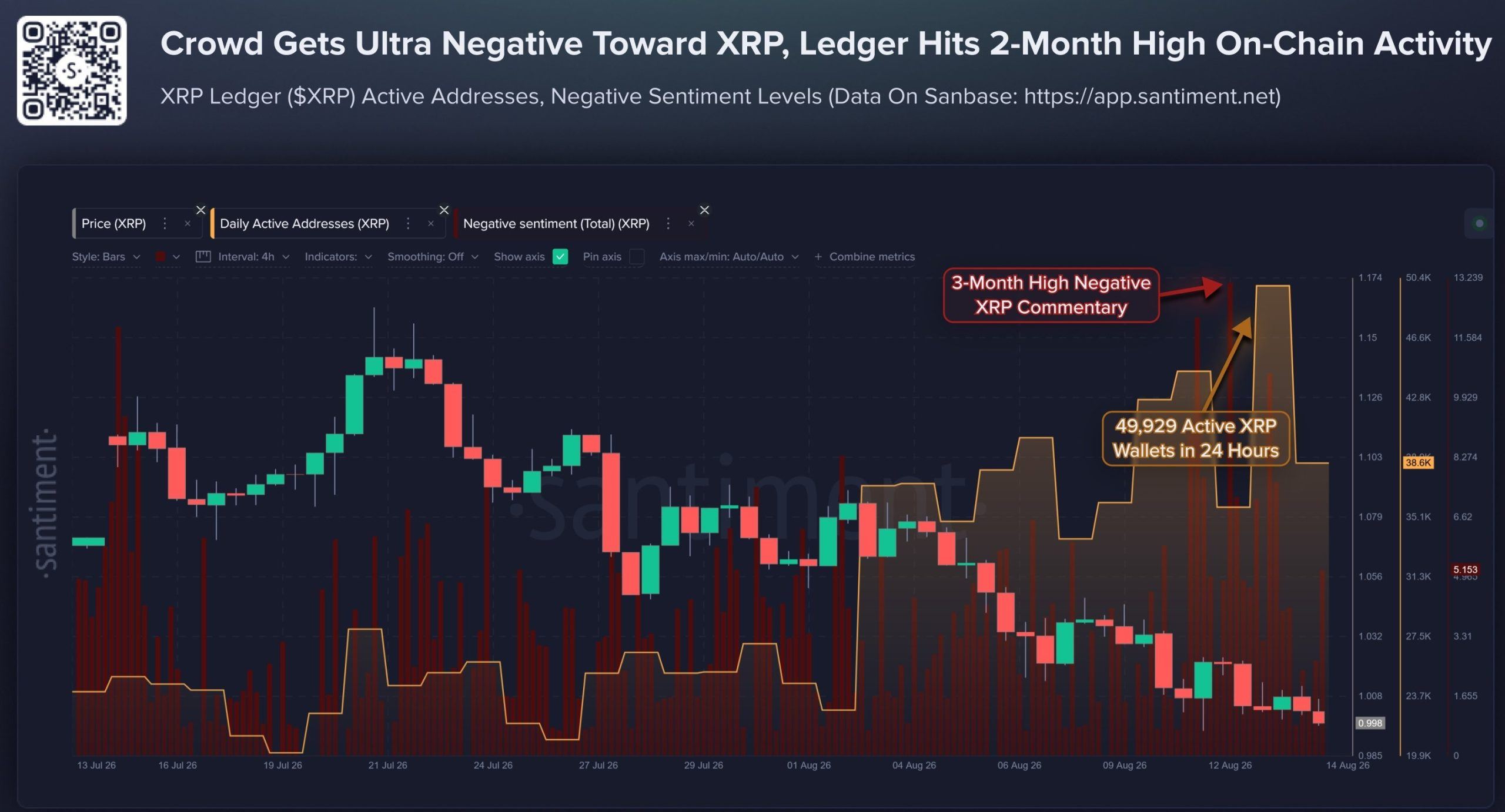
Santiment data shows activity on the $XRP Ledger increased to 49,929 active addresses in a 24-hour period, while sentiment for $XRP reached a three-month low.

This distinction is important to consider when interpreting on-chain activity. A blockchain address does not necessarily correspond to a single individual user, as wallets can generate and manage multiple addresses. Therefore, a higher number of active addresses indicates increased network participation but does not clarify whether this activity was related to new investors, institutional transfers, exchange movements, or repeated transactions by existing participants.

Bearish Comments Contrast with On-Chain Activity

The sentiment metric from Santiment tracks discussions on X, Reddit, Telegram, and other crypto channels, so the three-month sentiment low is more an indicator of crowd psychology than network fundamentals. Sentiment analysis can factor in social media, news, and other signals to assess trader attitudes, which can differ significantly from blockchain activity or long-term adoption trends.

Bearish sentiment also does not mean $XRP has entered or will remain in a definitive market phase. Bear markets are typically characterized by falling prices and weakening confidence, while individual sentiment indicators can change faster than overall price trends. Thus, the current signal for $XRP reflects unusually negative commentary, not a prediction of a reversal or a confirmation of future price direction.

The $XRP Ledger itself operates independently of these social signals. The $XRP Ledger uses a validator-based consensus process instead of proof-of-work mining, where validators agree on the order and validity of transactions before finalizing new ledger versions. This architecture allows activity to increase even when market participants maintain pessimistic outlooks on $XRP's short-term price dynamics.

XRPL Development Provides Broader Network Context

Network development represents another metric to consider separately from short-term price and market sentiment data. Ripple has reported investing over $550 million into $XRP Ledger ecosystem initiatives since 2017, including grants, incentives, partnership programs, and development programs aimed at supporting payments, tokenization, decentralized finance, and other applications.

Ripple has also expanded its institutional strategy for tokenized assets, stablecoins, custody, trading, and credit infrastructure. Its expanded institutional XRPL stack connects tokenized assets with settlement, liquidity, and collateral systems, although available data does not point to these initiatives as the cause of the August 14th activity spike.

Strategic investments have extended these efforts into regulated fund management and tokenized capital market infrastructure. Ripple's investments in Zilo and Licuido target issuance, trading, settlement, and collateral functions, serving as further evidence of XRPL's development, though not establishing a direct link to the recent rise in active addresses.

Santiment noted:

"If $XRP holds its structure and demand recovers, today's negativity could be tomorrow's story of a favorable market entry."

This statement reflects a conditional market interpretation, not proof of a price recovery beginning. The next test will be whether active address levels remain elevated following the one-day spike amidst ongoing bearish sentiment, showing whether this divergence extends beyond a short-term network activity surge.

end-content

Crypto di tendenza

Domande pertinenti

QAccording to the article, what is the key contradiction reported regarding XRP on August 14th?

AOn August 14th, the number of active addresses on the XRP Ledger surged to a two-month high of 49,929, while market sentiment towards XRP hit a three-month low. This created a sharp divergence between on-chain activity and investor mood.

QWhat does the article suggest is the likely reason for the increase in active XRP addresses, based on the data about new addresses?

AThe increase in active addresses is likely due to more intensive use of existing addresses rather than an influx of new users. Data shows the number of new addresses created daily remained virtually unchanged from July to August, while active addresses rose significantly.

QHow does the XRP Ledger's consensus mechanism differ from Bitcoin's, and why is this relevant to the reported activity?

AThe XRP Ledger uses a validator-based consensus mechanism, not Bitcoin's proof-of-work mining. This architecture allows network activity to grow independently of short-term market sentiment and price predictions, which explains why activity can increase even when traders are pessimistic.

QWhat broader ecosystem development efforts by Ripple are mentioned in the article, and how are they characterized in relation to the recent activity spike?

AThe article mentions Ripple has invested over $550 million since 2017 into the XRPL ecosystem, including grants and development programs for payments, tokenization, and DeFi. It also details Ripple's expanded strategy in tokenized assets and institutional infrastructure. However, the article states these initiatives are not directly linked as the cause of the August 14th activity spike.

QWhat does the Santiment statement quoted at the end of the article imply about the current market situation for XRP?

ASantiment's statement implies that the current negative sentiment could represent a potential buying opportunity if XRP's underlying structure holds and demand recovers. However, the article clarifies this is a conditional market interpretation, not proof of an imminent price recovery. The key test will be whether the high activity levels persist.

Letture associate

Media: Anthropic Aims for Revenue Up to $200 Billion by 2028 Ahead of IPO

Anthropic, the AI company behind Claude, is reportedly projecting its revenue could reach between $190 billion and $200 billion by 2028, according to sources cited by Reuters. This forecast, significantly higher than its reported $47 billion annual run-rate in May 2026, is being used by investors and bankers to value the company ahead of a potential IPO. Anthropic has confidentially filed with the SEC, with listing details dependent on market conditions and regulatory approval. The valuation reportedly applies a revenue multiple (EV/Revenue) to these future 2028 figures, an approach common for high-growth tech firms but unusual for a forecast two years ahead of an IPO. This reflects confidence in Anthropic's rapid scaling; its annual run-rate grew tenfold yearly for three years leading into 2026, jumping from ~$9B in late 2025 to over $47B by May 2026. Investors are betting the company's massive spending on GPUs, model training, and infrastructure will eventually outpace costs, leading to expanding margins. Public companies like Palantir, Cloudflare, and SpaceX, valued at high multiples of their forward revenue, serve as benchmarks. While this forward-looking method has precedents, some analysts question the sustainability of such valuations and the actual productivity gains from AI. Despite these concerns, earlier reports suggested Anthropic could be valued at over $1 trillion for its IPO.

cryptonews.ru19 min fa

Media: Anthropic Aims for Revenue Up to $200 Billion by 2028 Ahead of IPO

cryptonews.ru19 min fa

Open Blockchain Business: Who Gets the Fees and Why a Foundation is Needed

Business of Open Blockchain: Who Gets the Fees and Why a Foundation is Needed In public blockchains, user transaction fees do not simply become "revenue" for a single entity. The flow of money is complex and protocol-dependent. In Ethereum, fees consist of a base fee (burned, permanently removing ETH from circulation) and a priority tip (paid to the validator). In Solana, half the base fee is burned and half goes to the validator, while priority fees go entirely to validators. Thus, "fees" are not synonymous with "project revenue"; they may go to network operators or be destroyed. Foundations like the Ethereum Foundation do not take a cut of user fees. They are funded by their own treasuries, which can generate income (e.g., from staking rewards) and finance ecosystem development, research, and security. Their role is to fund public goods that are hard to monetize directly. Developers of open-source blockchain code can monetize through services, not the code itself. For example, Optimism provides its technology freely but sells enterprise support and managed services (OP Enterprise). Additionally, networks built on Optimism's tech, like Coinbase's Base, share a portion of their revenue with the Optimism ecosystem via agreements, creating an economic link. Token holders do not automatically receive fees as dividends. In Optimism, a portion of protocol revenue is now used to buy back and treasury-lock OP tokens, creating an indirect link between network usage and token economics. In Ethereum, fee burning reduces ETH supply but doesn't distribute funds to all holders; stakers and validators receive direct rewards. For evaluation, analysts should look beyond total fee figures. Key questions are: Who paid and for what? Where did the money go (to validators, operators, treasury, or burning)? What were the recipient's costs? Is there a mechanism linking this income to the token? The same fee amount impacts different blockchain economies in vastly different ways depending on these factors.

cryptonews.ru20 min fa

Open Blockchain Business: Who Gets the Fees and Why a Foundation is Needed

cryptonews.ru20 min fa

Trading

Spot

Articoli Popolari

Cosa è XRP 2.0

XRP 2.0: Una Nuova Frontiera nel Paesaggio delle Criptovalute Introduzione a XRP 2.0 Nel mondo in continua evoluzione delle criptovalute, nuovi progetti emergono continuamente, cercando attenzione e adozione. Una tale iniziativa promettente è XRP 2.0, un nuovo progetto di criptovaluta progettato per sfruttare avanzate tecnologie blockchain e metodologie di crittografia robuste. Anche se il nome richiama alla mente l'XRP di Ripple, è fondamentale notare che XRP 2.0 opera in modo indipendente, concentrandosi sul miglioramento della sicurezza delle transazioni, della privacy e della scalabilità. Mentre il panorama finanziario digitale abbraccia sempre di più soluzioni decentralizzate, XRP 2.0 mira a contribuire in modo significativo al web3 e all'espansione generale dei progetti crypto. Cos'è XRP 2.0? Alla sua base, XRP 2.0 è un progetto di criptovaluta che mira a creare un ecosistema di valuta digitale sicuro e decentralizzato. La sua tecnologia fondamentale integra principi di blockchain sofisticati con tecniche di crittografia all'avanguardia. L'obiettivo principale di XRP 2.0 è quello di affermarsi come una piattaforma affidabile ed efficiente in grado di consentire un'esecuzione rapida delle transazioni, dando priorità a migliori protezioni della privacy per i suoi utenti. Il progetto è promosso come una soluzione a molte limitazioni affrontate dalle criptovalute esistenti, proponendo un sistema in grado di gestire un volume maggiore di transazioni con migliorata velocità e privacy. Questa versatilità pone XRP 2.0 come un significativo competitor in un mercato affollato di varie valute digitali. Chi è il Creatore di XRP 2.0? L'identità del creatore dietro XRP 2.0 è stata segnalata come 'Wilbur'. Tuttavia, i dettagli completi riguardanti Wilbur o l'entità associata rimangono sfuggenti. L'anonimato di molti creatori di criptovalute non è un fenomeno raro nel settore, spesso progettato per mantenere un certo grado di privacy e sicurezza. Chi sono gli Investitori di XRP 2.0? Al momento, informazioni specifiche relative alle fondazioni o organizzazioni di investimento a supporto di XRP 2.0 non sono disponibili pubblicamente. Nel settore delle criptovalute, il supporto di investitori rinomati può influenzare significativamente la credibilità e il successo di un progetto, tuttavia la trasparenza riguardo ai sostenitori finanziari di XRP 2.0 non è stata stabilita. Come Funziona XRP 2.0? XRP 2.0 si distingue per l'impiego di una combinazione di tecnologia blockchain e algoritmi di crittografia avanzati che garantiscono transazioni sicure e decentralizzate. La sua struttura innovativa include caratteristiche uniche progettate per promuovere il coinvolgimento degli utenti e ampliare le funzionalità oltre le transazioni convenzionali delle criptovalute. Tra queste caratteristiche, XRP 2.0 incorpora capacità alimentate da intelligenza artificiale, come funzionalità di testo in immagini e testo in voce. Queste aggiunte sono progettate per migliorare l'esperienza interattiva per gli utenti, promuovendo una maggiore applicabilità in vari settori. Unendo progressi tecnologici con design incentrati sugli utenti, XRP 2.0 mira a catturare l'attenzione di una vasta gamma di individui e aziende che cercano di integrare soluzioni di criptovaluta nei loro framework operativi. Cronologia di XRP 2.0 Comprendere XRP 2.0 richiede di esaminare i traguardi che hanno definito il suo percorso fino ad ora: 23 luglio 2023: XRP 2.0 viene introdotto come un nuovo progetto di criptovaluta, mirante a rivoluzionare le capacità di transazione sicura e decentralizzata nel dominio blockchain. 8 settembre 2023: Si verifica il lancio di un altro progetto, XRP20, marcando l'emergere di un token ERC-20 sulla blockchain di Ethereum che resta non correlato a XRP 2.0. 13 novembre 2023: Il ledger XRP subisce un significativo aggiornamento con il rilascio della versione 2.0.0 del software server rippled. È essenziale notare che questo sviluppo è scollegato dal progetto di criptovaluta XRP 2.0. Punti Chiave su XRP 2.0 Per distillare l'essenza di XRP 2.0, emergono diversi fattori critici: Caratteristiche Uniche: L'inclusione di funzionalità come il testo in immagini e testo in voce alimentato da intelligenza artificiale diversifica ulteriormente le potenziali applicazioni di XRP 2.0. Tecnologia Blockchain: Il framework utilizza meccanismi blockchain avanzati e protocolli di crittografia, garantendo un ambiente sicuro e decentralizzato per le transazioni. Scalabilità e Privacy: XRP 2.0 dà priorità a migliori protezioni della privacy nei processi di transazione e alla scalabilità necessaria per accogliere una base di utenti in crescita. Nessuna Affiliazione con Ripple: È importante notare che, nonostante il suo nome, XRP 2.0 non ha alcuna fedeltà o collaborazione con l'XRP di Ripple, distinguendo il proprio framework operativo e obiettivi all'interno dell'ecosistema delle criptovalute. Conclusione XRP 2.0 rappresenta un'ambiziosa venture nell'ambito delle criptovalute, mirante a offrire una combinazione di sicurezza, privacy ed efficienza nelle transazioni digitali. Integrando tecnologie sofisticate e caratteristiche user-friendly, il progetto si propone di ampliare gli orizzonti di ciò che le criptovalute possono realizzare nell'economia digitale odierna. Sebbene l'anonimato del suo creatore e la mancanza di investitori dichiarati possano sollevare domande per alcuni, il focus di XRP 2.0 su funzionalità avanzate e decentralizzazione ne amplifica l'appeal in un mercato crypto sempre più affollato. Man mano che il panorama delle criptovalute continua a evolversi, XRP 2.0 potrebbe emergere come un attore decisivo nell'espansione di soluzioni blockchain sicure e scalabili.

308 Totale visualizzazioniPubblicato il 2024.04.05Aggiornato il 2024.12.03

Cosa è XRP 2.0

Come comprare XRP

Benvenuto in HTX.com! Abbiamo reso l'acquisto di XRP (XRP) semplice e conveniente. Segui la nostra guida passo passo per intraprendere il tuo viaggio nel mondo delle criptovalute.Step 1: Crea il tuo Account HTXUsa la tua email o numero di telefono per registrarti il tuo account gratuito su HTX. Vivi un'esperienza facile e sblocca tutte le funzionalità,Crea il mio accountStep 2: Vai in Acquista crypto e seleziona il tuo metodo di pagamentoCarta di credito/debito: utilizza la tua Visa o Mastercard per acquistare immediatamente XRPXRP.Bilancio: Usa i fondi dal bilancio del tuo account HTX per fare trading senza problemi.Terze parti: abbiamo aggiunto metodi di pagamento molto utilizzati come Google Pay e Apple Pay per maggiore comodità.P2P: Fai trading direttamente con altri utenti HTX.Over-the-Counter (OTC): Offriamo servizi su misura e tassi di cambio competitivi per i trader.Step 3: Conserva XRP (XRP)Dopo aver acquistato XRP (XRP), conserva nel tuo account HTX. In alternativa, puoi inviare tramite trasferimento blockchain o scambiare per altre criptovalute.Step 4: Scambia XRP (XRP)Scambia facilmente XRP (XRP) nel mercato spot di HTX. Accedi al tuo account, seleziona la tua coppia di trading, esegui le tue operazioni e monitora in tempo reale. Offriamo un'esperienza user-friendly sia per chi ha appena iniziato che per i trader più esperti.

1.9k Totale visualizzazioniPubblicato il 2024.12.10Aggiornato il 2026.06.02

Come comprare XRP

Discussioni

Benvenuto nella Community HTX. Qui puoi rimanere informato sugli ultimi sviluppi della piattaforma e accedere ad approfondimenti esperti sul mercato. Le opinioni degli utenti sul prezzo di XRP XRP sono presentate come di seguito.

活动图片