Not Just Crypto: Research Says XRP Is Moving Into Bank-Grade Payment Infrastructure

bitcoinistPubblicato 2025-12-13Pubblicato ultima volta 2025-12-13

Introduzione

A DAS Research report indicates XRP is evolving beyond a trading asset into bank-grade payment infrastructure. The analysis highlights three key factors: XRP's structural advantages for cross-border payments (speed, low cost, and acting as a neutral bridge currency), its planned synergy with Ripple's upcoming stablecoin (RLUSD) to provide liquidity and stability, and growing catalysts like RippleNet partnerships, institutional custody services, and potential ETF discussions. While adoption is still in early stages and not yet at large commercial scale, these developments position XRP for a deeper future role in regulated global payment systems.

XRP is being positioned as something more than a trading asset as analysts point to signs suggesting it may be shaped for financial infrastructure over time.

A report from Digital Asset Solutions (DAS) highlights three main points behind this shift, tying the altcoin’s technical setup to Ripple’s work on stablecoins and regulated payment rails.

Structural Edge For XRP

Reports have disclosed that XRP offers several qualities that matter to companies moving money across borders. It settles fast, costs little to send, and works as a neutral bridge asset between different currencies.

Ripple’s ledger is described as reliable and globally distributed, which is why some enterprises are testing it for predictable transfers. However, many firms still use RippleNet without using the crypto directly, so broad bank-level usage has not taken hold.

The research frames these features as the first major factor behind the digital asset’s potential role in global payment flows. The traits are real, but adoption varies and has not yet reached large commercial scale.
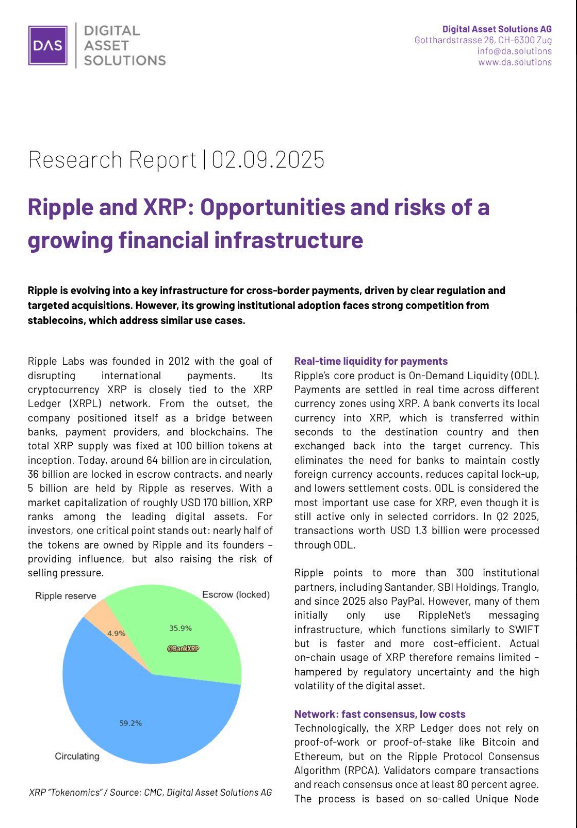
Source: DAS Research

Stablecoins And XRP Working Together

Ripple plans to use RLUSD as a fiat-backed anchor while relying on the crypto to provide liquidity between different corridors.

The concept is simple: Stablecoins maintain price stability tied to fiat, while XRP acts as the connector for moving value across currencies. This pairing is presented as the second major point in DAS Research’s findings.

Ripple Prime, ZK-enabled identity tools, and licensing efforts are being built to meet compliance requirements from regulated institutions.

XRPUSD now trading at $2.04. Chart: TradingView

Early RLUSD corridors have started to appear, but the level of real-world transaction volume remains small compared to the broader payments industry.

Catalysts Forming In The Background

The final point focuses on developments that analysts believe could help XRP move closer to regulated financial rails.

RippleNet partnerships are growing, institutional custody services are improving, RLUSD integrations are underway, and conversations around possible ETF structures have emerged.
Image: Trading News

Each of these adds some weight to the idea that XRP may gain a deeper role in payment systems in the future. Some of these steps are active today, while others remain early discussions. Custody upgrades, for example, are happening across the crypto sector, not only for the altcoin.

While procedural steps like exchange listings and filings have progressed for multiple XRP ETF proposals, the US Securities and Exchange Commission has not yet given formal approval to a spot XRP ETF. Even so, these developments show how Ripple is preparing for broader institutional use.

Featured image from Unsplash, chart from TradingView

Crypto di tendenza

Letture associate

72-Hour Countdown: Can the CLARITY Act Pass 'Miracleously' Before the Senate Recess?

"CLARITY Act Faces 72-Hour Deadline as Senate Recess Looms The U.S. Senate has released its schedule for the week, omitting the crucial CLARITY Act and instead prioritizing another resolution for a procedural vote. With the Senate set to recess on August 7th, the bill now has only about 72 hours to advance. Senate procedural hurdles are steep. First, a cloture petition requires signatures from 16 Senators. Second, a vote requires 60 votes, meaning the Republican's 53 votes need at least 7 Democratic supporters—a key sticking point that has stalled the bill for two months. If passed, a further 30 hours of debate is required before a vote to proceed to consideration. If 16 signatures are not secured by Wednesday, the bill won't even face a vote. Even if filed Wednesday, the earliest vote would be Friday, leaving no time for actual consideration before recess. The major divide remains ethical provisions. The draft bans certain senior officials from issuing or sponsoring digital assets until 2029, but Democrats argue enforcement loopholes are too large, failing to constrain existing holdings and family arrangements. The White House has not formally responded to the revised draft. The Trump family's substantial crypto profits have further eroded Democratic trust. Stablecoin rewards remain contentious. Banks liken them to deposit interest, fearing capital flight, while crypto firms see them as anti-competitive protection for banks. A current compromise bans passive interest but allows rewards for trading, staking, and platform activity. Polymarket data shows the bill's probability of passing by 2026 has fallen to 31%, down 7 points in a week. Betting volume is around $3.7 million. Analyst Bernstein warns failure to advance the bill could trigger a 'bad news' sell-off, pressuring Bitcoin and crypto valuations. Industry advocates, including Grayscale and Treasury Secretary (presumably Yellen, though 'Besant' appears in text), have urged swift action with thousands of contacts to Congress, but progress remains slow. If missed this week, the bill delays until September, where a busier schedule and approaching midterms complicate passage. Democrats suggest a procedural vote this week could keep hope alive for September, but that hope is fading hourly. Market sentiment appears resigned to delay, though a surprise passage could trigger a significant positive reaction. The bill's arduous journey underscores its potential impact on the industry."

marsbitAdesso

72-Hour Countdown: Can the CLARITY Act Pass 'Miracleously' Before the Senate Recess?

marsbitAdesso

George Santos Settles Dispute with Commodity Futures Trading Commission (CFTC) Over Trading on His Own Kalshi Market

Former U.S. Representative George Santos has settled with the Commodity Futures Trading Commission (CFTC) over allegations he manipulated a futures contract on the Kalshi prediction market related to his potential attendance at a presidential State of the Union address. According to a July 31 order, Santos must repay $17,569.98, pay a $17,500 civil penalty, and is barred from trading on any CFTC-registered exchange for three years. The CFTC found that Santos made misleading public statements about his plans to attend the event while trading on the outcome. He first built a profitable position betting he would attend, then reversed course and profited by betting against his own attendance after travel disruptions. Santos earned profits totaling over $17,000 from these trades. Santos agreed to the settlement without admitting to the findings. His attorney stated Santos initially intended to attend but changed plans due to winter weather, denying any intent to mislead traders or manipulate the market. Kalshi detected the suspicious activity, froze his account, and provided evidence to the CFTC. The exchange is considering further actions and potential restitution for affected traders. While Kalshi also referred the matter to the Justice Department, a spokesperson has denied an investigation exists. The CFTC settlement remains the only confirmed federal action regarding these trades.

cryptonews.ru6 min fa

George Santos Settles Dispute with Commodity Futures Trading Commission (CFTC) Over Trading on His Own Kalshi Market

cryptonews.ru6 min fa

Trading

Spot

Articoli Popolari

Cosa è XRP 2.0

XRP 2.0: Una Nuova Frontiera nel Paesaggio delle Criptovalute Introduzione a XRP 2.0 Nel mondo in continua evoluzione delle criptovalute, nuovi progetti emergono continuamente, cercando attenzione e adozione. Una tale iniziativa promettente è XRP 2.0, un nuovo progetto di criptovaluta progettato per sfruttare avanzate tecnologie blockchain e metodologie di crittografia robuste. Anche se il nome richiama alla mente l'XRP di Ripple, è fondamentale notare che XRP 2.0 opera in modo indipendente, concentrandosi sul miglioramento della sicurezza delle transazioni, della privacy e della scalabilità. Mentre il panorama finanziario digitale abbraccia sempre di più soluzioni decentralizzate, XRP 2.0 mira a contribuire in modo significativo al web3 e all'espansione generale dei progetti crypto. Cos'è XRP 2.0? Alla sua base, XRP 2.0 è un progetto di criptovaluta che mira a creare un ecosistema di valuta digitale sicuro e decentralizzato. La sua tecnologia fondamentale integra principi di blockchain sofisticati con tecniche di crittografia all'avanguardia. L'obiettivo principale di XRP 2.0 è quello di affermarsi come una piattaforma affidabile ed efficiente in grado di consentire un'esecuzione rapida delle transazioni, dando priorità a migliori protezioni della privacy per i suoi utenti. Il progetto è promosso come una soluzione a molte limitazioni affrontate dalle criptovalute esistenti, proponendo un sistema in grado di gestire un volume maggiore di transazioni con migliorata velocità e privacy. Questa versatilità pone XRP 2.0 come un significativo competitor in un mercato affollato di varie valute digitali. Chi è il Creatore di XRP 2.0? L'identità del creatore dietro XRP 2.0 è stata segnalata come 'Wilbur'. Tuttavia, i dettagli completi riguardanti Wilbur o l'entità associata rimangono sfuggenti. L'anonimato di molti creatori di criptovalute non è un fenomeno raro nel settore, spesso progettato per mantenere un certo grado di privacy e sicurezza. Chi sono gli Investitori di XRP 2.0? Al momento, informazioni specifiche relative alle fondazioni o organizzazioni di investimento a supporto di XRP 2.0 non sono disponibili pubblicamente. Nel settore delle criptovalute, il supporto di investitori rinomati può influenzare significativamente la credibilità e il successo di un progetto, tuttavia la trasparenza riguardo ai sostenitori finanziari di XRP 2.0 non è stata stabilita. Come Funziona XRP 2.0? XRP 2.0 si distingue per l'impiego di una combinazione di tecnologia blockchain e algoritmi di crittografia avanzati che garantiscono transazioni sicure e decentralizzate. La sua struttura innovativa include caratteristiche uniche progettate per promuovere il coinvolgimento degli utenti e ampliare le funzionalità oltre le transazioni convenzionali delle criptovalute. Tra queste caratteristiche, XRP 2.0 incorpora capacità alimentate da intelligenza artificiale, come funzionalità di testo in immagini e testo in voce. Queste aggiunte sono progettate per migliorare l'esperienza interattiva per gli utenti, promuovendo una maggiore applicabilità in vari settori. Unendo progressi tecnologici con design incentrati sugli utenti, XRP 2.0 mira a catturare l'attenzione di una vasta gamma di individui e aziende che cercano di integrare soluzioni di criptovaluta nei loro framework operativi. Cronologia di XRP 2.0 Comprendere XRP 2.0 richiede di esaminare i traguardi che hanno definito il suo percorso fino ad ora: 23 luglio 2023: XRP 2.0 viene introdotto come un nuovo progetto di criptovaluta, mirante a rivoluzionare le capacità di transazione sicura e decentralizzata nel dominio blockchain. 8 settembre 2023: Si verifica il lancio di un altro progetto, XRP20, marcando l'emergere di un token ERC-20 sulla blockchain di Ethereum che resta non correlato a XRP 2.0. 13 novembre 2023: Il ledger XRP subisce un significativo aggiornamento con il rilascio della versione 2.0.0 del software server rippled. È essenziale notare che questo sviluppo è scollegato dal progetto di criptovaluta XRP 2.0. Punti Chiave su XRP 2.0 Per distillare l'essenza di XRP 2.0, emergono diversi fattori critici: Caratteristiche Uniche: L'inclusione di funzionalità come il testo in immagini e testo in voce alimentato da intelligenza artificiale diversifica ulteriormente le potenziali applicazioni di XRP 2.0. Tecnologia Blockchain: Il framework utilizza meccanismi blockchain avanzati e protocolli di crittografia, garantendo un ambiente sicuro e decentralizzato per le transazioni. Scalabilità e Privacy: XRP 2.0 dà priorità a migliori protezioni della privacy nei processi di transazione e alla scalabilità necessaria per accogliere una base di utenti in crescita. Nessuna Affiliazione con Ripple: È importante notare che, nonostante il suo nome, XRP 2.0 non ha alcuna fedeltà o collaborazione con l'XRP di Ripple, distinguendo il proprio framework operativo e obiettivi all'interno dell'ecosistema delle criptovalute. Conclusione XRP 2.0 rappresenta un'ambiziosa venture nell'ambito delle criptovalute, mirante a offrire una combinazione di sicurezza, privacy ed efficienza nelle transazioni digitali. Integrando tecnologie sofisticate e caratteristiche user-friendly, il progetto si propone di ampliare gli orizzonti di ciò che le criptovalute possono realizzare nell'economia digitale odierna. Sebbene l'anonimato del suo creatore e la mancanza di investitori dichiarati possano sollevare domande per alcuni, il focus di XRP 2.0 su funzionalità avanzate e decentralizzazione ne amplifica l'appeal in un mercato crypto sempre più affollato. Man mano che il panorama delle criptovalute continua a evolversi, XRP 2.0 potrebbe emergere come un attore decisivo nell'espansione di soluzioni blockchain sicure e scalabili.

251 Totale visualizzazioniPubblicato il 2024.04.05Aggiornato il 2024.12.03

Cosa è XRP 2.0

Come comprare XRP

Benvenuto in HTX.com! Abbiamo reso l'acquisto di XRP (XRP) semplice e conveniente. Segui la nostra guida passo passo per intraprendere il tuo viaggio nel mondo delle criptovalute.Step 1: Crea il tuo Account HTXUsa la tua email o numero di telefono per registrarti il tuo account gratuito su HTX. Vivi un'esperienza facile e sblocca tutte le funzionalità,Crea il mio accountStep 2: Vai in Acquista crypto e seleziona il tuo metodo di pagamentoCarta di credito/debito: utilizza la tua Visa o Mastercard per acquistare immediatamente XRPXRP.Bilancio: Usa i fondi dal bilancio del tuo account HTX per fare trading senza problemi.Terze parti: abbiamo aggiunto metodi di pagamento molto utilizzati come Google Pay e Apple Pay per maggiore comodità.P2P: Fai trading direttamente con altri utenti HTX.Over-the-Counter (OTC): Offriamo servizi su misura e tassi di cambio competitivi per i trader.Step 3: Conserva XRP (XRP)Dopo aver acquistato XRP (XRP), conserva nel tuo account HTX. In alternativa, puoi inviare tramite trasferimento blockchain o scambiare per altre criptovalute.Step 4: Scambia XRP (XRP)Scambia facilmente XRP (XRP) nel mercato spot di HTX. Accedi al tuo account, seleziona la tua coppia di trading, esegui le tue operazioni e monitora in tempo reale. Offriamo un'esperienza user-friendly sia per chi ha appena iniziato che per i trader più esperti.

1.7k Totale visualizzazioniPubblicato il 2024.12.10Aggiornato il 2026.06.02

Come comprare XRP

Discussioni

Benvenuto nella Community HTX. Qui puoi rimanere informato sugli ultimi sviluppi della piattaforma e accedere ad approfondimenti esperti sul mercato. Le opinioni degli utenti sul prezzo di XRP XRP sono presentate come di seguito.

活动图片