In a positive development for the crypto industry, a recent study by White House economists affirmed that stablecoin yield won’t harm community banks, and its prohibition won’t have a meaningful impact on overall lending in the banking system.
Stablecoin Yield Is Not A Threat
On Wednesday, the Council of Economic Advisers (CEA) released the highly anticipated study on a key issue that has become a major point of contention between the banking and crypto industries over the past few months: stablecoin yield and its potential impact on deposit flight and bank lending.
For context, the landmark crypto legislation, the GENIUS Act, requires issuers to maintain reserves backing outstanding stablecoins on a one-to-one basis and to hold these reserves in certain assets, including US dollars, Federal Reserve notes, and short-term US Treasuries.
The bill also introduced key restrictions that prohibit issuers from offering any form of interest or yield to stablecoin holders. The banking industry has urged US lawmakers to extend the prohibition to digital asset exchanges, brokers, dealers, and related entities, which has led to prolonged debate and delay of the crypto market structure bill, also known as the CLARITY Act.
While some analysts estimate that the effect of lending in the trillions of dollars, the CEA report found that eliminating stablecoin yield would only boost bank lending by $2.1 billion, equivalent to a 0.02% increase.
Large banks would conduct 76% of this additional lending, while community banks—which have assets below $10 billion—would lend the remaining 24%. In our baseline, that adds up to $500 million in additional lending from community banks, meaning their lending rising by 0.026%.
As they noted, even under the worst-case assumptions, the CEA’s model produced only $521 billion in additional aggregate lending, corresponding to a 4.4% increase in bank loans as of Q4 2025.
Moreover, that figure would require the stablecoin market to grow sixfold as a share of deposits, all reserves to be locked in unlendable cash instead of US treasuries, and the Federal Reserve (Fed) to “abandon its current monetary framework.”
“Even under those implausible conditions, community bank lending only rises by $129 billion, corresponding to an increase of 6.7%,” the White House economists emphasized, concluding that prohibiting yield would have only a moderate impact on overall lending in the banking system.
The conditions for finding a positive welfare effect from prohibiting yield are similarly implausible. In short, a yield prohibition would do very little to protect bank lending, while forgoing the consumer benefits of competitive returns on stablecoin holdings.
Regulatory Uncertainty More Harmful Than Rewards
The CEA study directly contradicts one of the banking sector’s main arguments for banning stablecoin yield: it would mostly affect community banks. In January, Bank of America CEO Brian Moynihan told investors that the banking industry could face significant challenges if the US Congress does not prohibit interest-bearing stablecoins.
During its Q4 earnings call, the executive stated that up to $6 trillion in deposits, roughly 30% to 35% of all US commercial bank deposits, could flow out of the banking system and into the stablecoin sector, citing Treasury Department studies.
The CEO asserted that while Bank of America would not be affected by this issue, small- and medium-sized businesses would be particularly hurt, as they’re “largely lent to end consumers by the banking industry.”
Earlier this year, the Independent Community Bankers of America affirmed that offering interest on payment stablecoins could drain community bank deposits and limit credit availability for local economies.
The group asserted that allowing digital asset entities to pay interest, yield, or “rewards” on payment stablecoins would significantly reduce community banks’ ability to support local lending needs, potentially losing $1.3 trillion in deposits and $850 billion in loans.
Nonetheless, a former Commodity Futures Trading Commission (CFTC) chief, Chris Giancarlo, said in March that banks require regulatory clarity more than the crypto industry. He argued that banks will be hesitant to invest in new technology without clear rules, and their systems will eventually be obsolete.
“The banks, however, can’t afford regulatory uncertainty. Their general counselors are telling their boards, you can’t invest billions of dollars in this (...) unless you’ve got regulatory certainty. (...) The banks need this clarity because they need to build this. They need to be in the forefront, not in the rear guard of this innovation,” he stated.
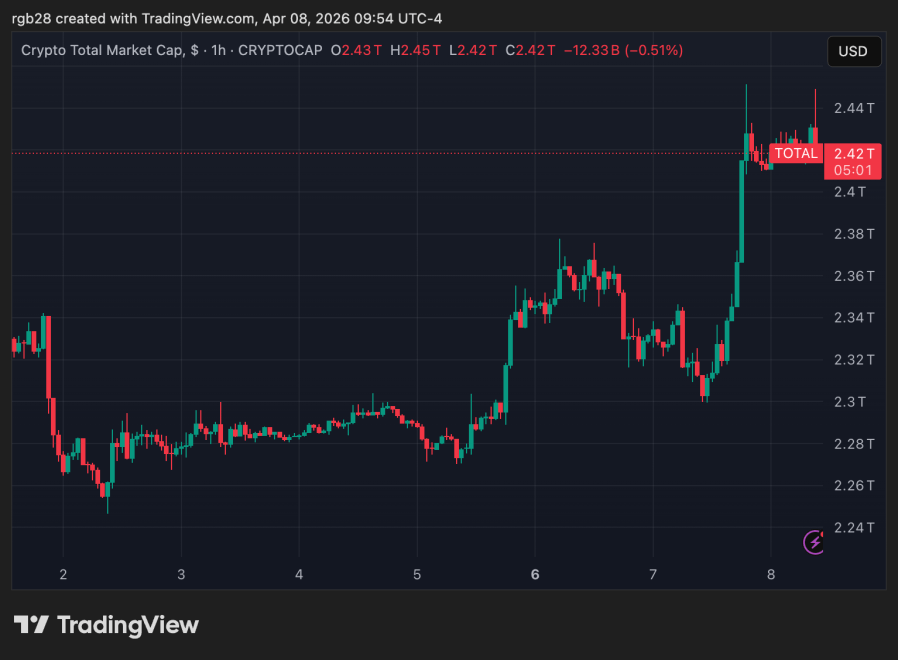
The total crypto market capitalization is at $2.42 trillion in the one-week chart. Source: TOTAL on TradingView