Nobel Laureate Becomes New Employee at Anthropic

marsbitPubblicato 2026-06-20Pubblicato ultima volta 2026-06-20

Introduzione

Nobel laureate and AlphaFold lead John Jumper has left Google DeepMind after nearly nine years to join AI company Anthropic. Jumper, who co-won the 2024 Nobel Prize in Chemistry for his work on the protein-structure-predicting AI, led the AlphaFold project from its early stages, revolutionizing structural biology by predicting hundreds of millions of protein structures. His departure follows closely that of Transformer co-inventor Noam Shazeer, who recently left Google for OpenAI, marking a significant talent drain for the tech giant. Analysts suggest top AI researchers are seeking environments where individual impact can more directly shape a company's trajectory. Anthropic's hiring of Jumper signals a major push into AI for life sciences. The company recently acquired biotech firm Coefficient Bio and is building wet labs, aiming to drastically accelerate drug discovery and biomedical research. This move aligns with a broader trend, as OpenAI and Google DeepMind (via Isomorphic Labs) are also heavily investing in AI-driven biology and healthcare. The stage is now set for intensified competition among AI leaders to redefine life sciences through artificial intelligence.

Nobel laureate joins Anthropic!

Today, AlphaFold core leader John Jumper announced: He is leaving Google DeepMind after nearly 9 years and joining Anthropic.

A Nobel laureate who rewrote structural biology with an AI model has turned and left.
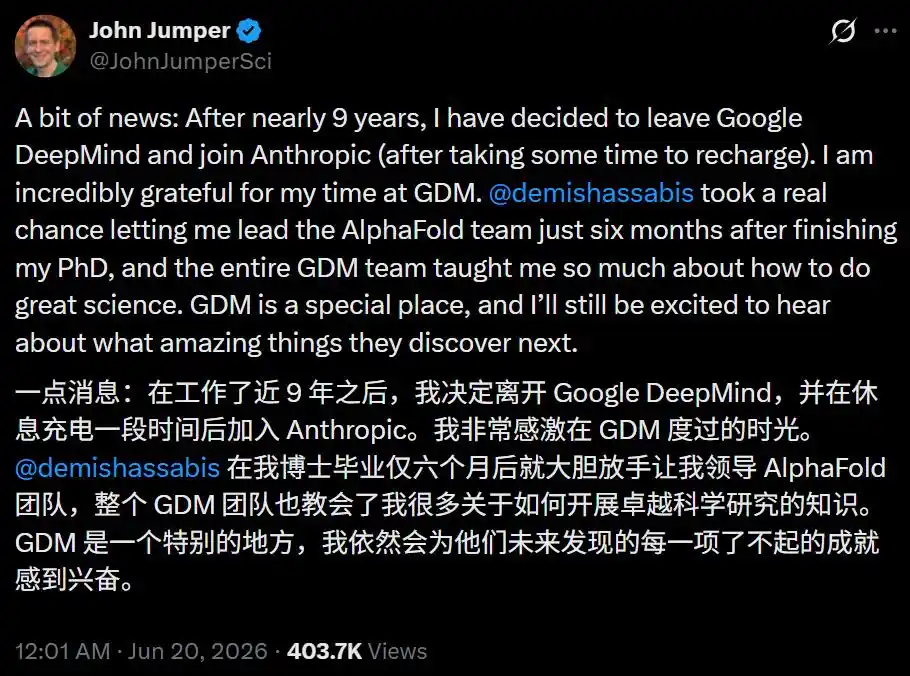
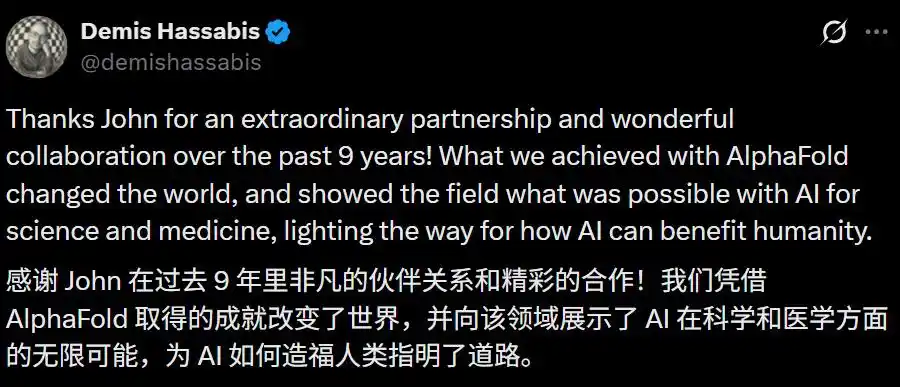
Hassabis responded quickly: "Thank you John for an incredible partnership over the past 9 years! What we achieved with AlphaFold changed the world."

Nine years of collaboration, sharing a Nobel Prize—this is probably the most amicable farewell in the tech circle.
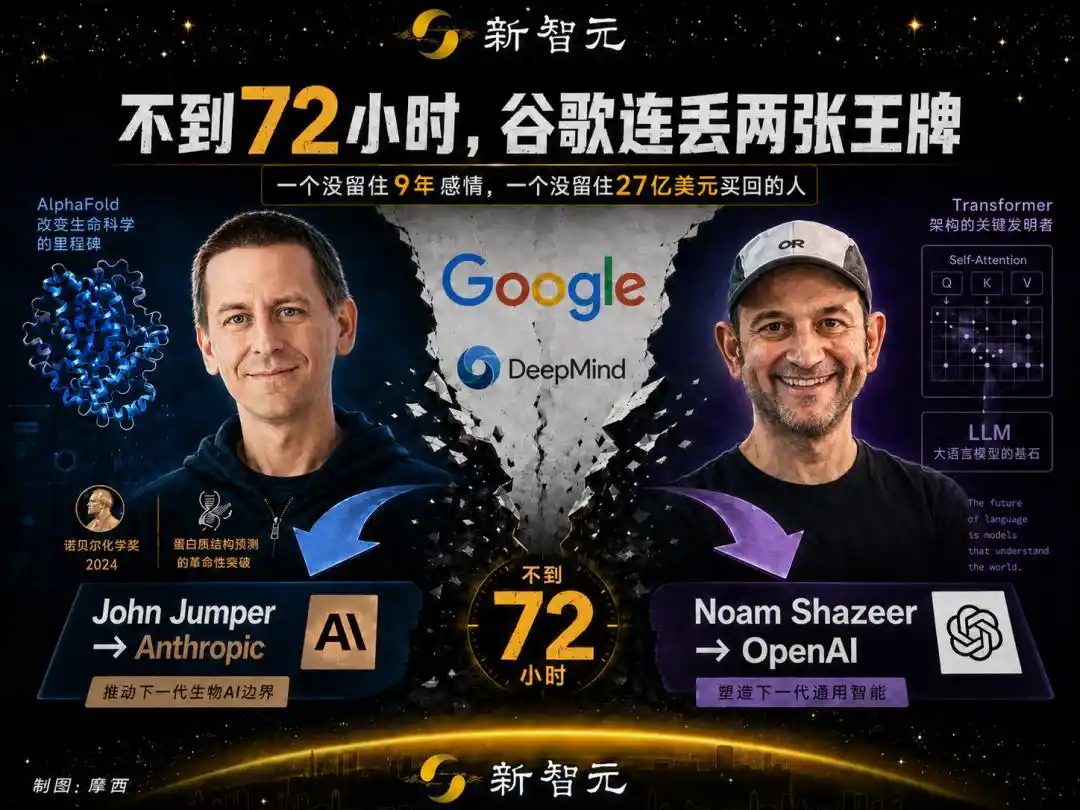
And just two days ago, the legendary co-first author of the Transformer paper and Gemini co-lead, Noam Shazeer, announced he was leaving Google for OpenAI.

In less than 72 hours, Google lost two aces.

One couldn't be kept even after a $2.7 billion buyback, the other couldn't be kept even after 9 years of shared history.

Leading AlphaFold Directly, 6 Months After PhD Graduation

In the life sciences world, John Jumper is practically synonymous with "rewriting an entire discipline with AI."

Born in 1985 in Little Rock, Arkansas, an ordinary small town in the American South.

He earned a dual bachelor's degree in Mathematics and Physics from Vanderbilt, then went on to the University of Chicago all the way to his Ph.D., researching theoretical chemistry. Specifically, using computational methods to simulate the dynamic behavior of proteins.

Mathematics gave him intuition for modeling, physics gave him understanding of complex systems, and theoretical chemistry made him understand the protein problem itself better than any pure AI researcher.

The combination of these three fields just happens to be the rarest knowledge set needed to solve the protein folding problem.

After receiving his Ph.D. in 2017, Jumper directly joined DeepMind.
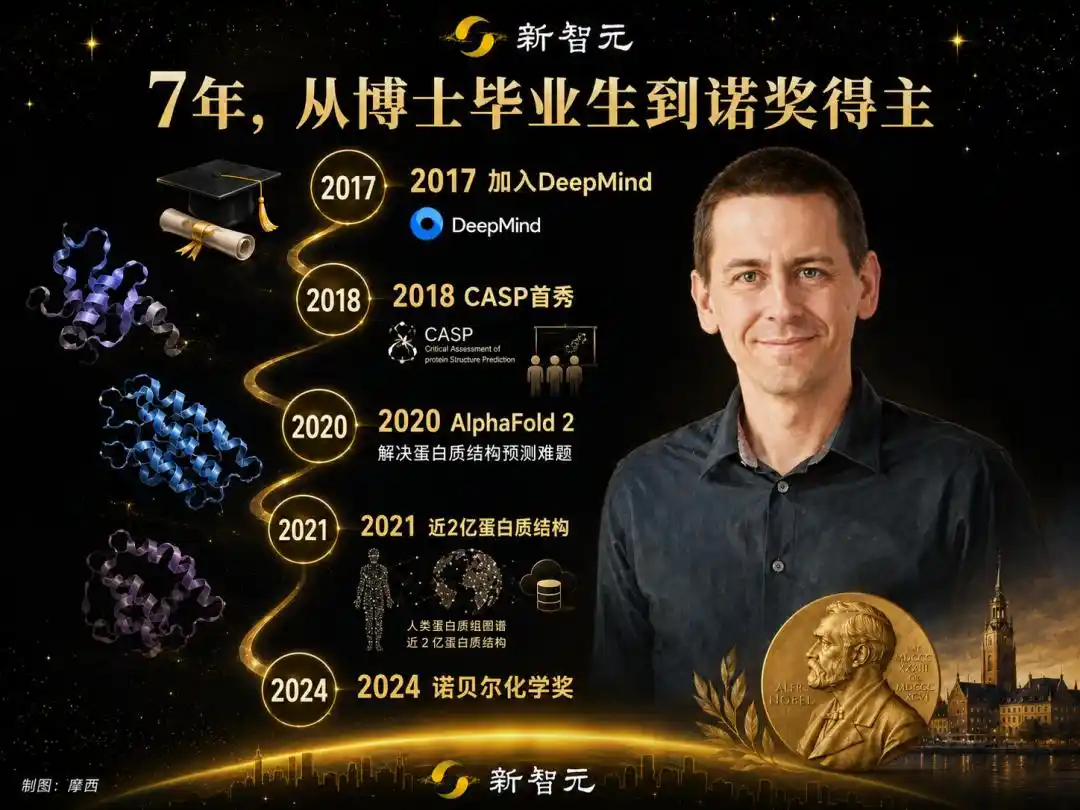
Notably, at that time he had almost no deep learning experience. What stood out on his resume was not mastery of neural networks, but his understanding of protein physics.

But that's precisely what Hassabis valued.

Immediately after, he made a decision no one expected—letting this young man, who had graduated only 6 months prior and had to learn deep learning on the job, directly lead the AlphaFold team.

No transition period, no "do a few years as a researcher to build seniority."

Hassabis was betting that solving the protein folding puzzle required understanding proteins more than understanding AI. And what Jumper took on was the biggest gamble in the entire field of computational biology.

Single-handedly Scaling Biology by 1000x

What happened in the following years can only be described as "unbelievable"—

2018, AlphaFold made its debut at the protein structure prediction competition CASP, crushing traditional methods.

2020, AlphaFold 2 emerged, directly "solving" the protein folding problem that had puzzled biologists for 50 years.

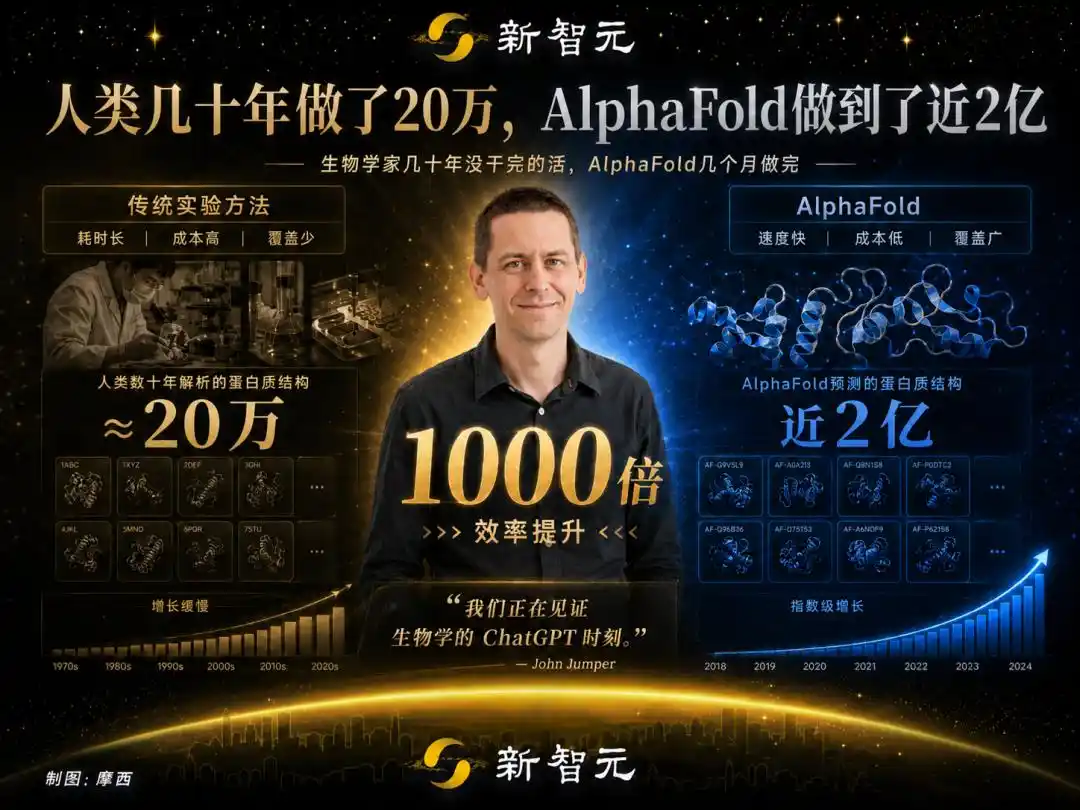
2021, Jumper's team calculated the 3D structures of nearly all 50,000+ human proteins. Ultimately, they generated structures for about 1 million species, nearly 200 million known protein structures.

Before AlphaFold, humanity spent decades using experimental methods like X-ray crystallography, cryo-electron microscopy to solve about 200,000 protein structures in total.

Jumper's team scaled that by 1000x in one go.

It's no exaggeration to say that the work biologists hadn't finished in the past hundred years, AlphaFold did in a few months.
May 2024, AlphaFold 3 was released—not just predicting proteins anymore, it can calculate interactions between DNA, RNA, small molecule drugs. Protein-ligand docking accuracy 76.4%, 1.8x improvement over previous methods.

Five months later in Stockholm, John Jumper and Demis Hassabis stood together on the Nobel Chemistry Prize podium.

That year Jumper was 39, the youngest Chemistry Nobel laureate in 70 years.

From a fresh Ph.D. graduate who had to learn deep learning on the fly, to standing under the Stockholm spotlight, it took him only 7 years.

Thus, the return on Hassabis's bet back then is probably among the highest in the history of human science.

So his departure today is not simply about Google DeepMind losing a Director.

What's Really Going on with Google?

After the news exploded, comments on X directly boiled over.

User Chubby exclaimed: "This is a huge loss for Google, and absolutely insane for Anthropic!"
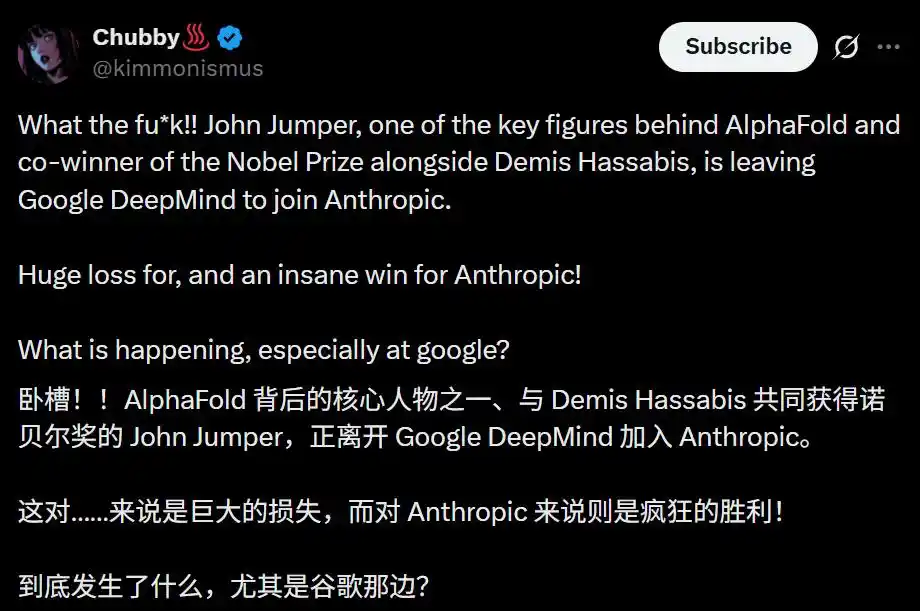
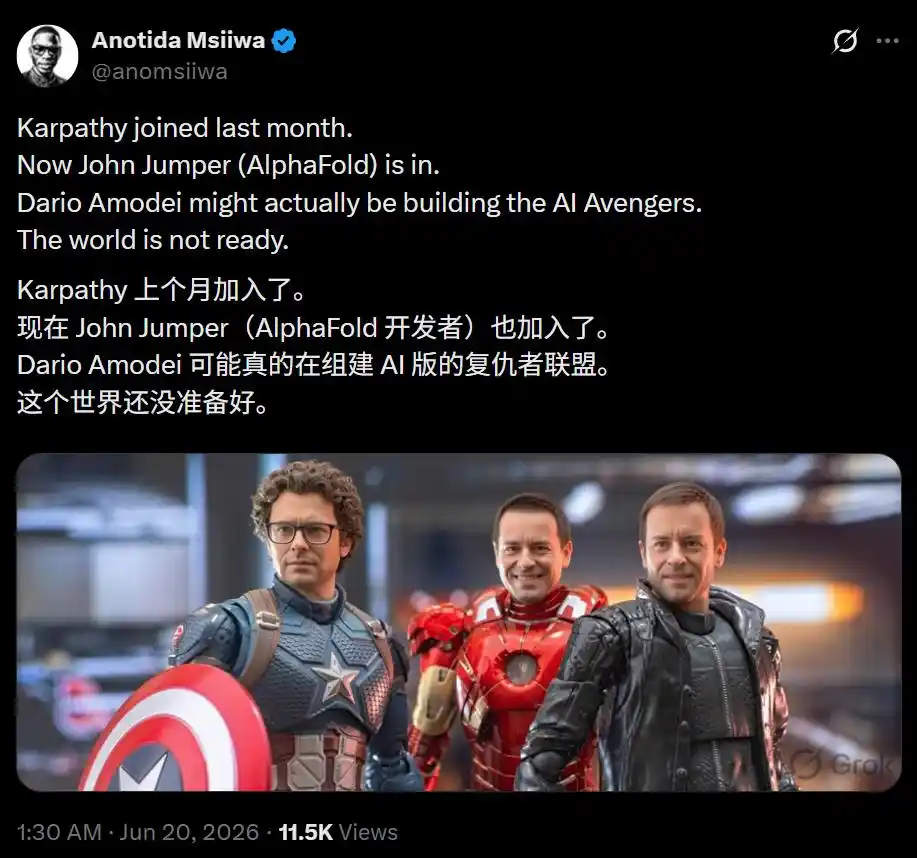
Some lamented, "Anthropic welcomes a Nobel laureate, talent is continuously concentrating towards OpenAI and Anthropic." Others outright declared: "First Karpathy, now the person behind AlphaFold, Anthropic is assembling an AI Avengers."

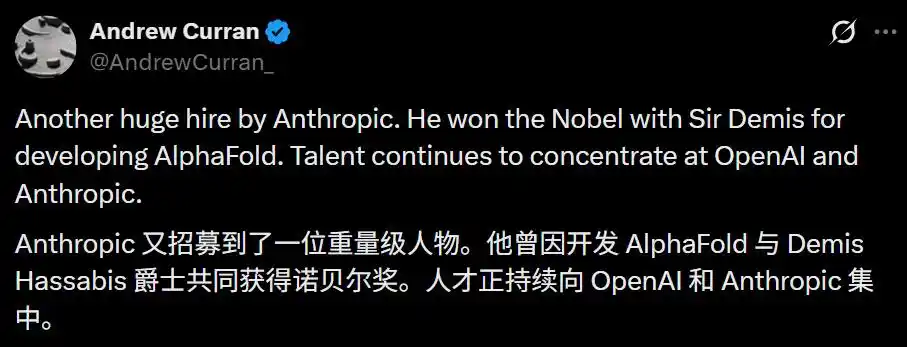
Logan Kilpatrick joked about expecting Jumper to "win another Nobel Prize." The tone was teasing, but on second thought, it's not really an exaggeration.

And after the shock, everyone was asking the same question—what's wrong with Google?

Jumper didn't say, Anthropic didn't say, Google didn't say.

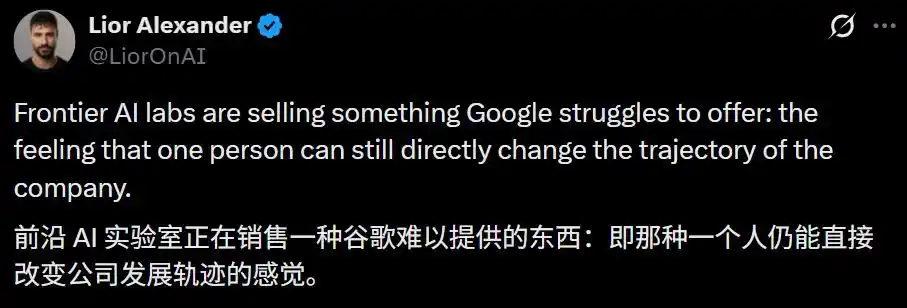
Perhaps a comment by investor Lior Alexander is the closest to an answer currently—

"Frontier AI labs are selling something Google can't offer: the feeling that one person can change a company's trajectory."
Couldn't Keep the Person Bought Back for $2.7 Billion Either

Just two days before Jumper's announcement, Noam Shazeer announced leaving Google for OpenAI, as "Head of Architecture Research."

In the 2017 foundational paper of modern AI, "Attention Is All You Need," he was one of the core authors. The multi-head attention mechanism was his design, the first usable implementation that beat SOTA was coded line by line by him.

And Google spent $2.7 billion to bring him back from Character.AI.

After returning, Shazeer became Gemini co-lead, a key figure in Google's counterattack with large models.

Result: less than two years later, he left again. Two days after that, Jumper left.

They are neither the first, nor will they be the last.
Over the past 8 years, more than 20 top researchers who authored milestone papers have left DeepMind/Brain one after another.

In 2025 alone, at least 11 executives left. DeepMind co-founder Mustafa Suleyman himself was also poached by Microsoft in a $650 million acqui-hire round.

Life Sciences, the Next Battlefield for the AI Big Three

Back to Anthropic's side. The groundwork began over two months ago.

April 3rd, Anthropic acquired biotech company Coefficient Bio for $400 million in stock. The team was less than 10 people but had already achieved top-tier results in AI-driven antibody design.

Meanwhile, Anthropic is also building its own wet lab. Last October, they launched Claude for Life Sciences to help researchers accelerate drug discovery and biological experiment design. This January, they launched Claude for Healthcare for medical institutions.

They say the goal is to compress the life science R&D cycle by 10x. And now, a Nobel-caliber protein scientist is leading this effort.

In fact, it's not just Anthropic betting on life sciences.
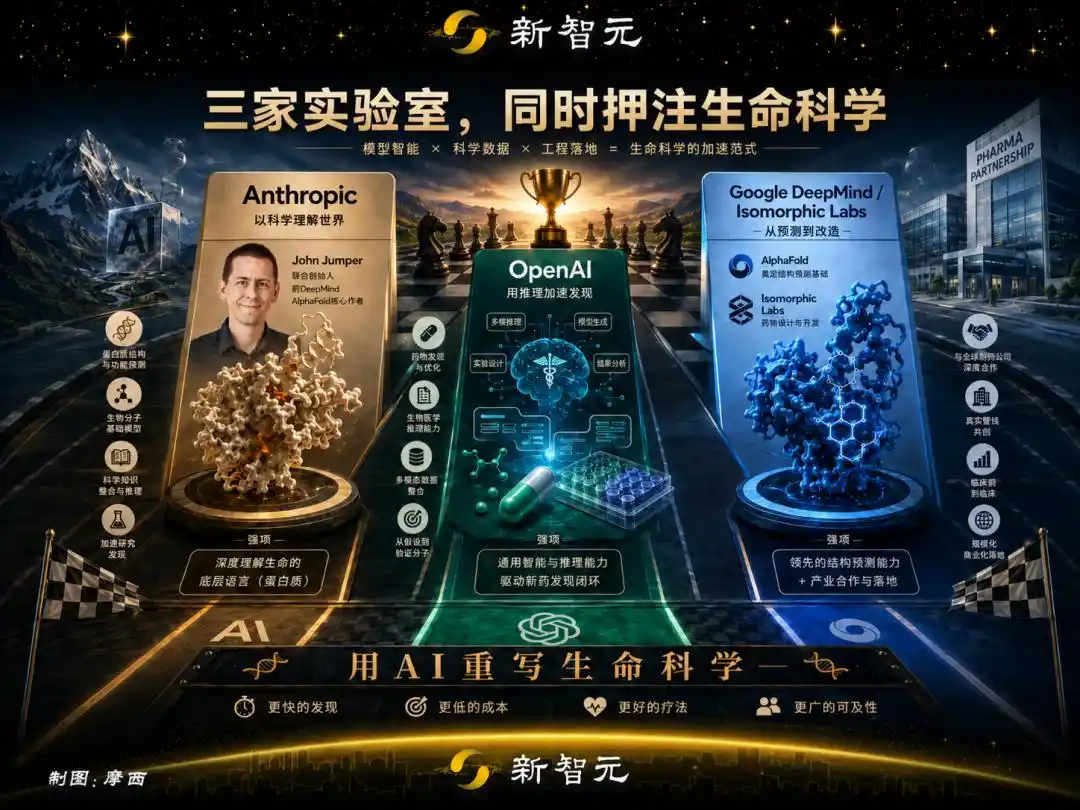
OpenAI released GPT-Rosalind in April this year, a reasoning model specifically for biomedicine, focusing on drug discovery, genomic analysis, and protein engineering. They have already partnered with top pharmaceutical companies like Amgen, Moderna, Thermo Fisher.

The OpenAI Foundation directly stated: investments in life sciences in the coming year will be no less than $1 billion. With the newly poached Shazeer overseeing architecture research, OpenAI is also making a strong move on this track.

On Google DeepMind's side, Hassabis's Isomorphic Labs raised $600 million last year, signed collaboration agreements with Eli Lilly and Novartis with total milestone values up to $3 billion. The AlphaFold technology foundation remains the industry benchmark.

Three labs simultaneously placed their bets on the same direction—rewriting life sciences with AI.

Jumper's choice is just the latest move in this grand chess game.

References:

https://x.com/JohnJumperSci/status/2068001285173834106

Editor: Moses

This article is from the WeChat public account "新智元", author: ASI启示录

Crypto di tendenza

Domande pertinenti

QWhat significant move did Nobel laureate John Jumper recently make?

ANobel laureate John Jumper recently announced that he has left Google DeepMind, where he worked for nearly nine years, to join the AI company Anthropic.

QWhat major scientific contribution is John Jumper best known for?

AJohn Jumper is best known for leading the AlphaFold team at Google DeepMind, which developed the AI system that revolutionized structural biology by solving the protein folding problem and predicting the structures of nearly 200 million proteins.

QWhy is John Jumper's departure considered a significant loss for Google?

AHis departure is a significant loss because Jumper was a key leader of the groundbreaking AlphaFold project, a recent Nobel Prize winner, and his move follows closely after another top AI researcher, Noam Shazeer, also left Google, indicating a pattern of top talent leaving for competitors.

QWhat area is Anthropic focusing on with its recent acquisitions and hires?

AAnthropic is focusing on the life sciences sector. This is evidenced by its $400 million stock acquisition of biotech company Coefficient Bio, the establishment of its own wet lab, and now the hiring of Nobel laureate John Jumper, aiming to compress life science R&D cycles.

QWhich other major AI companies are also heavily investing in the life sciences field?

AAlongside Anthropic, OpenAI and Google DeepMind are also heavily investing in life sciences. OpenAI has released GPT-Rosalind for biomedicine and pledged over $1 billion, while Google's Isomorphic Labs has secured major partnerships in drug discovery, all aiming to use AI to rewrite the field.

Letture associate

Base Under Pressure

**Title: The Pressure Mounts for Base** Base, the Ethereum Layer 2 scaling solution backed by Coinbase, is facing significant pressure and public scrutiny from its leadership following the launch of Robinhood Chain. Base co-founder Jesse Pollak recently acknowledged strategic missteps, admitting that the chain's past focus on social and creator tokens (e.g., through Farcaster, Zora) failed to deliver sustainable adoption. He has refocused on core infrastructure, handing leadership of the Base App back to Coinbase's Cobie. While Base remains a top L2 contender alongside OP Mainnet and Arbitrum, and boasts the highest TVL (nearly $12B), its weaknesses are being highlighted by the new competitor. Key criticisms include its slow progress on decentralization. Base has faced issues with its single sequencer causing block production halts, and L2BEAT is reportedly considering downgrading its decentralization rating from Stage 1 to Stage 0. This contrasts sharply with the rapid initial success of Robinhood Chain, whose DEX quickly entered the top five by volume. The leadership styles of the parent companies are also being compared: Robinhood's CEO actively engages with new projects, while a recent incident where Coinbase's Brian Armstrong briefly changed his profile picture—sparking and then crashing a related meme token—drew community ire and mockery. Pollak stated Base is working with Coinbase on tokenized stocks backed 1:1 by real equity, differentiating it from Robinhood's derivatives model. However, the article argues that Base's most urgent task is to address its long-standing technical and trust issues. With more traditional finance players likely to emulate Robinhood's path, Base must use this competitive pressure to solidify its position as long-term financial infrastructure.

Foresight News10 min fa

Base Under Pressure

Foresight News10 min fa

White House Concession Removes Ethical Hurdle, Clarity Act Races Against Final Window Before Recess?

On July 21st, industry sources reported that the Trump administration has agreed to include an ethics provision in the "Clarity Act" (Digital Asset Market Clarity Act of 2025). This concession addresses the long-standing conflict-of-interest concerns regarding government officials and the crypto industry, potentially removing the final major obstacle to the bill's progress. Additionally, Patrick Witt, the executive director of the White House's Digital Asset Advisory Committee, confirmed he will remain in his role to help finalize the bill, alleviating previous concerns about his potential departure. The Clarity Act aims to establish a unified federal regulatory framework for the U.S. digital asset market. Its core objective is to resolve regulatory ambiguity by defining different types of digital assets (digital commodities, investment contract assets, and permitted payment stablecoins) and clarifying the respective oversight roles of the SEC and CFTC. This would end the long-running jurisdictional dispute between the two agencies and provide clearer compliance paths for the industry. With the ethics issue moving toward resolution, the most urgent challenge now is time. The U.S. Congress is set to begin its August recess in mid-August, leaving only a few working weeks to finalize the text and advance the bill through the Senate. Industry advocates, like the Blockchain Association's Kristin Smith, stress that this is a critical moment. If negotiations conclude successfully in the coming weeks, the Clarity Act could pass a key hurdle before the recess; otherwise, it may face significant delays. If enacted, the Clarity Act could mark a historic turning point in crypto regulation. By providing a clearer and more predictable legal framework, it aims to reduce uncertainty for businesses, developers, and traditional financial institutions looking to enter the digital asset space, potentially setting a global benchmark for market structure regulation.

Odaily星球日报16 min fa

White House Concession Removes Ethical Hurdle, Clarity Act Races Against Final Window Before Recess?

Odaily星球日报16 min fa

AI Era, Industrial Revolution, and Future Civilization Interview — Zhang Dingwen: The Future Does Not Belong to Chasers

"AI Era, Industrial Revolution and Future Civilization: An Interview with Zhang Dingwen – The Future Does Not Belong to Those Who Chase" In this interview, entrepreneur Zhang Dingwen reflects on his entrepreneurial journey and philosophy, moving beyond discussions of financing or success to emphasize understanding the "era" itself. He argues that true entrepreneurs should not chase short-term trends ("winds"), but position themselves in the direction of long-term technological and societal evolution. Zhang shares key lessons from his early days, including the realization that user value does not automatically translate to commercial value. For him, the core of entrepreneurship is not building a company but constantly upgrading one's own "cognition" – the ability to interpret information, ask the right questions, and understand the underlying "causes" behind business outcomes, not just the effects. His thinking has evolved from a focus on creating good products to a strategic focus on building "entrances" – platforms that naturally connect users to digital services. He sees smart wearables, like watches, not merely as hardware but as potential future gateways combining technological, financial, social, and even fashion attributes to create sustained user relationships and ecosystems. Ultimately, Zhang's vision transcends individual products or companies. He discusses business competition in three stages: product, platform, and finally, "civilization" – where the greatest companies influence how society operates by defining new rules and ways of life. He believes the mission of a truly great enterprise is to solve problems of its time, build enduring trust, and contribute lasting value, leaving behind not just wealth but a positive impact on how the world works. The future, he concludes, belongs not to the fastest, but to those with the correct long-term direction and a commitment to continuous learning and evolution.

marsbit27 min fa

AI Era, Industrial Revolution, and Future Civilization Interview — Zhang Dingwen: The Future Does Not Belong to Chasers

marsbit27 min fa

Cryptocurrency & Stock Market Barometer丨Strategy Cash Reserves Increase to $3.23 Billion, Halting BTC Purchases; Vanguard and Other Asset Managers Increase Holdings in Strategy Stock (July 21)

Market Overview & Warnings: The article warns of high volatility in South Korean stocks and continued dependence on U.S. stocks on geopolitics. Chinese A-shares remain under pressure. It advises against using leverage in current equity markets. For crypto-linked stocks, most have limited growth except Robinhood, with caution advised. U.S. Stock Market: Bearish bets on U.S. stocks, particularly targeting AI-related companies, have reached record highs since 2010, signaling deep skepticism about the sustainability of the AI-driven rally. Tech and chip stocks led a market decline, with the Philadelphia Semiconductor Index potentially entering a bear market. Increased expectations for Federal Reserve interest rate hikes and geopolitical tensions contributed to the negative sentiment. Bitcoin Treasury Company Updates: * Strategy: Increased its cash reserves to $3.23 billion and paused Bitcoin purchases. Several major asset managers, including Vanguard Group and Capital Group, increased their holdings of Strategy (MSTR) stock. * Global corporate Bitcoin buying slowed significantly to just $1.33 million last week. * Other notable activity: Strive purchased 21 BTC; ORANGE JUICE raised $40 million for Bitcoin acquisitions; Bitcoin Japan Corp. raised $60 million, allocating $4.08 million for its first BTC purchase. Other Crypto Treasury Holdings: * Ethereum: BitMine increased its ETH holdings to 5.78 million, nearing its 5% of supply goal. Its total crypto assets, cash, and securities are valued at $11.5 billion. * Solana: No significant corporate treasury activity reported. * Altcoins: HypeStrat made no adjustments to its treasury; its mNAV ratio fell to a long-term low. (Note: This summary is for informational purposes only and does not constitute investment advice.)

marsbit28 min fa

Cryptocurrency & Stock Market Barometer丨Strategy Cash Reserves Increase to $3.23 Billion, Halting BTC Purchases; Vanguard and Other Asset Managers Increase Holdings in Strategy Stock (July 21)

marsbit28 min fa

Trading

Spot

Articoli Popolari

Come comprare CORE

Benvenuto in HTX.com! Abbiamo reso l'acquisto di CORE (CORE) semplice e conveniente. Segui la nostra guida passo passo per intraprendere il tuo viaggio nel mondo delle criptovalute.Step 1: Crea il tuo Account HTXUsa la tua email o numero di telefono per registrarti il tuo account gratuito su HTX. Vivi un'esperienza facile e sblocca tutte le funzionalità,Crea il mio accountStep 2: Vai in Acquista crypto e seleziona il tuo metodo di pagamentoCarta di credito/debito: utilizza la tua Visa o Mastercard per acquistare immediatamente CORECORE.Bilancio: Usa i fondi dal bilancio del tuo account HTX per fare trading senza problemi.Terze parti: abbiamo aggiunto metodi di pagamento molto utilizzati come Google Pay e Apple Pay per maggiore comodità.P2P: Fai trading direttamente con altri utenti HTX.Over-the-Counter (OTC): Offriamo servizi su misura e tassi di cambio competitivi per i trader.Step 3: Conserva CORE (CORE)Dopo aver acquistato CORE (CORE), conserva nel tuo account HTX. In alternativa, puoi inviare tramite trasferimento blockchain o scambiare per altre criptovalute.Step 4: Scambia CORE (CORE)Scambia facilmente CORE (CORE) nel mercato spot di HTX. Accedi al tuo account, seleziona la tua coppia di trading, esegui le tue operazioni e monitora in tempo reale. Offriamo un'esperienza user-friendly sia per chi ha appena iniziato che per i trader più esperti.

251 Totale visualizzazioniPubblicato il 2024.12.13Aggiornato il 2026.06.02

Come comprare CORE

Discussioni

Benvenuto nella Community HTX. Qui puoi rimanere informato sugli ultimi sviluppi della piattaforma e accedere ad approfondimenti esperti sul mercato. Le opinioni degli utenti sul prezzo di CORE CORE sono presentate come di seguito.

活动图片