‘No Token Issuance’ Statement Fails to Curb Frenzy, ClawdBot Trapped in Crypto Kidnapping Dilemma

比推Pubblicato 2026-01-27Pubblicato ultima volta 2026-01-27

Introduzione

ClawdBot, an open-source AI assistant, gained massive traction with over 40,000 GitHub stars and a rapidly growing Discord community. Despite its technical success, it became the center of an unsolicited meme coin frenzy when a token named CLAWD was launched without authorization, reaching a market cap of $16 million. The founder, Peter Steinberger, explicitly stated he would never issue a token and condemned the harassment and scams targeting the project. His account was even hijacked by crypto scammers attempting to force a token launch. Steinberger, a retired entrepreneur whose previous company received a €100 million investment, has no financial incentive to engage in crypto speculation. The incident highlights a shift in meme coin culture from seeking legitimacy through technical projects to aggressively “adopting” viral trends through coercion and scams, potentially harming genuine open-source development.

Author: Curry, Deep Tide TechFlow

Original Title: ClawdBot Founder Says Never Issuing Tokens, Meme Trenches Go Crazy


On January 25th, an open-source AI assistant called ClawdBot went viral.

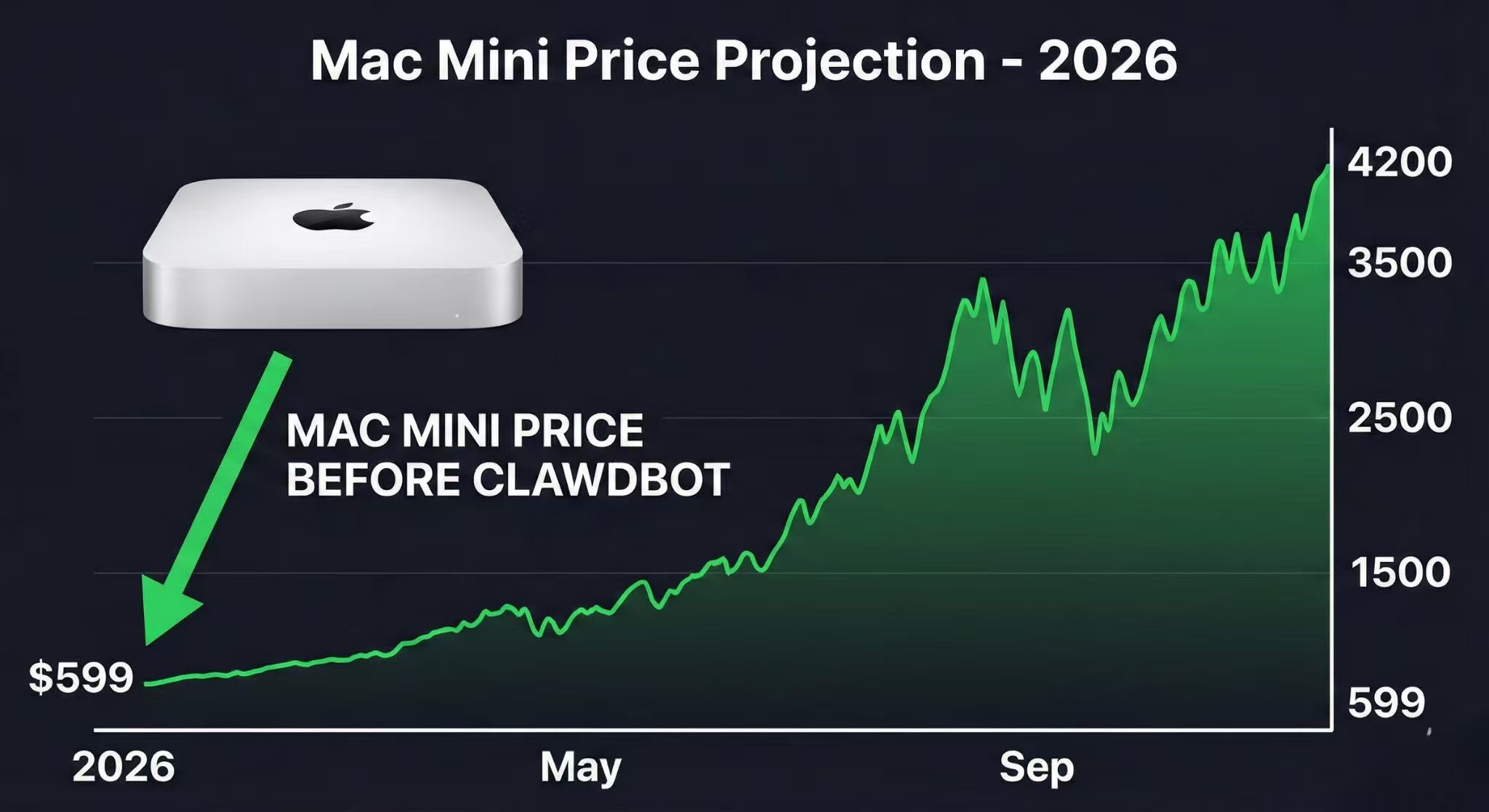
You might have seen it extensively on Twitter and various media platforms at home and abroad over the past couple of days. The project's GitHub stars surpassed 40,000, and foreigners joked that Mac minis would sell out because of it, as it needs to run 24/7, and a brand new Mac, free of other tasks, versatile and capable, is a good choice.
Simultaneously, nearly ten thousand people flooded into the project's Discord community.

ClawdBot founder Peter Steinberger also tweeted, saying he hardly looks at code anymore, letting AI write it all;

This sparked another phenomenon-level technical topic on Twitter after Dan Koe's viral inspirational piece "How to Fix Your Life in a Day" – "How to Quickly Deploy ClawdBot".

Naturally, attention brings liquidity, and the crypto friends smelled it and came.

The同名 Meme token CLAWD was actually launched on the 25th, with its market cap once soaring to $16 million. Everything looked familiar: a trending AI project, a同名 token, early players getting rich. The only problem was:

The founder said he wouldn't issue a token.

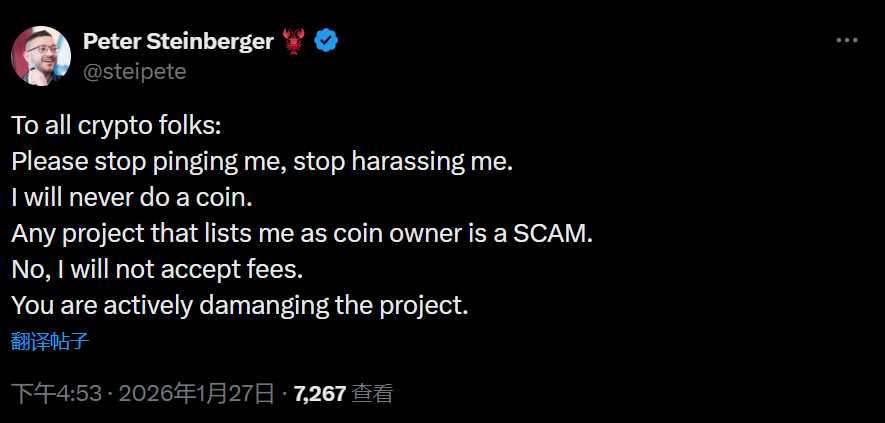
On January 27th, Peter Steinberger posted a statement on Twitter:

"Stop DMing me. Stop harassing me. I will never issue a token. Any project listing me as a token owner is a scam. No, I don't accept any fees. You are damaging the project".
On the same day, he posted another tweet:

Any GitHub folks who can help me get my account back? It's been hijacked by crypto scammers.

You won't issue a token, I'll DM you to issue it. You still won't, then I'll hijack your account and issue it for you.

Unlike the poor devs in the Meme trenches desperately waiting for an official move, this developer who created ClawdBot doesn't seem to be short of money.

I looked into his background. Peter previously founded a company called PSPDFKit, developing PDF tools.

In 2021, Insight Partners invested €100 million in this company, which at the exchange rate then was roughly:

$116 million.

After the investment was completed, Peter and his co-founder retired. In his own words, he "came back from retirement to mess with AI", now returning from retirement to fiddle with AI.
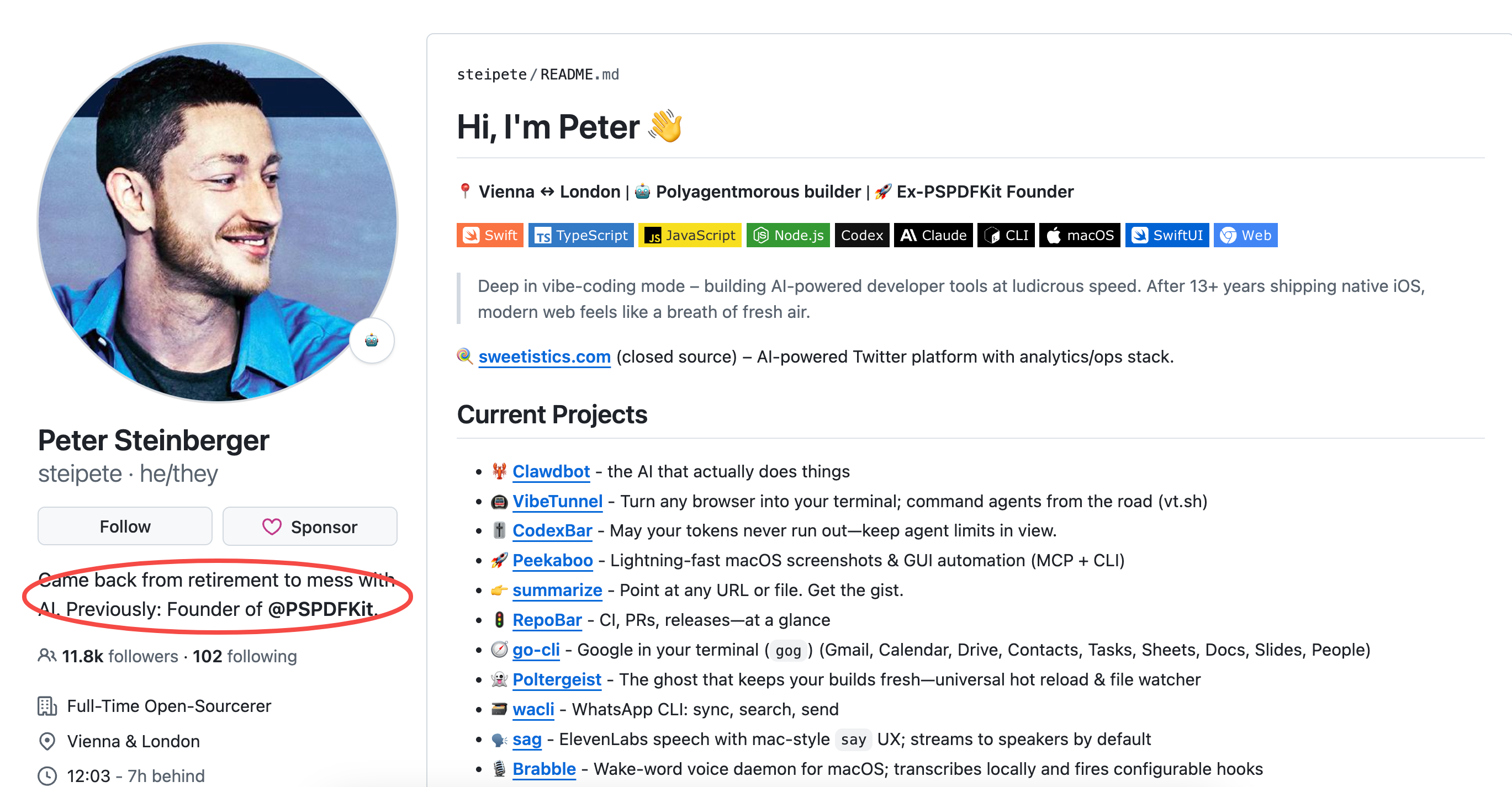
A person who retired by making products really doesn't need your token profits.

But the brothers in the Meme trenches need it.

This is the most interesting part of the story. In the crypto world's perception, "who wouldn't want to make money" is the first principle. A project goes viral, issuing a token is a matter of course.

If you don't issue, you're either pretending or waiting for a better time, even if the project has little to do with crypto.

So people will DM, harass, even hijack accounts to issue tokens through scams.

Remember when AI Meme first got hot the year before last and last year, the routine was like this:

First, have a technical project or product prototype, then the team announces they will issue a token, the community follows up, the narrative is self-consistent. This is called "technical legitimacy": you have something, so you qualify to issue.

Now it's changed.

Now, upon seeing the hype, first抢注 a同名 token, then wait for "official adoption". If adopted, everyone is happy; if not, keep speculating. Anyway, retail investors can't tell which is real.

In the Meme trenches, this "forced adoption" model is becoming the norm.

Whether it's Chinese Meme or overseas Meme, seeking mention,暗示, or endorsement from an official role in a hot topic is an action that will never stop.

It's just that this initiative is a bit too wolf-like.

Before, Meme was about "creating gods", finding a founder with a technical background, packaging them as the next Vitalik; later it was "蹭神" (rubbing against gods), naming projects after Elon, Trump.

Now it's "绑神" (kidnapping gods), if you don't cooperate, I'll hijack your account.

From active god-making to passive kidnapping, the narrative cycle of AI Meme might really be at its end.

Peter Steinberger said something in the tweet statement above that is truly worth pondering: you are damaging the project.

An open-source, free AI assistant that anyone can use is being forced to spend energy dealing with this nonsense because of harassment from the crypto circle.

I wonder if he will shut down the project because of this, or simply make the code private. Only know that if it really comes to that, the ones who lose the most certainly won't be those speculating on tokens.

The ones who lose the most are the ordinary developers who actually want to use this tool.

But does that matter?

In the crypto world, making money is what matters.


Twitter:https://twitter.com/BitpushNewsCN

BitPush TG Discussion Group:https://t.me/BitPushCommunity

BitPush TG Subscription: https://t.me/bitpush

Original link:https://www.bitpush.news/articles/7606372

Domande pertinenti

QWhat is the founder of ClawdBot and what is his background?

AThe founder of ClawdBot is Peter Steinberger. He previously co-founded a company called PSPDFKit, which developed PDF tools. In 2021, the company received a €100 million (approximately $116 million at the time) investment from Insight Partners, after which Peter retired. He has since returned from retirement to work on AI projects like ClawdBot.

QWhy did the ClawdBot project gain significant attention on January 25th?

AClawdBot, an open-source AI assistant, gained significant attention because its GitHub repository surpassed 40,000 stars, and its Discord community grew to nearly 10,000 members. It became a trending topic on Twitter, with discussions on how to quickly deploy it, and it was humorously suggested that Mac minis might sell out due to the project's requirement to run 24/7.

QHow did the cryptocurrency community react to the popularity of ClawdBot?

AThe cryptocurrency community quickly capitalized on ClawdBot's popularity by launching a meme token named CLAWD on the same day it went viral. The token's market capitalization briefly reached $16 million. Despite the founder's clear statement that he would never issue a token, some individuals resorted to harassing him and even hijacking his social media accounts in an attempt to force or fake an official endorsement.

QWhat was Peter Steinberger's response to the token and the harassment from the crypto community?

APeter Steinberger explicitly stated on Twitter that he would never issue a token and denounced any projects listing him as a token owner as scams. He expressed frustration over the harassment, stating that such actions were damaging the project. He also reported that his GitHub account was hijacked by crypto scammers.

QWhat does the article suggest about the current state of AI-related meme tokens?

AThe article suggests that the narrative cycle for AI-related meme tokens may be ending. It describes a shift from projects building legitimacy through technology and official token launches ('造神' or 'making a god') to simply蹭神' or 'rubbing against a god' by using famous names, and now to '绑神' or 'kidnapping a god,' where communities harass or hijack accounts of legitimate projects to force association. This behavior risks harming genuine open-source projects and their communities.

Letture associate

Once-Popular Web3 Enters Wave of Layoffs

The once-hot Web3 industry is experiencing a severe wave of layoffs. While many companies attribute job cuts to AI-driven restructuring, the primary reason is often financial pressure. The Web3 sector, at the intersection of tech and finance, has been hit particularly hard. Employees at major cryptocurrency exchanges report sudden, impersonal layoffs—often with system access revoked overnight—and minimal or no severance. Common tactics include setting impossible performance targets or terminating employees for minor policy violations. The working atmosphere has become toxic, marked by intense monitoring, excessive meetings, and management obsessed with control and internal politics rather than product innovation. The industry's core business model is collapsing. Exchange revenue from trading fees and listing charges has plummeted due to a decline in quality projects and retail investor exodus. Events like the massive forced liquidation on October 10th further shattered confidence. Competition from on-chain derivatives platforms and prediction markets is intensifying the downturn. As layoffs continue, displaced workers struggle to find new opportunities. Many transition to the AI sector, but face significant bias from traditional finance and even some AI firms, which view crypto industry experience with suspicion. The current downturn appears more structural than cyclical, driven by unsustainable practices, internal strife, and a failure to innovate, raising questions about the industry's future trajectory.

marsbit49 min fa

Once-Popular Web3 Enters Wave of Layoffs

marsbit49 min fa

Sales Drop 26% But Prices Rise? Xiaomi's Dilemma

Xiaomi, facing a significant 26.3% year-on-year decline in global smartphone shipments in Q2 2026, has implemented its third price hike of the year. On August 2nd, prices were raised for nine models, including the flagship Mi 17 series (up 400-500 yuan) and Redmi K90/Turbo 5 series (up 300 yuan). This move completes a pattern where cost pressure, originating from surging memory chip prices, has climbed from entry-level to mid-range and now flagship products. The primary driver is a severe supply squeeze on consumer-grade DRAM and NAND flash memory, as major manufacturers like Samsung shift advanced capacity to more profitable HBM for AI applications. According to Xiaomi President Lu Weibing, memory prices for the same configuration have skyrocketed nearly fourfold since Q1 2025, adding roughly 1500 yuan to the cost of a mainstream 12GB+512GB phone. IDC estimates consumer memory costs have risen nearly 300% year-on-year. While the price increases hurt demand and contributed to the sales slump, Xiaomi's strategy of reducing entry-level models and upgrading its product mix also played a role. Domestically, its market share in China fell to 12% (5th place), while leaders Huawei and Apple saw shipments grow over 24%. To mitigate future risks, Xiaomi is accelerating its in-house "Surge" chip development and optimizing memory configurations across its lineup. Xiaomi is not alone; major brands like OPPO, vivo, and Apple have already raised prices in 2026, with industry insiders predicting another round of increases (200-800 yuan) in the second half. A full-scale industry-wide涨价 cycle is underway, forcing both manufacturers and consumers to recalibrate their strategies and purchasing decisions amid sustained cost pressures.

marsbit1 h fa

Sales Drop 26% But Prices Rise? Xiaomi's Dilemma

marsbit1 h fa

Trading

Spot
活动图片