No Agreement Reached In White House Meeting Between Banks And The Crypto Industry

bitcoinistPubblicato 2026-02-12Pubblicato ultima volta 2026-02-12

A second White House meeting between major U.S. banks and leading crypto firms ended without a deal on stablecoin yield, leaving one of the most contentious issues in U.S. digital asset regulation unresolved.

The February 10 session, led by Patrick Witt, Executive Director of the President’s Crypto Council, focused on whether stablecoin issuers should be allowed to offer yield or rewards to holders.

While participants described the talks as more detailed than previous discussions, no compromise was reached. The outcome keeps the proposed Digital Asset Market Clarity Act of 2025, known as the CLARITY Act, stalled in the Senate Banking Committee.
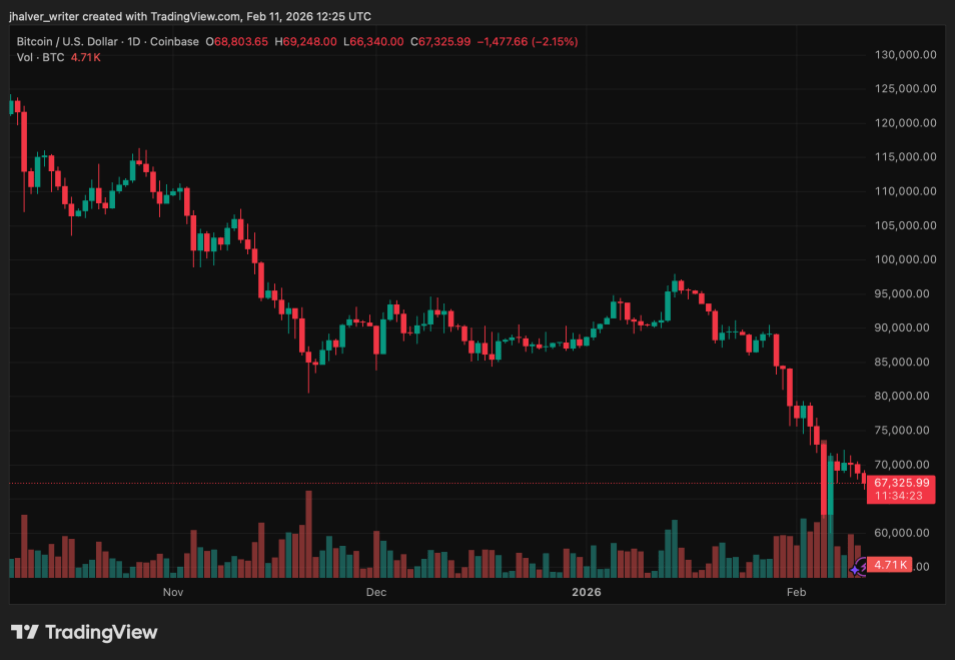
BTC's price trends to the downside on the daily chart. Source: BTCUSD on Tradingview

Stablecoin Yield at the Center of the Dispute

At the heart of the disagreement is whether stablecoin rewards resemble bank interest and, if so, should face similar restrictions.

Banking representatives from Goldman Sachs, JPMorgan, Bank of America, Wells Fargo, Citi, PNC, and U.S. Bank argued that yield-bearing stablecoins could trigger large-scale deposit outflows from traditional banks.

Banks presented a written set of “prohibition principles” calling for a ban on “any form of financial or non-financial consideration” offered to stablecoin holders. They contend that allowing such rewards could undermine lending capacity and disrupt the traditional deposit model.

Crypto firms, including Coinbase, Ripple, a16z, Paxos, and the Blockchain Association, pushed back. They argue that stablecoin rewards are a core feature of on-chain finance and necessary for fair competition with traditional financial products.

Industry representatives also said overly restrictive rules could slow innovation or drive activity outside the United States.

CLARITY Act Remains in Limbo

The debate over stablecoin yield has become a key obstacle for the CLARITY Act, which aims to define regulatory oversight for digital assets and clarify the roles of the SEC and the CFTC. The bill passed the House in 2025 but has not advanced in the Senate due to unresolved concerns around stablecoin regulation.

Although banks maintained a firm stance, participants noted a shift in tone. For the first time, banking representatives signaled limited openness to discussing potential exemptions for transaction-based rewards. However, disagreements over what qualifies as “permissible activities” remain unresolved.

The White House has urged both sides to reach an agreement by March 1 to preserve legislative momentum. Further discussions are expected in the coming days, though it is unclear whether another full-scale meeting will be held before the deadline.

Until a compromise is reached, stablecoin regulation and broader reform of the U.S. crypto market structure remain in a holding pattern.

Cover image in ChatGPT, BTCUSD chart on Tradingview

Domande pertinenti

QWhat was the main topic of disagreement in the White House meeting between banks and crypto firms?

AThe main topic was whether stablecoin issuers should be allowed to offer yield or rewards to holders.

QWhich major financial institutions argued against yield-bearing stablecoins?

ARepresentatives from Goldman Sachs, JPMorgan, Bank of America, Wells Fargo, Citi, PNC, and U.S. Bank argued against them.

QWhat is the name of the proposed legislation that is currently stalled due to this disagreement?

AThe proposed legislation is called the Digital Asset Market Clarity Act of 2025, also known as the CLARITY Act.

QWhat was the primary concern expressed by the banking representatives regarding stablecoin rewards?

AThey argued that yield-bearing stablecoins could trigger large-scale deposit outflows from traditional banks and undermine their lending capacity.

QWhat was the deadline given by the White House for the two sides to reach an agreement?

AThe White House urged both sides to reach an agreement by March 1 to preserve legislative momentum.

Letture associate

SharpLink CEO: How to Understand Ethereum Developers Just Exceeded 1 Million?

SharpLink CEO reflects on the milestone of Ethereum surpassing 1 million historical developers, emphasizing that this figure represents the largest pool of technical talent ever assembled around an open, permissionless blockchain network. While approximately 232,000 developers remain active, the key question for the crypto industry is not which chain is fastest, but where the best builders choose to build long-term. Ethereum's advantage lies in a decade-long accumulation of infrastructure, standards, tools, liquidity, and a cohesive culture, making it the default operating system for programmable finance. This developer base is tackling complex challenges: the Glamsterdam upgrade aims to enhance scalability while preserving core principles; synchronous composability seeks to unify Rollup ecosystems; and significant efforts are underway for post-quantum security. Ethereum's deeper network effects stem from composability and shared standards (like the EVM and Solidity), creating a flywheel of more developers, tools, and liquidity. Three reinforcing strengths cement Ethereum's lead: credible neutrality (secured by ~900k validators), a modular architecture with interconnected Rollups, and a culture that attracts top researchers. The ecosystem is consolidating as the trusted coordination layer for internet-native finance, favored by large institutions valuing security and liquidity. The future of Ethereum is being built by this global community of founders and architects.

链捕手6 min fa

SharpLink CEO: How to Understand Ethereum Developers Just Exceeded 1 Million?

链捕手6 min fa

A Clod of Chinese Soil Chokes Two Japanese Giants

"Chinese Soil Chokes Japanese Giants" The production of a key electronic specialty gas, tungsten hexafluoride (WF6), vital for manufacturing AI chips, was halted by two leading Japanese producers—Kanto Denka and Central Glass. Their shutdown was not due to a technological failure but a sudden, critical shortage of a raw material they had long taken for granted: ultra-high-purity (6N-grade) tungsten powder, which is almost entirely sourced from China. Following a quiet Chinese export announcement in January 2026, tungsten powder shipments to Japan dropped to zero for months. Despite frantic efforts, Japanese companies found no viable alternative; imported powder was three times more expensive and lacked the required purity. Their existing stockpiles were exhausted by mid-2026. WF6 is essential for depositing tungsten into the microscopic contact holes of High Bandwidth Memory (HBM) chips, which are crucial for advanced processors like those from Nvidia. While Japanese firms had mastered producing ultra-pure WF6 gas, their entire supply chain relied on China's 6N tungsten powder—a dependency now revealed as a fatal vulnerability. China's dominance in this "soil" results from decades of painstaking R&D by companies like Xiamen Tungsten and China Tungsten & Hightech. They overcame immense technical hurdles, such as separating chemically similar molybdenum from tungsten, to achieve mass production of the world's purest tungsten powder. With their primary suppliers gone, Kanto Denka and Central Glass announced a permanent halt to WF6 production starting July 1, 2026. This immediately created a supply crisis for major semiconductor manufacturers like Samsung and SK Hynix, forcing them to urgently seek and certify new Chinese suppliers for WF6 itself. The reversal marks a dramatic shift: China has moved from exporting low-value raw materials to controlling the high-purity foundation of a critical global tech supply chain, upending a long-established industrial hierarchy.

marsbit37 min fa

A Clod of Chinese Soil Chokes Two Japanese Giants

marsbit37 min fa

Without Tencent, What's Left for Suiyuan?

The article centers on the crucial question posed in the title: what is Seyond Technology really worth if its dominant customer, Tencent, were to stop purchasing its AI chips? As the last of China's "Four AI Chip Dragons" to secure approval for a public listing, Seyond's IPO filing reveals a profound and controversial dependency. In 2025, 74.9% to over 80% of its revenue came from Tencent. The piece argues that this extreme customer concentration is not merely a vulnerability but a strategic outcome of China's AI industry evolution. It contrasts Seyond's path with its peers (Moore Thread, Biren Technology, and MetaX), noting that while others raced to market with ambitious stories, Seyond focused first on securing and delivering for a major client. Its explosive revenue growth—with Q1 2026 up 1474.85% year-on-year—is driven by concentrated orders from Tencent, which itself faces massive, escalating AI compute demands for products like its Yuanbao and Hunyuan models. The relationship is framed as a deliberate, symbiotic cultivation of a supply chain. As both a major shareholder (20.26%) and primary client, Tencent is actively fostering Seyond to build a controllable, stable alternative to NVIDIA, similar to how global tech giants historically nurtured key suppliers. The high switching costs—involving software stacks and deployed systems—create a deep "ecological moat" for Seyond within Tencent's ecosystem. The analysis positions the AI chip landscape in three tiers: NVIDIA as the global leader, Huawei's Ascend as the state-backed player, and commercial firms like Seyond competing for market orders. Seyond is increasingly seen as "Tencent's compute foundation," with its product roadmap closely aligned with the tech giant's needs. The conclusion is that the industry's metric for success is shifting from fundraising and technical specs to real orders, delivery capability, and ecosystem binding. Seyond's value, therefore, lies not just in its chips but in holding a massive, multi-year procurement order from China's largest internet company—a tangible asset arguably more telling than any technical whitepaper in the current climate. The core insight is that for domestic chips, the ultimate challenge isn't just catching up technologically with NVIDIA, but earning the trust, scenarios, and recurring orders from a major anchor client.

marsbit1 h fa

Without Tencent, What's Left for Suiyuan?

marsbit1 h fa

Trading

Spot
Futures

Articoli Popolari

Come comprare HOUSE

Benvenuto in HTX.com! Abbiamo reso l'acquisto di Housecoin (HOUSE) semplice e conveniente. Segui la nostra guida passo passo per intraprendere il tuo viaggio nel mondo delle criptovalute.Step 1: Crea il tuo Account HTXUsa la tua email o numero di telefono per registrarti il tuo account gratuito su HTX. Vivi un'esperienza facile e sblocca tutte le funzionalità,Crea il mio accountStep 2: Vai in Acquista crypto e seleziona il tuo metodo di pagamentoCarta di credito/debito: utilizza la tua Visa o Mastercard per acquistare immediatamente HousecoinHOUSE.Bilancio: Usa i fondi dal bilancio del tuo account HTX per fare trading senza problemi.Terze parti: abbiamo aggiunto metodi di pagamento molto utilizzati come Google Pay e Apple Pay per maggiore comodità.P2P: Fai trading direttamente con altri utenti HTX.Over-the-Counter (OTC): Offriamo servizi su misura e tassi di cambio competitivi per i trader.Step 3: Conserva Housecoin (HOUSE)Dopo aver acquistato Housecoin (HOUSE), conserva nel tuo account HTX. In alternativa, puoi inviare tramite trasferimento blockchain o scambiare per altre criptovalute.Step 4: Scambia Housecoin (HOUSE)Scambia facilmente Housecoin (HOUSE) nel mercato spot di HTX. Accedi al tuo account, seleziona la tua coppia di trading, esegui le tue operazioni e monitora in tempo reale. Offriamo un'esperienza user-friendly sia per chi ha appena iniziato che per i trader più esperti.

287 Totale visualizzazioniPubblicato il 2025.04.27Aggiornato il 2026.06.02

Come comprare HOUSE

Discussioni

Benvenuto nella Community HTX. Qui puoi rimanere informato sugli ultimi sviluppi della piattaforma e accedere ad approfondimenti esperti sul mercato. Le opinioni degli utenti sul prezzo di HOUSE HOUSE sono presentate come di seguito.

活动图片