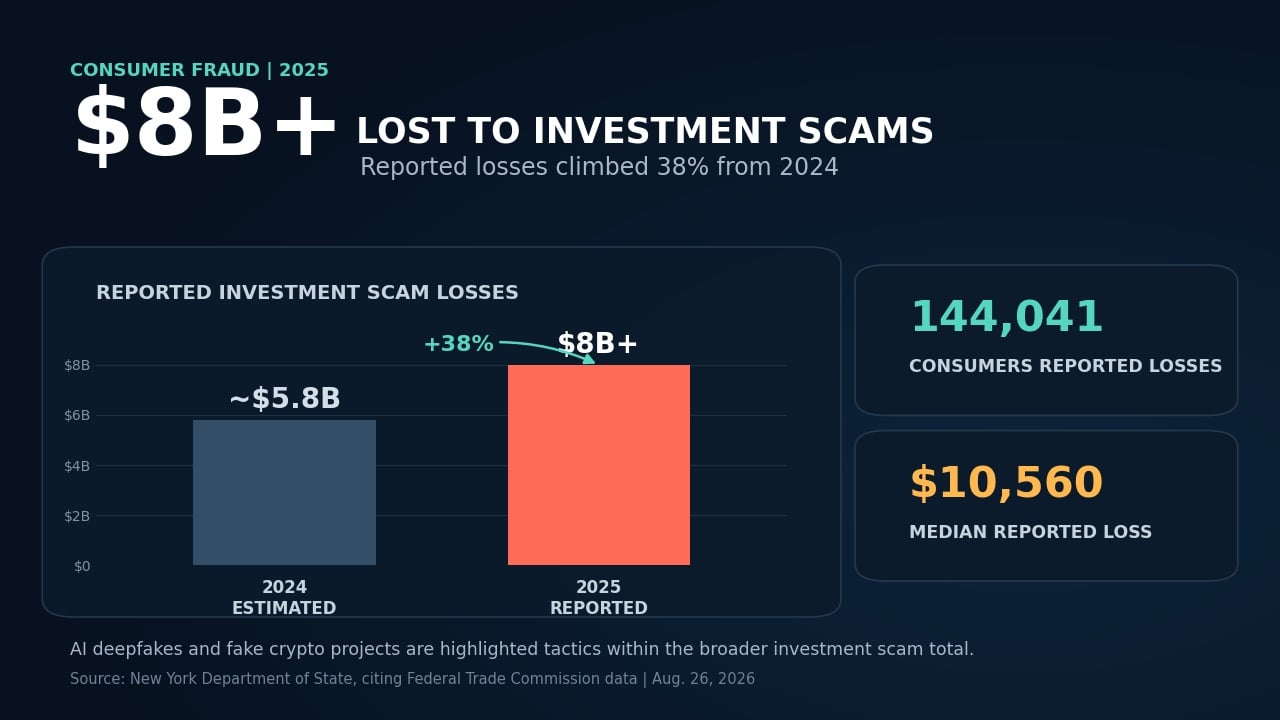
According to New York state authorities, investment scams became the costliest fraud category tracked by the Federal Trade Commission in 2025. On August 26, the state's Consumer Protection Bureau issued a warning about AI-enabled investment scams after 144,041 consumers reported losing over $8 billion, a 38% increase from 2024. The median reported loss reached $10,560.
Fraudulent schemes can originate through social media, dating apps, text messages, email, online ads, or even friendly conversations. In its own consumer warning issued in April, the FTC noted total losses for the same 2025 period were over $7.9 billion, with the median individual loss exceeding $10,000. This agency included cryptocurrency alongside stocks and forex in its list of investments that scammers promote through fake coaching offers.
State Secretary Walter T. Mosley warned:
"New Yorkers need to be on the alert for scammers who may use artificial intelligence technologies or other means to create increasingly sophisticated and realistic messaging in order to steal your hard-earned money. If something seems too good to be true, it usually is."
AI 'Deepfakes' Promote Fake Crypto Investments
Artificial intelligence allows scammers to clone voices, fake videos, impersonate financial figures, and create professionally designed social media ads. An April warning from New York Attorney General Letitia James described schemes involving celebrity deepfakes, fraudulent cryptocurrencies, pump-and-dump operations, and fake trading platforms promoted on Facebook, Instagram, and WhatsApp.
Victims may encounter professionally designed apps displaying fabricated account balances, returns, and trading activity. Some operators allow small initial withdrawals to build trust before pushing victims to make larger deposits. Similar tactics have appeared internationally: Australian regulators recently took down 3,106 fraudulent cryptocurrency investment platforms during the 2026 financial year, as AI-generated celebrity endorsements became increasingly difficult to distinguish from genuine advertisements.
Fake Platforms Build Trust Before Demanding Fees
A separate case in Australia demonstrated how organized groups create an entire fake ecosystem around a non-existent crypto investment. Investigators detailed the fake trading platforms, fabricated news articles, and chatbots posing as support staff that were involved before one woman lost nearly $74,690. Operators may then demand additional fees before returning funds, which the New York warning advises consumers should never pay.
New York authorities advised consumers to verify the identity of any promoter, research the company and investment, and find out where their money is going before transferring funds. Typical signs of a crypto scam include promises of high returns, unsolicited investment offers, aggressive sales tactics, and projects lacking clear documentation. Anyone suspecting fraud should immediately stop sending money and report it to the Federal Trade Commission (FTC), FBI's Internet Crime Complaint Center (IC3), Securities and Exchange Commission (SEC), or the New York State Attorney General.