New Protocol Tacit: The ZEC of the Bitcoin Ecosystem

marsbitPubblicato 2026-05-14Pubblicato ultima volta 2026-05-14

Introduzione

The article discusses Tacit, a new privacy-focused Bitcoin asset protocol emerging after a period of relative quiet in the Bitcoin ecosystem. Unlike BRC-20 or Runes, Tacit is a "meta-protocol" where the indexer runs directly in the user's browser, removing the need for centralized servers. Its key innovation is enabling privacy for token amounts on the Bitcoin mainnet. Tacit employs cryptographic techniques like Pedersen Commitments and Bulletproofs to conceal transaction amounts while proving conservation of funds. It uses Mimblewimble-style signatures to prevent inflation and ECDH encryption to ensure only senders and receivers can decrypt real amounts. This makes it a native "privacy coin" for Bitcoin, albeit one that hides amounts but not the direction of fund flows between addresses. The protocol, developed by ross.wei (known for Ethereum's ZAMM), has rapidly evolved since its May 7 launch. It now supports fair launches, a marketplace, token swaps, and a novel mixer similar to Tornado Cash but without relying on smart contracts. However, this privacy comes at a cost, with transaction fees estimated to be about 10 times higher than Runes. Future plans include privacy-wrapping native Bitcoin (cBTC), implementing silent receipts, and hiding the token type in transfers. The main token, $TAC, has gained traction with a market cap around $4 million. Positioned between simpler token standards and complex solutions like RGB, Tacit represents a significant and innovative step ...

The Bitcoin ecosystem had been forgotten for a long time. Especially after Magic Eden, once the largest Bitcoin ecosystem marketplace, stopped supporting the Bitcoin ecosystem and discontinued its Magic Eden Wallet service, it gave players who hadn't paid attention to the Bitcoin ecosystem for a while a feeling that "the Bitcoin ecosystem is over."

However, not only are veteran Bitcoin infrastructure projects like UniSat and Xverse still working hard, but after Magic Eden, marketplaces like SatFlow and ord.net have also filled the gap. Recently, the emergence of a new Bitcoin asset protocol has brought the Bitcoin ecosystem back into the spotlight.

This new protocol is called Tacit.

What is Tacit?

First, we need to classify Tacit into the "meta-protocol" category like BRC-20 and Runes, which rely on indexers to handle asset confirmation. If there's any difference, it's that Tacit's indexer runs directly in the user's browser, eliminating the need to trust any centralized server (indexer). As long as two computers run the same code and view the same Bitcoin blockchain data, they will arrive at the same balance results.

Tacit's unique aspect is that it is a new Bitcoin asset protocol focused on "privacy." Many players promoting this new protocol directly use analogies like "ZEC on Bitcoin." This has some merit but isn't entirely accurate, because Tacit's hiding capability only applies to the *amount* of tokens (including the total supply amount specified during new token deployment and the specific amount of each transfer), not to the on-chain address graph.

In other words, Tacit hides the *amount* of fund flow, but not the *direction* of fund flow.

Nevertheless, it is still a native privacy asset protocol on the Bitcoin mainnet. Let's use a simple analogy to explain how it achieves this on the Bitcoin mainnet.

An ordinary Bitcoin transaction is like a transparent ledger; everyone can see a transaction and how much money is involved. Tacit, on the other hand, is like putting the transaction into a "black box" (a Pedersen commitment).

People can still see that this transaction occurred. Although they cannot see the amount, you can prove to everyone that "the money I put in plus the money I take out balances the books."

Pedersen commitments and Bulletproofs are used to hide the transaction amount while proving to the entire network that you haven't fabricated tokens out of thin air (e.g., proving the transferred amount is not negative and the total is conserved).

Mimblewimble-style signatures prove that the outgoing amount equals the incoming amount, ensuring tokens cannot be maliciously inflated.

When the sender transfers tokens to the receiver, the amount information is encrypted using ECDH and written onto the blockchain. Only the sender and receiver can decrypt and see the real amount using their private keys; to others, this data is just gibberish.

Finally, the indexer built into the dApp (the user's browser) reads the data on the Bitcoin chain, independently verifies the aforementioned cryptographic proofs, and thereby calculates your real balance.

Since its launch on May 7th, developer ross.wei (@z0r0zzz) has been updating quickly. Currently, Tacit already supports fair launches, has a marketplace, supports token swaps, and even has a mixer.
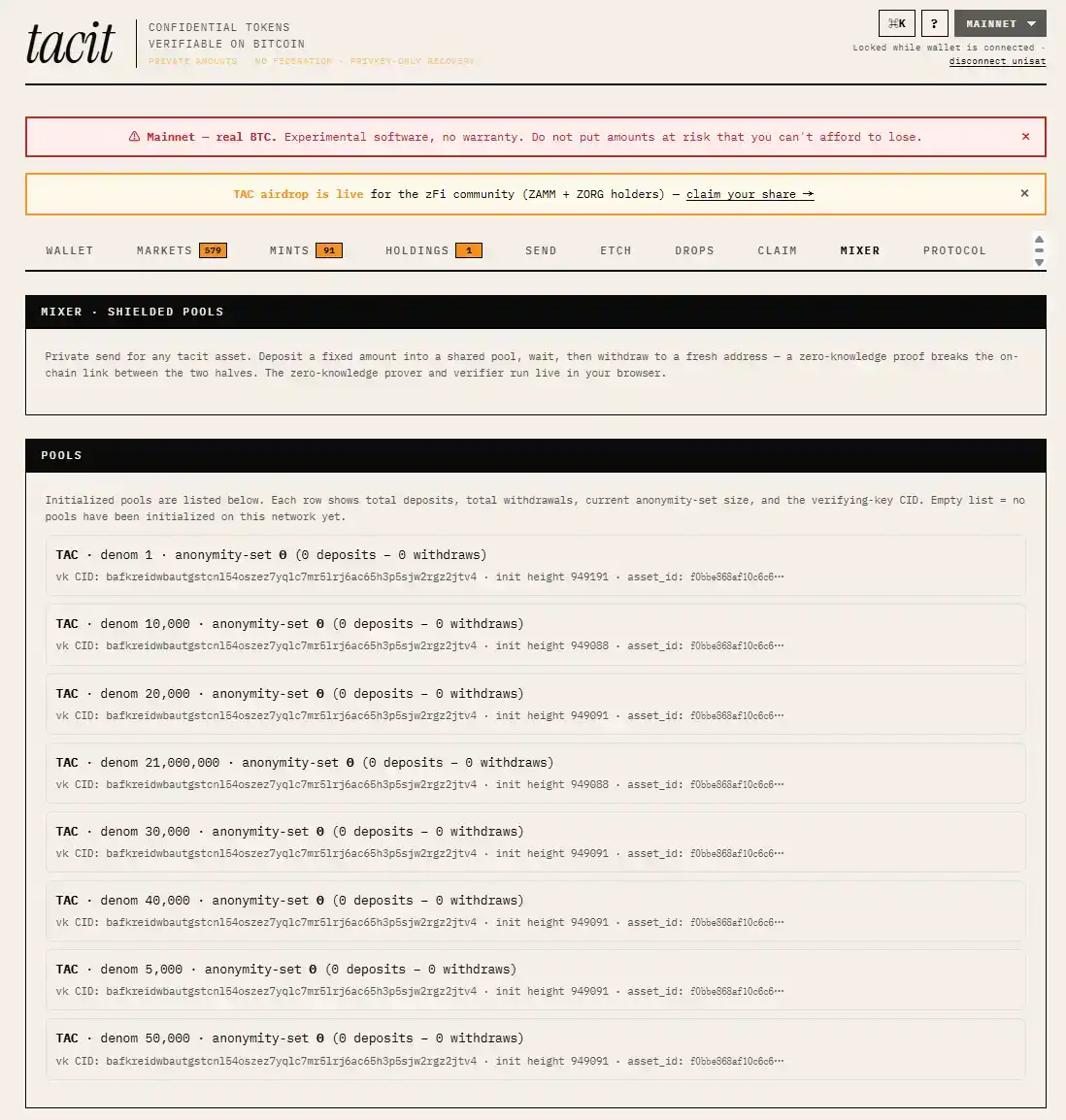
This mixer is somewhat similar to Tornado Cash—the more people deposit, the higher the privacy (harder to identify which addresses in the pool correspond). However, Tacit's mixer does not rely on smart contracts. It embeds the deposit proof in the Taproot transaction note, and the zero-knowledge proof for withdrawals is handled by the indexer in the browser.

It's even slightly stronger than Tornado Cash in some aspects because Tornado Cash cannot hide the amount being mixed. However, Tacit's mixer cannot mix native Bitcoin because hiding the mixing amount itself requires first wrapping the Bitcoin.

Of course, privacy comes at a cost. According to the GitHub documentation, due to the larger witness data required for hiding, the transfer cost corresponds to a mainnet fee rate of approximately 10 sat/vB, meaning each transfer costs about 25,000-30,000 sat, roughly 10 times the cost of a Runes transfer.

Who Built Tacit?

Developer ross.wei (@z0r0zzz) is a relatively well-known developer in the Ethereum ecosystem. He previously developed ZAMM, which uses a single contract for creating new tokens, managing LPs, farming, and swaps, significantly improving gas efficiency and user experience.

$ZAMM was also a notable project on Ethereum in the past, reaching a market cap in the tens of millions of dollars and receiving a retweet from crypto KOL Ansem.

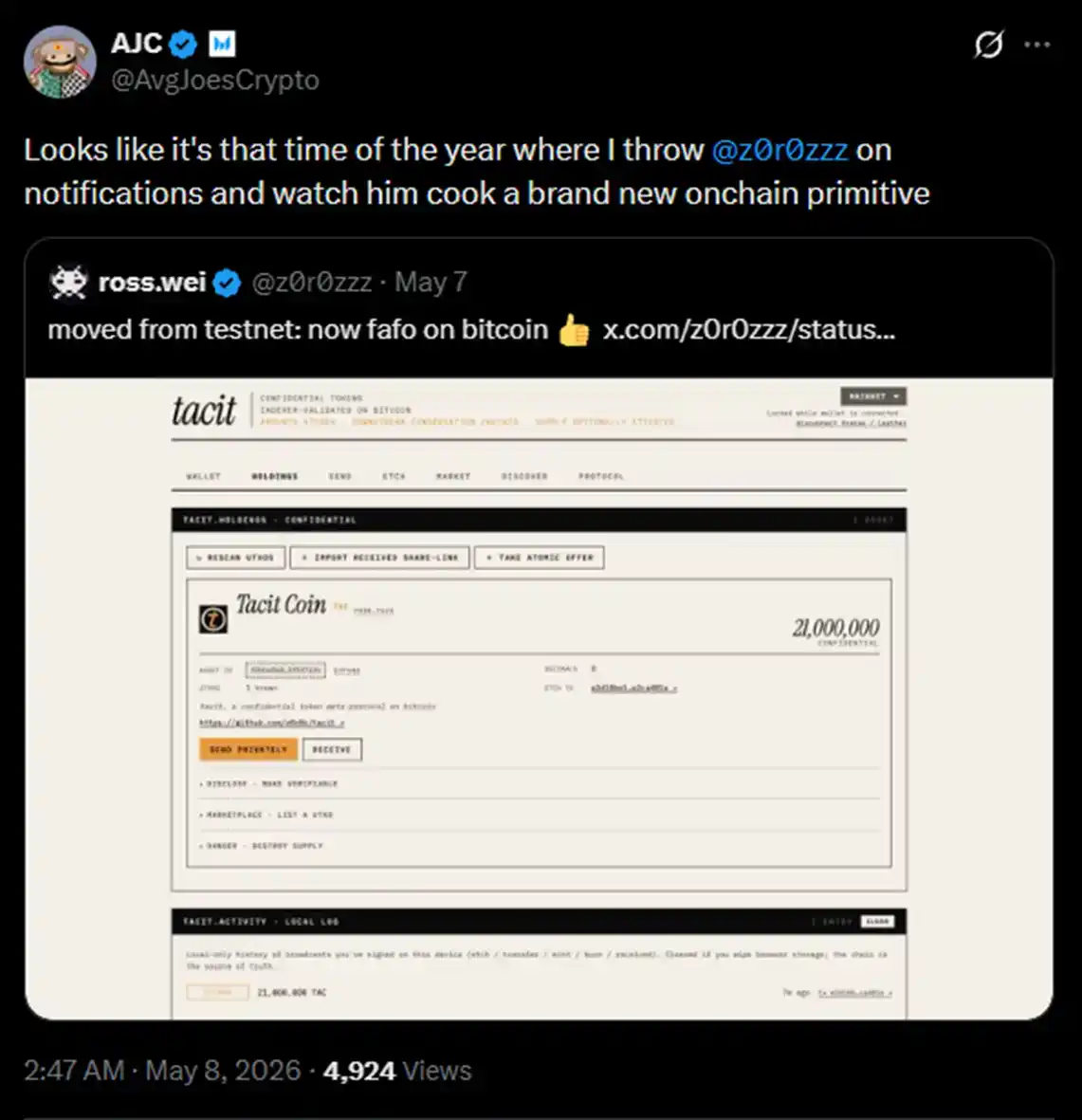
Tacit isn't something he suddenly created on a whim; he has been interested in Bitcoin technology for a while. This new protocol has also garnered attention from Messari Enterprise Research Manager @AvgJoesCrypto.
In the future, the author also plans to implement privacy-wrapped native Bitcoin (cBTC), silent receiving (generating a new one-time address for each receiving transaction), and hiding the type of currency being transferred.

Relevant Assets

Currently, the token with the highest trading volume is $TAC. This token was deployed by the protocol author himself and was airdropped not long ago based on holdings of the $ZORG staking token from the Ethereum-based $ZAMM. Its current market cap is approximately $4 million, making it the undisputed leader.

The first token launched via fair launch is $FAIR, though trading for this token is not yet available on the marketplace.

Conclusion

This is indeed an innovative Bitcoin asset protocol. Compared to BRC-20 and Runes, it has already implemented amount privacy and plans to achieve more. Compared to RGB, Taproot Assets, and Liquid CT, it doesn't rely on off-chain client-side proofs or exist as a sidechain; it operates entirely using on-chain data.

After repurposing its own protocol components to create a mixer, it has also addressed the hiding of the on-chain address graph.

Although the usage cost is relatively high, this is truly a refreshing and eye-catching innovation not seen in the Bitcoin ecosystem for a long time.


Domande pertinenti

QWhat is the main characteristic that differentiates the new Bitcoin asset protocol Tacit from protocols like BRC-20 and Runes?

ATacit is a privacy-focused Bitcoin asset protocol. Its primary differentiating characteristic is that it can hide the amount of tokens in transactions (including the total supply defined at deployment and the specific amount in each transfer), while protocols like BRC-20 and Runes have transparent ledgers. However, Tacit does not hide the direction of fund flows (i.e., the address graph).

QHow does Tacit achieve transaction amount privacy on the Bitcoin mainnet according to the article?

ATacit uses a combination of cryptographic techniques: Pedersen commitments and Bulletproofs to hide the transaction amount while proving to the network that no tokens are fraudulently created (e.g., proving amounts are non-negative and conserved). Mimblewimble-style signatures prove that the output amount equals the input amount, preventing malicious inflation. The actual amount information is encrypted using ECDH and written on-chain, decryptable only by the sender and receiver with their private keys.

QWho is the developer behind the Tacit protocol, and what is their background mentioned in the article?

AThe developer behind Tacit is ross.wei (@z0r0zzz). He is a well-known Ethereum developer who previously created ZAMM, a project that reached a multi-million dollar market cap and gained attention from crypto KOLs like Ansem. His interest in Bitcoin technology led to the development of Tacit.

QWhat is the current primary token associated with the Tacit protocol, and how was it distributed?

AThe primary token is $TAC. It was deployed by the protocol author and recently airdropped to holders of $ZORG, the staking token of the Ethereum-based $ZAMM project. Its current market capitalization is approximately $4 million.

QWhat are some of the planned future features for the Tacit protocol as mentioned in the article?

APlanned future features for Tacit include: privacy encapsulation for native Bitcoin (cBTC), silent receiving (generating a new one-time address for each incoming transaction), and hiding the type of token being transferred.

Letture associate

No Coding Required: Build Your First AI Agent in 2 Days (Complete Tutorial)

A No-Code Guide to Building Your First AI Agent in a Weekend This article presents a weekend, zero-code tutorial for beginners to build a functional AI Agent using tools like Claude. It clarifies the core difference between a chatbot, which responds to queries, and an Agent, which autonomously plans and executes multi-step tasks using tools to deliver a final result. The process is broken into four stages over two days: 1. **Saturday Morning: Understanding Agents.** Learn that an Agent requires a clear Goal, a Plan, necessary Tools, and an execution Loop. Identify a simple, multi-step task from your own work/life as your first project. 2. **Saturday Afternoon: Building with Claude.** Create a one-page "Agent Blueprint" answering: the Goal, sequential Steps, required Tools, the desired Output format, and error-handling rules. Implement this blueprint in Claude (Desktop Cowork or web Projects) and run the Agent for the first time. 3. **Sunday Morning: Debugging & Optimization.** Review the initial (often 60-70% accurate) output. Identify flaws, trace them back to vague instructions in your blueprint, and refine it with more specific criteria and error handling. Iterate this run-review-refine cycle 3-4 times to reach ~90% reliability. 4. **Sunday Afternoon: Expansion.** Apply the learned workflow to quickly build a second, different Agent (e.g., for research, content repurposing, or meeting prep), experiencing the compounding efficiency gains. The core skill is not writing a perfect blueprint initially, but rapidly iterating based on output. By the end of the weekend, you'll have built two usable Agents, moving beyond just chatting with AI to automating multi-step workflows, fundamentally changing how you approach repetitive tasks.

marsbit1 h fa

No Coding Required: Build Your First AI Agent in 2 Days (Complete Tutorial)

marsbit1 h fa

Trading

Spot
Futures

Articoli Popolari

Come comprare ZEC

Benvenuto in HTX.com! Abbiamo reso l'acquisto di Zcash (ZEC) semplice e conveniente. Segui la nostra guida passo passo per intraprendere il tuo viaggio nel mondo delle criptovalute.Step 1: Crea il tuo Account HTXUsa la tua email o numero di telefono per registrarti il tuo account gratuito su HTX. Vivi un'esperienza facile e sblocca tutte le funzionalità,Crea il mio accountStep 2: Vai in Acquista crypto e seleziona il tuo metodo di pagamentoCarta di credito/debito: utilizza la tua Visa o Mastercard per acquistare immediatamente ZcashZEC.Bilancio: Usa i fondi dal bilancio del tuo account HTX per fare trading senza problemi.Terze parti: abbiamo aggiunto metodi di pagamento molto utilizzati come Google Pay e Apple Pay per maggiore comodità.P2P: Fai trading direttamente con altri utenti HTX.Over-the-Counter (OTC): Offriamo servizi su misura e tassi di cambio competitivi per i trader.Step 3: Conserva Zcash (ZEC)Dopo aver acquistato Zcash (ZEC), conserva nel tuo account HTX. In alternativa, puoi inviare tramite trasferimento blockchain o scambiare per altre criptovalute.Step 4: Scambia Zcash (ZEC)Scambia facilmente Zcash (ZEC) nel mercato spot di HTX. Accedi al tuo account, seleziona la tua coppia di trading, esegui le tue operazioni e monitora in tempo reale. Offriamo un'esperienza user-friendly sia per chi ha appena iniziato che per i trader più esperti.

248 Totale visualizzazioniPubblicato il 2024.12.12Aggiornato il 2025.03.21

Come comprare ZEC

Discussioni

Benvenuto nella Community HTX. Qui puoi rimanere informato sugli ultimi sviluppi della piattaforma e accedere ad approfondimenti esperti sul mercato. Le opinioni degli utenti sul prezzo di ZEC ZEC sono presentate come di seguito.

活动图片