New DePIN protocol rolls out ZK-Proof processing marketplace

cointelegraphPubblicato 2025-12-08Pubblicato ultima volta 2025-12-08

Introduzione

Brevis has launched ProverNet, a decentralized physical infrastructure (DePIN) marketplace for zero-knowledge proof (ZK-proof) computation. The platform enables users to earn by providing proving capacity and allows applications to access scalable ZK-proof processing. Initially using USDC for settlements, the network plans to transition to its native BREV token upon mainnet launch, which will also introduce staking and slashing mechanisms for provers. ProverNet addresses the computationally intensive nature of ZK-proof generation by distributing tasks through continuous auctions and job matching. Brevis, already an established player, has processed over 250 million proofs for partners like Uniswap, PancakeSwap, and MetaMask. The system is designed to handle variable workloads, offering flexibility and avoiding vendor lock-in. Production workloads, including Ethereum block execution proofs from ETHProofs, are already being migrated to the new network.

零知识证明(ZK-Proof)协处理器Brevis推出其市场平台,允许用户通过计算ZK证明获得收益。

根据Brevis周一的公告,该"ProverNet"去中心化物理基础设施(DePIN)网络允许应用程序访问ZK证明验证能力,同时让计算提供商通过计算证明获利。目前该网络使用Circle的USDC稳定币作为原生结算货币。

不过Brevis计划在ProverNet结束测试阶段并启动主网时,转向尚未发行的BREV代币。在主网上线后,系统还将引入证明者质押机制,并对"不当行为或超时未完成"实施罚没惩罚。

目前ProverNet支持通过持续竞价分配证明任务、USDC支付结算以及证明者注册和任务匹配。证明者现已可以注册并开始竞标任务,应用程序也可以直接向网络提交证明请求。
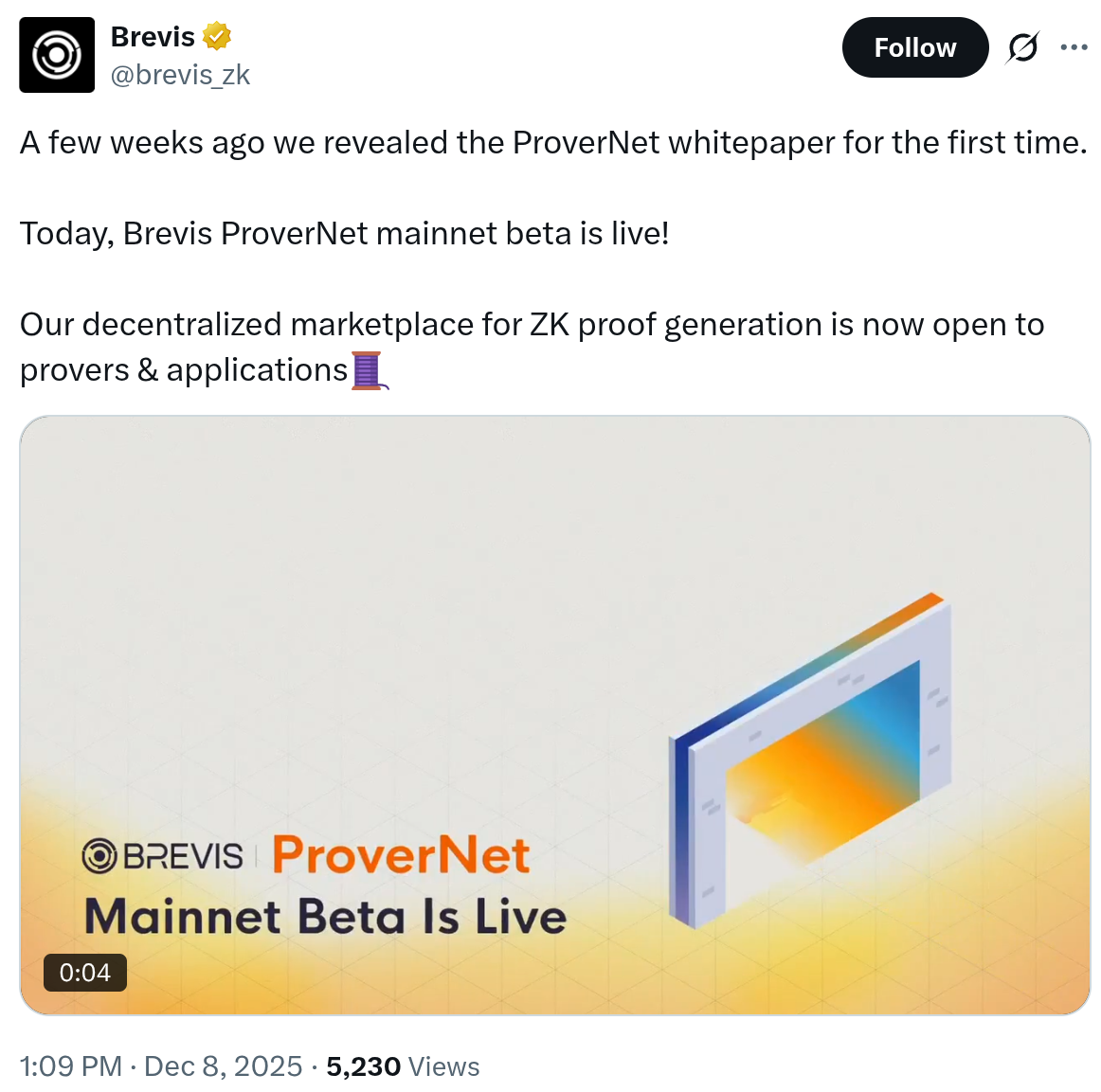
来源:Brevis

相关阅读:ZK证明可以在不透露年龄的情况下验证用户是否成年

行业老将

计算ZK证明需要大量计算资源,这意味着开发人员或用户自行计算通常不切实际。在某些需要大量证明的项目中,这种情况尤为明显。

Brevis长期为行业提供ZK证明处理解决方案。该公司在2023年底宣布支持Uniswap v4钩子功能,可无需信任地读取和计算流动性提供者及交易者的交易历史。

去年10月,去中心化交易所Uniswap基于其技术推出路由返利计划,并宣布Brevis获得资助开发该功能。今年早些时候,Brevis还公布了"MetaMask、Linea和Brevis之间的合作,为MetaMask Card用户提供ZK证明驱动的奖励功能"。

PancakeSwap也集成了Brevis的ZK证明处理功能。在2024年获得币安投资后,该技术还被用于驱动BNB链上无需信任的跨链再质押基础设施。

Brevis声称已为30多个合作伙伴处理超过2.5亿次证明。该组织解释说,他们发现ZK证明的工作负载变化很大,因此开发了ProverNet来提供足够的灵活性:

"从此,应用程序可以获得专用计算能力而无需被供应商绑定,证明者也能找到与其硬件匹配的工作负载。生态系统将形成共享基础设施而非 fragmented silos"。

相关阅读:以太坊首个ZK-rollup项目ZKsync Lite将于2026年停服

首日即投入使用的DePIN

Brevis在公告中还提到,正在"逐步将生产工作负载迁移至ProverNet"。目前正在迁移"ETHProofs的部分以太坊区块执行证明功能"。

ETHPoofs是一项面向公众的服务,用于生成以太坊区块执行的ZK证明——验证特定区块包含的内容。除其他应用外,这使得跨链验证能够实现最小化信任的桥接。

杂志专题:当隐私与反洗钱法规冲突:加密项目的两难抉择

Domande pertinenti

QWhat is the main purpose of Brevis' newly launched ProverNet marketplace?

AThe main purpose of ProverNet is to create a marketplace where applications can access ZK-Proof proving capacity and computing providers can earn money by computing ZK-proofs.

QWhat cryptocurrency is currently used as the native settlement currency on ProverNet, and what is the planned future token?

ACircle's USDC stablecoin is currently used as the native settlement currency. Brevis plans to transition to its own BREV token once ProverNet exits beta and launches its mainnet.

QWhat problem does Brevis aim to solve with its ZK-proof processing service?

ABrevis aims to solve the problem that computing ZK-proofs is computationally intensive and often impractical for individual developers or users, especially when large volumes of proofs are needed for various applications.

QName two major DeFi projects that have integrated Brevis' infrastructure for ZK-proof processing.

ATwo major DeFi projects that have integrated Brevis are Uniswap, for its routing rebate program and v4 hooks, and PancakeSwap.

QWhat existing Brevis service is being partially migrated to ProverNet to provide initial usage?

ABrevis is gradually migrating a subset of Ethereum block execution proving from its existing public service, ETHProofs, to ProverNet.

Letture associate

How Much Debt Does Strategy Really Have? Is There a Risk of Implosion?

MicroStrategy's Debt Risk: A Turning Point in the "Never Sell" Strategy As of June 3, 2026, MicroStrategy holds 843,706 bitcoins (valued at ~$53.1B) but faces significant financial obligations. Its capital structure includes $6.75B in convertible notes and $15.48B in perpetual preferred stock (led by the $8.5B STRC series), creating an annual payout burden of ~$1.71B. With software revenue at only ~$500M, interest and dividend obligations far exceed operating income. A critical shift occurred in late May 2026 when the company sold 32 bitcoins for ~$2.5M to cover dividends, breaking CEO Michael Saylor's long-standing "never sell" pledge. This symbolic move triggered a sharp decline in both Bitcoin's price and MSTR stock, reflecting market fears about cash flow sustainability. The core of the strain is the STRC perpetual preferred stock, designed as a "permanent loan" with no maturity date but requiring high monthly dividends (currently 11.5%). Its business model relies on a three-part cycle: issuing new STRC shares, using proceeds to buy more Bitcoin and fund a USD reserve, and using that reserve to pay dividends. This cycle depends on continuous investor demand for STRC and Bitcoin's price appreciation. Analysis shows Bitcoin needs to appreciate at least 2.3% annually to cover the $1.71B in yearly obligations at current holdings. With Bitcoin price down ~22% from March 2026 highs, this pressure has intensified. The company's $900M USD reserve can only cover about 7 months of payments if STRC issuance stalls. Key risks are not immediate bankruptcy or forced Bitcoin liquidation (as BTC is not collateral), but rather: 1) The erosion of MSTR's premium to its Bitcoin holdings (mNAV), which would cripple its ability to raise cheap capital; 2) A vicious cycle where stagnant Bitcoin prices reduce STRC demand, draining the USD reserve and forcing BTC sales, further depressing prices. The period from February 2027 to September 2028 is a crucial test, with over $5.9B in convertible notes facing put options or maturity. In essence, MicroStrategy has evolved from a simple Bitcoin holder into a complex financial entity acting like a "private Bitcoin bank," leveraging its BTC holdings to create layered financial products. Its survival depends on maintaining Bitcoin's price trend, its stock premium, and market appetite for its preferred shares. The recent token sale marks not a betrayal of its Bitcoin thesis, but an admission that the leveraged strategy must eventually be paid for.

marsbit8 min fa

How Much Debt Does Strategy Really Have? Is There a Risk of Implosion?

marsbit8 min fa

Anthropic Cries Wolf: Is the AGI Threat Real, or Just an IPO Story?

Anthropic has published an article titled "When AI builds itself," discussing the emerging concept of "recursive self-improvement," where AI begins to actively participate in designing, training, testing, and optimizing its own subsequent versions. The company presents internal data showing that by May 2026, over 80% of code merged into its codebase was written by Claude, its AI model. Claude's capabilities have expanded to handling complex, open-ended engineering tasks, achieving a 76% success rate in such areas, and even contributing to research processes, such as optimizing code performance and conducting AI safety experiments. Anthropic outlines an evolution from human-driven development to AI-assisted workflows, culminating in the current stage where AI agents can autonomously write, run, and delegate code. The company cautions that the path toward a "closed loop," where AI continuously improves itself, is becoming visible. It calls for coordinated global mechanisms to potentially slow or pause frontier AI development to allow safety research and societal structures to catch up. However, the timing of this warning coincides with Anthropic's preparations for an IPO, framing the narrative not just as a safety concern but also as a demonstration of Claude's advanced capabilities and its integral role in accelerating Anthropic's own R&D—creating a potential "flywheel" effect for competitive advantage. This contrasts with OpenAI's recent, more policy-oriented discussion of the same risks, highlighting the competitive dynamics in the AI industry as companies position themselves in both the technological and regulatory landscape.

marsbit1 h fa

Anthropic Cries Wolf: Is the AGI Threat Real, or Just an IPO Story?

marsbit1 h fa

BIT Research: ETF Purchases Have Slowed, Strategy (MicroStrategy) Has Slowed, What Else Can Drive Bitcoin's Rise?

Market Refocus on Inflation and Rate Expectations Weighs on Bitcoin Currently, the market is in a phase of macro-repricing dominated by inflation and interest rate expectations. Bitcoin, which previously benefited from easy liquidity and low inflation, is seeing its core bullish drivers weaken. These drivers were market expectations for interest rate cuts and strong inflows from Bitcoin ETFs and institutions like MicroStrategy (referred to as "Strategy" in the text). The logic has shifted. Recent high inflation data (e.g., CPI hitting 3.8% in a May 2026 report) has caused the market to sharply reduce its rate cut expectations for 2025 and even price in potential hikes. This is a key constraint for Bitcoin, as it lacks cash flows and is highly sensitive to rate expectations. Concurrently, institutional capital flows have slowed significantly. Following the hot CPI data, Bitcoin ETFs saw accelerated outflows, with around $4.3 billion leaving over a period. MicroStrategy's ability to keep adding substantial Bitcoin to its balance sheet is also diminishing. Together, ETF and MicroStrategy holdings total roughly $110 billion, but their momentum as growth engines is cooling. In summary, Bitcoin's current pressure stems not from its own fundamentals but from a changing macro environment. As long as inflation stays elevated, Bitcoin is likely to remain in a consolidating phase. However, historically, inflation eventually peaks. Once it recedes and rate cut expectations rebuild, institutional capital could return, potentially fueling a new and more robust recovery phase for Bitcoin.

marsbit1 h fa

BIT Research: ETF Purchases Have Slowed, Strategy (MicroStrategy) Has Slowed, What Else Can Drive Bitcoin's Rise?

marsbit1 h fa

Trading

Spot
Futures

Articoli Popolari

Come comprare ZK

Benvenuto in HTX.com! Abbiamo reso l'acquisto di ZKsync (ZK) semplice e conveniente. Segui la nostra guida passo passo per intraprendere il tuo viaggio nel mondo delle criptovalute.Step 1: Crea il tuo Account HTXUsa la tua email o numero di telefono per registrarti il tuo account gratuito su HTX. Vivi un'esperienza facile e sblocca tutte le funzionalità,Crea il mio accountStep 2: Vai in Acquista crypto e seleziona il tuo metodo di pagamentoCarta di credito/debito: utilizza la tua Visa o Mastercard per acquistare immediatamente ZKsyncZK.Bilancio: Usa i fondi dal bilancio del tuo account HTX per fare trading senza problemi.Terze parti: abbiamo aggiunto metodi di pagamento molto utilizzati come Google Pay e Apple Pay per maggiore comodità.P2P: Fai trading direttamente con altri utenti HTX.Over-the-Counter (OTC): Offriamo servizi su misura e tassi di cambio competitivi per i trader.Step 3: Conserva ZKsync (ZK)Dopo aver acquistato ZKsync (ZK), conserva nel tuo account HTX. In alternativa, puoi inviare tramite trasferimento blockchain o scambiare per altre criptovalute.Step 4: Scambia ZKsync (ZK)Scambia facilmente ZKsync (ZK) nel mercato spot di HTX. Accedi al tuo account, seleziona la tua coppia di trading, esegui le tue operazioni e monitora in tempo reale. Offriamo un'esperienza user-friendly sia per chi ha appena iniziato che per i trader più esperti.

190 Totale visualizzazioniPubblicato il 2024.12.13Aggiornato il 2026.06.02

Come comprare ZK

Discussioni

Benvenuto nella Community HTX. Qui puoi rimanere informato sugli ultimi sviluppi della piattaforma e accedere ad approfondimenti esperti sul mercato. Le opinioni degli utenti sul prezzo di ZK ZK sono presentate come di seguito.

活动图片