Naval Steps Into the Arena: A Historic Collision Between Ordinary People and Venture Capital

marsbitPubblicato 2026-04-25Pubblicato ultima volta 2026-04-25

Introduzione

Naval Ravikant, co-founder of AngelList and a prominent Silicon Valley thinker, has taken a hands-on role as the chairman of the investment committee at USVC—a new SEC-registered fund allowing non-accredited investors to access high-growth private tech companies with a minimum investment of $500. The fund’s initial portfolio includes leading AI firms like OpenAI, Anthropic, xAI, and others. This move represents a significant shift in democratizing access to venture capital, a space traditionally dominated by institutional investors and high-net-worth individuals. USVC aims to let ordinary investors participate in the high-alpha, pre-IPO growth phase of tech companies—a stage where much of the value creation now occurs before public listings. However, the fund is not without complexities. It offers limited liquidity, with potential quarterly redemptions capped at 5%, and charges an all-in fee of 2.5% in its first year. While this is higher than traditional ETFs, it is positioned as a more accessible alternative to conventional VC fee structures. Ultimately, USVC symbolizes a broader movement toward financial inclusion in high-stakes tech investing—not through crypto or Web3 mechanisms, but via regulated, retail-friendly investment vehicles. It offers a ticket to early-stage innovation, though risks typical of venture capital remain.

Author: 0xMedia

Naval is stepping into the arena.

This time, he's not just discussing wealth, freedom, and leverage on a podcast, nor is he commenting on startup trends as a Silicon Valley thinker and angel investor. Instead, he is directly taking on the role of Chairman of the Investment Committee at USVC.
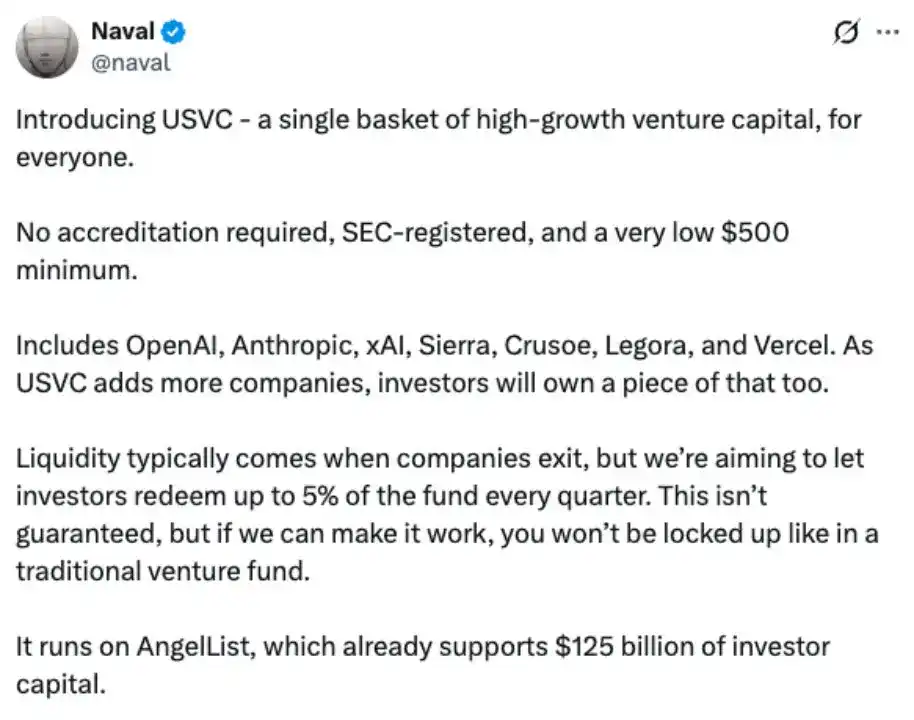
This signal itself is very telling. Naval is not someone who would easily endorse a financial product. His persona is complex: co-founder of @AngelList, a representative figure of early-stage investment culture, an evangelist for the Silicon Valley entrepreneurial spirit, and a long-standing intellectual symbol in the Web3 world.

So when Naval @naval chooses to step into the forefront for USVC, it's not just about the launch of a new fund. It seems more like a retail extension of AngelList's over-a-decade-long infrastructure for startup financing.

In the past, AngelList served entrepreneurs, angel investors, fund managers, and private capital networks. Now, it is attempting to break down a portion of the access to venture capital, once reserved for a select few, into a gateway that ordinary people can also participate in.

USVC is an SEC-registered fund with a minimum investment of $500, requiring no accredited investor status. Its early portfolio includes companies like OpenAI, Anthropic, xAI, Sierra, Crusoe, Legora, and Vercel.
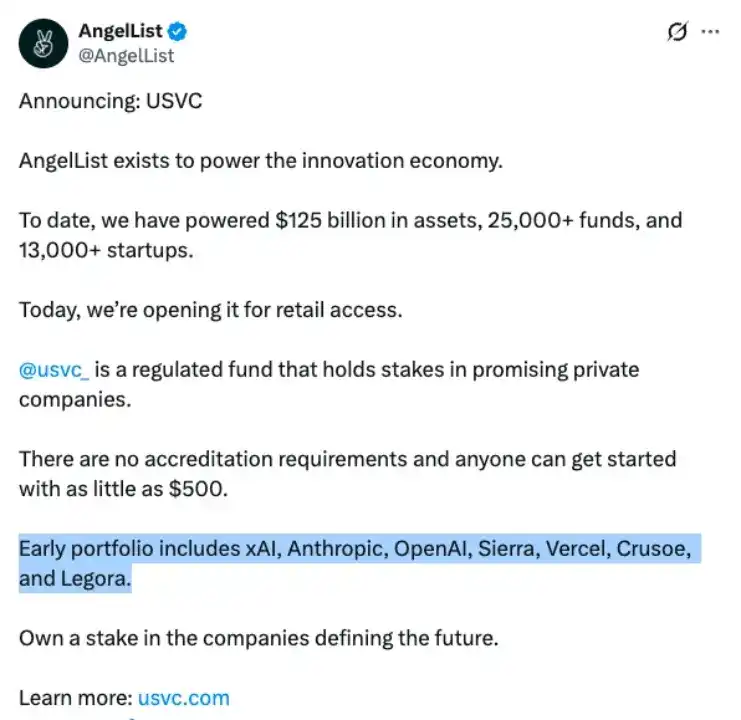
This is the real point of discussion that USVC provokes. It's not simply selling a basket of AI star companies; it's responding to an increasingly尖锐的时代问题: when the most explosive tech growth happens earlier and earlier in the private markets, can ordinary people still participate in the future sooner?

Over the past decade, the most brutal change in tech investing hasn't been the AI explosion, nor the revaluation of SaaS or chip stocks, but the overall forward shift of the wealth creation timeline.

Many of the most important companies complete multiple rounds of massive funding and value leaps long before entering the public markets. By the time ordinary investors can finally buy in through an IPO or the secondary market, the story has often been told many times over, valuations have been fully priced by earlier rounds of capital, and the truly asymmetric alpha has already been captured upfront by private capital.

For example, as we all know, Benchmark merely led a $75 million funding round in April 2025 for Manus, securing a position in this AI Agent newcomer's most critical growth window.

At that time, Manus @ManusAI was valued at around $500 million, and just months later, Meta acquired it for over $2 billion, delivering early capital an approximate 4x paper return in a very short time.

This is the most alluring aspect of venture capital. The real alpha often occurs when ordinary people don't yet have the qualifications to enter.

Names like OpenAI, Anthropic, xAI, and Vercel are exciting not just because they represent AI, large models, developer tools, and next-generation software infrastructure, but because they symbolize a fact: the future is being bought earlier and earlier.

Ordinary people use these products daily, contributing data, attention, subscription revenue, and ecosystem growth, but at the capital level, they often can only stand outside the glass window, watching institutions, funds, and high-net-worth investors participate in the value revaluation.

It is precisely this glass pane that USVC is attempting to shatter.

The entry point it offers is very direct: ordinary people can participate with a minimum of $500 in a venture capital basket composed of high-growth private tech companies. This threshold, placed alongside the names of these assets, creates a stark contrast.
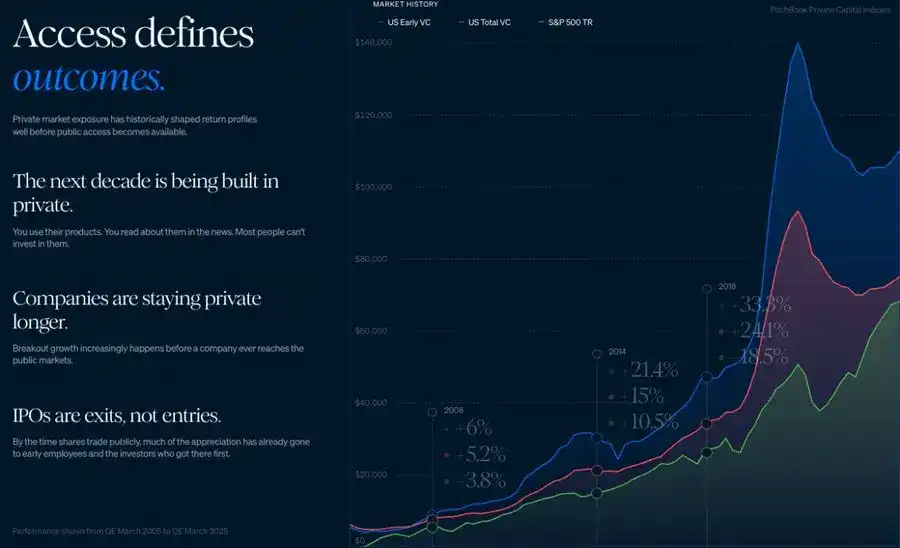
* US Early VC vs. S&P 500 returns, from USVC website https://usvc.com/

In the past, those who could access such assets were typically top VCs, family offices, sovereign wealth funds, university endowments, or accredited high-net-worth investors. Now, USVC is attempting to productize,合规化, and retail this asset exposure, placing it before ordinary investors.

But precisely because of this, USVC cannot be understood merely as an emotional product of "$500 to buy OpenAI." The真正复杂的地方在于, venture capital is never just about buying the name of a good company, but about the price, stage, structure, fees, and liquidity terms at which one buys.

OpenAI, Anthropic, and xAI are certainly the most watched tech companies of this era, but a great company does not automatically equate to a great investment. Especially after they have undergone multiple rounds of high-valuation funding, what investors真正需要判断 is not whether these companies are strong enough, but whether the future returns through USVC still possess sufficient吸引力.

This is also why Naval's involvement is crucial. Naval's symbolic significance is not just his influence, but that he represents a long-term understanding of entrepreneurship, capital, networks, and leverage.
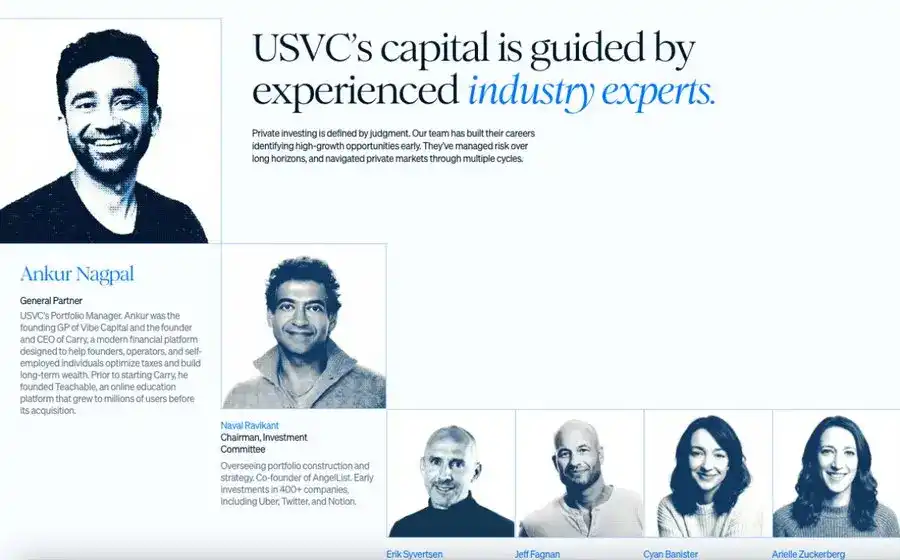
One of the most important things AngelList did back in the day was to partially loosen startup financing from extremely closed circles, allowing more angel investors, entrepreneurs, and new fund managers to connect through the platform.

What USVC is doing today is, in a sense, a continuation of the same logic: if AngelList once reduced the organizational cost of the startup financing network, then USVC is now attempting to lower the barrier to entry for ordinary people to access venture capital assets.

However, the expansion of access does not mean the disappearance of risk.

USVC is not an ETF. It cannot be traded intraday like a Nasdaq ETF, nor can it be bought and sold at any time like public stocks. Its underlying assets are private companies and private fund shares, inherently characterized by low liquidity, opaque valuation, and long exit cycles.

The team mentions hoping to achieve up to 5% fund redemptions quarterly in the future, but this does not mean investors can exit at any time. More accurately, this is a designed partial liquidity, not the天然具备的高流动性 of the underlying assets.

The fee issue同样不能回避. USVC's current all-in fee for the first year is 2.5%. At first glance, this number is certainly high compared to S&P 500 ETFs, Nasdaq ETFs, or other low-cost index products.

But if compared within the traditional venture capital system, the situation becomes much more complex. The common fee structure for traditional VCs is 2/20, meaning a 2% annual management fee plus a 20% performance fee (carried interest).

If investing indirectly through a fund of funds, an additional layer of fees might be stacked on top of the underlying VC fees. USVC's proposition is that the current 2.5% includes fees related to the underlying funds, with AngelList absorbing costs exceeding that比例 in the first year, and USVC charging no additional fees for direct investments.

If it were merely repackaging already very expensive late-stage star assets for retail investors, then 2.5% would be hard to call cheap. But if it can consistently secure truly scarce, completely inaccessible-to-ordinary-people, and still attractively valued优质私募资产 through the AngelList and Naval network, then this fee更像是一种进入风险资本网络的通行成本.

In other words, the greatest value of USVC lies not in being cheap, but in whether it can持续提供真实的、稀缺的、值得付费的风投权限.

This is also where USVC subtly intersects with the Web3 narrative.

Over the past few years, Web3 has been talking about financial inclusion. DeFi allows ordinary people to lend, trade, market-make, and participate in yield strategies on-chain; RWA attempts to bring real-world assets on-chain; stablecoins have made dollar payments globalized, low-friction, and real-time.

But USVC is taking a different path. It hasn't used tokens to achieve asset openness, nor has it used on-chain mechanisms to provide liquidity. Instead, through an SEC-registered fund, NAV, an investment committee, the AngelList network, and compliant distribution channels, it is bringing exposure to previously closed private tech assets before ordinary investors.

The paths are different, but the underlying question is similar: Who is qualified to own the future? USVC might not be a ticket to guaranteed returns, but rather a ticket to get closer to the future, sooner. DYOR.


Crypto di tendenza

Domande pertinenti

QWhat is the significance of Naval Ravikant's role as the Investment Committee Chair at USVC?

ANaval Ravikant's involvement is significant because he is a respected Silicon Valley thinker, co-founder of AngelList, and a symbol of early investment culture. His endorsement signals that USVC is not just another financial product but a serious attempt to democratize access to high-growth private tech investments, extending AngelList's mission of making venture capital more accessible.

QHow does USVC aim to change普通人's access to venture capital investments?

AUSVC aims to democratize access by offering an SEC-registered fund with a minimum investment of $500, open to non-accredited investors. It provides exposure to a basket of high-growth private tech companies like OpenAI, Anthropic, and xAI, which were previously only available to institutional investors, VCs, or high-net-worth individuals.

QWhat are some key risks associated with investing in USVC?

AKey risks include low liquidity (as the fund holds private company shares and私募基金份额, with limited quarterly redemptions), valuation opacity, long investment horizons, and fees (an all-in fee of 2.5% annually). Unlike public ETFs, it lacks daily tradability and transparency in pricing.

QHow does USVC's fee structure compare to traditional venture capital funds?

AUSVC charges an all-in fee of 2.5% annually, which includes underlying fund fees. This is lower than the traditional VC '2 and 20' model (2% management fee plus 20% performance fee). However, it is higher than low-cost public market ETFs, and its value depends on USVC's ability to source稀缺, high-quality private assets at attractive valuations.

QWhat is the broader implication of USVC in the context of financial democratization and Web3 narratives?

AUSVC represents an alternative path to financial democratization, contrasting with Web3's use of tokens and DeFi for open access. It uses SEC-regulated funds and traditional structures to provide retail investors with exposure to private tech assets. This addresses the core issue of who gets to participate in early-stage wealth creation from high-growth companies before they go public.

Letture associate

Senior Trader's Confession: How to Trade Market's False Expectations?

Veteran trader's case study: trading the market's "wrong expectations". This trade centered on a textbook "expectation error" after a weak CPI report. While the market initially priced in broad monetary easing (sending Nasdaq to 30,060), the crucial 30-year real yield hit a 20-year high. This signaled a fractured transmission mechanism: short-term rates eased, but long-term funding costs (vital for tech valuations) refused to fall. The trader executed five short positions on the Nasdaq (NQ) as it fell from 30,060 to 28,768. The core methodology: don't just trade the data, but analyze the market's implied causal chain and identify where it breaks. In this case, the chain was: Weak CPI → Policy Easing → Lower Long-Term Funding Costs → NQ Valuation Expansion. The break occurred between policy easing and long-term rates. The "veto variable" – long-term real yields – refused to confirm the bullish narrative. Trades were structured around "fast variables" (price) temporarily repairing while "slow variables" (funding conditions) remained broken. The article outlines a repeatable framework: 1) Map the market's implied causal chain. 2) Identify the veto variable. 3) Observe if it rejects the narrative. 4) Enter when price still follows the old script. 5) Choose the cleanest asset expression (e.g., short NQ, not broad S&P). 6) Define both invalidation and fulfillment exit conditions. The key insight: Alpha often comes not from an information edge, but from a "reaction function edge" – recognizing when the market is applying an outdated causal logic to new data. The critical question: What causal chain is the market's first reaction relying on, and is that chain still valid today?

marsbit19 min fa

Senior Trader's Confession: How to Trade Market's False Expectations?

marsbit19 min fa

Opinion: The Hedging Relationship Between U.S. Treasuries and Stocks Has Broken Down, and BTC, as a Risk Asset, Is Under Dual Pressure

For the past 20 years, U.S. investors relied on a free insurance policy: when stocks fell, bonds rose, cushioning portfolio losses. This reliable inverse correlation underpinned entire financial strategies. However, this mechanism broke down around 2020 and has not recovered. Currently, the two-month rolling correlation between the S&P 500 and 10-year Treasury yields is at -0.69, its lowest level since 1996, indicating stocks and bonds are moving in sync to an unprecedented degree, eliminating the traditional portfolio shock absorber. The失效 of this hedge is not simply due to lost confidence in U.S. debt. The key driver is the shift from growth-dominated to inflation-dominated market narratives. When growth fears prevail, stocks and bonds move inversely. Since 2022, persistent inflation volatility has been the dominant factor, causing both asset classes to suffer simultaneously from higher inflation expectations. Investors now seek safety without duration risk, favoring cash, dollars, and short-term Treasuries while selling long-duration bonds. Record U.S. deficits, rising net interest payments, and waning foreign demand (e.g., from Japan) are pressuring long-term yields, with the 30-year yield surpassing 5%. This environment places Bitcoin, as a risk asset on the far end of the risk curve, under dual pressure. Higher risk-free rates increase the opportunity cost of holding non-yielding assets like Bitcoin, while falling equities reduce overall risk appetite. Bitcoin's performance has become highly sensitive to macro conditions such as real yields, dollar strength, and financial conditions. While its long-term thesis as a fixed-supply asset outside the sovereign credit system is strengthened by these fiscal trends, the same conditions hurt it in the short term. The return of bonds as a effective hedge requires inflation volatility to subside, growth risks to retake dominance, and the Fed to have room to ease policy. Until then, Bitcoin trades in a market where the deepest asset class no longer absorbs shocks, removing the safety floor for all risk assets, especially those that pay nothing to wait.

marsbit19 min fa

Opinion: The Hedging Relationship Between U.S. Treasuries and Stocks Has Broken Down, and BTC, as a Risk Asset, Is Under Dual Pressure

marsbit19 min fa

Funding Weekly | Crypto.com Secures $400M Investment, CeFi and Stablecoin Sectors Continue to Attract Capital

Crypto Weekly Investment Recap: Funds Converge on CeFi, Stablecoins, and AI Last week's crypto and AI investment landscape saw significant capital concentration, with a few large deals dominating. **Crypto/Web3 Highlights (July 13-19):** Total investment exceeded **$812 million** across 17 deals. Key trends: * **Centralized Finance (CeFi) & Stablecoins** remained a major magnet, led by **Crypto.com**'s massive **$400 million** raise from Citadel Securities, valuing the exchange at $20B. * **Infrastructure & Tools** saw 7 deals, including **Cyclops** ($20M for stablecoin payments) and **ADI Chain** ($50M for stablecoin settlement infrastructure). * **DeFi** had 2 deals, such as AI-native DEX **Quote Trade** ($4M). * Other notable raises: API broker **Alpaca** ($135M), cross-border platform **Flex** ($70M), treasury firm **ORANGE JUICE** ($40M), and prediction market **Pascal** ($9M). * **Acquisitions:** Keyrock bought BlockFills' trading unit, SBI Holdings acquired Singapore exchange Coinhako, and MoonPay bought startup Glide. **AI & Robotics Highlights:** Investment momentum in AI remained very strong. * Nvidia-backed AI cloud service **Fireworks** raised a massive **$1.5 billion** at a $17.5B valuation. * In robotics, **Walden Robotics** (spun out from Toyota) secured **$300 million**, and Chinese humanoid firm ****逐际动力** **(Climax Dynamics) raised nearly **$200 million** in a Pre-IPO round. * Other significant AI raises included Indian programming platform **Emergent** ($130M) and drone company **Brinc** ($125M), backed by Sam Altman. Overall, the trend shows capital flowing heavily into established crypto financial services, stablecoin infrastructure, and large-scale AI/robotics commercialization.

marsbit1 h fa

Funding Weekly | Crypto.com Secures $400M Investment, CeFi and Stablecoin Sectors Continue to Attract Capital

marsbit1 h fa

The Gentlest Bear Market? BTC Bears Exit, ARK and Bitwise Collectively Bullish

**Title: The Mildest Bear Market? BTC Shorts Exit, ARK and Bitwise Collectively Bullish** Bitcoin continues to consolidate around $75,000 while Ethereum struggles near $1,900. Market data shows $116 million in liquidations over 24 hours, with $62.7 million from short positions, and the Fear & Greed Index remains at 35 (Fear). According to Polymarket, there's a 33% probability BTC falls below $50,000 this year. ARK Invest's Q2 2026 Bitcoin report notes technical weakness but identifies potential bottoming signals, including a record high in long-term holder supply, suggesting selling exhaustion. Bitwise's Juan Leon calls this the "structurally mildest bear market" on record, with a ~50% drawdown from highs, less severe than past cycles. He highlights institutional accumulation and a shift in investor dialogue from survival to entry points. Technical analysis from Bit suggests a potential C-wave low may have formed, with an ideal bottoming range between $50,000-$55,000. However, glassnode's CryptoVizArt warns that failure to break $66,000 could signal a local top, as new buyer accumulation is concentrated there. Analyst Darkfost identifies a critical support band between $59,000-$70,000, where 50% of BTC's circulating supply has changed hands. Notably, trader Doctor Profit announced closing all crypto short positions—including BTC shorts from $115k-$125k and over 100 altcoin shorts—for significant profit. He has begun a phased accumulation of Bitcoin spot starting at $64,000, reversing his previous $40k-$50k target, citing structural positives like regulatory clarity and institutional adoption. He argues the anticipated September/October bottom may arrive earlier than the herd expects.

Foresight News2 h fa

The Gentlest Bear Market? BTC Bears Exit, ARK and Bitwise Collectively Bullish

Foresight News2 h fa

Trading

Spot

Articoli Popolari

Come comprare PEOPLE

Benvenuto in HTX.com! Abbiamo reso l'acquisto di ConstitutionDAO (PEOPLE) semplice e conveniente. Segui la nostra guida passo passo per intraprendere il tuo viaggio nel mondo delle criptovalute.Step 1: Crea il tuo Account HTXUsa la tua email o numero di telefono per registrarti il tuo account gratuito su HTX. Vivi un'esperienza facile e sblocca tutte le funzionalità,Crea il mio accountStep 2: Vai in Acquista crypto e seleziona il tuo metodo di pagamentoCarta di credito/debito: utilizza la tua Visa o Mastercard per acquistare immediatamente ConstitutionDAOPEOPLE.Bilancio: Usa i fondi dal bilancio del tuo account HTX per fare trading senza problemi.Terze parti: abbiamo aggiunto metodi di pagamento molto utilizzati come Google Pay e Apple Pay per maggiore comodità.P2P: Fai trading direttamente con altri utenti HTX.Over-the-Counter (OTC): Offriamo servizi su misura e tassi di cambio competitivi per i trader.Step 3: Conserva ConstitutionDAO (PEOPLE)Dopo aver acquistato ConstitutionDAO (PEOPLE), conserva nel tuo account HTX. In alternativa, puoi inviare tramite trasferimento blockchain o scambiare per altre criptovalute.Step 4: Scambia ConstitutionDAO (PEOPLE)Scambia facilmente ConstitutionDAO (PEOPLE) nel mercato spot di HTX. Accedi al tuo account, seleziona la tua coppia di trading, esegui le tue operazioni e monitora in tempo reale. Offriamo un'esperienza user-friendly sia per chi ha appena iniziato che per i trader più esperti.

504 Totale visualizzazioniPubblicato il 2024.12.12Aggiornato il 2026.06.02

Come comprare PEOPLE

Discussioni

Benvenuto nella Community HTX. Qui puoi rimanere informato sugli ultimi sviluppi della piattaforma e accedere ad approfondimenti esperti sul mercato. Le opinioni degli utenti sul prezzo di PEOPLE PEOPLE sono presentate come di seguito.

活动图片