Nasdaq Plunges 4.2% in a Single Day, Did 'Black Friday' Pop the U.S. Stock Bubble?

Odaily星球日报Pubblicato 2026-06-08Pubblicato ultima volta 2026-06-08

Introduzione

The Nasdaq Composite plummeted 4.18% on June 5, its biggest single-day drop since April 2025, triggering widespread debate over whether the U.S. stock market has peaked. The sell-off was sparked by a stronger-than-expected U.S. non-farm payrolls report, which fueled fears of economic overheating and pushed back market expectations for Federal Reserve rate cuts, leading to a sharp rise in Treasury yields. The AI sector, the primary driver of the recent bull market, suffered severe losses, with the Philadelphia Semiconductor Index crashing over 10%. Stocks like Nvidia, Broadcom, and Micron led the decline. Concerns are mounting about the sustainability of AI capital expenditures and high valuations, with signs of order cuts for next-generation chips emerging. Analyses point to several warning signs: historically high market valuations (e.g., elevated Shiller CAPE ratio, Buffett Indicator), extreme bullish sentiment indicators, and significant insider selling. The sell-off also caused a key technical breakdown, with the S&P 500 breaking below its short-term moving average and testing its 200-day moving average. Wall Street is divided on the outlook. Bears warn this could be the start of a bubble deflation or a "stagflation" scenario, while bulls view it as a healthy, overdue correction within a bull market driven by solid corporate earnings growth. A more moderate view suggests the easy liquidity-driven rally is over, and markets are entering a phase of fundamental stock-pick...

Original | Odaily Planet Daily (@OdailyChina)

Author | Qin Xiaofeng (@QinXiaofeng 888 )
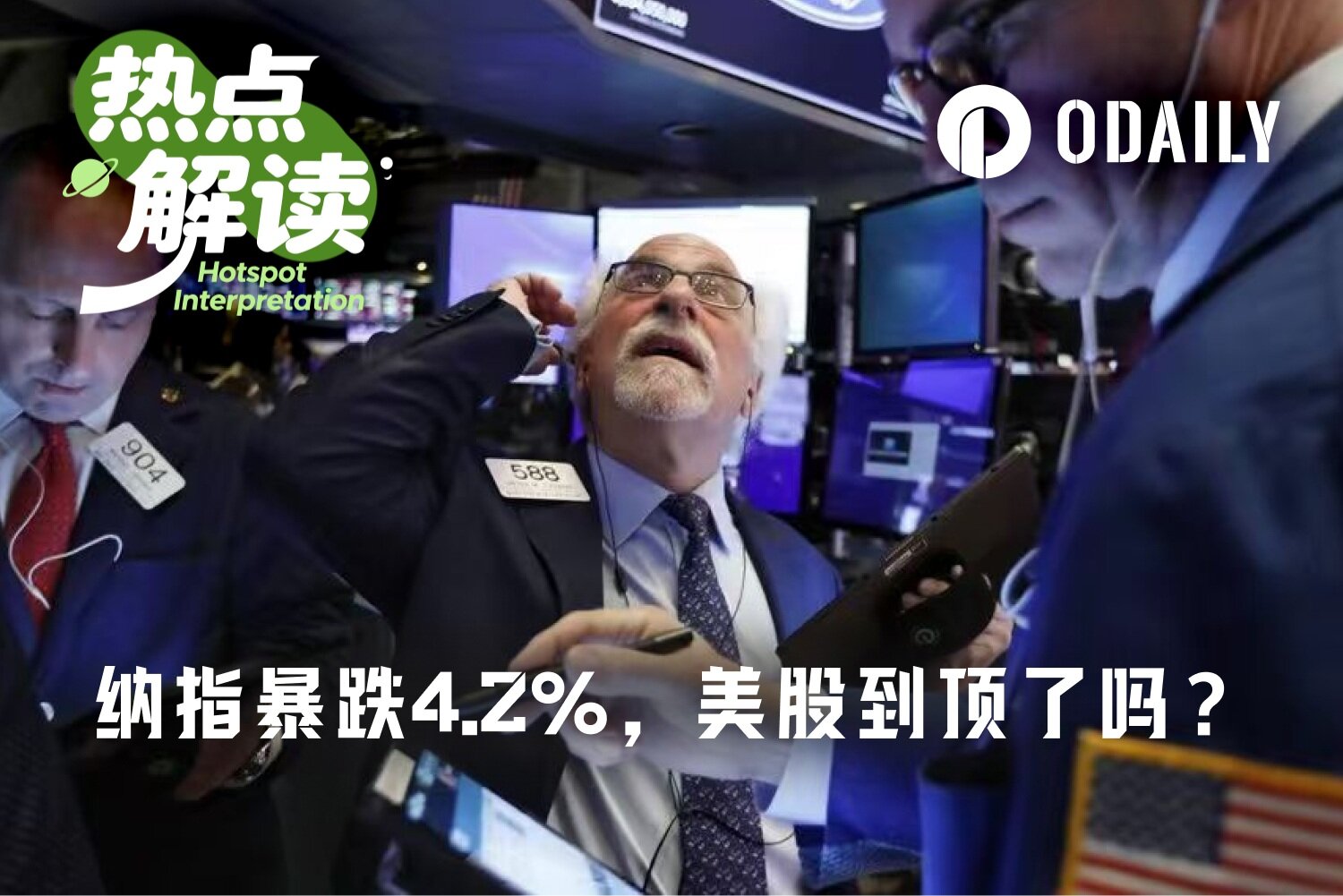
On Friday, June 5th, the U.S. stock market experienced its sharpest single-day correction so far in 2026. The Nasdaq Composite Index plummeted 4.18%, closing at 25,709.43 points, marking its largest single-day drop since April 2025; the S&P 500 index fell 2.64% to 7,383.74 points, ending a nine-week winning streak; the Dow Jones Industrial Average dropped 695.15 points (1.35%) to 50,866.78 points. The Philadelphia Semiconductor Index crashed over 10%, erasing approximately $1.3 trillion in market value in a single day, with core AI stocks like Nvidia, Broadcom, Micron, and Marvell leading the decline.

Instantly, the question of "Has the U.S. stock market peaked?" spread from trading floors to screens of investors worldwide. Odaily Planet Daily will conduct a rigorous analysis combining recent data and historical comparisons: Are current U.S. stock valuations too high? Is this a healthy pullback or a trend reversal? Where are the future drivers?

1. The Full Picture of the June 5th Plunge: A Data-Driven 'Perfect Storm'

The immediate trigger for this plunge was the non-farm payroll data released Friday evening.

U.S. Labor Department data for May showed a job increase of 172,000, nearly double the market expectation of 88,000 and significantly higher than April's 115,000. April's employment data had already exceeded expectations. March's figures were revised up by 29,000, and April's by 64,000, making the past three months' employment growth the strongest in two years. This indicates a systemic underestimation of the U.S. job market in previous reports, enough to spark overheating concerns.

The strong job data raised inflation expectations, with markets anticipating the Fed could raise rates as early as October this year. Post-data, U.S. Treasuries were sold off, with the 10-year yield rising 5.8 basis points to 4.531%, and the more policy-sensitive 2-year yield jumping over 7 basis points to 4.1% in a day.

The spike in bond yields hit tech stocks hardest, as high-valuation, high-growth assets are most sensitive to interest rates.

Broadcom's strong earnings the previous day failed to meet the market's extremely high expectations for its AI custom chip business guidance, triggering a chain reaction. Nvidia fell over 6%, Micron dropped 13.3%, Marvell plunged 16.7%, and AMD declined 10.9%. A concentrated profit-taking in the semiconductor sector, coupled with doubts about the sustainability of AI capital expenditures, created an avalanche effect. Reports that Meta plans to invest hundreds of billions more in AI failed to stem the sector's decline.

Volume surged, and the VIX fear index spiked 37% to 21.15, indicating rapidly spreading risk aversion. Bitcoin also fell below $60,000, with gold and oil adjusting lower, showing pressure across risk assets. However, not all sectors fell: Defensive sectors like utilities, healthcare, and consumer staples rose against the market trend, with "old-guard blue chips" like Johnson & Johnson and Coca-Cola attracting safe-haven flows. This suggests the market was not in a full-blown panic but rather undergoing a targeted adjustment in overvalued sectors.

On a weekly basis, the S&P 500 ended its nine-week rally, the Nasdaq lost 4.7% for its worst week in over a year. The Dow showed relative resilience, down only 0.3% for the week, reflecting signs of sector rotation.

"This is an extreme manifestation of 'good news is bad news'," said Michael Wilson, Morgan Stanley's Chief U.S. Equity Strategist, in an after-market report. "Strong employment data means the Fed's tightening shackles will be clamped tighter, directly shaking the only pillar supporting U.S. stock high valuations—the imminent rate cut expectation."

2. The AI Myth Fades: Dominoes of a Crowded Trade

If the non-farm payroll was the trigger, then the bubble and fragility accumulated within the AI sector itself were the massive explosive charge.

Over the past 18 months, AI was the sole narrative driving U.S. stocks to successive new highs. Nvidia's market cap once surpassed $5 trillion, accounting for over 7% of the S&P 500's weight, with the entire AI ecosystem-related stocks approaching 40% of the S&P's total market cap.

However, since Q2 2026, cracks have begun to appear in this faith.

Recent supply chain surveys revealed that several cloud service providers are cutting some orders for Nvidia's next-generation Blackwell Ultra chips due to overstocking and slower-than-expected monetization of enterprise AI applications. Nvidia's late-May earnings, while still impressive, showed its revenue growth guidance slowing for the third consecutive quarter, with gross margin showing early signs of decline.

The previously extremely crowded long-tech giants trade rapidly turned into a stampede for exits under the interest rate shock. When non-farm data triggered the rate spike, the appeal of holding these high-duration, high-valuation growth stocks plummeted. Their marginal buyers—leveraged quantitative funds and retail investors—were the first to retreat, triggering a chain reaction.

"The AI trade has shifted from FOMO (Fear Of Missing Out) to fear of being trapped." noted Jeremy Grantham, co-founder of GMO and a well-known value investor who has long warned of excessive AI valuations. He has compared the current situation to the eve of the 2000 internet bubble, pointing out that many AI companies' revenues may struggle to support their current high valuations.

3. Valuation and Historical Comparison: Has the U.S. Stock Market Reached a Bubble Peak?

The reason this pullback sparked widespread discussion about a "market top" is its occurrence against a backdrop of converging high valuation and sentiment indicators.

First, valuations are at historically high levels. Before the June 5th correction, the S&P 500's Cyclically Adjusted Price-to-Earnings ratio (CAPE, Shiller P/E) was around 39.5, the third highest after the 2000 internet bubble and the 2021 pandemic stimulus period, significantly above pre-2008 financial crisis levels. The forward P/E ratio also reached around 22.5, far above the long-term historical average of 15.8. The "Buffett Indicator"—the ratio of total U.S. stock market capitalization to U.S. GDP—briefly touched a high of 237% in late May, well above the "significantly overvalued" range defined by Buffett himself (>120%). Any unexpected negative news could accelerate mean reversion.

Second, capital and sentiment were at extreme levels. The BofA Bull & Bear indicator rose to 8.5 in late May, firmly locked in the "extreme bullish" zone, often seen as a reliable contrarian sell signal. The American Association of Individual Investors (AAII) bullish sentiment reading was in the 35%-45% range for most of May, optimistic but not reaching extreme euphoria. Retail margin debt balances remained near a record high of around $1.3 trillion in April-May, indicating active use of leverage.

Meanwhile, "smart money" showed signs of retreat: Berkshire Hathaway's Q1 13F filing revealed its cash and equivalents reached a record high of about $397 billion, with the company maintaining net stock sales in Q2; the ratio of corporate insider selling to buying rose to higher levels in May, the highest since 2021.

Third, key technical breakdowns occurred. The S&P 500 not only broke below short-term moving averages last Friday but also breached the lower rail of its recent uptrend channel. The index is now testing its 200-day moving average (around the 7000-7200 point range). Technical analysts like BTIG's Chief Technical Analyst Jonathan Krinsky note that if the S&P 500 fails to quickly reclaim key support levels and further loses the 200-day moving average, it would technically confirm the possible start of a mid-term correction, with a potential decline of 10%-15%.

4. Bull vs. Bear Debate: Pullback, Correction, or Bear Market Beginning?

Facing the market correction, Wall Street's bulls and bears quickly took sides, engaging in a fierce debate.

The bearish camp believes this could be the start of a bubble adjustment. Some strategists point to potential "stagflation" risks in the U.S. economy—while the May ISM Manufacturing PMI rebounded to 54.0 (expansion from the previous month), inflation indicators remain sticky. They warn that corporate earnings growth may face downward revision pressure due to financing costs and demand uncertainty, and the equity risk premium is currently at low levels.

Albert Edwards, Société Générale's star strategist and a long-term bear, warned that the AI bubble resembles past tech bubbles, potentially accompanied by capital misallocation and challenges for some companies, with the Nasdaq index facing significant downside risk.

The bullish camp emphasizes this is a healthy, overdue correction within a bull market. Goldman Sachs' Chief U.S. Equity Strategist David Kostin acknowledges high valuations but argues a market driven by earnings growth still has support. He expects S&P 500 component earnings to grow about 7% in 2026, with AI-driven productivity gains improving corporate profit margins starting in the second half. "Strong non-farm data precisely proves the economy isn't heading for a hard landing, with minimal recession risk. Once rate panic subsides, capital will recognize the solid earnings foundation." Goldman maintains a higher year-end target for the S&P 500, previously raised to the 6900-7600 range.

UBS Global Wealth Management also advises clients to "buy the dip," citing healthy household and corporate balance sheets and ongoing corporate share buyback plans providing a market cushion.

Charles Schwab's Chief Investment Strategist Liz Ann Sonders offers a balanced, pragmatic perspective: "A 'top' is never a point but a process. Currently, the liquidity- and sentiment-driven phase of broad gains is over. We are entering a fundamentals-driven stock-picking market. The overall market index may range and trend slightly lower over the coming months, but a 2008-style collapse is unlikely unless we see credit markets freeze."

5. Future Key Junctures: Inflation Data and the Fed's 'Judgment'

Undoubtedly, two major events in the coming week will be critical watersheds determining the nature of this adjustment. On Wednesday, June 10th, the U.S. May Consumer Price Index (CPI) will be released. The market consensus expects core CPI year-over-year growth around 2.8%-2.9% (April was 2.8%). If data significantly exceeds expectations upward, it will further reinforce market concerns about "sticky inflation," potentially pushing back Fed rate cut expectations further, intensifying pressure on bonds and stocks.

The Federal Reserve's Federal Open Market Committee (FOMC) meeting on June 16-17 will be a crucial observation window. Following the strong June 5th non-farm data, several Fed officials reiterated the need for caution. Officials like Cleveland Fed President Beth Hammack emphasized that while the labor market shows resilience, rates may need to stay at current higher levels for longer. The released Economic Projections Summary (dot plot) will be closely watched. If the median projection shows fewer rate cuts in 2026 than previously expected, or even suggests rates remain unchanged for the year, market expectations for the rate path will undergo significant repricing.

Additionally, geopolitical and trade policy risks could introduce extra uncertainty. The U.S. has previously imposed import tariffs and export controls on advanced semiconductors to strengthen domestic supply chain security and restrict key technology outflows. This ongoing policy direction, during fragile tech sentiment, could have long-term impacts on the global AI supply chain, raise the inflation center, and compress valuations for some companies.

Conclusion

Returning to the initial question: "Has the U.S. stock market peaked?"

For investors, all necessary conditions sufficient to confirm a long-term major top—extreme valuation, policy shift, core narrative loosening, retail frenzy, technical breakdown—are appearing simultaneously for the first time in over a decade. Historical experience suggests that when these signals highly resonate, even if the bull market doesn't end immediately, its risk-reward ratio has already deteriorated extremely. The current market is in a fragile transition period from "narrative" to "reality." The long-term productivity promise of the AI revolution must now begin to withstand the rigorous test of every macroeconomic data point and earnings report.

The era of one-sided bets on perpetual market gains may be over. Prudence is the most fundamental reverence for risk. In the coming two weeks, investors need to closely watch every decimal point in the May CPI report and every slight shift in the Fed's dot plot. Together, they will determine whether this summer is an interlude in a bull market or the prelude to a new era.


Domande pertinenti

QWhat was the main catalyst for the stock market plunge on June 5th, 2026, as described in the article?

AThe main catalyst was the release of the much stronger-than-expected May non-farm payrolls report by the U.S. Labor Department. This data, showing nearly double the expected job gains, heightened concerns about economic overheating and pushed back market expectations for Federal Reserve interest rate cuts, causing a sharp sell-off in bonds and rate-sensitive tech stocks.

QHow did the AI and semiconductor sectors perform during the market decline on June 5th?

AThe AI and semiconductor sectors were hit particularly hard. The Philadelphia Semiconductor Index plunged over 10%, erasing approximately $1.3 trillion in market value. Key AI stocks like Nvidia, Broadcom, Micron, and Marvell led the decline, with Micron falling 13.3% and Marvell dropping 16.7%. The sell-off was fueled by profit-taking and growing concerns about the sustainability of AI capital expenditures.

QAccording to the article, what are some key valuation metrics indicating the U.S. stock market may be overvalued?

AKey overvaluation metrics mentioned include: the S&P 500's Cyclically Adjusted P/E Ratio (CAPE/Shiller P/E) at approximately 39.5x, ranking historically high; its forward P/E ratio around 22.5x, well above the long-term average of 15.8x; and the 'Buffett Indicator' (U.S. stock market total capitalization to GDP) reaching a high of 237%, far above the level defined as 'significantly overvalued' (>120%).

QWhat upcoming events does the article identify as critical for determining the future direction of the market after the plunge?

AThe article identifies two critical upcoming events: the release of the May Consumer Price Index (CPI) data on June 10th, and the Federal Open Market Committee (FOMC) meeting on June 16th-17th. The CPI data will provide new evidence on inflation trends, while the FOMC's economic projections (dot plot) will be crucial in shaping market expectations for the future path of interest rates.

QHow does the article summarize the core debate among Wall Street analysts regarding the nature of the market decline?

AThe core debate is between those viewing the decline as the start of a bubble adjustment and those seeing it as a healthy correction within a bull market. Bears point to high valuations, potential 'stagflation' risks, and a possible shift in the dominant market narrative. Bulls argue that strong employment data indicates low recession risk and that solid corporate earnings growth, particularly from AI-driven productivity gains, will ultimately support the market.

Letture associate

Wang Chuan: After Investing in Storage Stocks and Seeing a Thirty-Fold Return, How to Remain Unanxious (Part 7) - A Quarter-Century Cycle

Wang Chuan: Reflections on Investment Anxiety and Market Cycles After Observing a 30x Gain in a Storage Stock (Part 7) – A Quarter-Century Cycle This article examines the cyclical nature and inherent risks in technology hardware investments, using the storage and semiconductor sectors as examples. It criticizes the misleading practice of "annualized" Net Dollar Retention (NDR) rates, where short-term growth is extrapolated unrealistically. A key concept explored is "reflexivity" – demand driven by panic, exploration, and liquidity during market booms, which can vanish just as quickly when conditions reverse. This reflexivity exists both in product demand and among speculative stock buyers, creating powerful feedback loops that inflate prices during upturns and exacerbate crashes during downturns. The author highlights a major risk for hardware sectors: unlike assets with defined cycles (e.g., Bitcoin's halving), there's no guarantee of a swift recovery post-crash. Companies like Micron, Intel, and Cisco took roughly a quarter-century to surpass their 2000 highs, enduring drawdowns exceeding 80%. This is attributed to the "bullwhip effect" in supply chains, where demand collapses instantly but过剩产能 persists, and a migration of narrative-driven capital. High-valuation stories吸引 speculative funds during growth phases, but these funds quickly depart for the next hot narrative once growth slows, leaving behind stronger companies with much lower valuations. The piece warns of dangerous mental models formed during bull markets: 1) equating current strong demand with perpetual high growth, and 2) believing that making fast, large profits is easy. Citing巴菲特, the author notes that easy money undermines rationality, likening speculators to Cinderella at a ball with a clock that has no hands. The current phase presents an asymmetric risk-reward scenario: potential for further gains exists, but the downside risk is an 80%+ drawdown and a multi-decade wait for breakeven, which reflexive speculators cannot tolerate. The hypothetical investor "老王" (Lao Wang), who achieved a 30x return, is used to illustrate potential pitfalls. Leverage could lead to a wipeout during a sharp correction. Even without leverage, ingrained beliefs in easy money would likely lead him to double down after losses, expecting a quick rebound. Instead, he might face a protracted decline, depleting his resources through frantic trading as the high-growth narrative fades. The conclusion references Schopenhauer, comparing those who have seen multiple market cycles to an audience seeing the same magic trick repeatedly—once the illusion is understood, its power is gone.

marsbit6 min fa

Wang Chuan: After Investing in Storage Stocks and Seeing a Thirty-Fold Return, How to Remain Unanxious (Part 7) - A Quarter-Century Cycle

marsbit6 min fa

US Stocks Too Expensive? This Top CIO Scoured the Globe and Found 5 Stocks More Attractive Than NVIDIA

Summary: Main Street Research CIO James Demmert maintains his bullish 8,100 target for the S&P 500 but argues that greater opportunities now lie overseas. He identifies five international stocks with superior valuations poised to benefit from the AI revolution, suggesting international markets will outperform the US for years. Key Recommendations: 1. **ASML (Netherlands):** A foundational chip manufacturing technology provider, offering crucial AI exposure and geographic diversification. Demmert's top long-term pick. 2. **HSBC (UK/Asia):** A global bank with a 9x P/E ratio, better growth prospects than US peers like JPMorgan, and strong Asian presence. 3. **Siemens Energy (Germany):** A direct play on global power grid expansion driven by AI, crypto, and EV electricity demand. 4. **BHP Group (Australia):** A "hidden AI play" and "second derivative" of the trend due to massive copper demand for data centers. Trades at a 16x P/E. 5. **AstraZeneca (UK):** An undervalued healthcare stock with a strong pipeline (18x P/E, >20% growth), expected to benefit from AI's impact on medicine. Core Thesis: International outperformance is driven by both attractive valuations and a major policy shift. While the US tightens fiscal policy, Europe and Japan are launching unprecedented stimulus, reigniting growth. Demmert recommends allocating 45% of a portfolio internationally, citing excessive US investor conservatism as a key mistake.

marsbit11 min fa

US Stocks Too Expensive? This Top CIO Scoured the Globe and Found 5 Stocks More Attractive Than NVIDIA

marsbit11 min fa

a16z Partner: Three Paths for Crypto Projects to Find PMF

Author: Jason Rosenthal. Compiler: Shenchao TechFlow. Finding Product-Market Fit (PMF) is the most critical variable for a company's survival. In the crypto space, misaligned growth hacking and airdrops often mask the absence of true PMF. However, leading teams are now finding PMF faster. Here are three proven paths for crypto projects to achieve PMF: 1. **Co-build with Anchor Clients:** Partner with the most sophisticated potential clients in your field and develop the product based on their specific needs. Their adoption serves as the strongest validation, more valuable than media coverage or TVL metrics. This approach is shaping current product roadmaps, as seen in collaborations between crypto startups and traditional finance. 2. **Position Ahead of an Exponential Curve:** Identify and position yourself ahead of a major emerging trend before the market fully realizes it. The most evident current curve is the rise of AI Agents as autonomous economic actors. Projects like AgentCash by Merit Systems, which enables AI Agents to pay for API access with crypto, are building foundational payment rails for the impending Agent economy. 3. **Be Your Own First and Best Customer:** The most enduring infrastructure companies don't wait for external validation. They first build and prove their technology by using it to power their own applications at scale before offering it to others. Matter Labs exemplifies this by anchoring its ZKsync technology in a concrete application, Cari Network, which enables U.S. regional banks to conduct real-time, on-chain interbank transfers of tokenized deposits. The underlying logic is consistent: the fastest path to PMF involves choosing the right battlefield and executing with conviction—by co-building with clients whose validation compounds, positioning ahead of the curve before consensus forms, or becoming your own best case study.

marsbit12 min fa

a16z Partner: Three Paths for Crypto Projects to Find PMF

marsbit12 min fa

Wang Chuan: How to Avoid Anxiety When the Neighbor, Lao Wang, Made Thirty Times His Investment in Storage Stocks (7) - A Quarter-Century Cycle

Wang Chuan: Reflections on a Quarter-Century Cycle – How to Stay Calm After a 30x Gain on Storage Stocks (Part 7) This article continues the discussion on investment pitfalls. It highlights the deceptive use of metrics like the "Annualized Net Dollar Retention Rate" by some companies to inflate growth projections. The core analysis focuses on the "reflexivity" present in both product demand and financial markets during boom periods. In a bubble, speculative and fear-driven demand in the real economy interacts with speculative, leveraged buying in financial markets, creating a powerful upward feedback loop. This dynamic reverses sharply when faced with physical or liquidity constraints, leading to a cascading downturn. The hardware and semiconductor sectors face unique risks. Unlike assets with defined cycles, there's no guarantee of a swift recovery post-crash. Historical examples like Micron, Intel, and Cisco show it can take decades to surpass previous peaks after severe drawdowns (80-95%). This is due to the "bullwhip effect" in supply chains—demand vanishes quickly while过剩产能 persists—and the migration of speculative capital and growth narratives to new sectors once momentum slows. Companies may have stronger fundamentals years later, but the speculative "soul" of extreme valuations is long gone. The author warns of psychological traps for new investors: mistaking temporary, intense demand for permanent growth, and believing that making quick, large profits is easy. Citing Buffett, the piece cautions that easy money erodes rationality. The current phase presents an asymmetric risk-reward scenario: potential for further gains versus the risk of an 80%+ drawdown and a multi-decade recovery wait—an outcome reflexive speculators cannot endure. The hypothetical "Lao Wang" who made 30x may be wiped out by leverage or, driven by the "get-rich-quick" mindset, may repeatedly try to recover losses until exhausted, failing to recognize that the high-growth narrative has ended. The piece concludes with Schopenhauer's analogy: those who've seen multiple cycles are like an audience watching the same magic trick repeatedly—the illusion no longer works.

链捕手20 min fa

Wang Chuan: How to Avoid Anxiety When the Neighbor, Lao Wang, Made Thirty Times His Investment in Storage Stocks (7) - A Quarter-Century Cycle

链捕手20 min fa

Trading

Spot
Futures
活动图片