Mystery Bitcoin Whale Dumps $1.3B In BlackRock’s IBIT As Market Barely Blinks

bitcoinistPubblicato 2026-05-27Pubblicato ultima volta 2026-05-27

Introduzione

An unidentified entity sold approximately $1.3 billion worth of shares in BlackRock's spot Bitcoin ETF, IBIT, in a large dark pool block trade on Tuesday morning. ETF analysts, including Galaxy's Alex Thorn and Bloomberg's Eric Balchunas, confirmed the unprecedented 29-million-share transaction. Notably, the market absorbed the massive sale with minimal price disruption to IBIT. This sale occurs amid a broader trend of significant outflows from US spot Bitcoin ETFs. Recent weeks have seen over $2.5 billion in net outflows, with IBIT itself accounting for $1.008 billion in outflows during the May 18–22 period. Analysts suggest the sustained selling pressure, despite the market's resilience, may indicate institutional skittishness in a rising inflation and interest rate environment. At the time of reporting, Bitcoin was trading around $75,730.

A large, unidentified holder sold roughly $1.3 billion worth of BlackRock’s spot Bitcoin ETF, IBIT, through a dark pool on Tuesday morning, in what ETF analysts described as an unusually large block trade. The sale stood out not only because of its size, but because the market appeared to digest it with little visible disruption.

BlackRock Bitcoin ETF Handles $1.3B Block Sale

Galaxy research lead Alex Thorn first flagged the transaction on X, calling it a “massive $1.289 billion IBIT block sale by an unknown party through dark pool at 10:30am today.” Thorn said it was the “biggest such trade I’ve ever seen,” while adding that he was still checking whether it was the largest in IBIT’s history.

Bloomberg ETF analyst Eric Balchunas later said the trade had been confirmed. “Confirmed.. 29 million share trade ($1.3b) of IBIT executed at 1030am this morning. This screen shows all the IBIT trades today by size and you can see one of these is not like the others. Price unchanged today so mkt absorbed it well.”
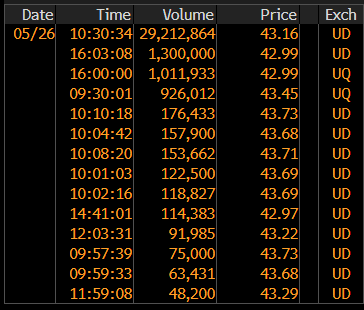
Source: X @EricBalchunas

James Seyffart, another Bloomberg ETF analyst, also said he had verified the print on his terminal. “It was def a massive block sale of IBIT,” he wrote. “29.2 million shares.”

Spot Bitcoin ETF Continue To Bleed

The trade comes after a sharp reversal in US spot BTC ETF flows. According to SoSoValue, US spot Bitcoin ETFs saw $1.257 billion of net outflows during the May 18–22 trading week, with IBIT accounting for $1.008 billion of that total. Fidelity’s FBTC followed with $112 million of weekly outflows, while total spot Bitcoin ETF net assets stood at $98.87 billion and cumulative net inflows at $57.08 billion.

That followed another weak week. For May 11–15, SoSoValue data shows $1.039 billion of net outflows, ending six consecutive weeks of inflows. ARKB led that week’s withdrawals with $324 million, while IBIT saw $317 million of outflows; total spot Bitcoin ETF net assets were then listed at $104.29 billion.

The daily data also shows that the pressure was not confined to a single print. SoSoValue data shows US spot Bitcoin ETFs recorded $70.47 million of net outflows on May 20, extending the streak to four days, followed by $101 million on May 21 and $105 million on May 22, the sixth consecutive day of outflows.

Michael Nadeau of The DeFi Report framed the sale against that broader run of withdrawals. “This is on the heels of $2.5b of outflows over the last few weeks. The ETFs have held up remarkably well. Many have pointed to this as evidence that the bottom is in.”

He added a more cautious macro read: “But it looks like institutions are starting to get skittish about what they’re holding in an environment where inflation and rates are rising.”

At press time, BTC traded at $75,730.
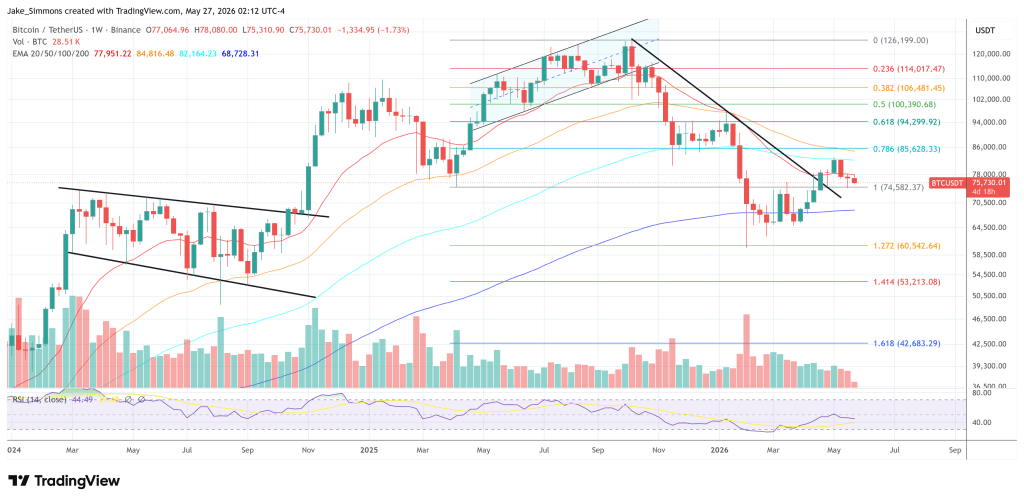
Bitcoin hovers below the 20-week EMA, 1-week chart | Source: BTCUSDT on TradingView.com

Domande pertinenti

QWhat is the size and nature of the Bitcoin ETF transaction that occurred, and why was it notable?

AAn unidentified entity sold approximately $1.3 billion (29 million shares) worth of BlackRock's spot Bitcoin ETF, IBIT, through a dark pool. It was notable for being an unusually large block trade that the market absorbed with minimal visible price disruption.

QWho first identified and later confirmed the large IBIT block sale?

AGalaxy research lead Alex Thorn first flagged the transaction on social media. It was later confirmed by Bloomberg ETF analysts Eric Balchunas and James Seyffart using terminal data.

QWhat has been the recent trend in flows for US spot Bitcoin ETFs according to SoSoValue data?

AAccording to SoSoValue, US spot Bitcoin ETFs experienced significant net outflows recently. The trading week of May 18–22 saw $1.257 billion in outflows, preceded by $1.039 billion in outflows the week of May 11–15, ending a six-week streak of inflows.

QHow did Michael Nadeau of The DeFi Report interpret the market's reaction to the recent ETF outflows?

AMichael Nadeau noted that the ETFs have held up remarkably well despite about $2.5 billion in outflows over recent weeks, with many seeing this as evidence the market bottom is in. However, he cautioned that institutions might be getting skittish in a rising inflation and interest rate environment.

QWhat was the price of Bitcoin (BTC) at the time the article was published?

AAt press time, Bitcoin (BTC) traded at $75,730.

Letture associate

AI PC Battle: Bet on the Toll Booth, Not the Camp

**Title:** The AI PC Battle: Don't Bet on Sides, Bet on the Tollbooth **Summary:** The AI PC competition is moving beyond simple "x86 vs. Arm" narratives. The core investment thesis should focus on identifying which players can sustain margins, cash flow, and pricing power throughout the upgrade cycle, rather than backing a particular architecture. The opportunity is analyzed in three layers: 1. **The Advanced Foundry Tollbooth:** TSMC is positioned to collect "tolls" regardless of which chip designer wins, due to its dominant ~70% share in advanced semiconductor manufacturing, which is essential for high-end AI PC chips. 2. **Compute & Platform Spillover:** AMD represents an offensive in the x86 CPU+GPU space, while NVIDIA leverages its GPU and CUDA software stack dominance. Both benefit from the demand for increased local AI compute. 3. **Architecture Diffusion & Turnaround Plays:** ARM and Intel offer potential for significant upside (elasticity), but investments here require stricter discipline due to higher execution risks and competitive challenges. The industry is transitioning from concept to shipment validation. While short-term forecasts for AI PC adoption have been revised down slightly due to tariffs and procurement delays, the long-term trend towards AI becoming a standard PC feature remains intact. The key driver for upgrade cycles will be whether compelling enterprise applications (e.g., privacy-sensitive computing, low-latency inference) emerge beyond consumer-focused features like meeting summarization. Investment strategy should prioritize companies with platform-level advantages and recurring revenue streams. TSMC offers high certainty as the foundational tollbooth. AMD presents a strong offensive play within the established ecosystem. ARM and Intel are higher-risk, higher-potential-reward turnaround bets. The report cautions against chasing short-term hype and emphasizes a disciplined, long-term approach focused on buying ecosystem strength and cash-flow certainty after market enthusiasm subsides. **Key Risks:** Underwhelming AI PC applications slowing upgrade cycles; slow improvement in Windows on Arm compatibility; macro/tariff impacts on PC demand; potential advanced node supply-demand mismatches affecting TSMC; high overall AI sector valuations making stocks vulnerable to a risk-off shift in markets.

marsbit11 min fa

AI PC Battle: Bet on the Toll Booth, Not the Camp

marsbit11 min fa

Ten-Thousand-Word Analysis: From $10 to $290, MRVL Wins the Entire AI Era by 'Not Making GPUs'

Marvell Technology's stock price surged from under $10 in 2016 to a record $290 in June 2026, fueled not by making GPUs, but by dominating AI infrastructure connectivity. This analysis argues the market misvalues MRVL as merely a smaller Broadcom in custom AI chips, overlooking its true, unique position. Marvell's core strength lies in enabling high-speed data flow for AI clusters through three interconnected businesses. First, it holds a commanding ~70% market share in high-speed optical DSPs (essential for data center light modules), a deep-moat business with accelerating growth. Second, its custom AI chip design business serves hyperscalers like AWS, Microsoft, and Google, with a significant revenue pipeline despite lower margins. Third, stable cash flows come from Ethernet switch chips and enterprise storage controllers. Together, they form a full-stack "AI data movement" platform. CEO Matt Murphy's transformative leadership since 2016, involving strategic divestments, key acquisitions (like Inphi for optical DSPs), and securing long-term agreements with major cloud providers, repositioned the company. A pivotal $2 billion strategic investment from NVIDIA in 2026 underscored Marvell's critical role in the AI ecosystem, particularly through collaborations like NVLink Fusion. While Marvell faces risks—including client concentration (losing the Amazon Trainium3 design), lower-margin business mix, competitive threats, insider selling, and complex supply chains—its fundamentals remain strong. The optical interconnect moat is widening with the acquisition of Celestial AI (photonics fabric), and financial metrics show accelerating revenue growth and operating leverage. With a PEG ratio suggesting undervaluation relative to its growth, the thesis is that the market undervalues Marvell's monopolistic position in AI "plumbing" while overemphasizing its competitive custom chip segment. The story transcends investing, symbolizing how in any complex system—from the internet to AI—the value of "connection" ultimately surpasses that of individual "nodes."

marsbit40 min fa

Ten-Thousand-Word Analysis: From $10 to $290, MRVL Wins the Entire AI Era by 'Not Making GPUs'

marsbit40 min fa

AI Relay Stations Spark Heated Debate on Zhihu: Behind Cheap Tokens, What Are Users Really Worried About?

A discussion on Zhihu about "AI relay stations" shifted the niche developer topic of "cheap tokens" into broader user awareness. Users moved beyond simply questioning the legitimacy of these services to focus on practical concerns: Where do cheap tokens truly come from? Is the model being accessed the real one? Can relay stations see prompts, code, and API keys? For occasional users, are the risks worth it? The core debate centered less on price and more on trust. A primary worry is model authenticity—the risk of "model swapping," where users paying for a premium model might be routed to a cheaper one, creating an information asymmetry. Others argued that cost comparisons matter; while cheaper than official pay-as-you-go APIs, relay stations may not be the lowest-cost option versus subscriptions, domestic models, or free tiers, making user needs assessment crucial. Speculation about token sources ranged from legitimate bulk discounts to gray-area methods like account sharing or exploiting regional pricing. This opacity makes risk assessment difficult for users. Data security emerged as a critical concern, especially for enterprise use. When processing sensitive information like code, contracts, or client data, the inability to verify a relay station's data handling, retention, or access policies poses significant compliance and confidentiality risks. The evolving consensus suggests relay stations can be used cautiously for low-sensitivity, disposable tasks (e.g., summarizing public info, simple translation). However, they should not be the default for sensitive, professional, or production workflows involving proprietary data, Agents, or automated systems. Recommendations include avoiding large prepayments, not relying on a single service, using test prompts to monitor quality, anonymizing data where possible, and keeping official channels as backups. Ultimately, the discussion framed tokens not just as a billing unit but as a measure of real cost encompassing price, model integrity, data security, and service stability. The popularity of relay stations highlights user demand for affordable access, but the debate underscores a key trade-off: the savings from cheap tokens may come at the price of trust, transparency, and control over one's data and AI experience.

marsbit1 h fa

AI Relay Stations Spark Heated Debate on Zhihu: Behind Cheap Tokens, What Are Users Really Worried About?

marsbit1 h fa

In-Depth Research Report on TradFi: The Convergence Wave of Crypto and Traditional Finance

In 2026, the crypto industry is undergoing a profound infrastructure-level transformation—TradFi assets are migrating on-chain at an unprecedented pace. According to CoinGecko's Q1 2026 report, the total value locked (TVL) of tokenized real-world assets (RWA) has surpassed $31 billion, a nearly 4x increase from $7.8 billion at the beginning of 2025, with the sector’s aggregate market capitalization reaching $19.3 billion. Among these, the market cap of tokenized stocks surged from $2 million to $486 million, with Q1 spot trading volume reaching $15.1 billion—a single quarter already surpassing the entire second half of 2025. RWA perpetual contract Q1 trading volume reached a staggering $524.8 billion, far exceeding the $313 billion for all of 2025. Meanwhile, BlackRock's BUIDL fund has reached $2.3 billion in scale and has filed for two new tokenized funds, signaling that the world's largest asset manager's tokenization strategy is evolving from pilot to product suite expansion. HTX, as a core participant in the crypto exchange sector, officially launched TradFi perpetual futures products including NVDA, AAPL, MSFT, META, and SPY in 2026, enabling crypto users to gain 24/7 trading access to core U.S. equities. Boston Consulting Group predicts that global tokenized asset scale could reach $16 trillion by 2030, while McKinsey offers a conservative estimate of approximately $2 trillion. The on-chain migration of TradFi assets is no longer a "future narrative" but a structural transformation unfolding in real time, as crypto exchanges evolve from single crypto asset trading platforms toward "multi-asset-class trading infrastructure."

HTX Learn1 h fa

In-Depth Research Report on TradFi: The Convergence Wave of Crypto and Traditional Finance

HTX Learn1 h fa

Trading

Spot
Futures

Articoli Popolari

Cosa è BITCOIN

Comprendere HarryPotterObamaSonic10Inu (ERC-20) e la sua posizione nel mondo delle criptovalute Negli ultimi anni, il mercato delle criptovalute ha assistito a un aumento della popolarità delle meme coin, catturando l'interesse non solo dei trader, ma anche di coloro che cercano coinvolgimento comunitario e valore di intrattenimento. Tra questi token unici c'è HarryPotterObamaSonic10Inu (ERC-20), un progetto intrigante che mescola riferimenti culturali nel tessuto delle criptovalute. Questo articolo esplora gli aspetti chiave di HarryPotterObamaSonic10Inu, analizzando i suoi meccanismi, l'etica guidata dalla comunità e il suo coinvolgimento con il panorama crittografico più ampio. Che cos'è HarryPotterObamaSonic10Inu (ERC-20)? Come suggerisce il suo nome, HarryPotterObamaSonic10Inu è una meme coin costruita sulla blockchain di Ethereum, classificata secondo lo standard ERC-20. A differenza delle criptovalute tradizionali che possono enfatizzare l'utilità pratica o il potenziale investimento, questo token prospera grazie al valore di intrattenimento e alla forza della sua comunità. Il progetto mira a creare un ambiente in cui gli utenti coinvolti possono riunirsi, condividere idee e partecipare ad attività ispirate a diversi fenomeni culturali. Una caratteristica notevole di HarryPotterObamaSonic10Inu è la zero tassa sulle transazioni. Questo elemento allettante tende a incoraggiare il trading e il coinvolgimento della comunità, privo di costi aggiuntivi che possono scoraggiare i trader di piccole dimensioni. L'offerta totale della moneta è fissata a un miliardo di token, un numero che segna la sua intenzione di mantenere una circolazione sostanziale all'interno della comunità. Creatore di HarryPotterObamaSonic10Inu (ERC-20) Le origini di HarryPotterObamaSonic10Inu sono avvolte in un certo mistero; i dettagli sul creatore rimangono sconosciuti. Lo sviluppo di questo token non presenta un team identificabile o un piano esplicito, cosa non rara nel settore delle meme coin. Invece, il progetto è emerso organicamente, con il suo progresso fortemente dipendente dall'entusiasmo e dalla partecipazione della sua comunità. Investitori di HarryPotterObamaSonic10Inu (ERC-20) Per quanto riguarda investimenti esterni e finanziamenti, HarryPotterObamaSonic10Inu rimane ambiguo. Il token non elenca alcuna fondazione di investimento conosciuta o un sostegno organizzativo significativo. Invece, la linfa vitale del progetto è la sua comunità di base, che informa la sua crescita e sostenibilità attraverso azioni collettive e coinvolgimento nello spazio crittografico. Come funziona HarryPotterObamaSonic10Inu (ERC-20)? In quanto meme coin, HarryPotterObamaSonic10Inu opera principalmente al di fuori delle strutture tradizionali che governano spesso il valore degli asset. Ci sono diversi aspetti distintivi che definiscono il funzionamento del progetto: Transazioni senza tasse: Senza costi fiscali sulle transazioni, gli utenti possono comprare e vendere liberamente il token senza preoccuparsi di costi nascosti. Coinvolgimento della comunità: Il progetto prospera sull'interazione della comunità, sfruttando le piattaforme social per creare entusiasmo e facilitare il coinvolgimento. Discussioni, condivisione di contenuti e coinvolgimento sono elementi cruciali che aiutano ad espandere la sua portata e a favorire la lealtà tra i sostenitori. Nessuna utilità pratica: Va notato che HarryPotterObamaSonic10Inu non offre un'utilità concreta all'interno dell'ecosistema finanziario. Piuttosto, è classificato come un token principalmente per attività di intrattenimento e comunitarie. Riferimento culturale: Il token incorpora astutamente elementi della cultura pop per attirare interesse, collegandosi a appassionati di meme e seguaci delle criptovalute. HarryPotterObamaSonic10Inu esemplifica come le meme coin operino in modo diverso rispetto ai progetti di criptovalute più tradizionali, entrando nel mercato come costrutti sociali innovativi piuttosto che come asset utilitari. Cronologia di HarryPotterObamaSonic10Inu (ERC-20) La storia di HarryPotterObamaSonic10Inu è segnata da diversi traguardi notevoli: Creazione: Il token è emerso da un meme virale, catturando l'immaginazione di molti appassionati di criptovalute. Le date di creazione specifiche non sono disponibili, sottolineando la sua crescita organica. Inserimento negli scambi: HarryPotterObamaSonic10Inu ha fatto il suo ingresso in vari scambi, consentendo un accesso e un trading più facili da parte della comunità. Iniziative di coinvolgimento della comunità: Attività in corso volte a migliorare l'interazione della comunità, comprese gare, campagne sui social media e generazione di contenuti da parte di fan e sostenitori. Piani di espansione futura: La tabella di marcia del progetto include il lancio di una collezione NFT, merchandising e un sito di eCommerce relativo ai suoi temi culturali, coinvolgendo ulteriormente la comunità e cercando di aggiungere più dimensioni al suo ecosistema. Punti chiave su HarryPotterObamaSonic10Inu (ERC-20) Natura guidata dalla comunità: Il progetto dà priorità al contributo collettivo e alla creatività, garantendo che il coinvolgimento degli utenti sia al centro del suo sviluppo. Classificazione come meme coin: Rappresenta l'epitome delle criptovalute basate sull'intrattenimento, distinguendosi dai veicoli d'investimento tradizionali. Nessuna affiliazione diretta con Bitcoin: Nonostante la somiglianza nel nome del ticker, HarryPotterObamaSonic10Inu è distintivo e non ha alcuna relazione con Bitcoin o altre criptovalute consolidate. Focus sulla collaborazione: HarryPotterObamaSonic10Inu è progettato per creare uno spazio per la collaborazione e la condivisione di storie tra i suoi detentori, fornendo un canale per la creatività e il legame comunitario. Prospettive future: L'ambizione di espandersi oltre il suo presupposto iniziale verso NFT e merchandising delinea un percorso per il progetto per potenzialmente entrare in strade più mainstream all'interno della cultura digitale. Poiché le meme coin continuano a catturare l'immaginazione della comunità crittografica, HarryPotterObamaSonic10Inu (ERC-20) si distingue per i suoi legami culturali e il suo approccio centrato sulla comunità. Anche se potrebbe non adattarsi al modello tipico di un token orientato all'utilità, la sua essenza risiede nella gioia e nella camaraderia coltivate tra i suoi sostenitori, evidenziando la natura in evoluzione delle criptovalute in un'epoca sempre più digitale. Con la continuazione dello sviluppo del progetto, sarà importante osservare come le dinamiche della comunità influenzano la sua traiettoria nel panorama in continuo cambiamento della tecnologia blockchain.

1.6k Totale visualizzazioniPubblicato il 2024.04.01Aggiornato il 2024.12.03

Cosa è BITCOIN

Come comprare BTC

Benvenuto in HTX.com! Abbiamo reso l'acquisto di Bitcoin (BTC) semplice e conveniente. Segui la nostra guida passo passo per intraprendere il tuo viaggio nel mondo delle criptovalute.Step 1: Crea il tuo Account HTXUsa la tua email o numero di telefono per registrarti il tuo account gratuito su HTX. Vivi un'esperienza facile e sblocca tutte le funzionalità,Crea il mio accountStep 2: Vai in Acquista crypto e seleziona il tuo metodo di pagamentoCarta di credito/debito: utilizza la tua Visa o Mastercard per acquistare immediatamente BitcoinBTC.Bilancio: Usa i fondi dal bilancio del tuo account HTX per fare trading senza problemi.Terze parti: abbiamo aggiunto metodi di pagamento molto utilizzati come Google Pay e Apple Pay per maggiore comodità.P2P: Fai trading direttamente con altri utenti HTX.Over-the-Counter (OTC): Offriamo servizi su misura e tassi di cambio competitivi per i trader.Step 3: Conserva Bitcoin (BTC)Dopo aver acquistato Bitcoin (BTC), conserva nel tuo account HTX. In alternativa, puoi inviare tramite trasferimento blockchain o scambiare per altre criptovalute.Step 4: Scambia Bitcoin (BTC)Scambia facilmente Bitcoin (BTC) nel mercato spot di HTX. Accedi al tuo account, seleziona la tua coppia di trading, esegui le tue operazioni e monitora in tempo reale. Offriamo un'esperienza user-friendly sia per chi ha appena iniziato che per i trader più esperti.

4.0k Totale visualizzazioniPubblicato il 2024.12.12Aggiornato il 2026.06.02

Come comprare BTC

Cosa è $BITCOIN

ORO DIGITALE ($BITCOIN): Un'Analisi Completa Introduzione all'ORO DIGITALE ($BITCOIN) L'ORO DIGITALE ($BITCOIN) è un progetto basato su blockchain che opera sulla rete Solana, con l'obiettivo di combinare le caratteristiche dei metalli preziosi tradizionali con l'innovazione delle tecnologie decentralizzate. Sebbene condivida un nome con Bitcoin, spesso definito “oro digitale” a causa della sua percezione come riserva di valore, l'ORO DIGITALE è un token separato progettato per creare un ecosistema unico all'interno del panorama Web3. Il suo obiettivo è posizionarsi come un asset digitale alternativo valido, anche se i dettagli riguardanti le sue applicazioni e funzionalità sono ancora in fase di sviluppo. Cos'è l'ORO DIGITALE ($BITCOIN)? L'ORO DIGITALE ($BITCOIN) è un token di criptovaluta esplicitamente progettato per l'uso sulla blockchain di Solana. A differenza di Bitcoin, che fornisce un ruolo di stoccaggio di valore ampiamente riconosciuto, questo token sembra concentrarsi su applicazioni e caratteristiche più ampie. Aspetti notevoli includono: Infrastruttura Blockchain: Il token è costruito sulla blockchain di Solana, nota per la sua capacità di gestire transazioni ad alta velocità e a basso costo. Dinamiche di Offerta: L'ORO DIGITALE ha un'offerta massima fissata a 100 quadrilioni di token (100P $BITCOIN), sebbene i dettagli riguardanti la sua offerta circolante siano attualmente non divulgati. Utilità: Sebbene le funzionalità precise non siano esplicitamente delineate, ci sono indicazioni che il token potrebbe essere utilizzato per varie applicazioni, potenzialmente coinvolgendo applicazioni decentralizzate (dApp) o strategie di tokenizzazione degli asset. Chi è il Creatore dell'ORO DIGITALE ($BITCOIN)? Attualmente, l'identità dei creatori e del team di sviluppo dietro l'ORO DIGITALE ($BITCOIN) rimane sconosciuta. Questa situazione è tipica tra molti progetti innovativi nel settore blockchain, in particolare quelli allineati con la finanza decentralizzata e i fenomeni delle meme coin. Sebbene tale anonimato possa favorire una cultura guidata dalla comunità, intensifica le preoccupazioni riguardo alla governance e alla responsabilità. Chi sono gli Investitori dell'ORO DIGITALE ($BITCOIN)? Le informazioni disponibili indicano che l'ORO DIGITALE ($BITCOIN) non ha alcun sostenitore istituzionale noto o investimenti di venture capital prominenti. Il progetto sembra operare su un modello peer-to-peer incentrato sul supporto e sull'adozione della comunità piuttosto che su percorsi di finanziamento tradizionali. La sua attività e liquidità si trovano principalmente su exchange decentralizzati (DEX), come PumpSwap, piuttosto che su piattaforme di trading centralizzate consolidate, evidenziando ulteriormente il suo approccio di base. Come Funziona l'ORO DIGITALE ($BITCOIN) Le meccaniche operative dell'ORO DIGITALE ($BITCOIN) possono essere elaborate in base al suo design blockchain e alle caratteristiche della rete: Meccanismo di Consenso: Sfruttando il proof-of-history (PoH) unico di Solana combinato con un modello di proof-of-stake (PoS), il progetto garantisce una validazione efficiente delle transazioni contribuendo all'alta performance della rete. Tokenomics: Sebbene meccanismi deflazionistici specifici non siano stati dettagliati ampiamente, l'ampia offerta massima di token implica che potrebbe soddisfare microtransazioni o casi d'uso di nicchia che devono ancora essere definiti. Interoperabilità: Esiste il potenziale per l'integrazione con l'ecosistema più ampio di Solana, inclusi vari piattaforme di finanza decentralizzata (DeFi). Tuttavia, i dettagli riguardanti integrazioni specifiche rimangono non specificati. Cronologia degli Eventi Chiave Ecco una cronologia che evidenzia traguardi significativi riguardanti l'ORO DIGITALE ($BITCOIN): 2023: Il dispiegamento iniziale del token avviene sulla blockchain di Solana, contrassegnato dal suo indirizzo di contratto. 2024: L'ORO DIGITALE guadagna visibilità poiché diventa disponibile per il trading su exchange decentralizzati come PumpSwap, consentendo agli utenti di scambiarlo contro SOL. 2025: Il progetto assiste a un'attività di trading sporadica e a un potenziale interesse per impegni guidati dalla comunità, sebbene non siano state documentate partnership significative o avanzamenti tecnici fino ad ora. Analisi Critica Punti di Forza Scalabilità: L'infrastruttura sottostante di Solana supporta alti volumi di transazioni, il che potrebbe migliorare l'utilità di $BITCOIN in vari scenari di transazione. Accessibilità: Il potenziale basso prezzo di trading per token potrebbe attrarre investitori al dettaglio, facilitando una partecipazione più ampia grazie a opportunità di proprietà frazionata. Rischi Mancanza di Trasparenza: L'assenza di sostenitori, sviluppatori o di un processo di audit pubblicamente noti potrebbe generare scetticismo riguardo alla sostenibilità e all'affidabilità del progetto. Volatilità del Mercato: L'attività di trading è fortemente dipendente dal comportamento speculativo, il che può comportare una significativa volatilità dei prezzi e incertezze per gli investitori. Conclusione L'ORO DIGITALE ($BITCOIN) emerge come un progetto intrigante ma ambiguo all'interno dell'evolvente ecosistema di Solana. Sebbene tenti di sfruttare la narrativa dell'“oro digitale”, la sua partenza dal ruolo consolidato di Bitcoin come riserva di valore sottolinea la necessità di una chiara differenziazione della sua utilità e struttura di governance. L'accettazione e l'adozione future dipenderanno probabilmente dall'affrontare l'attuale opacità e dalla definizione più esplicita delle sue strategie operative ed economiche. Nota: Questo rapporto comprende informazioni sintetizzate disponibili a ottobre 2023, e potrebbero essersi verificati sviluppi oltre il periodo di ricerca.

99 Totale visualizzazioniPubblicato il 2025.05.13Aggiornato il 2025.05.13

Cosa è $BITCOIN

Discussioni

Benvenuto nella Community HTX. Qui puoi rimanere informato sugli ultimi sviluppi della piattaforma e accedere ad approfondimenti esperti sul mercato. Le opinioni degli utenti sul prezzo di BTC BTC sono presentate come di seguito.

活动图片













