MSTR Earnings Review: The 'Flywheel' Now Has a 'Safety Valve', Arbitrage Opportunity Emerges

marsbitPubblicato 2026-05-08Pubblicato ultima volta 2026-05-08

Introduzione

MicroStrategy's recent earnings call has fundamentally changed its strategy. Management has explicitly stated a key metric: a 1.22x premium to its mNAV (adjusted net asset value). This acts as a trigger for the company's actions regarding its Bitcoin holdings. If MicroStrategy's stock trades at a premium **above** 1.22x mNAV, the company will continue its established playbook: issuing equity to raise capital and buying more Bitcoin. However, if the premium falls **below** 1.22x, the strategy reverses. Management committed to selling Bitcoin to generate cash, which would then be used for debt management, dividends, or stock buybacks. This clear threshold creates a potential arbitrage opportunity. Should the premium dip below 1.22x, a trade involving going long MSTR stock while shorting an equivalent value of Bitcoin could profit. The logic is that the company's promised actions (selling BTC, buying back stock) would directly work to close that valuation gap, providing a catalyst for the trade. For holders of MicroStrategy's high-yield preferred stock (STRC), this policy introduces a significant safety net. The commitment to sell BTC to protect the balance sheet and meet obligations reduces the prior risk of the company facing a liquidity crisis during a deep Bitcoin downturn, making STRC resemble a more traditional corporate bond. Regarding Bitcoin's market impact, the announcement has mixed implications. In the short term, it is sentimentally bearish as it ends the narrat...

This MicroStrategy (MSTR) earnings report has completely changed its game: it used to be "mindlessly print shares to buy Bitcoin," but now the company has provided a clear-cut metric – a 1.22x mNAV (asset value premium). This number will determine whether MSTR buys or sells coins next.

● For MSTR:

○ Premium > 1.22x: Continue the old playbook: issue high-priced shares, take the money to buy BTC.

○ Premium < 1.22x (the core reversal): It no longer makes sense for the company to issue more shares. Management has explicitly stated that if the premium falls below this level, they will sell BTC, use the cash to repay debt or repurchase shares.

● How to arbitrage: If MSTR's premium falls below 1.22x, it will trigger a conditional arbitrage opportunity: "long MSTR, short BTC." Because at that point, the company will personally step in to "sell Bitcoin, buy its own shares." The company's selling action will close the price gap. Management's stance is the core confidence behind this arbitrage trade.

● For STRC (Preferred Stock): Previously, people feared that a MicroStrategy blow-up would render these 11.5% dividend preferred shares worthless. Now, the official statement "will sell Bitcoin to repay debt if necessary" means STRC has a solid safety net; it's no longer a Ponzi gamble.

● For the broader BTC market: The myth of "MicroStrategy will never sell" is shattered, which is negative for short-term sentiment. The benefit is that the company's proactive selling to reduce leverage completely eliminates the future risk of a "forced, cascading liquidation" during a deep bear market.

Diamond Hands No More: The 1.22x mNAV is the Lifeline and Bitcoin's Bull/Bear Dividing Line

Over the past two years, there has been much FUD in the market regarding MSTR, particularly about how they manage their leverage and interest expenses. Bitcoin is an asset without cash flow, yet MSTR has to pay significant interest for financing it. Where would this come from? In this Q1 earnings call, management personally declared: they will sell Bitcoin if the mNAV premium falls below 1.22x.

This is equivalent to revealing the company's "bottom card" and "auto-execution program":

● Above the waterline (balance sheet expansion phase): The company is a die-hard BTC bull. As long as retail investors are willing to give a premium higher than 1.22x, MicroStrategy can engage in "risk-free arbitrage balance sheet expansion." Issue shares to raise capital -> massively buy BTC -> increase book assets -> push the stock price higher. This positive flywheel keeps spinning.

● Below the waterline (defensive balance sheet contraction phase): The flywheel slams on the brakes. If MSTR trades at too steep a discount relative to its Bitcoin holdings, issuing more shares would mean selling company assets at a discount. Management very rationally stated that at this point, selling BTC for cash, using it to pay dividends, manage debt, or directly repurchase MSTR common shares at low prices would provide the greatest value enhancement for existing shareholders.

This means MSTR finally has a hard "value support line." It is no longer a runaway train without brakes.

Arbitrage Opportunity: Long MSTR / Short BTC when the mNAV premium falls below 1.22

What is the biggest fear in arbitrage? It's finding an excellent price discrepancy, but the market remains irrational for an extended period (e.g., MSTR stays at a discount), and eventually, your hedge position gets worn down by funding rates or interest costs.

However, the 1.22x threshold provided by MSTR this time offers an arbitrage opportunity with strong certainty.

In-depth practical logic:

● Strict trigger condition: Only when MSTR's mNAV premium falls significantly below 1.22x.

● Position entry: At this point, MSTR's price is "excessively undervalued" relative to its underlying BTC assets. Traders should go long MSTR and simultaneously short an equivalent market value of BTC.

● The winning underlying logic: Even if market participants don't close the gap, MicroStrategy's management will force it to converge. Once the threshold is breached, to maximize "Bitcoin per share," management will initiate their promised self-rescue operation – "sell BTC, repurchase undervalued MSTR shares." Do you see it? The direction of your long/short position will be completely synchronized with the official market intervention direction of MicroStrategy's tens of billions of dollars. You don't need to predict whether BTC will rise or fall tomorrow; you just need to calmly capture the "price gap convergence" profit, which is essentially risk-free.
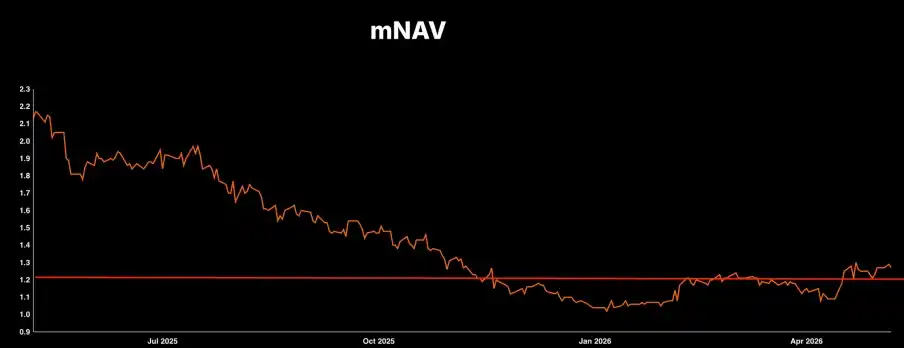
Monitoring tip: Currently, MSTR's premium is fluctuating around 1.28x, not yet triggering the arbitrage condition. Blindly opening positions is premature. However, it has already entered an excellent targeting zone. Set up price alerts and wait for it to drop below the threshold before acting.

3. Significantly Enhanced Safety Net for STRC (Preferred Shares)

STRC offers a high dividend yield of 11.5%. In the previous bearish narrative, MicroStrategy was a gambler with massive leverage. Once Bitcoin faced a black swan event like a halving or more in price, MicroStrategy's cash flow would break, and STRC preferred shares would instantly become worthless.

But the Q1 earnings report completely revealed the company's true financials, not only refuting the shorts but also giving fixed-income investors a dose of confidence:

● Impressive asset thickness: On the liabilities side, the company has $13.5 billion in preferred shares and $8.2 billion in convertible bonds. On the asset side, there is a corresponding $64 billion in BTC reserves. The net leverage ratio is a negligible 9%, which is considered extremely robust in traditional finance.

● Extreme downside stress test: Even if the crypto market experiences another major crash, with BTC plummeting 90% from current levels (all the way down to $7,300), selling their coins would still be enough to repay all net debt.

● Cash moat: As a last resort, even if Bitcoin liquidity dries up and they can't sell quickly, the company still holds $2.25 billion in pure cash on its books. The interest earned from this cash alone, even at a savings rate, would be enough to cover the future 1.5 years (annual $1.5 billion) of debt interest and preferred dividends without lifting a finger. Overall, as long as BTC appreciates by a mere 2.3% annually, STRC's interest obligations can be perfectly covered.

The most crucial expectation reversal lies in this: management has broken the dogma of "never selling coins." This means they will proactively and gradually sell Bitcoin to preserve the company's credit rating and ability to pay interest before an extreme crisis hits. STRC has completely shed the label of "crypto Ponzi high-yield debt." Its risk pricing logic is now moving closer to that of traditional high-quality corporate bonds, making it highly likely to attract allocation buys from traditional institutional funds.

4. Impact on the Broader BTC Market: Losing a "Die-hard Buyer," Removing a "Cascade Liquidation Landmine"

The sentiment shock from this earnings call on the broader BTC spot market is two-sided, requiring traders to view it through different timeframes:

● Short-term pain (sentiment negative): Retail investors previously viewed MicroStrategy as a "bottomless pit" that only buys and never sells, providing perpetual support. Now, management's admission that "they will sell if valuation is wrong" directly shatters this bullish totem. In the short term, this is a significant blow to market optimism and speculative hype.

● Long-term benefit (structural upgrade of the foundation): Traders who understand a bit of cycle history know why the last bear market (2022) fell so hard. Because giants like LUNA, Three Arrows Capital, and Celsius "held on to the bitter end," until liquidity completely dried up and they were forcibly liquidated, leading to cascading sell-offs. The current MicroStrategy is no longer a "believer" swept up by狂热; it's a savvy "Wall Street veteran" who knows how to crunch numbers. It has set a clear early warning line for selling and understands how to proactively reduce leverage by adjusting its portfolio at the onset of a crisis. This is equivalent to defusing the largest "systemic liquidation nuke" hanging over the crypto market in advance.

Summary: MicroStrategy remains the largest "BTC bull commander-in-chief" in the entire U.S. stock market. However, it has evolved from a reckless charger into a precise calculator that knows when to advance and retreat, even harvesting market sentiment in reverse.


Domande pertinenti

QWhat is the significance of the 1.22x mNAV threshold for MicroStrategy, according to the article?

AThe 1.22x mNAV (premium to net asset value) is a critical threshold that dictates MicroStrategy's capital allocation strategy. If MSTR's premium is above 1.22x, the company will continue its historical playbook of issuing stock to buy more Bitcoin (BTC). If the premium falls below 1.22x, management has explicitly stated they will reverse course, selling BTC to raise cash for debt repayment, stock buybacks, or dividends. This provides a hard 'value floor' and removes uncertainty for investors.

QHow does the article describe the arbitrage opportunity related to MSTR and BTC?

AThe article describes a conditional arbitrage strategy triggered when MSTR's premium to its Bitcoin holdings falls below the 1.22x mNAV threshold. At that point, a trader would go long on MSTR stock while simultaneously shorting an equivalent amount of BTC. The 'sure win' logic is that if the market doesn't correct the price disparity, MicroStrategy's management will force it to converge by executing their promised action of selling BTC to buy back their own undervalued shares, aligning with the trader's position.

QWhy is the STRC (Series 2 Preferred Stock) considered to have a significantly improved safety cushion after MicroStrategy's Q1 report?

ASTRC's safety cushion improved because the Q1 report and management commentary changed the risk profile. Previously, STRC, which pays an 11.5% dividend, was seen as risky if a crypto crash forced MSTR into insolvency. Now, management's commitment to sell BTC if necessary to manage liabilities provides a concrete backstop. The article highlights that MSTR's leverage is low (9%), and even a 90% drop in BTC's price would still leave enough value to cover net debt, while the company's cash reserves could cover interest and preferred dividends for 1.5 years without selling any BTC.

QWhat are the two-sided impacts of MicroStrategy's new policy on the broader Bitcoin (BTC) market, as outlined in the article?

AThe impacts are twofold: 1) Short-term negative sentiment (bearish): The policy shatters the myth of MicroStrategy as a 'diamond hands' perpetual buyer that would never sell, removing a key psychological and speculative support pillar for the market. 2) Long-term structural positive (bullish): By establishing a clear selling threshold and showing willingness to de-leverage proactively, MicroStrategy eliminates the risk of a future 'forced liquidation cascade' during a deep bear market. This removes a major potential systemic risk, making the market's foundation healthier.

QHow has MicroStrategy's role in the market evolved, according to the article's conclusion?

AAccording to the article's conclusion, MicroStrategy has evolved from being a reckless, dogma-driven 'believer' or 'charging fool' into a strategic 'Wall Street veteran' or 'actuary.' It remains the largest 'BTC bull commander' in the stock market, but it has transformed into a more rational entity that calculates carefully, advances and retreats with discipline, and can even profit from market sentiment reversals, rather than just blindly accumulating Bitcoin at any cost.

Letture associate

Annual Salary of Millions Competing for Electricians, Meta Rushes to Open Its Own Technical School

The AI boom is facing an unexpected bottleneck: a severe shortage of skilled construction workers and electricians. As tech giants like Meta, OpenAI, and Alphabet race to build massive data centers—such as OpenAI's $16 billion "Stargate" project—they are hitting a critical labor wall. The U.S. needs an estimated 130,000 more electricians, 240,000 construction workers, and 150,000 supervisors by 2030 for AI infrastructure alone, but tens of thousands of electrician jobs go unfilled each year. While AI companies offer high premiums, with electricians earning up to $280,000 annually, worker scarcity still causes massive losses—delays on a single project can cost $14.2 million per month. The complexity of building AI data centers, which require immense power (equivalent to powering hundreds of thousands of homes), sophisticated electrical systems, and advanced liquid cooling solutions, demands highly skilled technicians who are in short supply. To combat this, companies are investing heavily in training. Meta has committed $115 million to a free training school offering tuition, housing, and stipends, targeting 5,000 new workers. OpenAI is partnering with unions to secure skilled labor. These efforts are paying off, with a significant rise in Gen Z interest in trade schools over college. However, the power demands are staggering. AI data centers are driving a rapid surge in electricity consumption, projected to account for up to 12% of U.S. power use by 2028 and raising costs for consumers. Furthermore, the construction boom is project-based, leading to a potential future glut of trained workers once building peaks, which could depress wages industry-wide. The race for AI supremacy now depends as much on skilled hands as on advanced chips.

marsbit22 min fa

Annual Salary of Millions Competing for Electricians, Meta Rushes to Open Its Own Technical School

marsbit22 min fa

OpenAI No Longer Sells Its Most Expensive Model for Profit

OpenAI is shifting its business strategy away from promoting its most expensive, flagship models for every task. Recent price cuts—80% for GPT-5.6 Luna and 20% for Terra—signal a deeper change: the company now actively advises users that many tasks don't require the most powerful model. Instead, OpenAI recommends a tiered approach: use the high-end GPT-5.6 Sol for complex planning and analysis, then delegate execution to cheaper models like Luna. This mirrors moves by Anthropic, which recently launched Claude Opus 5 at half the price of its top model, Fable 5. Both companies are de-emphasizing flagship models as primary revenue drivers, using them instead for brand prestige and technological showcases. The industry is entering a "mass-market" phase, similar to automotive, where high-volume, cost-effective models handle daily operations and drive scale. OpenAI's price reductions are partly enabled by AI models themselves optimizing underlying code and infrastructure, creating a self-reinforcing cycle of efficiency gains and cost reduction. Competition is shifting from "who is smartest" to "who offers the best value." The goal is no longer selling individual models but fostering widespread API adoption and ecosystem lock-in. By making AI calls cheap and ubiquitous, companies like OpenAI aim to become the indispensable, utility-like infrastructure powering automated workflows—the "water and electricity" of software, quietly embedded everywhere.

marsbit22 min fa

OpenAI No Longer Sells Its Most Expensive Model for Profit

marsbit22 min fa

Will the Fed Definitely Raise Interest Rates in September? How Will Crypto and U.S. Stocks Withstand the Pressure?

The market's expectation for a September Fed rate hike surged dramatically in early August, jumping from under 50% to over 80% within a week. This shift followed a contentious July FOMC meeting, where a 9-3 vote to hold rates revealed growing dissent from hawkish members advocating for an immediate hike to combat persistent inflation. The primary catalyst for this repricing is rising oil prices, driven by renewed geopolitical tensions around the Strait of Hormuz, which threaten global supply. Energy costs directly influence inflation metrics, making the upcoming July CPI report (due August 12th) a critical data point. If it shows inflation reaccelerating, the probability of a September hike will solidify. For Bitcoin and crypto assets, this is typically bearish news. Bitcoin continues to behave as a high-beta, liquidity-sensitive risk asset. A rate hike raises the opportunity cost of holding non-yielding assets and could drive capital toward money markets, pressuring crypto prices in the short term. However, historical patterns suggest that if a hike is perceived as the end of a tightening cycle rather than the start, any negative price impact may be brief. U.S. stocks, particularly crypto-linked equities like Coinbase and growth-oriented tech stocks, are also vulnerable. Higher rates increase discount rates in valuation models, putting pressure on high-multiple companies. This coincides with a pivotal tech earnings season where investor focus has shifted from massive AI capital expenditure to tangible revenue and cash flow generation. Companies with negative cash flow and weak growth narratives could face heightened volatility if borrowing costs rise in September. In summary, a September Fed hike has evolved into a mainstream market scenario. Key factors to watch are oil prices, the July CPI report, and Fed communications, which will determine the final decision and its impact on volatile crypto and equity markets.

marsbit32 min fa

Will the Fed Definitely Raise Interest Rates in September? How Will Crypto and U.S. Stocks Withstand the Pressure?

marsbit32 min fa

Trading

Spot
活动图片




