MSCI Again Talks About Excluding Cryptotreasuries from Global Indices

cryptonews.ruPubblicato 2026-08-14Pubblicato ultima volta 2026-08-14

Introduzione

Index provider MSCI has proposed changes to its Global Investable Market Indexes (GIMI) methodology, potentially leading to the exclusion of companies that primarily accumulate investment assets instead of conducting operational business. This could affect firms like Strategy, Metaplanet, and other crypto treasuries (DATs), impacting passive investment flows into their stocks. No final decision has been made; consultations will run until September 30, 2026, with results to be announced by October 16. If approved, changes could be implemented during MSCI's November index review. This follows a previous review in early 2026 where MSCI opted against excluding DATs but committed to a broader reassessment of non-operational companies. The new methodology involves a two-step screening process. Companies failing an initial screen (where operational assets must exceed 50% of total assets) face a secondary screen with five financial criteria. A company is deemed ineligible if it meets at least four criteria, such as having operational assets below 20% of total assets, negative operating cash flow, or heavy reliance on capital raising to accumulate assets—a key factor for crypto treasury firms. An analysis of the MSCI ACWI IMI identified three potential exclusions: Strategy, Yellow Cake, and Metaplanet. JPMorgan previously estimated that excluding Strategy alone could trigger outflows of up to $8.8 billion, with broader DAT exclusions potentially causing $10-$15 billion in outflows.

Index provider MSCI has proposed changes to the rules for inclusion in its Global Investable Market Indexes (GIMI), which could potentially lead to the exclusion of companies that primarily accumulate investment assets instead of conducting operational business. The proposed methodology could affect Strategy, Metaplanet, and other DATs, and potentially impact passive investment flows into their shares.

MSCI has not yet made a final decision: consultations will continue until September 30, 2026, and the results are planned to be announced by October 16.

If the proposed rules are approved, changes could be implemented during the MSCI index review in November.

Recall that this is not MSCI's first attempt to reconsider the status of such companies. In early 2026, the provider, after consultations, decided not to exclude DATs from GIMI, but announced its intention to more broadly review its approach to non-operational companies.

Companies That Could Be Excluded from MSCI Indices

As part of its analysis of the MSCI ACWI IMI index, the company identified three potential exclusions — Strategy, Yellow Cake, and Metaplanet.

Another three companies could be placed on a new public watchlist — Center Laboratories, Lydia Holding, and SharpLink.
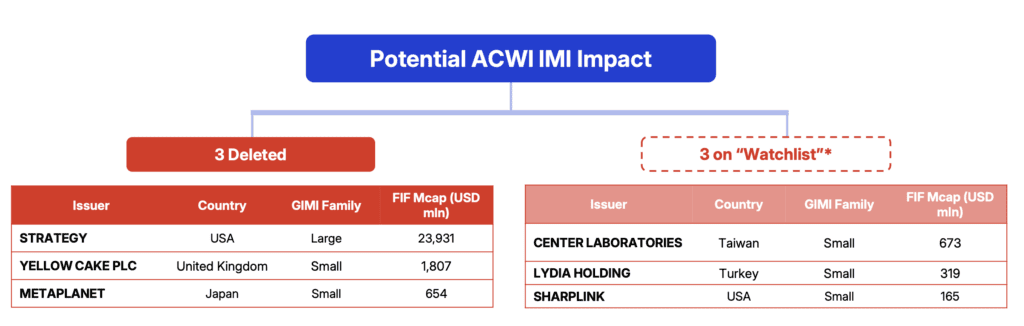
ACWI IMI: Impact of Proposed Methodology. Source: MSCI.

For current index constituents, MSCI proposes applying an additional protective mechanism: a company must fail to meet the criteria for two consecutive annual periods before being excluded. For companies not yet in the index, one period is sufficient to deem them ineligible.

Criteria Proposed by MSCI

The methodology consists of two stages. First, a company must pass the Core Screen, which requires operational assets to comprise more than 50% of total assets. If it fails this requirement, an additional Exclusion Screen with five financial metrics is applied.

A company will be deemed ineligible for index inclusion if at least four of the five criteria are triggered:

  • operational assets constitute less than 20% of total assets;
  • operating expenses — less than 5% of assets;
  • operating cash flow is negative;
  • the proportion of non-operational fair value changes exceeds thresholds set by MSCI;
  • the company is significantly reliant on raising capital to accumulate assets.

This last criterion is one of the key ones for companies that use capital raising to purchase crypto assets.

Previously, JPMorgan estimated that the potential exclusion of Strategy alone could trigger outflows of up to $8.8 billion, while estimates from DAT supporters suggested potential outflows of $10 billion-$15 billion in case of a broader exclusion of such companies.

end-content

Domande pertinenti

QWhat is MSCI proposing regarding its Global Investable Market Indexes (GIMI) and which type of companies are primarily targeted?

AMSCI is proposing to change the inclusion rules for its Global Investable Market Indexes (GIMI), which could potentially lead to the exclusion of companies that primarily accumulate investment assets instead of running an operational business. The proposed methodology may affect DATs, or crypto treasuries, like Strategy, Metaplanet, and others.

QWhat is the timeline for MSCI's consultation and final decision on the proposed index rule changes?

AThe consultation period will last until September 30, 2026. MSCI plans to announce the results of the consultation by October 16, 2026. If the rules are approved, the changes could be implemented during MSCI's index review in November 2026.

QWhich three companies were specifically identified as potential exclusions from the MSCI ACWI IMI index in the analysis?

AIn the analysis of the MSCI ACWI IMI index, three companies were identified as potential exclusions: Strategy, Yellow Cake, and Metaplanet.

QWhat are the two main stages of the methodology proposed by MSCI for determining a company's eligibility for the index?

AThe proposed methodology consists of two stages. First, a company must pass the Core Screen, requiring operating assets to be more than 50% of total assets. If it fails, a second Exclusion Screen is applied, which assesses the company against five specific financial criteria.

QAccording to the article, what are the potential financial impacts estimated for the exclusion of companies like Strategy from MSCI indices?

AAccording to the article, JPMorgan estimated that the potential exclusion of Strategy alone could trigger an outflow of up to $8.8 billion. Supporters of DATs estimated a potential outflow of $10 billion to $15 billion in the event of a broader exclusion of such companies.

Letture associate

Trading

Spot
活动图片