Moutai Moment: When Liquidity Dries Up, Everyone Huddles Around HYPE and ZEC

marsbitPubblicato 2026-05-21Pubblicato ultima volta 2026-05-21

Introduzione

In May 2026, a notable sentiment shift is occurring in the crypto market, symbolized by prominent Ethereum advocate David Hoffman selling his remaining ETH. While major assets like ETH and SOL struggle—ETH is down over 50% from its 2025 high—two assets, HYPE and ZEC, are rallying strongly. This divergence mirrors the "core asset crowding" phenomenon seen in traditional markets during liquidity crunches, where capital concentrates in few perceived safe havens. The market faces liquidity pressure, partly due to Bitcoin ETF outflows and stalled narratives for major Layer 1s. In contrast, Hyperliquid (HYPE) attracts capital due to its strong fundamentals as a leading decentralized perp exchange with substantial protocol revenue and a share of USDC reserve yields. Its tokenomics, heavily favoring users, add to its appeal. Meanwhile, Zcash (ZEC) surges as a "privacy beta" play, driven by growing fears over AI-driven deanonymization and quantum computing threats. Endorsements from figures like Arthur Hayes and Multicoin Capital's Tushar Jain, alongside regulatory clarity and ETF expectations, fuel its rise. This crowding poses risks. Similar to the A股白酒 rally that ended when liquidity returned, the current crypto crowding could unravel if macro conditions improve or if positions become too concentrated, leading to a sharp correction. The article concludes by questioning whether investors hold assets out of conviction or inertia and prompts consideration of what the next crowded tr...

Author: Deep Tide TechFlow

David Hoffman tweeted at dawn on May 21, 2026.

Just one sentence: "Has the vibe on Crypto Twitter genuinely shifted over the last two weeks, or have I just sold my last ETH?"
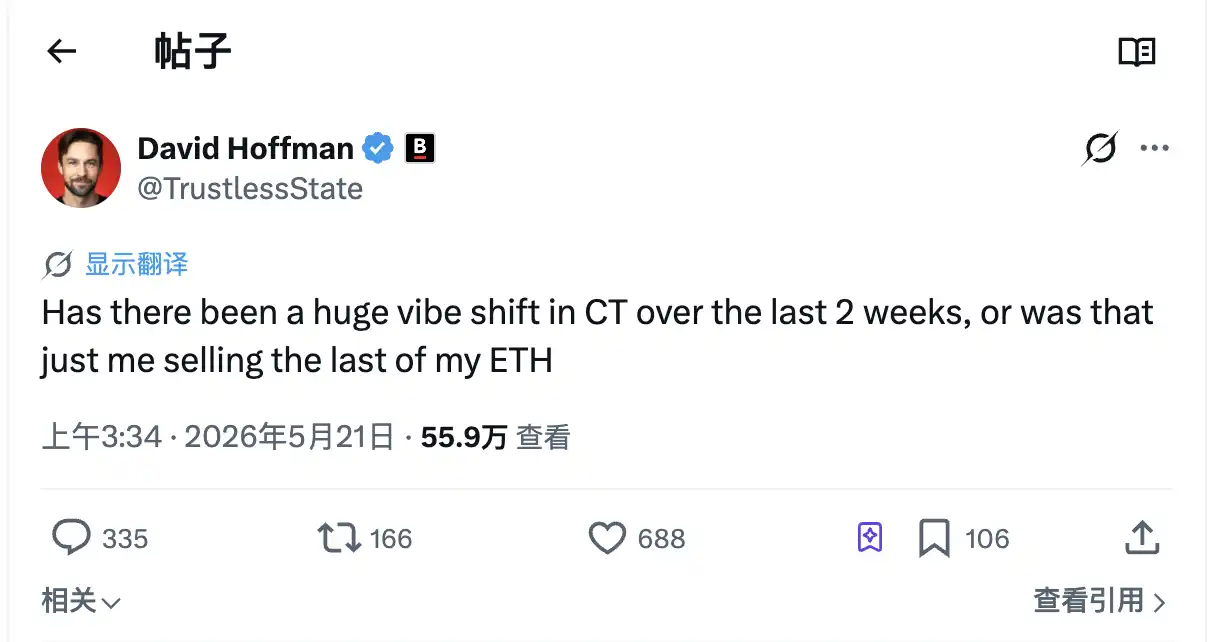
David Hoffman is the co-founder of Bankless, one of Ethereum's biggest public evangelists over the past six years. He once wrote on his personal page, "99% of wealth isn't in banks, it's on Ethereum." This is the man who authored "Ether: The Triple Point Asset" and was a core missionary in the narrative that defined ETH as "ultrasound money."

Now, he has cleared his position.

If last year some still viewed ETH as "the bond of the future world" and SOL as "a high-speed Nasdaq," by May 2026, the market had voted with its prices to complete a thorough de-faithing. ETH is currently struggling around $2,100, halved from its peak of $4,946 in August 2025.

Yet, in the very same market, HYPE is just one step away from its all-time high of $59.39, up 15% in the past seven days; ZEC has more than doubled in the past month, with a year-to-date increase of over 1400%, and its market cap has already squeezed into the top 20.

One market, two different climates.

The Former Baijiu

This isn't the first time such a split has appeared in the crypto world. But you need to temporarily look away from the screen and return to the A-share market in 2020.

From the second half of 2020 to early 2021, A-share liquidity peaked and receded, forcing mutual funds to make a choice: either spread their positions evenly across over 3,000 stocks and accept mediocre beta returns, or concentrate their ammunition on a handful of core assets with clear future cash flow stories. Everyone ultimately chose the latter. The result was that Moutai and Wuliangye were lifted to the sky, while the rest of the stocks were thrown into "garbage time" by the market.

That year, there was a very precise term called "core asset huddling." Its essence wasn't fund managers colluding, but an inevitable reaction in an environment of contracting liquidity. When the water in the pool shrinks, all the fish swim to the deepest corner.

The crypto market is now swimming towards that deepest corner.

What happened in the past year? Bitcoin ETFs absorbed roughly $70 billion in funds from 2024-2025, turning Bitcoin into an "asset priced by Wall Street." But this also means Bitcoin's marginal buying power began to be constrained by macro interest rates and stock market risk appetite. Q1 2026 inflation data exceeded expectations, coupled with a single-week net outflow of $1 billion from ETFs, causing the entire market to tremble.

What's more critical is the collapse of the narrative side. Citi cut its 12-month target price for ETH from $4,304 to $3,175 at the beginning of 2026, citing "stalled market structure legislation and weakening on-chain activity"; JPMorgan stated more bluntly in a May 19 report, "ETH needs stronger network growth and DeFi adoption to reverse its weakness relative to Bitcoin." The short-selling research firm Culper Research even publicly shorted ETH and released a report claiming that the Fusaka upgrade weakened the burn mechanism of EIP-1559, stripping ETH of its previous deflationary properties.

Solana is caught in another dilemma. It remains the best chain for DePIN, meme coins, and on-chain transaction experience, but when the market enters a risk-averse period, its greatest asset in the past, "high beta," ironically becomes a liability. Tushar Jain from Multicoin, the man who once carried Solana out of the ruins, publicly announced at Consensus Miami in May that Multicoin had taken a significant long position in Zcash.

This is a landmark moment. Solana's earliest and largest financial backer began shifting faith to another chain.

Huddling Around HYPE and ZEC

So, where did the money go?

The answer is surprisingly consistent: HYPE and ZEC.

The story of Hyperliquid was actually foreshadowed from the almost perfect airdrop in November 2024. The team, led by Harvard alumni Jeff and Iliensinc with backgrounds from Caltech/MIT/Citadel/Hudson River Trading, did something almost no one in crypto had managed in the past decade: distributing 76% of the tokens to users, with zero VC allocation.

If you only see this, you only see its "morality story." What truly propelled HYPE to rise against the trend during the liquidity drought of 2026 is its "cash flow story."

HYPE is not a traditional "narrative token." It is a complete chain, more accurately, a high-speed on-chain ATM in operation: as the largest decentralized perpetual contract exchange, it generates over $1.2 billion in annual protocol revenue; it has an agreement with Circle to share 90% of the USDC reserve yield, a stream alone contributing $135 to $160 million annually to token buybacks; this week (May 19), Bitwise announced adding HYPE to its balance sheet and launched an ETF product based on HYPE.

HYPE's contract open interest currently stands at $2.1 billion, and the funding rate has turned positive, indicating that new long-side capital is continuously entering, not a false prosperity from short squeezes.

The story of ZEC belongs to a completely different dimension. It's not a "cash flow story"; it's a "fear story."

Arthur Hayes wrote directly in his January essay, "This year's dominant narrative is privacy, and ZEC will be the privacy beta. To outperform Bitcoin and Ethereum, I will sell BTC to fund my privacy positions." His fund, Maelstrom, started building positions from Q3 2025.

Then, in early May, Multicoin Capital's Tushar Jain publicly doubled down at Consensus. CoinDesk's March research labeled ZEC with the tag "encryption supremacy," meaning privacy networks have become a dominant infrastructure. The underlying logic chain is the simultaneous convergence of three factors: AI gaining the ability to deanonymize users en masse on transparent blockchains, the threat of quantum computing creating long-term uncertainty for existing wallet encryption systems, and on-chain quarterly trading volume surpassing $100 billion for the first time, turning "wealth visible to the entire network" into a real fear.

The proportion of ZEC supply locked in shielded addresses has reached 30%, a historical high, meaning real privacy demand has quantifiable evidence on-chain, no longer just a literary narrative. The SEC officially closed its over-two-year investigation into the Zcash Foundation on May 20 without proposing any enforcement action. Robinhood has already listed ZEC, and expectations for a Grayscale ZEC ETF are being pushed to the forefront.

Hayes predicts ZEC's market cap will eventually reach 10% of Bitcoin's, corresponding to a token price 15-20 times above current levels.

Will the Huddle Dissolve?

When will the huddle break?

The A-share baijiu huddle broke after the Lunar New Year in 2021. The trigger wasn't deteriorating fundamentals, but a shift in central bank policy, turning the market from a zero-sum game back to a game of incremental funds. When the water in the pool starts to rise, all the fish no longer need to cram into the deepest corner.

When will the crypto world's pool expand? That depends on when the Fed cuts rates, when ETF funds flow back in, when stablecoin market cap hits new highs, and when traditional finance moves more money on-chain.

But one must also be wary of another possibility: the huddle could collapse under its own weight from becoming "too tight." ZEC's contract open interest surged 40% in the past 24 hours to $1.3 billion. This concentration itself is a risk signal. Hayes, Multicoin, retail traders, Robinhood users—everyone crowding into the same trade means the exit of any marginal buyer could trigger a chain reaction of long liquidations. HYPE's funding rate has turned positive and continues to rise, building up financing costs.

The endgame of a huddle is either a rising tide lifts all boats, and everyone takes profits together; or a stampede for the exit, with the last person in taking all the chips.

At which stage are we now? No one can give a definitive answer. But one question is worth asking for everyone reading this article:

If even David Hoffman has sold, the ETH still in your wallet—do you hold it because you believe in it, or because you forgot it was there?

The next question is more practical: When a market has only two names left to huddle around, what will the third name be? Aave? Maker? Some undiscovered privacy L2? Some high-performance chain yet to issue a token?

The person who figures this out will be the first to join the next huddle.

The person who doesn't will be the last to hold the bag when the next huddle breaks.

Domande pertinenti

QWhy is the crypto market showing such a split performance between assets like ETH and HYPE/ZEC?

AThe crypto market is experiencing a significant liquidity contraction. As Bitcoin ETFs have absorbed massive inflows and traditional finance factors now influence its price, broader market liquidity has dried up. In such an environment, capital tends to 'huddle' towards a few select assets with the strongest narratives or fundamentals. HYPE offers a strong cash flow story through its protocol revenue and tokenomics, while ZEC is seen as a prime 'privacy beta' hedge against increasing surveillance and AI-driven de-anonymization threats on transparent blockchains. This creates a two-tier market where money flows only to the perceived safest or highest-conviction bets, leaving former leaders like ETH behind.

QWhat are the main reasons for HYPE's (Hyperliquid) strong performance during the market downturn?

AHYPE's strength is driven by its dual narrative of 'moral legitimacy' and a robust 'cash flow story.' Firstly, its token distribution, with 76% allocated to users and no VC allocation, builds strong community trust. More importantly, it functions as a cash-generating machine: it's the largest decentralized perpetual exchange, generating over $1.2B in annual protocol revenue. A key revenue stream is its agreement with Circle, sharing 90% of the USDC reserve yield, which contributes $135-160M annually for token buybacks. Its recent inclusion in Bitwise's balance sheet and the launch of an HYPE-based ETF further solidify its status as a 'quality asset' in a risk-off environment.

QWhat is the core narrative driving the massive surge in ZEC's price?

AThe surge in ZEC is driven by a 'fear narrative' centered on privacy becoming a critical infrastructure need. Key catalysts include the growing capability of AI to de-anonymize users on transparent blockchains, the long-term threat of quantum computing to existing cryptographic security, and the psychological impact of managing increasingly large, publicly visible on-chain wealth. Figures like Arthur Hayes and funds like Multicoin Capital have publicly endorsed ZEC as the premier 'privacy beta' play. Tangible evidence includes a record 30% of ZEC's supply being locked in shielded addresses, indicating real usage. Furthermore, the SEC's closure of its investigation into the Zcash Foundation without action removed a regulatory overhang, boosting confidence.

QWhat historical market phenomenon does the article compare the current crypto market situation to?

AThe article compares the current situation in crypto to the 'core asset huddle' (or '抱团') seen in China's A-share market in 2020-2021. During that period, as market liquidity peaked and began to recede, mutual funds concentrated their capital into a handful of 'core assets' like Kweichow Moutai (茅台) and Wuliangye (五粮液) that had clear future cash flow stories, while neglecting the broader market. The article uses the metaphor: 'When the water in the pond decreases, all the fish swim to the deepest corner.' This mirrors the current crypto environment where shrinking liquidity is forcing capital to concentrate in assets like HYPE and ZEC.

QAccording to the article, what are the potential outcomes for the current market 'huddle' around HYPE and ZEC?

AThe article outlines two potential outcomes for the current 'huddle.' The first is a positive scenario where 'the tide lifts all boats'—increased overall market liquidity from factors like Fed rate cuts, ETF inflows, or stablecoin growth allows everyone in the trade to profitably exit. The second is a negative, self-destructive scenario where the huddle becomes too crowded and collapses. Warning signs include ZEC's open interest surging 40% in 24 hours and HYPE's funding rate turning positive and rising, indicating high leverage and concentrated positions. A single shift in marginal buying pressure could trigger a cascade of liquidations, leaving the last entrants holding the bag ('the last person to enter takes all the chips').

Letture associate

IOSG Founder: Web3 Is 'Losing Blood,' How Can Practitioners Survive Better?

IOSG Founder: Web3 Is "Bleeding Out" – How Can Practitioners Survive Better? In a candid reflection, the founder of IOSG Ventures voices deep concerns about the current state of Web3, describing an ecosystem experiencing severe "blood loss." Despite the recent MuShanghai event showcasing a successful pivot towards a more diverse, global community, a somber reality persists: many crypto-native attendees were there exploring exits or new labels in biotech, AI, and robotics. The core issue is identified as a breakdown in the ecosystem's positive feedback loop. Alarmingly, underestimated "low-probability bad events" are occurring simultaneously: a significant brain drain of Chinese developers to AI, a lack of breakout applications despite massive funding, and a widening credibility gap for practitioners globally, often stigmatized as scam artists. This has created a dire接班人 (successor) problem, with the next generation seeing little professional prestige or financial upside in crypto compared to fields like AI. A significant portion of the critique focuses on Ethereum and Vitalik Buterin. While not pessimistic about Ethereum's technology, the founder worries that critical development windows were missed by focusing on niche technical narratives like ZK and L2 instead of mass-market applications. A more urgent concern is that Vitalik may be isolated in an "information bubble," shielded from the grassroots community's hardships by layers of intermediaries, preventing crucial feedback from reaching him. The call is for Vitalik to return to a founder's mindset, re-engage directly with the community, and rally efforts for the next decade. The divergence between U.S. and Chinese OG (Original Gangster) ecosystems is stark. While many U.S. builders reinvest their wealth into the ecosystem, the Chinese scene suffers from a severe lack of "造血能力" (blood-making ability), with most market-driven funds struggling and many early success stories cashing out entirely. This threatens the entire Asian Web3 ecosystem's survival. For individual practitioners, survival advice is pragmatic: find your core "why," maintain life balance beyond token prices, continuously learn new skills (like AI), form small, trusted alliances for mutual support, and practice self-compassion. The industry's greatest need is not money or tech, but lighthouses—individuals at all levels who offer mentorship, grants, referrals, and honest reflection to guide others. The piece concludes with a direct appeal: OGs must pay forward the opportunities the industry gave them; founders must not struggle alone; and builders must continue their work, ensuring it remains a viable profession. The survival of Web3's "cathedral" depends not on any single leader but on the collective responsibility of everyone who remains.

marsbit24 min fa

IOSG Founder: Web3 Is 'Losing Blood,' How Can Practitioners Survive Better?

marsbit24 min fa

Deficits, Inflation, and the New Fed: The Deep Logic Behind US Bond Yields Breaking 5% and the Market Reset

In the week of May 15-19, 2026, U.S. long-term Treasury yields surged to multi-year highs, with the 30-year yield hitting 5.2%, a level unseen since 2007, and the 10-year yield climbing to 4.687%. Equity markets declined in response. Four primary factors are driving the rise in yields. First, stubborn inflation persists, with April wholesale prices rising 6% year-over-year, fueling expectations of potential future Fed rate hikes instead of cuts. Second, newly confirmed Fed Chair Kevin Warsh inherits a complex inflation battle, with markets closely awaiting his first FOMC meeting. Third, deteriorating U.S. fiscal health, marked by large deficits and rising debt servicing costs, is eroding the traditional "safe-haven" premium for Treasuries. Fourth, the "One Big Beautiful Bill" tax cuts are projected to add trillions to the national debt, contributing to Moody's recent credit rating downgrade. Rising yields pressure stocks through several channels: a higher discount rate reduces the present value of future earnings (especially for growth stocks); rising risk-free rates compress equity risk premiums, making bonds relatively more attractive; higher borrowing costs impact consumers and corporations; and a stronger dollar affects multinational earnings. For investors, the environment favors value and financial stocks over long-duration growth stocks. Bond investors find attractive yields in short to intermediate maturities, while income investors see the best fixed-income opportunities in over a decade. Key developments to watch include Chair Warsh's first FOMC meeting, upcoming inflation data, Treasury auction demand, and whether the 30-year yield approaches 6%, a level that could trigger a more sustained equity valuation reset. The bond market's message is clear: the era of cheap government borrowing is over, posing a central challenge for markets in late 2026.

marsbit25 min fa

Deficits, Inflation, and the New Fed: The Deep Logic Behind US Bond Yields Breaking 5% and the Market Reset

marsbit25 min fa

Is MicroStrategy Selling Bitcoin Not a Bearish Signal? Deconstructing the 5 Financial Logics Behind Corporate Bitcoin Divestment

The article "Is Strategy Selling Bitcoin Not a Bearish Signal? Decoding 5 Financial Logics Behind Corporate Bitcoin Divestment" analyzes why companies might sell their bitcoin holdings, arguing it's not necessarily negative. It begins by noting the market's surprise at Strategy's potential sale, contrasting its previous "never sell" stance. The core argument is that corporate decisions prioritize shareholder value, and selling bitcoin can be a rational strategic choice. The article outlines five key financial reasons for such sales: 1. **Increase Bitcoin Holdings Per Share:** Companies can use proceeds from bitcoin sales to repurchase shares when the stock price is undervalued relative to its bitcoin assets. This reduces the outstanding share count, potentially increasing the bitcoin amount backing each remaining share. 2. **Optimize Capital Structure & Reduce Financing Costs:** Building cash reserves through bitcoin sales can improve credit ratings (as favored by agencies like S&P), leading to lower future borrowing costs. Repaying debt with sale proceeds also reduces financial leverage. 3. **Legitimate Tax Planning:** In the absence of wash-sale rules for bitcoin in the US, companies can sell to realize capital losses, then repurchase, lowering the tax basis of their holdings and creating tax offsets. 4. **Counter Negative Market Narratives:** A controlled, non-disruptive sale could demonstrate market resilience and disprove fears that corporate selling would crash the market, thereby normalizing bitcoin as a corporate treasury asset. 5. **Repurchase Preferred Stock at a Discount:** If a company's preferred stock trades significantly below its face value, using bitcoin sale proceeds to repurchase it can retire expensive liabilities at a profit, saving on future dividend payments. The conclusion emphasizes that bitcoin's monetary properties offer flexibility. Strategic sales can protect corporate and shareholder interests, making asset utilization more important than rigid "hold" mandates.

marsbit55 min fa

Is MicroStrategy Selling Bitcoin Not a Bearish Signal? Deconstructing the 5 Financial Logics Behind Corporate Bitcoin Divestment

marsbit55 min fa

Why Did Zhipu Surge Nearly 30% in a Single Day?

"Global AI Model Unicorn" Zhipu's stock surged nearly 30% in a single day, reaching a new market cap high. The catalyst was the launch of its GLM-5.1-highspeed API, boasting a generation speed of **400 tokens per second**, setting a new global benchmark. This speed, roughly 3-5 times faster than industry leaders like OpenAI's GPT-4o and Anthropic's Claude, is achieved **without compromising the full-scale model's capabilities**. In the era of AI Agents requiring dozens of self-calls, such latency reduction is critical, transforming speed from a system metric into a determinant of intelligence limits. The breakthrough stems from a three-layer technical overhaul: 1. **TileRT Inference Engine**: Compiles the entire model into a continuous, always-on computation pipeline using "Warp Specialization," minimizing GPU idle time by having different processor groups handle data loading, computation, and communication in parallel. 2. **Heterogeneous Parallelism for MLA**: To efficiently run the GLM-5.1 model using the MLA attention mechanism, TileRT employs a heterogeneous strategy. One GPU handles sparse indexing/routing, while the others perform dense computation, optimizing for MLA's unique workflow. 3. **ZCube Network Architecture**: Replaces the standard Spine-Leaf (ROFT) network topology with a flat, dual-group interconnect. This design creates a single optimal path between any two GPUs, eliminating network congestion at scale and reducing latency. The business impact is significant: a 15% increase in cluster throughput (free extra capacity), a 40.6% reduction in tail latency (improved stability), and a one-third cut in networking hardware costs. Long-term, this innovation challenges the dominance of NVIDIA's integrated hardware-software stack (GPU+NVLink+InfiniBand), potentially benefiting manufacturers of high-density Leaf switches and optical modules while lowering the software barrier for domestic AI chips like Huawei's Ascend. The innovation proves that more can be achieved with the same compute, reshaping the infrastructure beyond just GPUs.

marsbit2 h fa

Why Did Zhipu Surge Nearly 30% in a Single Day?

marsbit2 h fa

Trading

Spot
Futures

Articoli Popolari

Come comprare HYPE

Benvenuto in HTX.com! Abbiamo reso l'acquisto di Hyperliquid (HYPE) semplice e conveniente. Segui la nostra guida passo passo per intraprendere il tuo viaggio nel mondo delle criptovalute.Step 1: Crea il tuo Account HTXUsa la tua email o numero di telefono per registrarti il tuo account gratuito su HTX. Vivi un'esperienza facile e sblocca tutte le funzionalità,Crea il mio accountStep 2: Vai in Acquista crypto e seleziona il tuo metodo di pagamentoCarta di credito/debito: utilizza la tua Visa o Mastercard per acquistare immediatamente HyperliquidHYPE.Bilancio: Usa i fondi dal bilancio del tuo account HTX per fare trading senza problemi.Terze parti: abbiamo aggiunto metodi di pagamento molto utilizzati come Google Pay e Apple Pay per maggiore comodità.P2P: Fai trading direttamente con altri utenti HTX.Over-the-Counter (OTC): Offriamo servizi su misura e tassi di cambio competitivi per i trader.Step 3: Conserva Hyperliquid (HYPE)Dopo aver acquistato Hyperliquid (HYPE), conserva nel tuo account HTX. In alternativa, puoi inviare tramite trasferimento blockchain o scambiare per altre criptovalute.Step 4: Scambia Hyperliquid (HYPE)Scambia facilmente Hyperliquid (HYPE) nel mercato spot di HTX. Accedi al tuo account, seleziona la tua coppia di trading, esegui le tue operazioni e monitora in tempo reale. Offriamo un'esperienza user-friendly sia per chi ha appena iniziato che per i trader più esperti.

252 Totale visualizzazioniPubblicato il 2024.12.11Aggiornato il 2026.04.28

Come comprare HYPE

Discussioni

Benvenuto nella Community HTX. Qui puoi rimanere informato sugli ultimi sviluppi della piattaforma e accedere ad approfondimenti esperti sul mercato. Le opinioni degli utenti sul prezzo di HYPE HYPE sono presentate come di seguito.

活动图片













