Moscow Exchange Set to Launch $XRP Indices and Futures Contracts

bitcoinistPubblicato 2026-02-03Pubblicato ultima volta 2026-02-03

Introduzione

The Moscow Exchange (MOEX), Russia's largest financial marketplace, is preparing to launch indices and futures contracts for XRP, marking a significant shift in the country's approach to digital assets. This move is seen as a pragmatic step toward using cryptocurrencies for cross-border liquidity outside the SWIFT system, particularly given XRP's institutional settlement utility. The introduction of futures will allow Russian institutional investors to hedge crypto exposure without direct token ownership. In contrast, the retail market is showing increased interest in high-risk, high-reward projects like Maxi Doge ($MAXI), an Ethereum-based token that promotes a high-leverage trading culture. It features gamified trading competitions and a staking system offering 68% APY to incentivize long-term holding. The project has raised $4.5M in its presale, targeting traders seeking aggressive returns in the current bull market.

Sanctions evasion and digital asset adoption have reached a critical flashpoint in Russia.

The Moscow Exchange (MOEX), the country’s largest financial marketplace, is reportedly finalizing the infrastructure to launch indices and futures contracts for $XRP, according to local media outlet RBC. That milestone marks a sharp pivot from the Kremlin’s historical skepticism regarding cryptocurrencies.

It signals a pragmatic shift toward assets that facilitate cross-border liquidity outside the SWIFT system.

Why $XRP? It’s long been positioned by Ripple Labs as a bridge currency for institutional settlement. (The irony of a U.S.-based blockchain firm becoming a liquidity rail for a sanctioned economy isn’t lost on anyone.)

The introduction of futures contracts on MOEX allows domestic institutional investors to hedge exposure to crypto assets without holding the underlying tokens directly, a massive step for integrating digital assets into the broader Russian economy. The choice of $XRP over other altcoins stems from its speed and established utility in global banking pilots.

While Bitcoin remains the primary store of value, $XRP’s lower transaction costs and sub-second finality make it a more attractive vehicle for the high-frequency nature of futures trading. The move effectively institutionalizes volatility, transforming what was once a speculative retail playground into a regulated derivative market.

But while institutions build compliant rails for $XRP, the retail sector is looking elsewhere. Traders are gravitating toward assets that embody the raw, unbridled energy of the current bull cycle. As traditional finance adopts crypto utility, the ‘degen’ economy is doubling down on high-leverage culture, seeking projects that mirror the relentless grind of market speculation. Projects like Maxi Doge ($MAXI).

Maxi Doge brings ‘Leverage King’ Culture to Ethereum

As the Moscow Exchange prepares to formalize crypto trading for the elite, the retail market is witnessing the rise of Maxi Doge ($MAXI), a project that arguably captures the current market zeitgeist better than any institutional derivative. Built on the Ethereum network, Maxi Doge positions itself as the ‘heavier,’ more aggressive cousin to the original Dogecoin, specifically targeting traders who live for high-leverage environments.
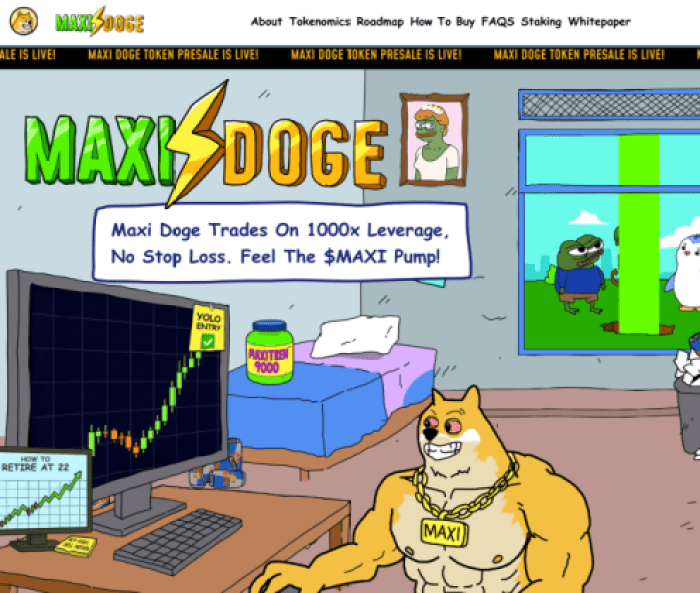
The project plans to differentiate itself through a gamified ‘Leverage King’ culture. Rather than relying solely on passive holding, Maxi Doge integrates holder-only trading competitions where participants vie for leaderboard rewards. It’s a shift that transforms the community from passive spectators into active participants.

This answers a specific behavioral shift in the market: retail traders aren’t satisfied with slow gains anymore; they’re seeking outsized returns and the social validation that comes with high-stakes trading.

By gamifying the grind of the bull market, Maxi Doge creates a sticky ecosystem that rewards conviction, a stark contrast to the sterile, regulated environment being built by traditional exchanges like MOEX.

FIND OUT MORE IN OUR ‘WHAT IS MAXI DOGE?’ GUIDE

Presale Momentum and Dynamic Staking Rewards

While the narrative drives the community, the numbers underpinning Maxi Doge reveal a financial structure designed for sustainability. The project has moved well beyond the conceptual phase, with the official presale already raising $4.5M.

This capital injection is being directed toward the ‘Maxi Fund’ treasury, which supports liquidity provision and future partnership developments (potentially even integrations with futures platforms down the line).

At the current presale price of $0.0002802, the token offers an accessible entry point for retail investors who missed the early days of legacy meme coins. But frankly, the protocol’s staking mechanism is where the long-term value proposition becomes clear.

Maxi Doge employs a dynamic APY system (currently offering 68% rewards), planning to distribute rewards daily from a dedicated 5% staking allocation pool. This smart contract-governed distribution is designed to incentivize lock-ups for up to one year, reducing circulating supply pressure while rewarding those with the ‘diamond hands’ mentality the project espouses.

The security of the ERC-20 standard provides the technical backbone, but the economic model is distinctively modern. By combining the viral appeal of ‘gym bro’ humor, ‘Never skip leg-day, never skip a pump,’ with hard-coded financial incentives, Maxi Doge attempts to solve the liquidity flight often seen in meme tokens.

It creates a feedback loop where staking reduces sell pressure, potentially amplifying price action when market volatility spikes.

BUY $MAXI NOW FROM ITS OFFICIAL PRESALE SITE.

The content provided in this article is for informational purposes only and does not constitute financial advice. Cryptocurrency markets, including derivatives on the Moscow Exchange and meme tokens like Maxi Doge, are highly volatile and carry significant risk. Always conduct your own due diligence before investing.


Domande pertinenti

QWhat is the Moscow Exchange planning to launch for $XRP, and why is this significant?

AThe Moscow Exchange is finalizing the infrastructure to launch indices and futures contracts for $XRP. This is significant because it marks a major shift from Russia's historical skepticism of cryptocurrencies and represents a pragmatic move toward using digital assets for cross-border liquidity outside the SWIFT system.

QAccording to the article, what are the two main reasons $XRP was chosen over other altcoins for this initiative?

A$XRP was chosen for its speed and its established utility in global banking pilots, making it more attractive for the high-frequency nature of futures trading due to its lower transaction costs and sub-second finality.

QHow does the article contrast the institutional adoption of $XRP with the current trend in the retail crypto market?

AThe article contrasts the institutional, compliant rails being built for $XRP with the retail trend of gravitating towards high-leverage, speculative projects like Maxi Doge ($MAXI), which embodies the 'degen' economy and raw energy of the current bull cycle.

QWhat is the core concept behind Maxi Doge's 'Leverage King' culture?

AMaxi Doge's 'Leverage King' culture is a gamified system that features holder-only trading competitions where participants compete for leaderboard rewards, transforming the community from passive holders into active participants seeking outsized returns and social validation.

QWhat are two key features of Maxi Doge's ($MAXI) financial structure mentioned in the article?

ATwo key features are its dynamic APY staking system (currently 68%), which rewards users daily from a dedicated pool to incentivize long-term lock-ups, and its 'Maxi Fund' treasury, which uses presale funds to support liquidity and future development.

Letture associate

In Conversation with Ray Dalio: We Are Currently in an AI Bubble, with 1% of My Portfolio in Bitcoin

Ray Dalio, founder of Bridgewater Associates, warns in an interview that the current AI boom shows classic bubble characteristics, which could lead to significant economic downturns as seen in past cycles like 1929 or 2000. He explains that speculative enthusiasm, fueled by debt and overvaluation, often precedes a crash when rising rates or taxation force asset sales, causing widespread losses and recession. Dalio also outlines his "Big Cycle" theory, describing an approximate 80-year pattern where widening wealth gaps, massive government deficits, and shifting geopolitical power (like China's rise) create internal conflict and global instability. He emphasizes that we are in a late-cycle, transitional phase where traditional powers like the US and UK face decline. For personal wealth protection, Dalio advises diversification beyond cash into assets like stocks, bonds, real estate, and particularly gold, which he prefers over Bitcoin. While he holds about 1% of his portfolio in Bitcoin as a non-printable hard asset, he views gold as more secure from technological or governmental threats. Regarding AI's impact, Dalio believes it will disproportionately benefit capital owners, worsening inequality by replacing both physical and cognitive labor. He suggests that human intuition and emotional intelligence, combined with AI, will be key for future workers. On taxation, Dalio argues that wealth taxes are impractical and risk triggering asset sell-offs, reducing productive investment. He points to the UK as a cautionary example of debt, low productivity, and political strife. Geopolitically, Dalio foresees a more regionalized world, with the US showing weakness in prolonged conflicts like with Iran, akin to past imperial declines. The ideal outcome, he suggests, is coexisting powerful blocs (e.g., Americas, China-Asia Pacific) without major war.

marsbit57 min fa

In Conversation with Ray Dalio: We Are Currently in an AI Bubble, with 1% of My Portfolio in Bitcoin

marsbit57 min fa

Daily 7.2 Trillion KRW: Foreign Capital's Record Net Buying on Friday! Wall Street Says Headwinds for Korean Stock Fund Flows Have Subsided

South Korean stock market sees a dramatic shift in fund flows. On July 31, foreign investors made a record net purchase of approximately KRW 7.2 trillion in KOSPI stocks, marking a fundamental reversal from the persistent large-scale net outflows seen in previous months. This contributed to a significant narrowing of foreign net selling in July to KRW 9.8 trillion, down sharply from KRW 48.4 trillion in June and KRW 44.5 trillion in May. Simultaneously, domestic institutional pressure eased. South Korean pension funds and asset managers turned to a net buying position in July, purchasing KRW 1.0 trillion worth of KOSPI shares, contrasting with net sales in May and June. Market volatility is expected to be dampened by new financial regulations. Effective July 31, the Financial Services Commission tightened access for retail investors to single-stock leveraged ETFs by raising the minimum cash deposit requirement. Trading volumes for these products subsequently dropped to about 50% of their monthly average. Citigroup Research maintains its year-end KOSPI target of 10,000 points. The firm cites several supportive factors: the substantial easing of headwinds from capital outflows, a robust fundamental outlook for the semiconductor sector, historically low market valuations, strong economic fundamentals, and the potential for policy support from financial authorities if needed.

marsbit57 min fa

Daily 7.2 Trillion KRW: Foreign Capital's Record Net Buying on Friday! Wall Street Says Headwinds for Korean Stock Fund Flows Have Subsided

marsbit57 min fa

Thanks to Dice Rolls, Bitcoin Keys Are Stored Offline, But Not Everyone Will Do It

The article discusses using dice rolls to generate secure Bitcoin wallet seeds, providing entropy independent of potentially flawed hardware random number generators. It explains that each fair dice roll offers about 2.585 bits of entropy, with around 50 rolls needed for a standard 12-word seed phrase and 99+ recommended for higher security. This method gained attention after a vulnerability was revealed in some Coldcard hardware wallets, where a faulty firmware RNG (dating back to 2021) compromised generated keys. The analysis notes that while a dice-generated main seed was safe from this specific flaw, other Coldcard functions (like creating paper wallets, backup keys, or passwords) could still be vulnerable if they used the defective RNG. The piece argues that while dice-based entropy is technically robust, the manual process is error-prone, tedious, and unrealistic for most new users, who might make mistakes in recording or inputting rolls. It concludes that while manual entropy generation should remain an option for advanced users, the long-term goal is to develop reliable, user-friendly hardware and software that securely generates randomness without requiring specialized knowledge. Coldcard users are advised to check their firmware version and replace any secondary secrets (like paper wallet keys) created with vulnerable devices, while also considering multi-signature setups with devices from different manufacturers for added security.

cryptonews.ru6 h fa

Thanks to Dice Rolls, Bitcoin Keys Are Stored Offline, But Not Everyone Will Do It

cryptonews.ru6 h fa

Trading

Spot
活动图片




