Morgan Stanley Eyes Bitcoin ETF With Fee That Could Shake An $83 Billion Market

bitcoinistPubblicato 2026-03-29Pubblicato ultima volta 2026-03-29

Introduzione

Morgan Stanley has filed for a spot Bitcoin ETF with a record-low fee of 0.14%, undercutting major competitors like BlackRock (0.25%) and Grayscale (0.15%). The bank’s strategy targets its network of 16,000 financial advisors who manage $6.2 trillion in assets, making the product an easy recommendation without client fee concerns. If approved, it would be the first U.S. spot Bitcoin ETF issued by a major bank. The fund has appointed Coinbase and Bank of New York Mellon as custodians, signaling a long-term commitment. This move could pressure the $83 billion ETF market to lower fees. Morgan Stanley is also expanding into other crypto ETFs, including Solana and staked Ether.

Morgan Stanley’s 16,000 financial advisors manage $6.2 trillion in client assets. That number has been sitting in the background of a major filing — and it explains a lot about why the bank set its proposed Bitcoin ETF fee where it did.

A Fee Built For Advisors, Not Just Investors

The bank filed an updated S-1 registration statement with the SEC on Friday, setting the fee for its proposed Morgan Stanley Bitcoin Trust at 0.14%.

If approved, that would make it the lowest fee of any spot Bitcoin ETF currently trading in the US market. Bloomberg ETF analyst Eric Balchunas said the fee was set with advisors in mind — at that price point, no one on the firm’s sales floor would feel awkward recommending the product to clients.
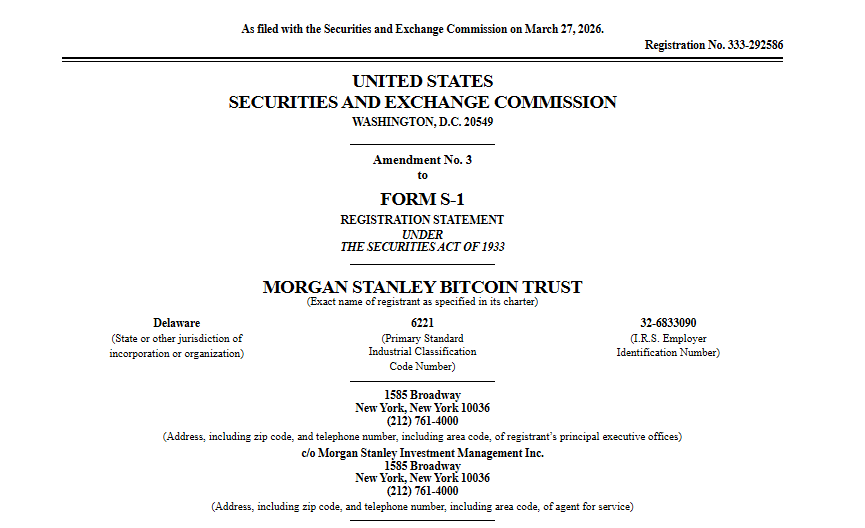
Morgan Stanley disclosed the 0.14% fee in its latest S-1 filing on Friday.

That is a practical calculation. Advisors who push high-fee products into client portfolios face questions. At 0.14%, those questions go away.

BlackRock’s iShares Bitcoin Trust charges 0.25%. The Grayscale Bitcoin Mini Trust sits at 0.15%. Morgan Stanley is going in one basis point below both of its nearest rivals.

Bloomberg ETF analyst James Seyffart called it a big move and said an early April launch is likely, pending regulatory approval.

Image: Kitco

First Bank To Issue A Spot Bitcoin ETF

Approval would put Morgan Stanley in a category of one. No major bank has yet issued a spot Bitcoin ETF in the US. That distinction, combined with a rock-bottom fee and a distribution network of thousands of advisors, gives the product a strong early position if it clears the SEC.

Bitcoin is now trading at $66,180. Chart: TradingView

The bank named Coinbase and Bank of New York Mellon as custodians for the fund. Those are two of the most established names in digital asset custody, and the pairing signals that Morgan Stanley is building this to last — not testing the waters.

Rivals will now face a decision. The $83 billion spot ETF market has operated with fees clustered around 0.20% to 0.25%. A new entrant coming in below all of them puts pressure on existing providers to respond or accept the risk of losing assets over time.

More Than Just Bitcoin

The Bitcoin ETF is one piece of a larger push. In January, Morgan Stanley also filed for a Solana ETF and a staked Ether ETF. Weeks later, it applied for a national trust banking charter that would allow it to custody digital assets, carry out trades, and offer staking services directly to clients.

Featured image from Unsplash, chart from TradingView

Domande pertinenti

QWhat is the proposed fee for Morgan Stanley's Bitcoin ETF and how does it compare to its competitors?

AMorgan Stanley's proposed Bitcoin ETF fee is 0.14%, which is lower than BlackRock's iShares Bitcoin Trust (0.25%) and the Grayscale Bitcoin Mini Trust (0.15%).

QWhy did Morgan Stanley set its Bitcoin ETF fee at 0.14%, according to Bloomberg analyst Eric Balchunas?

AEric Balchunas stated that the 0.14% fee was set with the firm's financial advisors in mind, making it a price point where no one would feel awkward recommending the product to clients.

QWhat significant distinction would Morgan Stanley achieve if its Bitcoin ETF is approved by the SEC?

AMorgan Stanley would become the first major bank to issue a spot Bitcoin ETF in the US.

QWhich two companies did Morgan Stanley name as custodians for its proposed Bitcoin fund?

AMorgan Stanley named Coinbase and Bank of New York Mellon as the custodians for the fund.

QBeyond a Bitcoin ETF, what other crypto-related products has Morgan Stanley recently filed for?

AIn addition to the Bitcoin ETF, Morgan Stanley has also filed for a Solana ETF, a staked Ether ETF, and applied for a national trust banking charter to custody digital assets and offer staking services.

Letture associate

Google and Amazon Simultaneously Invest Heavily in a Competitor: The Most Absurd Business Logic of the AI Era Is Becoming Reality

In a span of four days, Amazon announced an additional $25 billion investment, and Google pledged up to $40 billion—both direct competitors pouring over $65 billion into the same AI startup, Anthropic. Rather than a typical venture capital move, this signals the latest escalation in the cloud wars. The core of the deal is not equity but compute pre-orders: Anthropic must spend the majority of these funds on AWS and Google Cloud services and chips, effectively locking in massive future compute consumption. This reflects a shift in cloud market dynamics—enterprises now choose cloud providers based on which hosts the best AI models, not just price or stability. With OpenAI deeply tied to Microsoft, Anthropic’s Claude has become the only viable strategic asset for Google and Amazon to remain competitive. Anthropic’s annualized revenue has surged to $30 billion, and it is expanding into verticals like biotech, positioning itself as a cross-industry AI infrastructure layer. However, this funding comes with constraints: Anthropic’s independence is challenged as it balances two rival investors, its safety-first narrative faces pressure from regulatory scrutiny, and its path to IPO introduces new financial pressures. Globally, this accelerates a "tri-polar" closed-loop structure in AI infrastructure, with Microsoft-OpenAI, Google-Anthropic, and Amazon-Anthropic forming exclusive model-cloud alliances. In contrast, China’s landscape differs—investments like Alibaba and Tencent backing open-source model firm DeepSeek reflect a more decoupled approach, though closed-source models from major cloud providers still dominate. The $65 billion bet is ultimately about securing a seat at the table in an AI-defined future—where missing the model layer means losing the cloud war.

marsbit1 h fa

Google and Amazon Simultaneously Invest Heavily in a Competitor: The Most Absurd Business Logic of the AI Era Is Becoming Reality

marsbit1 h fa

Computing Power Constrained, Why Did DeepSeek-V4 Open Source?

DeepSeek-V4 has been released as a preview open-source model, featuring 1 million tokens of context length as a baseline capability—previously a premium feature locked behind enterprise paywalls by major overseas AI firms. The official announcement, however, openly acknowledges computational constraints, particularly limited service throughput for the high-end DeepSeek-V4-Pro version due to restricted high-end computing power. Rather than competing on pure scale, DeepSeek adopts a pragmatic approach that balances algorithmic innovation with hardware realities in China’s AI ecosystem. The V4-Pro model uses a highly sparse architecture with 1.6T total parameters but only activates 49B during inference. It performs strongly in agentic coding, knowledge-intensive tasks, and STEM reasoning, competing closely with top-tier closed models like Gemini Pro 3.1 and Claude Opus 4.6 in certain scenarios. A key strategic product is the Flash edition, with 284B total parameters but only 13B activated—making it cost-effective and accessible for mid- and low-tier hardware, including domestic AI chips from Huawei (Ascend), Cambricon, and Hygon. This design supports broader adoption across developers and SMEs while stimulating China's domestic semiconductor ecosystem. Despite facing talent outflow and intense competition in user traffic—with rivals like Doubao and Qianwen leading in monthly active users—DeepSeek has maintained technical momentum. The release also comes amid reports of a new funding round targeting a valuation exceeding $10 billion, potentially setting a new record in China’s LLM sector. Ultimately, DeepSeek-V4 represents a shift toward open yet realistic infrastructure development in the constrained compute landscape of Chinese AI, emphasizing engineering efficiency and domestic hardware compatibility over pure model scale.

marsbit2 h fa

Computing Power Constrained, Why Did DeepSeek-V4 Open Source?

marsbit2 h fa

Trading

Spot
Futures
活动图片