Morgan Stanley Confirms Bitcoin Push: Trading, Yield, Custody

bitcoinistPubblicato 2026-02-26Pubblicato ultima volta 2026-02-26

Introduzione

Morgan Stanley is expanding its Bitcoin and crypto services beyond basic access, as confirmed by Amy Oldenburg, Head of Digital Asset Strategy. The roadmap includes enabling spot trading for E*TRADE clients via a partnership, with plans to develop an in-house custody and exchange solution within a year. This move aims to position Morgan Stanley as the first major bank to offer such integrated services, emphasizing control, trust, and liability management. The bank is also exploring yield and lending products backed by Bitcoin, responding to client demand and the growth of off-platform crypto assets. Oldenburg highlighted the institutionalization of crypto and cited the bank's previous classification of Bitcoin as "digital gold," recommending a 2%–4% portfolio allocation.

Morgan Stanley is preparing to expand its Bitcoin and crypto offering beyond simple access, with plans that span spot trading on E*TRADE, a longer-term move toward native custody and an internal exchange stack, and early-stage exploration of yield and lending services backed by Bitcoin.

The roadmap was outlined onstage at Strategy World 2026 in Las Vegas by Amy Oldenburg, Morgan Stanley’s head of digital asset strategy, during a discussion with Strategy President and CEO Phong Le at the Bitcoin for Corporations conference.

From ‘Renting’ Bitcoin Rails To Building Them

Oldenburg framed Morgan Stanley’s near-term step as enabling E*TRADE clients to “buy and sell crypto, spot crypto,” via a partnership, before potentially moving to “a native custody and exchange solution” over the next year. She suggested that would put Morgan Stanley in position to be “the first major bank” to offer that combination in-house.

Oldenburg asked why the custody-and-exchange layer matters strategically. The answer, she said, comes down to control, trust, and liability. “It’s a natural. We really need to build this out internally. We can’t just primarily rent the technology to do this,” she said. “People expect Morgan Stanley, they trust our brand, to be no-fail. And when you sit in that position, you have a significant responsibility to your clients to make sure that you’re delivering that in any level of technology.”

For Morgan Stanley, custody is not just another feature in the product checklist, it changes the bank’s role and responsibility. “It’s a totally different environment to know that you are custodying your assets,” Oldenburg continued. “You have legal custody with Morgan Stanley, and Morgan Stanley is overseeing those assets for you. There’s always those that are going to want to self-custody. That’s a natural part of this space, especially in the Bitcoin space.”

Oldenburg also positioned the push as a response to client behavior: crypto wealth exists, but not necessarily where Morgan Stanley can serve it. With “$8 trillion in assets on platform,” Le pressed the commercial logic that “people have crypto assets off platform.” Oldenburg agreed and characterized the pool as material, saying it is “a considerable number” of “current clients.”

Oldenburg linked her thinking on adoption back to her prior career running Morgan Stanley’s emerging markets investing business, arguing she has watched Bitcoin and crypto usage develop up close for years. “This has been a very, very long journey for me, being on the ground with many of these companies and investors and users of cryptocurrencies early on,” she said, adding that the goal now is to provide services as crypto “continues to mainstream and institutionalize.”

Oldenburg confirmed that yield and lending against Bitcoin are not theoretical topics inside the firm. Asked directly whether Morgan Stanley might offer “yield and lending services against that Bitcoin,” she replied: “Absolutely. That’s part of the discussion and the exploration. It’s a natural part of the roadmap to continue to explore.”

She added that the bank is still early in designing those products, while noting renewed activity in onchain credit markets. “I think we’re in a very early journey on that, just in terms of the number of products that are out in the market,” she said. “I think we’ve seen, even this year, a little bit surprised at how much momentum there is around DeFi lending.”

In October last year, Morgan Stanley classified Bitcoin as “digital gold,” citing its fixed supply, decentralized architecture, and perceived role as a hedge against macroeconomic instability. The firm also recommended a 2%–4% allocation to digital assets.

At press time, Bitcoin traded at $68,138.
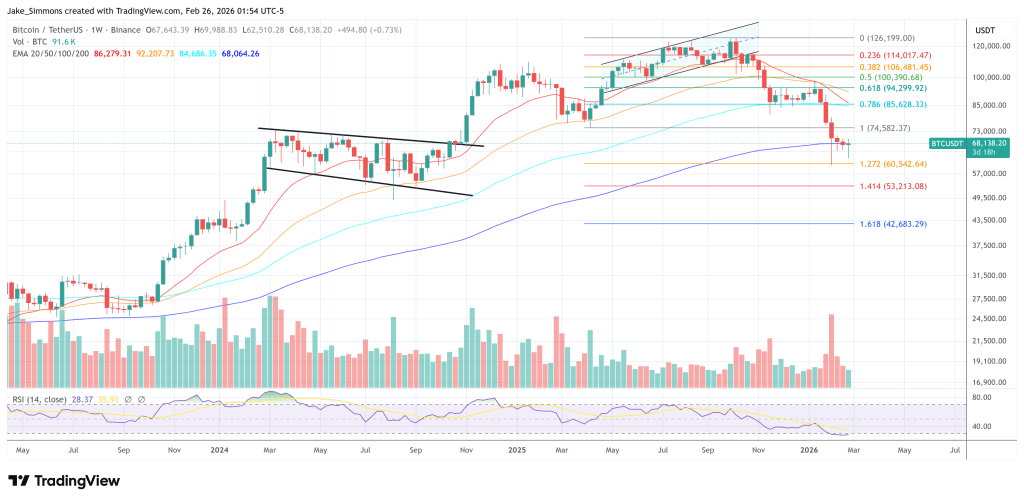
Bitcoin must remain above the 200-week EMA, 1-week chart | Source: BTCUSDT on TradingView.com

Domande pertinenti

QWhat are the key areas of Bitcoin and crypto services that Morgan Stanley is planning to expand into?

AMorgan Stanley is planning to expand into spot trading via E*TRADE, develop a native custody and exchange solution, and explore yield and lending services backed by Bitcoin.

QAccording to Amy Oldenburg, why is building a native custody and exchange solution strategically important for Morgan Stanley?

ABuilding a native custody and exchange solution is strategically important due to control, trust, and liability. It ensures the bank can deliver no-fail technology that aligns with client expectations and the Morgan Stanley brand.

QWhat client behavior did Amy Oldenburg cite as a key reason for Morgan Stanley's expanded crypto offerings?

AShe cited that clients hold significant crypto wealth 'off platform,' which represents a material pool of assets from current clients that Morgan Stanley currently cannot serve.

QBeyond trading and custody, what other Bitcoin-based financial products is Morgan Stanley exploring?

AMorgan Stanley is in the early stages of exploring yield and lending services that are backed by Bitcoin.

QHow did Morgan Stanley classify Bitcoin in a report from October of the previous year, and what allocation did they recommend?

AIn October of the previous year, Morgan Stanley classified Bitcoin as 'digital gold' and recommended a 2%–4% allocation to digital assets.

Letture associate

Codex Goal Mode Usage Guide: How to Make AI Continuously Pursue a Specific Objective

"Codex Goal Mode: How to Make AI Work Continuously Toward a Specific Goal" OpenAI's Codex "goal mode" (/goal) transforms the AI from a reactive code assistant into a proactive execution agent capable of working autonomously for hours or even days to achieve a defined objective. To maximize its effectiveness, follow these key principles: 1. **Define Clear, Verifiable Exit Criteria:** The goal prompt should be a concise, measurable success condition, not a lengthy specification. Use quantifiable metrics like "reduce build time by 30%" or "achieve 100% test parity." 2. **Provide Initial Guidance and Tools:** Direct Codex toward likely problem areas and specify available tools (e.g., browsers, testing environments) to prevent it from exploring unproductive paths. 3. **Enable Progress Measurement:** Equip Codex with ways to track advancement, such as creating comparison tools for visual tasks or evaluation sets, ensuring it can gauge its own progress. 4. **Use a Realistic Execution Environment:** For tasks like performance optimization, provide access to environments that closely mimic production (e.g., similar configs, databases) to yield valid results. 5. **Be Cautious with Visual Goals:** Avoid vague "pixel-perfect" instructions. Instead, supplement visual references with functional checklists or design system specifications to prevent Codex from obsessing over minor details. 6. **Implement Progress Tracking:** For long-running tasks, have Codex commit code to draft PRs, update progress documents, or send Slack updates to maintain visibility into its work. 7. **Review and Consolidate Results:** Once the goal is met, instruct Codex to review its work, clean up ineffective experimental code, and reflect on what strategies succeeded or failed. Ultimately, using goal mode shifts the developer's role from writing prompts to managing a persistent engineering agent—defining objectives, establishing metrics, configuring environments, and conducting final reviews.

marsbit41 min fa

Codex Goal Mode Usage Guide: How to Make AI Continuously Pursue a Specific Objective

marsbit41 min fa

From Ethereum to AI's 'CROPS': What Exactly Is This 'Slow Variable' That Vitalik Has Repeatedly Emphasized?

Recently, Vitalik Buterin has frequently emphasized the concept of "CROPS," first outlined in the Ethereum Foundation's March mandate as core principles guiding its focus: Censorship Resistance, Capture Resistance, Open Source, Privacy, and Security. CROPS represents Ethereum's commitment to providing foundational capabilities for user sovereignty—enabling asset ownership, identity expression, and coordination without reliance on centralized platforms or surrendering ultimate control. This framework is gaining new urgency with the rise of AI, particularly AI agents managing digital assets and automating transactions. While AI offers convenience, it risks centralizing user data, intent, and control if dependent on opaque, centralized services. Vitalik argues for "CROPS AI"—AI that is open, privacy-preserving, secure, and capable of local execution to maintain user agency. He highlights convergence between "CROPS Ethereum access layers" and "CROPS AI," such as using zero-knowledge proofs for private remote LLM calls and Ethereum RPC reads, ensuring users can access services without exposing sensitive information. Ultimately, CROPS is not just an abstract ideal but a practical guide for Ethereum's development and AI integration. It addresses the critical long-term question: as digital systems grow more powerful, how can users retain control over their privacy, assets, and autonomy? In an AI-driven era, these principles may define Ethereum's enduring value—prioritizing verifiable, secure, and user-centric design over short-term optimizations like speed and cost alone.

marsbit45 min fa

From Ethereum to AI's 'CROPS': What Exactly Is This 'Slow Variable' That Vitalik Has Repeatedly Emphasized?

marsbit45 min fa

Trading

Spot
Futures

Articoli Popolari

Come comprare PUSH

Benvenuto in HTX.com! Abbiamo reso l'acquisto di Push Protocol (PUSH) semplice e conveniente. Segui la nostra guida passo passo per intraprendere il tuo viaggio nel mondo delle criptovalute.Step 1: Crea il tuo Account HTXUsa la tua email o numero di telefono per registrarti il tuo account gratuito su HTX. Vivi un'esperienza facile e sblocca tutte le funzionalità,Crea il mio accountStep 2: Vai in Acquista crypto e seleziona il tuo metodo di pagamentoCarta di credito/debito: utilizza la tua Visa o Mastercard per acquistare immediatamente Push ProtocolPUSH.Bilancio: Usa i fondi dal bilancio del tuo account HTX per fare trading senza problemi.Terze parti: abbiamo aggiunto metodi di pagamento molto utilizzati come Google Pay e Apple Pay per maggiore comodità.P2P: Fai trading direttamente con altri utenti HTX.Over-the-Counter (OTC): Offriamo servizi su misura e tassi di cambio competitivi per i trader.Step 3: Conserva Push Protocol (PUSH)Dopo aver acquistato Push Protocol (PUSH), conserva nel tuo account HTX. In alternativa, puoi inviare tramite trasferimento blockchain o scambiare per altre criptovalute.Step 4: Scambia Push Protocol (PUSH)Scambia facilmente Push Protocol (PUSH) nel mercato spot di HTX. Accedi al tuo account, seleziona la tua coppia di trading, esegui le tue operazioni e monitora in tempo reale. Offriamo un'esperienza user-friendly sia per chi ha appena iniziato che per i trader più esperti.

533 Totale visualizzazioniPubblicato il 2024.12.13Aggiornato il 2026.06.02

Come comprare PUSH

Discussioni

Benvenuto nella Community HTX. Qui puoi rimanere informato sugli ultimi sviluppi della piattaforma e accedere ad approfondimenti esperti sul mercato. Le opinioni degli utenti sul prezzo di PUSH PUSH sono presentate come di seguito.

活动图片













