More Than a Madman: Trump's 11 Unchanging Decision-Making Principles Over 40 Years

marsbitPubblicato 2026-01-22Pubblicato ultima volta 2026-01-22

Introduzione

Donald Trump's 40-year decision-making framework, as detailed in his book "The Art of the Deal," consists of 11 consistent principles. These include thinking big to achieve higher outcomes, protecting downside risks while pursuing upside gains, maximizing options to avoid early commitments, and leveraging market knowledge and momentum. He emphasizes using leverage strategically, enhancing asset value, and aggressively promoting his actions. Trump is known for fighting back fiercely, delivering on promises, minimizing personal costs while maximizing gains, and maintaining an energetic, enjoyable approach. The analysis concludes that Trump is a calculated strategist rather than impulsive; investors should focus on his actions, not his rhetoric, to navigate market volatility effectively.

Author: Levi 💎⚡️

Compiled by: Deep Tide TechFlow

Deep Tide Introduction: Is Trump an unpredictable madman or an extremely rational calculator? After reading the book The Art of the Deal, written by Trump when he was 41, crypto researcher Levi discovered that this president has actually been using the same playbook from his real estate developer days for the past 40 years.

Whether it's extreme tariff threats, the TikTok divestiture negotiations, or his "smoke and mirrors" political fundraising, there are clear 11 principles hidden behind them. Levi believes that only by seeing through the "smoke screens" Trump sets up and focusing on his actions rather than his words can investors remain clear-headed amidst future market fluctuations. This article will deconstruct the "underlying code" Trump uses to handle all matters.

Main Body:

When Donald Trump was 41 years old, he wrote a book called The Art of the Deal. I read it from cover to cover, so you don't have to.

After reading it, I realized: Trump today is the same person he was 40 years ago. The playbook he uses now to make deals as President of the United States is exactly the same one he used as a real estate developer.
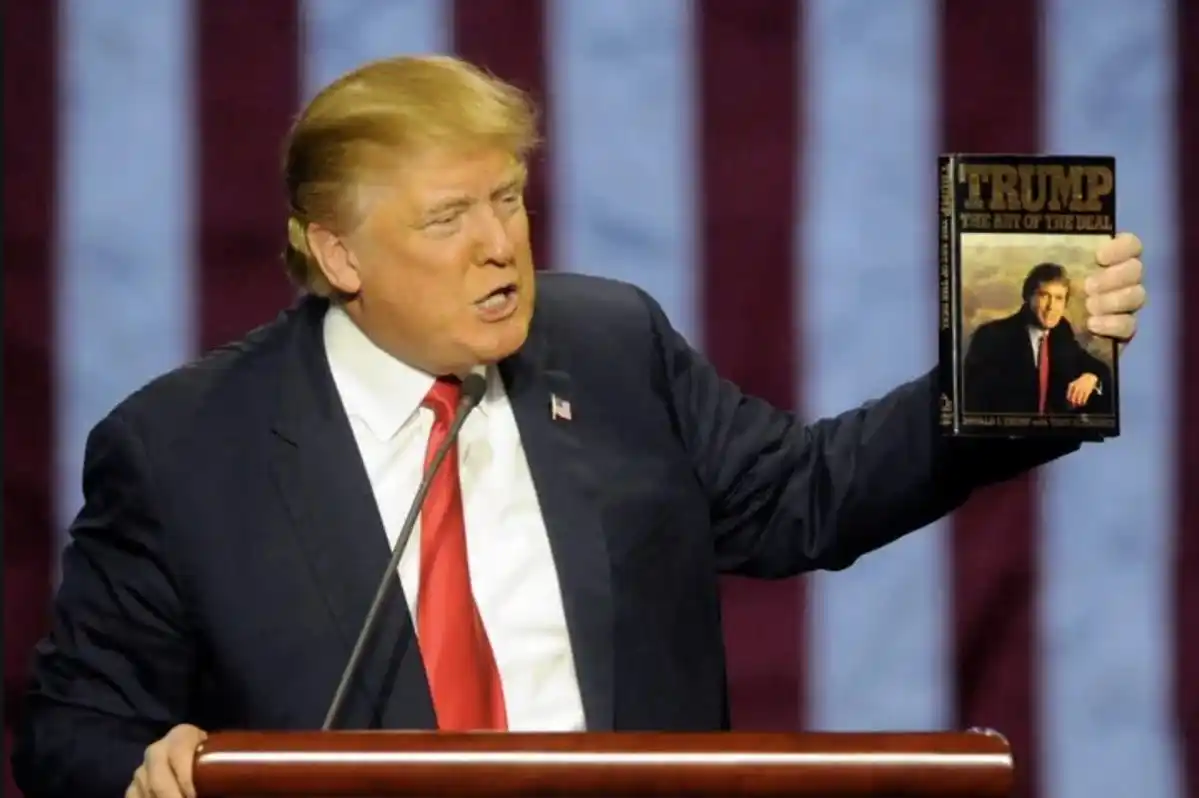
Caption: Trump praised his own book as the "number one bestselling business book of all time"

Below are the 11 steps he wrote himself. After reading them, you will be able to clearly see through his smoke screens, better cope with market volatility, and gain a "Trump advantage" in the game that surpasses the market.

1. Think Big

Trump likes to set grand goals. Because even if they aren't fully achieved, the accomplishment will be higher than if the goal was set too low. This is why you always see him proposing crazy objectives.

2. Protect the Downside and the Upside Will Take Care of Itself

Trump is very good at annoying people, but he is equally good at leaving room for recovery. Take China policy as an example: he would first announce 100% tariffs to force the other side back to the negotiating table, then soften his tone and extend tariff deadlines as details are finalized.

3. Maximize Your Options

Trump knows he is playing a high-stakes game, so he never locks himself in too early. In the TikTok sale case, he met with every executive, maximizing US equity and interests, while creating a sense of urgency through a tight ban deadline, extending it as needed.

4. Know Your Market

Trump won the election because he understood the voter market better than anyone else. You might not know that the "Make America Great Again (MAGA)" trademark was registered by him back in 2012. He has an astonishing intuition for the direction of momentum, going from a perceived "clown candidate" to serving two terms.

5. Use Your Leverage

Trump knows that factory jobs are the pillar of the Chinese economy, so the other side is eager to make a deal. This is why Trump applies high pressure. US wholesalers can order inventory in bulk to prepare for a breakdown in relations, but China, after a year of pandemic, cannot afford factory closures.

6. Enhance Your Location

Coming from a real estate background, Trump knows the US is sitting on a gold mine, but in the past chose to bow to the moral high ground of environmentalism. He reopened drilling, making US land more valuable and thus attracting new foreign investment.

7. Get the Word Out

This one is deeply felt by everyone. Trump's use of social media is an order of magnitude more intense than all previous presidents combined. He has "normalized" modern politics. This is why you feel he is always in the news—because he really is always there.

8. Fight Back

No words can surpass the impact of this moment:
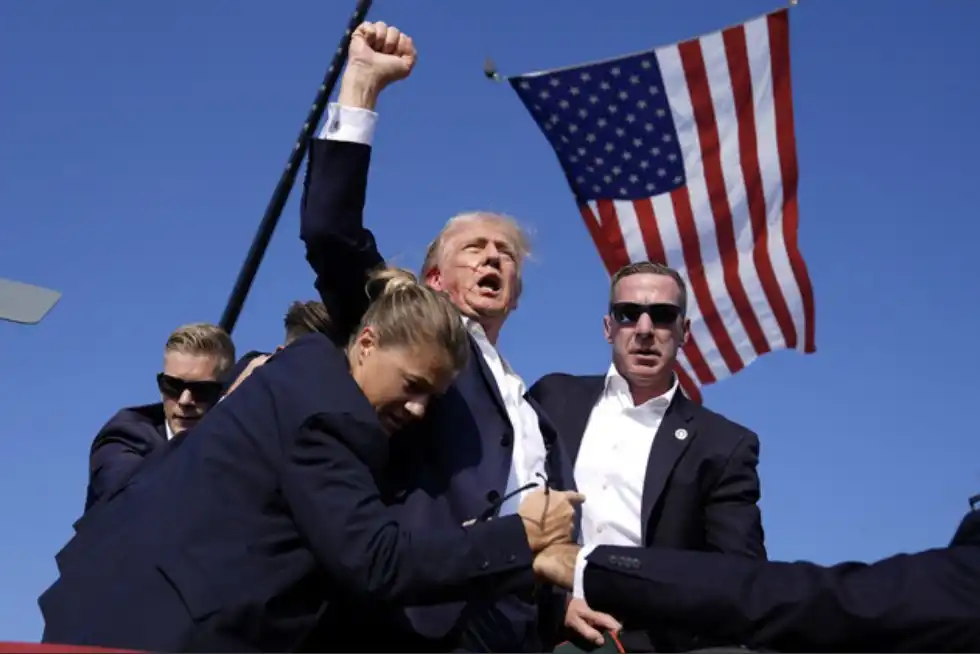
Caption: The moment after Trump was shot at a rally in Pennsylvania on July 13, 2024

9. Deliver the Goods

Trump delivered on almost every campaign promise through executive orders. Whether they will have long-term effects remains to be seen.

10. Contain the Costs

If you study how Trump does real estate deals, you'll find he is famous for "not investing personal capital." Instead, he finds landlords to provide funding, construction companies to develop, management companies to operate, and walks away with tens of millions in profit, with his name on the building.
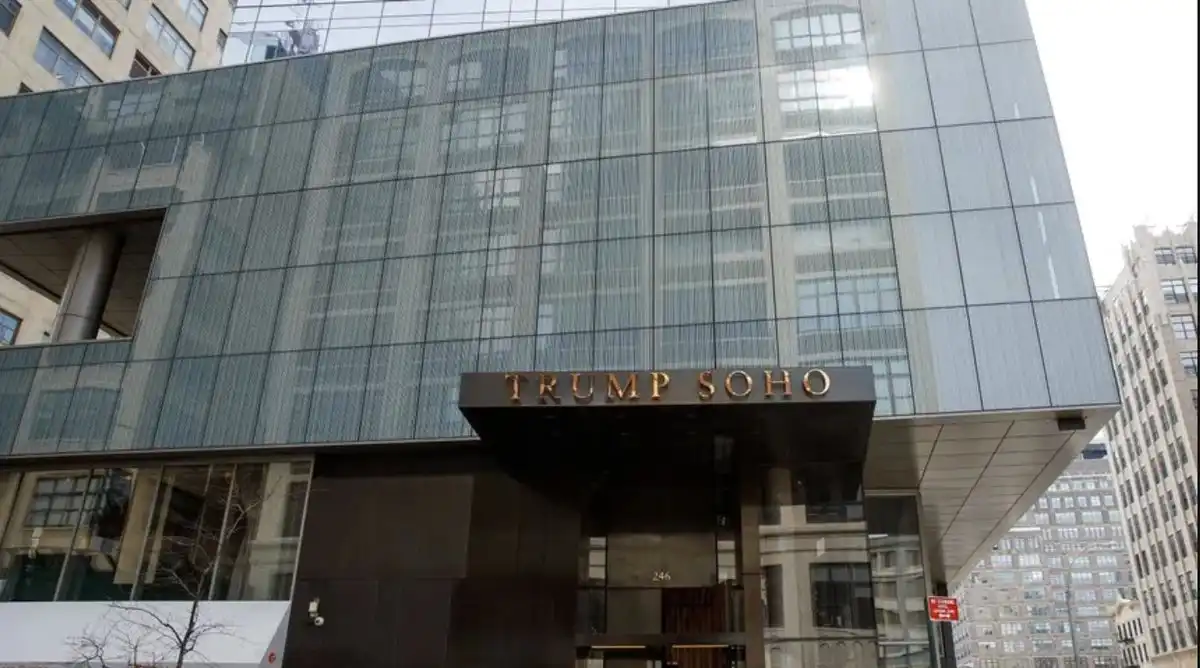
Caption: The Trump Soho project, where Trump gained 18% equity and a $6 million salary solely through brand licensing and management deals. He contributed no capital, only his time.

He spent $66 million on his 2016 campaign (because he was a nobody then), but did you know that in the 2020 and 2024 campaigns, he spent not a single penny of his own money?

11. Have Fun

I respect that Trump always seems full of energy. He has lived an extraordinary life and is clearly enjoying it.
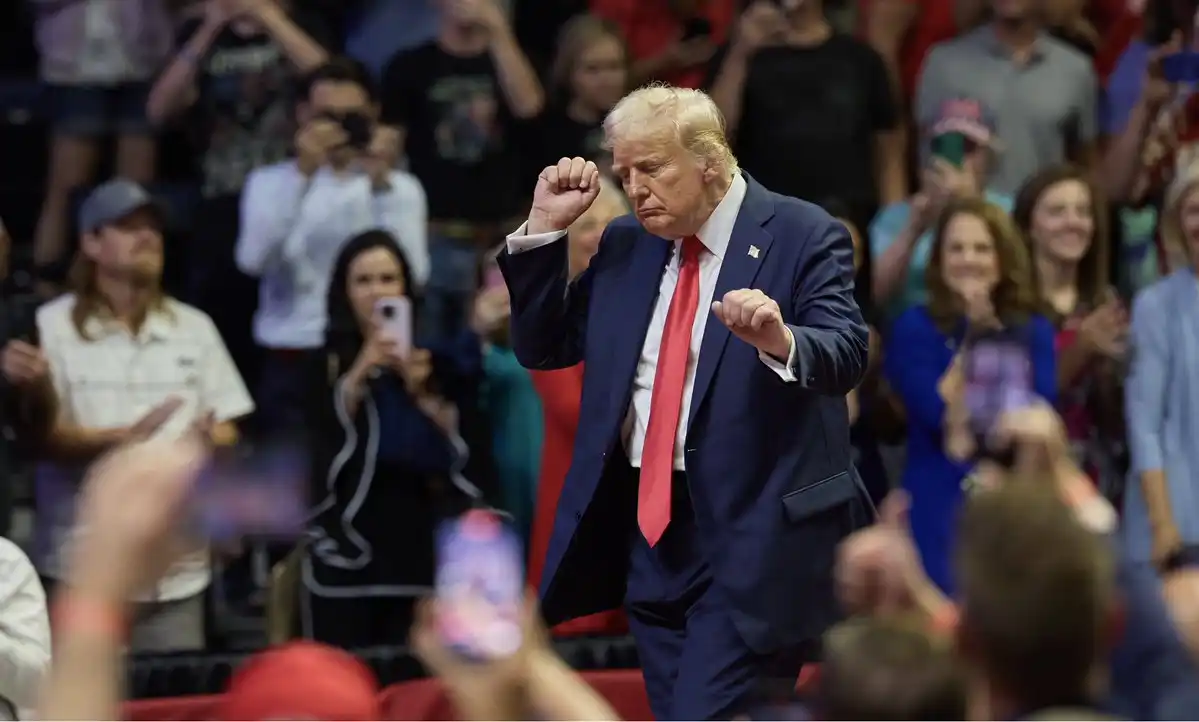
Caption: Trump doing his signature dance at a 2024 Michigan rally

Summary: How to Navigate the Future Trump Era

Trump is not the "reckless fool" portrayed by the media. On the contrary, beneath his impulsive exterior lies highly calculated and purposeful consideration.

Before reading his book, my impression of Trump was the same as everyone else's—a stupid, reckless, arrogant guy who would only ruin the country.

But now I know: Ignore his words, focus on his actions.

This has given me unprecedented clarity in dealing with the markets, and I no longer lose sleep at night. If you are troubled by Trump's actions in the future, come back to this article and understand what he is really trying to do.


Domande pertinenti

QWhat are the 11 decision-making principles that Donald Trump has consistently used for 40 years, according to the article?

AThe 11 principles are: 1. Think Big, 2. Protect the Downside and the Upside Will Take Care of Itself, 3. Maximize Your Options, 4. Know Your Market, 5. Use Your Leverage, 6. Enhance Your Location, 7. Get the Word Out, 8. Fight Back, 9. Deliver the Goods, 10. Contain the Costs, 11. Have Fun.

QHow does the article suggest one should interpret Trump's actions to better understand his strategy and navigate market volatility?

AThe article advises to ignore his rhetoric and focus on his actions, as his impulsive exterior masks a highly calculated and purposeful approach. This perspective provides clarity for dealing with market fluctuations.

QAccording to the article, what is an example of Trump 'Containing the Costs' in his business and political ventures?

AIn business, he was known for not investing personal capital in real estate deals, instead having others fund projects while he profited. In politics, he spent $66 million of his own money in 2016 but spent none of his personal funds in the 2020 and 2024 campaigns.

QWhat book did Trump write at age 41 that outlines his deal-making philosophy, and what does the article claim about its relevance to his presidency?

AHe wrote 'The Art of the Deal'. The article claims that the playbook he uses to make deals as President is exactly the same as the one he used as a real estate developer.

QHow does the article describe Trump's use of leverage in negotiations, using the China trade policy as an example?

AHe uses leverage by applying high pressure, knowing the other party's vulnerabilities. For example, he announced 100% tariffs on China to force them back to the negotiating table, knowing that factory jobs are the pillar of the Chinese economy and they could not afford factory closures.

Letture associate

Within Strategy's Framework, STRC's Dividend Yield Remains at 12% as Share Price Stays Below Par Value

Michael Saylor, Executive Chairman of Strategy (MSTR), confirmed that the dividend rate for its STRC perpetual preferred shares will remain at 12.00% through August 2026. The rate has increased from 9% at its July 2025 launch to the current high via a "ratchet" mechanism, which permanently raises the rate by 0.5% whenever the share price falls below $95. This mechanism is intended to push the price back toward its $100 par value and support Strategy's "at-the-market" (ATM) program for issuing new shares to fund Bitcoin purchases. However, the mechanism has not worked as intended. STRC shares closed at $89.46 on July 31, remaining about 10-11% below par value despite the record-high dividend. Competition from rival Strive's higher-yielding SATA securities has pressured demand. The persistent discount has forced Strategy to suspend new STRC issuances via its ATM program, limiting this funding channel for Bitcoin acquisitions. STRC's struggles reflect Bitcoin's own volatility, as the preferred shares historically move in tandem. Analysts have warned the ratchet structure carries long-term, one-way risk. A law firm is investigating Strategy's ability to maintain dividend payments if Bitcoin's price stays low. Retail investors own roughly 83% of outstanding STRC shares, a group seen as prone to panic selling during downturns. In response, Strategy has established financial reserves, including a liquidity cushion covering about 26 months of dividend/interest obligations, and a $2 billion share buyback program alongside a Bitcoin monetization framework, though the company emphasized it is not obligated to sell any Bitcoin.

cryptonews.ru2 min fa

Within Strategy's Framework, STRC's Dividend Yield Remains at 12% as Share Price Stays Below Par Value

cryptonews.ru2 min fa

Analyst: Bitcoin's Price Will Drop to $60k in August, Then Rebound to $70k

Financial analyst Andrey Poroshin has provided a new forecast for Bitcoin's price dynamics in August. Poroshin, an analyst at the Bitbanker exchange, expects the cryptocurrency market to experience a downturn this month, with prices retesting the $60,000 level due to a lack of supportive macroeconomic catalysts. He noted that the recent US Federal Reserve decision to hold interest rates did not significantly impact the market, while inflation remains above the 2% target. Poroshin stated that Bitcoin is ending July under pressure from moderate volatility and a lack of new macroeconomic stimuli, leading to continued market caution. According to his base scenario, Bitcoin will drop to a range of $60,000 to $62,000 before recovering to $70,000. He pointed out that even $70,000 remains below the cost of mining in the US, which has prompted some miners to shift towards AI data center operations. Poroshin cited the winding down of BitMEX's operations as a potential catalyst for a price rebound, suggesting the exit of weaker players often coincides with market reversals and reduced short-term selling pressure. He believes Bitcoin is currently less susceptible to geopolitical shocks, such as the Iran-US conflict, and does not expect significant market changes in August related to the pending CLARITY Act. Looking ahead, Poroshin forecasts that September will bring more active price fluctuations driven by potential Fed rate decisions and possible discussions or approval of the CLARITY Act.

cryptonews.ru3 min fa

Analyst: Bitcoin's Price Will Drop to $60k in August, Then Rebound to $70k

cryptonews.ru3 min fa

In Jinjiang, Fujian, a Storage Super Unicorn Lies Quiet

In Fujian's Jinjiang, a city known for sportswear, lies a quiet semiconductor giant: Fujian Jinhua Integrated Circuit Co. (JHICC). Once a promising domestic DRAM manufacturer alongside Yangtze Memory and ChangXin Memory Technologies (CXMT), its journey was derailed in 2018 when the U.S. placed it on an Entity List and filed criminal charges for alleged trade secret theft. This halted production for years. A turning point came in February 2024 when a U.S. federal court found JHICC not guilty. However, it had lost crucial time. While CXMT soared to become a top-valued A-share company in 2024, JHICC, with an estimated valuation of 80 billion RMB, was just restarting. Its current output is primarily customized DDR4 chips, not the advanced DDR5/HBM demanded for AI, but it still benefits from the broader memory chip upcycle. JHICC's story is tied to Chen Zhengkun, a veteran engineer who left Micron to lead the venture. Founded in 2016 with state-backed funding, JHICC partnered with Taiwan's UMC to develop DRAM technology. Rapid progress was cut short by the U.S. actions, which Micron initiated, partly due to its heavy reliance on the Chinese market. Post-sanctions, Chen's team worked to rebuild the production line with reduced reliance on U.S. technology. According to its records, JHICC achieved small-scale production and revenue growth under immense pressure. It now focuses on the stable "niche" DRAM market (e.g., TVs, routers) with a monthly capacity of ~40,000 wafers, aiming for 60,000 by 2026. It holds over 1,000 patents but remains on the Entity List. For Jinjiang, investing in JHICC was a bold industrial leap. The local government provided unwavering financial and logistical support during the crisis, helping the company survive. JHICC has become the anchor for a growing local semiconductor cluster. Though its scale lags behind domestic peers, JHICC's persistence symbolizes a hard-won foothold in a global market long dominated by Samsung, SK Hynix, and Micron. Having missed one boom, it seeks a place in the new AI-driven memory supercycle.

marsbit2 h fa

In Jinjiang, Fujian, a Storage Super Unicorn Lies Quiet

marsbit2 h fa

Trading

Spot
活动图片




