Monero, Zcash, and Canton Network: Who is the True King of Privacy?

marsbitPubblicato 2026-01-13Pubblicato ultima volta 2026-01-13

Introduzione

Blockchain transparency poses risks for institutions by exposing sensitive corporate and financial data. While Monero offers complete anonymity by hiding all transaction details, it lacks KYC/AML compliance, making it unsuitable for regulated entities. Zcash provides selective privacy through shielded addresses, allowing users to encrypt transactions but only in an all-or-nothing manner. In contrast, Canton Network enables granular, selective disclosure—allowing institutions to share only specific transaction components with authorized parties (e.g., regulators) while keeping other details private. This aligns with institutional needs for both privacy and compliance. Canton’s adoption by DTCC and over 400 institutions highlights its practical design for real-world financial workflows, positioning it as a leading privacy solution for the institutional era.

Written by: Tiger Research

Key Points

  • The core advantage of blockchain—transparency—can expose corporate trade secrets and investment strategies, posing substantial risks to businesses.
  • Fully anonymous privacy models like Monero do not support KYC or AML, making them unsuitable for regulated institutions.
  • Financial institutions require selective privacy, which protects transaction data while remaining compatible with regulatory compliance.
  • Financial institutions must determine how to connect with open Web3 markets for expansion.

1. Why is Blockchain Privacy Necessary?

One of the core features of blockchain is transparency. Anyone can inspect on-chain transactions in real-time, including who sent the funds, to whom, the amount, and when it was sent.

However, from an institutional perspective, this transparency presents obvious problems. Imagine a scenario where the market can observe how much NVIDIA transferred to Samsung Electronics, or precisely when a hedge fund deployed its funds. Such visibility would fundamentally alter competitive dynamics.

The level of information disclosure tolerable for individuals differs from what businesses and financial institutions can accept. A company's transaction history and the timing of institutional investments constitute highly sensitive information.

Therefore, expecting institutions to operate on a blockchain where all activities are fully exposed is unrealistic. For these participants, a system without privacy is less of a practical infrastructure and more of an abstract ideal with limited real-world application.

2. Forms of Blockchain Privacy

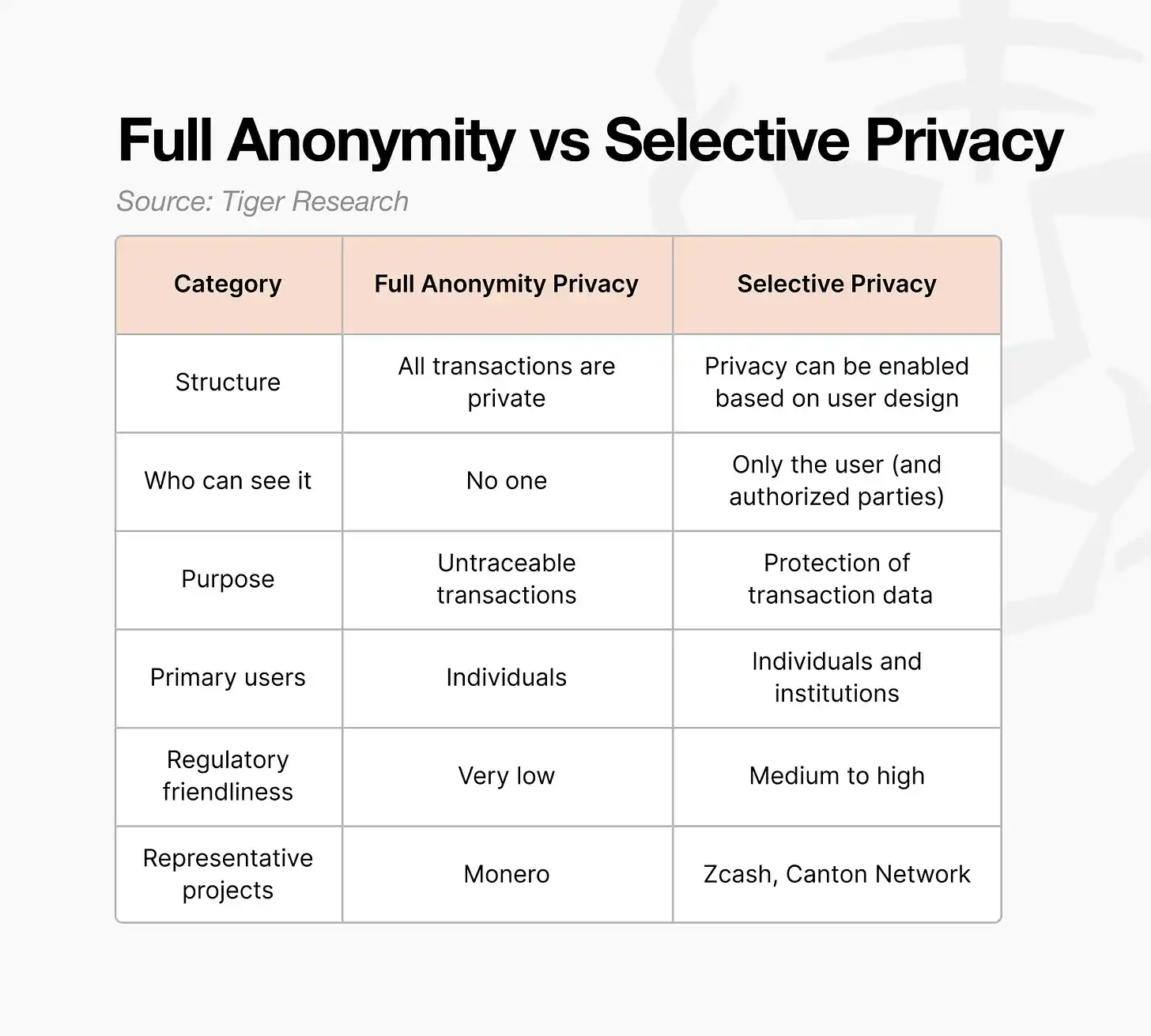
Blockchain privacy is generally divided into two categories:

  • Fully Anonymous Privacy
  • Selective Privacy

The key difference lies in whether information can be disclosed when another party requires verification.
2.1. Fully Anonymous Privacy

Fully anonymous privacy, simply put, hides everything.

The sender, receiver, and transaction amount are all hidden. This model stands in direct opposition to traditional blockchains, which prioritize transparency by default.

The primary goal of fully anonymous systems is to prevent third-party surveillance. Rather than enabling selective disclosure, they aim to completely prevent external observers from extracting meaningful information.
Source: Tiger Research

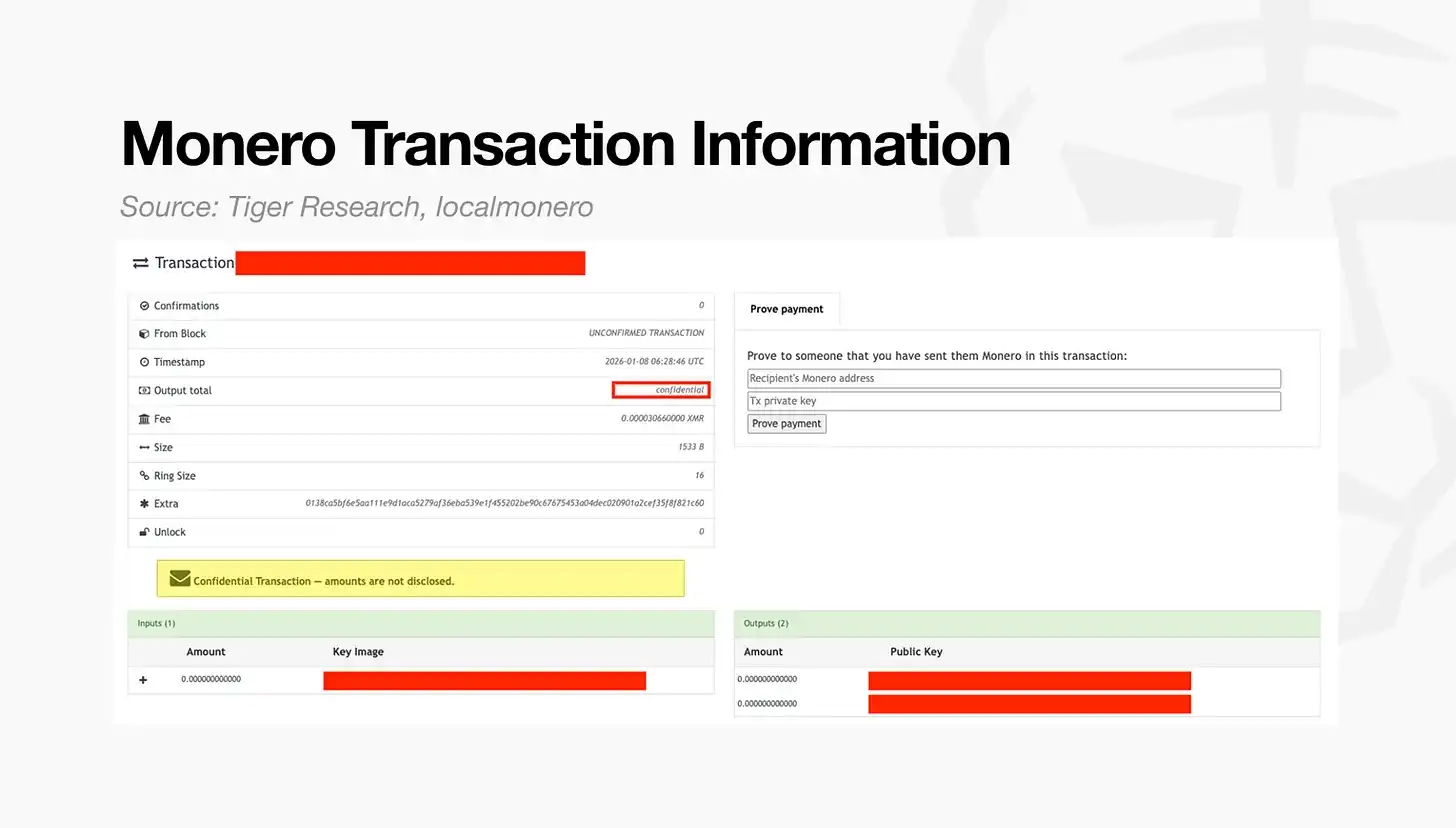
The above image shows a Monero transaction record, a representative example of fully anonymous privacy. Unlike transparent blockchains, details such as the transfer amount and counterparty are not visible.

Two characteristics illustrate why this model is considered fully anonymous:

  • Output Totals: The ledger does not display specific numbers but shows values as "confidential." Transactions are recorded, but their content cannot be interpreted.
  • Ring Signature Size: Although a single sender initiates the transaction, the ledger mixes it with multiple decoys, making it appear as if multiple parties are sending funds simultaneously.

These mechanisms ensure that transaction data remains opaque to all external observers without exception.

2.2. Selective Privacy

Selective privacy operates on a different assumption. Transactions are public by default, but users can choose to make specific transactions private by using designated privacy-enabled addresses.

Zcash provides a clear example. When initiating a transaction, users can choose between two address types:

  • Transparent Addresses: All transaction details are publicly visible, similar to Bitcoin.
  • Shielded Addresses: Transaction details are encrypted and hidden.
Source: Tiger Research

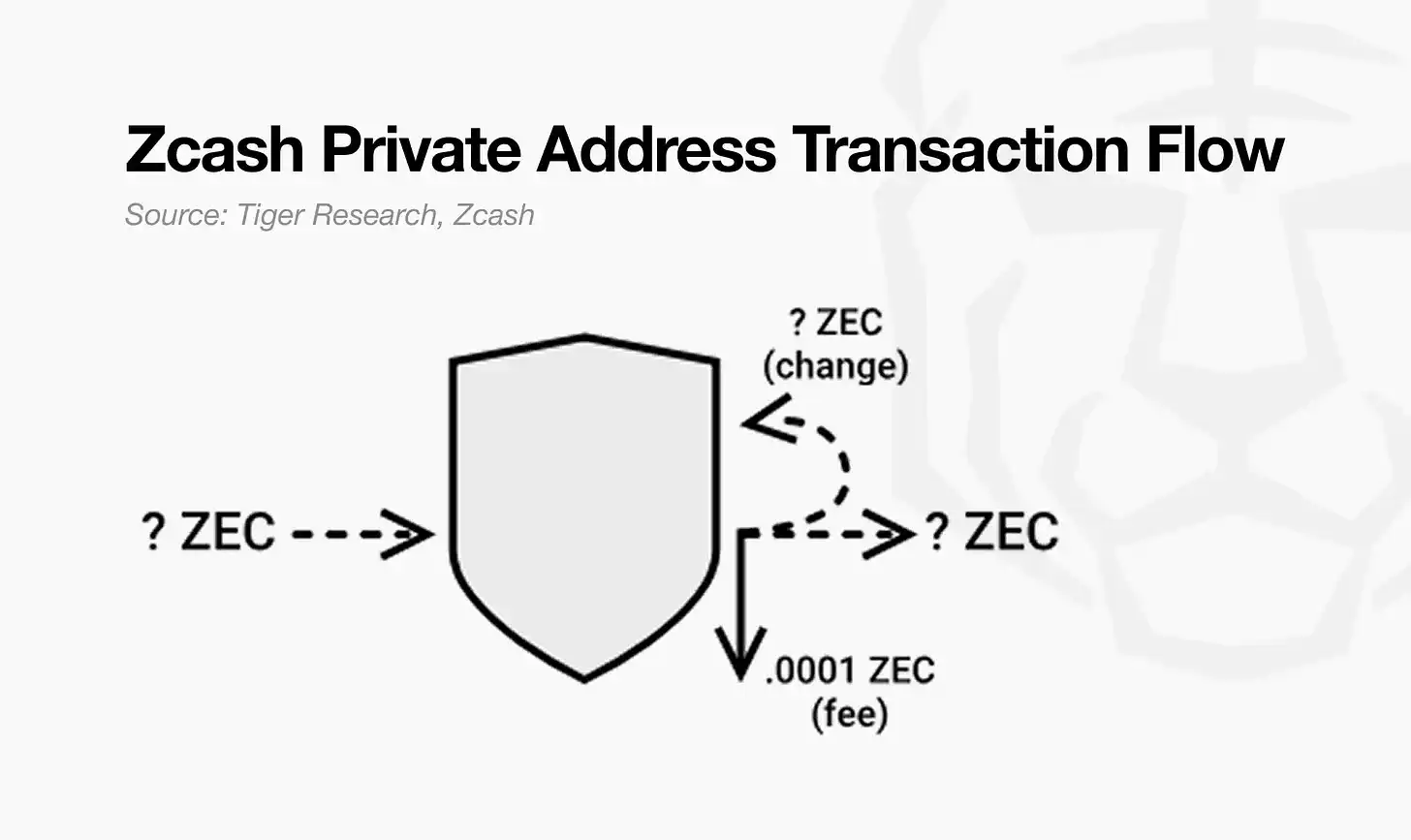
The above image illustrates which elements Zcash can encrypt when using shielded addresses. Transactions sent to shielded addresses are recorded on the blockchain, but their content is stored in an encrypted state.

While the existence of the transaction remains visible, the following information is hidden:

  • Address Type: Shielded (Z) addresses are used instead of transparent (T) addresses.
  • Transaction Record: The ledger confirms that a transaction occurred.
  • Amount, Sender, Receiver: All are encrypted and cannot be observed externally.
  • Viewing Rights: Only parties granted a viewing key can inspect the transaction details.

This is the core of selective privacy. Transactions remain on-chain, but users control who can view their content. When necessary, users can share a viewing key to prove transaction details to another party, while all other third parties remain unable to access that information.

3. Why Financial Institutions Prefer Selective Privacy

Most financial institutions have Know Your Customer (KYC) and Anti-Money Laundering (AML) obligations for every transaction. They must retain transaction data internally and respond immediately to requests from regulators or supervisory bodies.

However, in an environment built on fully anonymous privacy, all transaction data is irreversibly hidden. Because the information cannot be accessed or disclosed under any conditions, institutions are structurally unable to fulfill their compliance obligations.

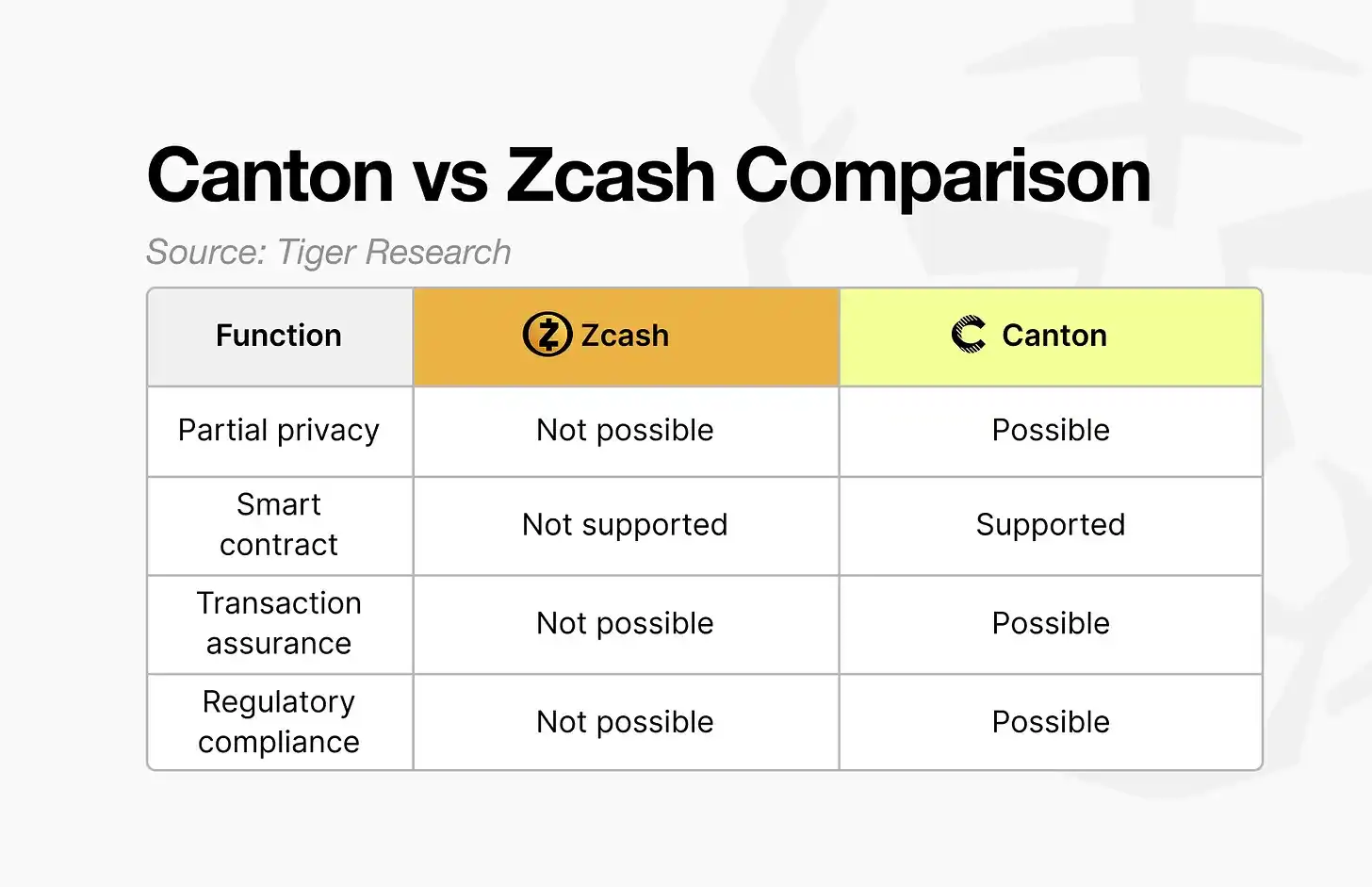
A representative example is the Canton Network, which has been adopted by the Depository Trust & Clearing Corporation (DTCC) and is currently used by over 400 companies and institutions. In contrast, Zcash, although also a selective privacy project, has seen limited real-world institutional adoption.

What is the reason for this difference?
Source: Tiger Research

Zcash offers selective privacy, but users cannot choose which information to disclose. Instead, they must choose whether to disclose the entire transaction.

For example, in a transaction where "A sends $100 to B," Zcash does not allow only the amount to be hidden. The transaction itself must be either fully hidden or fully disclosed.

In institutional transactions, different participants require different information. Not all participants need access to all data in a single transaction. However, Zcash's structure forces a binary choice between full disclosure and full privacy, making it unsuitable for institutional transaction workflows.

In contrast, Canton allows transaction information to be divided into separate components for management. For example, if a regulator only requires the transaction amount between A and B, Canton enables the institution to provide only that specific information. This functionality is achieved through Daml, the smart contract language used by the Canton Network.

Other reasons for institutional adoption of Canton are covered in more detail in previous Canton research.

4. Privacy Blockchains in the Institutional Era

Privacy blockchains evolve as demands change.

Early projects like Monero aimed to protect individual anonymity. However, as financial institutions and corporations began entering the blockchain environment, the meaning of privacy shifted.

Privacy is no longer defined as making transactions invisible to everyone. Instead, the core goal has become protecting transactions while still meeting regulatory requirements.

This shift explains why selective privacy models like the Canton Network have gained traction. Institutions need more than just privacy technology; they need infrastructure designed to match real-world financial transaction workflows.

In response to these demands, more institution-oriented privacy projects continue to emerge. Looking ahead, the key differentiator will be how effectively privacy technology can be applied to practical transaction environments.

Alternative forms of privacy that run counter to the current institution-driven trend may emerge. However, in the short term, privacy blockchain is likely to continue evolving around institutional transactions.

Crypto di tendenza

Domande pertinenti

QWhy is blockchain privacy necessary for institutions according to the article?

ABlockchain transparency can expose corporate trade secrets and investment strategies, posing substantial risks. Institutions require privacy that protects sensitive transaction data while remaining compatible with regulatory compliance, as full transparency is unrealistic for their operations.

QWhat is the key difference between fully anonymous privacy and selective privacy in blockchain?

AFully anonymous privacy hides all transaction details (sender, receiver, amount) from everyone, while selective privacy allows users to encrypt transactions but grant access to specific parties (e.g., regulators) via view keys when necessary.

QWhy are fully anonymous privacy models like Monero unsuitable for regulated financial entities?

AThey irreversibly hide all transaction data, making it impossible for institutions to fulfill KYC and AML obligations or respond to regulatory requests, as no information can be disclosed under any conditions.

QHow does Canton Network address the limitations of Zcash's selective privacy for institutional use?

ACanton allows granular control over transaction data disclosure using Daml smart contracts, enabling institutions to share specific information (e.g., only amount) with authorized parties, unlike Zcash's all-or-nothing binary approach.

QWhat shift in privacy needs does the article highlight as institutions adopt blockchain technology?

APrivacy is no longer about complete anonymity for all; instead, the focus is on protecting transactions while meeting regulatory requirements, leading to the rise of selective privacy models like Canton Network tailored for real-world financial workflows.

Letture associate

1996 or 1999? Walsh's First Test is 'How to View AI'

"1996 or 1999? Wall's First Big Test Is 'How to View AI'" Federal Reserve Chairman Wall's initial challenge is not whether to raise or cut rates, but a more fundamental judgment: what kind of boom is the current AI boom? This will determine the Fed's policy path and define his legacy. Economics is split between two opposing views, according to reporter Nick Timiraos. One sees imminent productivity gains that will increase supply and cool inflation, allowing the Fed to hold steady. The other argues that while productivity benefits are distant, demand shocks are here now, and waiting for data confirmation risks missing the intervention window, forcing sharper rate hikes later. Wall has signaled a leaning toward the first view, echoing 1996-era Alan Greenspan, who embraced strong, productivity-driven growth without fear of inflation. However, Wall faces a different macro environment than Greenspan did, with tariff pressures, expanding fiscal deficits, and diminishing globalization benefits, which could force more significant inflation pressures even if AI benefits materialize. Wall's logic, expressed before taking office, is that AI-driven productivity gains won't show in official data for years. If the Fed waits for confirmation, it might mistakenly tighten policy and choke off the very growth that could suppress inflation. This argues for using forward-looking narratives over lagging data. Chicago Fed President Austan Goolsbee presents a key counter-argument. He distinguishes between expected and unexpected productivity booms. A widely anticipated boom, like the current AI wave, can cause people to spend future wealth gains in advance, overheating the economy before productivity actually rises, thus requiring preemptive rate hikes. He cites rising costs for AI data centers as evidence of such overheating. Fed Governor Christopher Waller offers a rebuttal to Goolsbee, noting the "expected spending" mechanism only works if people can borrow against future income, which many households cannot do due to borrowing constraints. Wall also faces a paradox related to his desire to reduce the Fed's use of "forward guidance" (pre-announcing policy moves). This practice was established in 1999 when Greenspan began signaling hikes to avoid market shocks. If the economy follows a less optimistic path, Wall may be forced to choose between using the guidance he wants to abolish or risking market volatility by staying silent. The ultimate question defining Wall's first major test remains: Is this 1996 or 1999?

marsbit13 min fa

1996 or 1999? Walsh's First Test is 'How to View AI'

marsbit13 min fa

Ethereum Q1 2026 Report: Fees Decline, Users and Transaction Volume Hit New Highs

Ethereum Q1 2026 Report: Fees Down, Users & Transactions Hit New Highs Token Terminal's Q1 2026 report on Ethereum presents a pivotal development: the network achieved record highs in monthly active users (13.2M, +85.9% YoY), total transactions (200.4M, +81.5% YoY), and throughput (25.78 TPS), while transaction fees on the mainnet plummeted by 47.9% quarter-over-quarter. This shift is attributed to the network's strategic move into a "low fees for scale" phase, exemplified by the Fusaka upgrade which increased data capacity and lowered block space costs, releasing pent-up demand (a manifestation of Jevons's Paradox). The report highlights a core narrative shift for Ethereum: from a DeFi-centric blockchain to a global financial settlement layer. It maintains a dominant position in tokenized assets, holding majority market shares among top chains in stablecoins (61.8%), tokenized funds (73.0%), and tokenized commodities (84.0%). Growth in tokenized funds (+73.1% YoY) and commodities (+325.9% YoY) was particularly strong, driven by institutions like BlackRock and JPMorgan entering the space. Contrasting these usage gains, several USD-denominated value metrics declined in Q1: fully diluted market cap fell 30.3% QoQ, total value locked (TVL) dropped 11.0%, and ecosystem transaction volume decreased 24.0%. The report interprets this as Ethereum prioritizing long-term network expansion and cementing its role as the default settlement layer for finance over short-term fee capture. The commentary from Etherealize argues that, much like the early internet, Ethereum's open, permissionless model is poised to win over closed alternatives as institutional tokenization accelerates.

marsbit1 h fa

Ethereum Q1 2026 Report: Fees Decline, Users and Transaction Volume Hit New Highs

marsbit1 h fa

He Just Raised 2.7 Billion, and Li Fei-Fei Also Invested

Pete Florence, a former senior research scientist at Google DeepMind and a key contributor to the Vision-Language-Action (VLA) model architecture, is deliberately distancing his startup, Generalist AI, from the trendy "world model" label. He argues that the industry should prioritize concrete goals over buzzwords. His goal is to create robots that can perform a vast range of unseen tasks with high speed and success rates, without needing task-specific training data. Recently, his company raised $400 million (¥2.7 billion) at a $2 billion valuation. Notable investors include NVIDIA's NVentures, Bezos Expeditions, NFDG, as well as Xiaomi co-founder Lin Bin, Zoom founder Eric Yuan, and renowned AI scientist Fei-Fei Li. Florence's approach stems from his academic background at MIT under Professor Russ Tedrake, focusing on understanding the physical world. After joining DeepMind, he developed models like Transporter Network and co-created the VLA framework. He left in 2025 to found Generalist AI. The company has launched two models: GEN-0, which demonstrated that scaling laws apply to physical motion, and GEN-1. GEN-1 was trained on over 500,000 hours of physical interaction data collected via a specialized wearable device. It achieves a 99% success rate on precise mechanical tasks like folding boxes and maintains performance three times faster than its predecessor. Florence believes GEN-1 is reaching a commercial utility threshold similar to the GPT-3 inflection point. The substantial funding round, following GEN-1's release, signifies strong investor confidence in Generalist AI's practical, goal-driven path to creating versatile, useful robots, regardless of the "world model" terminology.

marsbit2 h fa

He Just Raised 2.7 Billion, and Li Fei-Fei Also Invested

marsbit2 h fa

Two Legends Lost in Three Days: Is Google's AI Talent Dam Cracking?

In three days, Google lost two AI legends. On June 18, Noam Shazeer, co-author of the seminal "Attention is All You Need" paper and Gemini co-lead, left for OpenAI. Just 48 hours later, John Jumper, 2024 Nobel laureate and AlphaFold lead, departed DeepMind for Anthropic. This follows Andrej Karpathy joining Anthropic in May. These moves highlight a structural trend: top AI talent is concentrating at mission-driven, pre-IPO firms like OpenAI and Anthropic, while Google becomes a primary source. The exodus stems from a core mission mismatch. Google's ad-centric model often subordinates AI research to product and revenue goals, creating friction for pioneers like Shazeer, who returned in 2024 only to leave again. In contrast, OpenAI and Anthropic offer singular focus on pushing AI boundaries, whether towards AGI or safety-aligned models, which deeply appeals to top researchers like Jumper. Financial incentives amplify the pull. With both OpenAI and Anthropic nearing IPO, employees stand to gain immensely from equity, an upside Google's mature stock cannot match. Furthermore, the 2023 merger of Google Brain and DeepMind, intended to consolidate strength, has instead created cultural tension and slowed the path from research to product, as evidenced by Gemini's pace. This talent redistribution is reshaping the AI landscape. While Google retains vast data and compute resources, its true crisis is the quiet, continuous loss of the people who define the field's future. The real moat in AI is not infrastructure, but the concentration of brilliant minds—a battle Google is currently losing.

marsbit4 h fa

Two Legends Lost in Three Days: Is Google's AI Talent Dam Cracking?

marsbit4 h fa

Trading

Spot
Futures

Articoli Popolari

Come comprare CORE

Benvenuto in HTX.com! Abbiamo reso l'acquisto di CORE (CORE) semplice e conveniente. Segui la nostra guida passo passo per intraprendere il tuo viaggio nel mondo delle criptovalute.Step 1: Crea il tuo Account HTXUsa la tua email o numero di telefono per registrarti il tuo account gratuito su HTX. Vivi un'esperienza facile e sblocca tutte le funzionalità,Crea il mio accountStep 2: Vai in Acquista crypto e seleziona il tuo metodo di pagamentoCarta di credito/debito: utilizza la tua Visa o Mastercard per acquistare immediatamente CORECORE.Bilancio: Usa i fondi dal bilancio del tuo account HTX per fare trading senza problemi.Terze parti: abbiamo aggiunto metodi di pagamento molto utilizzati come Google Pay e Apple Pay per maggiore comodità.P2P: Fai trading direttamente con altri utenti HTX.Over-the-Counter (OTC): Offriamo servizi su misura e tassi di cambio competitivi per i trader.Step 3: Conserva CORE (CORE)Dopo aver acquistato CORE (CORE), conserva nel tuo account HTX. In alternativa, puoi inviare tramite trasferimento blockchain o scambiare per altre criptovalute.Step 4: Scambia CORE (CORE)Scambia facilmente CORE (CORE) nel mercato spot di HTX. Accedi al tuo account, seleziona la tua coppia di trading, esegui le tue operazioni e monitora in tempo reale. Offriamo un'esperienza user-friendly sia per chi ha appena iniziato che per i trader più esperti.

229 Totale visualizzazioniPubblicato il 2024.12.13Aggiornato il 2026.06.02

Come comprare CORE

Discussioni

Benvenuto nella Community HTX. Qui puoi rimanere informato sugli ultimi sviluppi della piattaforma e accedere ad approfondimenti esperti sul mercato. Le opinioni degli utenti sul prezzo di CORE CORE sono presentate come di seguito.

活动图片