Mining the Last 929,465 Bitcoins Will Take Over a Century

cryptonews.ruPubblicato 2026-08-16Pubblicato ultima volta 2026-08-16

Introduzione

Title: Mining the Final 929,465 Bitcoins Will Take Over a Century The article clarifies a common misconception about Bitcoin's remaining supply. While 95.57% of the total 21 million BTC are already in circulation, the predetermined mining schedule means the last 4.43% will be produced very slowly. Currently, miners receive 3.125 BTC per block, with a new block added roughly every 10 minutes, resulting in about 164,250 new BTC annually. This emission rate is cut in half every 210,000 blocks (approximately every four years) in an event called a "halving." The next halving in 2028 will reduce the block reward to 1.5625 BTC. This process continues until rewards become minuscule fractions of a bitcoin (satoshi). The final satoshi is projected to be mined around 2140, with the last 1% of supply taking roughly a century to produce. This diminishing new supply has significant implications for miners, whose revenue primarily comes from these block rewards. Post-halving, their income from new coins is cut in half, forcing greater reliance on transaction fees for sustainability. The article notes current mining economics are strained, with transaction fees constituting a very small portion of total revenue. For investors, the predictable and decreasing issuance schedule is a key feature, creating a known scarcity. However, the article emphasizes that scarcity alone doesn't determine price, which is influenced by adoption, regulation, and broader economic factors. The upcoming 2028 h...

This aspect is often overlooked in headlines like "Bitcoin is almost fully mined." Yes, 95.57% of the nominal supply is already in circulation. But the Bitcoin network was built to concentrate most of the issuance in its early years and then make mining the remaining coins more difficult and slower. The last few percentage points are not a short countdown. It is undoubtedly a process spanning generations.

At the time of writing, at 8:00 AM Eastern Daylight Time (EDT) on August 15, 2026, Bitcoin miners receive 3.125 $BTC for each block added to the blockchain. A block is simply a bundle of transactions that has been verified and permanently recorded. Bitcoin aims to produce one block approximately every ten minutes, leading to a current emission rate of about 450 $BTC per day, or about 164,250 $BTC per year if the network operates on schedule.

The Bitcoin Emission Faucet Continues to Close

The emission schedule is hardcoded. No central bank can vote to change it, and no government can print more Bitcoin in a crisis. Every 210,000 blocks, or roughly every four years, the reward paid to miners is cut in half. Bitcoin users call this event a "halving."

When Satoshi first launched Bitcoin, the reward was initially 50 $BTC per block, then dropped to 25, 12.5, 6.25, and today's 3.125 $BTC. The next halving is expected around 2028. By then, the reward will drop to 1.5625 $BTC per block, reducing the expected daily issuance from about 450 $BTC to around 225 $BTC. The 2028 halving will be the last time miners receive a full coin as a reward, as by 2032 it will shrink to 0.78125 $BTC.
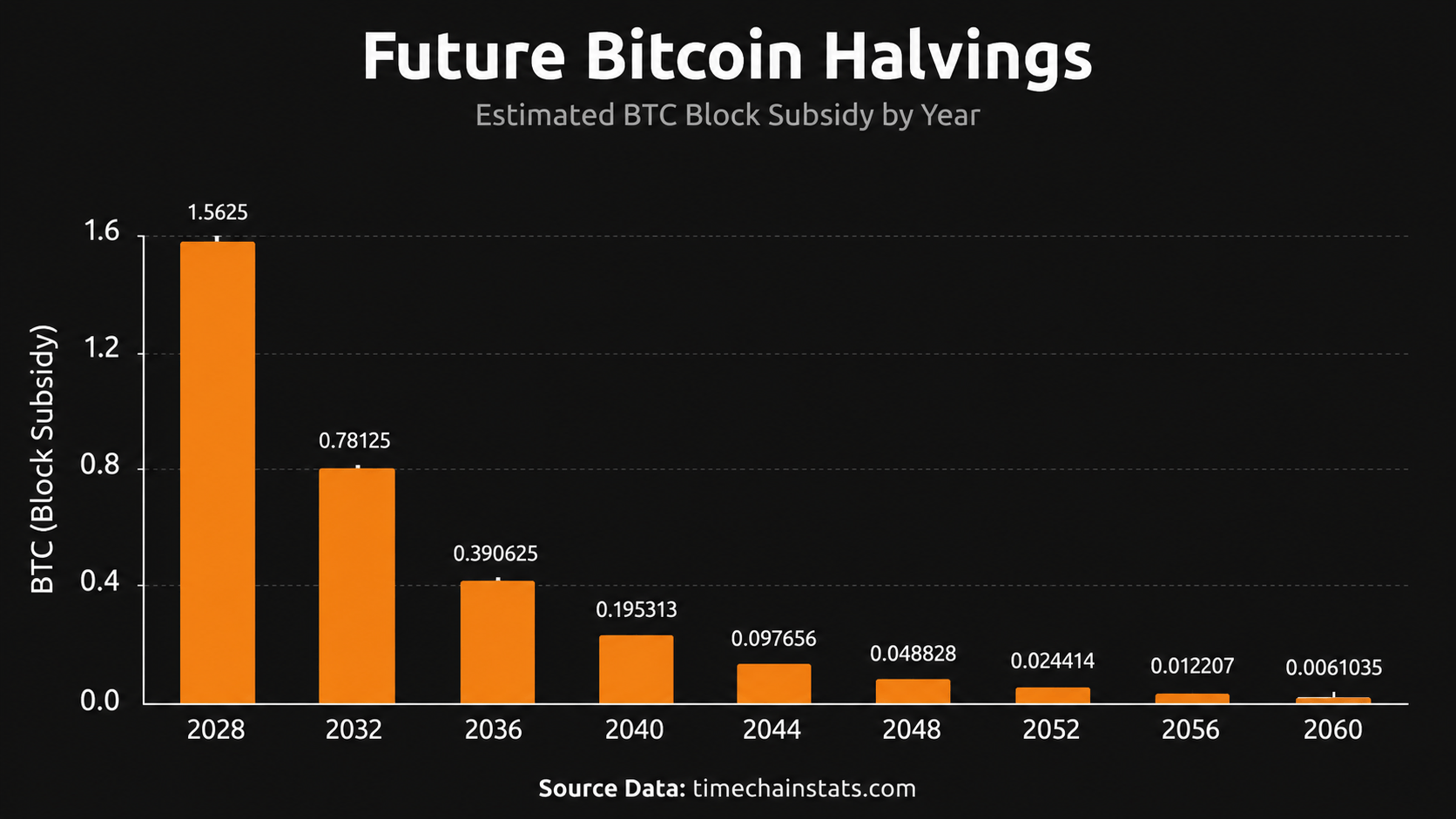
Forecast of projected block reward in $BTC until 2060. Data source: timechainstats.com.

This is why the remaining 4.43% matters more than it might seem at first glance. The share of Bitcoin mined went from 25% to 50% in less than two years. Reaching 75% took less than four years. Then the pace slowed dramatically. Bitcoin crossed the 95% threshold around December 3, 2025, and is projected to reach 99% around February 2035. Surprisingly, the last 1% will take about another century.

The Phrase 'The Last Bitcoin' is Misleading

In 2140, there won't be some dramatic final block that issues the last whole $BTC. By then, the mining reward will be minuscule. One Bitcoin ($BTC) is divisible into 100 million satoshis, and the block reward will continue halving until miners receive rewards of a few satoshis instead of whole coins.

The projected schedule illustrates this decline vividly. According to halving statistics published on timechainstats.com, the reward is expected to be 74 satoshis in 2112, 37 in 2116, 18 in 2120, nine in 2124, four in 2128, and just two satoshis in 2132. Following a final period of one-satoshi-per-block payouts, the reward will effectively reach zero around 2140. So far, everything is proceeding according to plan.

But even that date is an approximation. Halvings are triggered by the number of blocks mined, not a calendar date. Bitcoin aims for an average block time of ten minutes, but blocks can come faster or slower until the network adjusts the mining difficulty. However, the overall timeline is clear: issuance does not stop suddenly. It tapers off gradually, one tiny reward at a time.

There's also a small nuance regarding the 21 million figure. Bitcoin cannot create fractional satoshis. Eventually, through halvings, rewards become too small to pay out, resulting in a theoretical maximum of approximately 20,999,999.9769 $BTC. The difference is tiny, but it's a useful reminder that the famous 21 million cap is a simplified shorthand, not a precise mathematical and final payout amount.

Miners Will Feel It Again Soon

The network halving is important because miners receive a reward for keeping Bitcoin operational. They use specialized computers that confirm transactions and secure the network. Their revenue comes from two sources: newly created $BTC and transaction fees paid by users.

Currently, newly minted coins still constitute the bulk of the income. In the 24-hour period reflected in network data, mining revenue was approximately $28.7 million. Transaction fees accounted for just 0.69% of that amount. Fees can spike during periods of high activity, but low fees have been the norm lately, and this shows how heavily miners still depend on the subsidy.
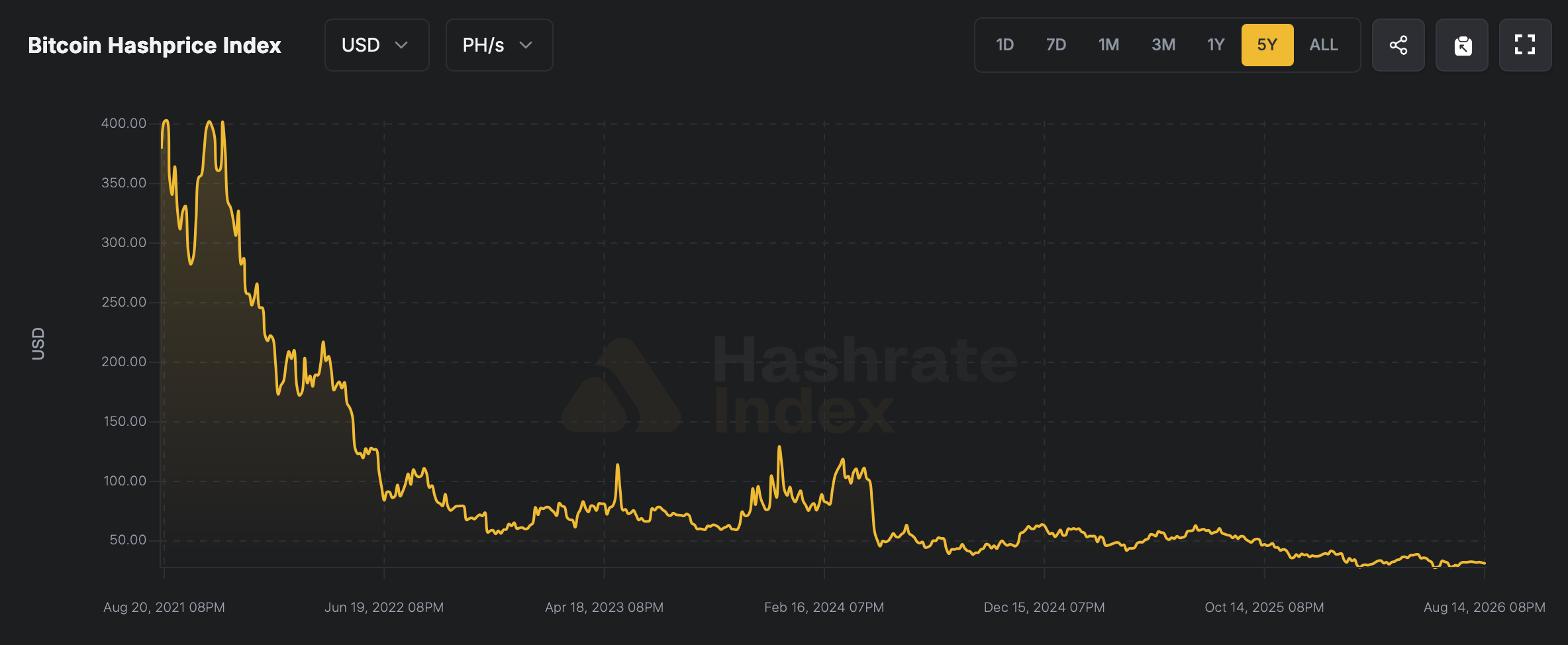
Bitcoin's hash price, or the estimated value of a specific amount of hashrate produced per day (in this chart's case, petahash per second, PH/s), has declined significantly since 2021. Screenshot of the hashprice chart taken on August 15, 2026, from hashrateindex.com.

This dependency becomes more acute after each halving. In 2028, miners will receive half as many new bitcoins for performing the same basic work. If the price of $BTC rises, fees increase, equipment becomes more efficient, or electricity gets cheaper, the industry can weather the blow. If these compensating factors don't materialize, weaker operators will be the first to shut down.

In 2026, two years after the 2024 halving, miners are struggling through a bear market for hashprice. The exodus of publicly-traded miners pivoting to AI infrastructure has only compounded the situation.

Bitcoin's Security Budget Under Review

Hashrate — the total computational power dedicated to mining — is Bitcoin's first line of defense. The higher the hashrate, the more expensive an attack on the network becomes. This weekend's figure of around 900 exahashes per second (EH/s) demonstrates how massive the mining industry has become, but it does not guarantee that this power will stay in the network forever.

Mining is a low-margin, volatile business. When revenues fall, less efficient machines are turned off. In this case, Bitcoin's difficulty adjustment mechanism reduces the amount of work required to mine blocks, helping block production return to its target pace. The system keeps functioning, but the economics underpinning it are constantly shifting.

This is why the real question is not whether Bitcoin can last until 2140. The question is whether transaction fees will become a sustainable revenue source for miners as the subsidy diminishes. The network doesn't need to wait for the last satoshi to face this challenge. It's already tackling it every four years.

Scarcity is a Strength, Not Magic

For investors, the emission schedule remains one of Bitcoin's most compelling advantages. At the current rate, approximately 164,250 $BTC are issued annually. After the next halving, this annual flow will shrink to about 82,125 $BTC. Four years later, it will drop again. New supply becomes increasingly hard to ignore when demand is rising.

But scarcity alone does not determine price. Priced at just under $63,000 per coin at 8 AM EDT on Saturday, Bitcoin still trades on factors like adoption, regulation, investor appetite, liquidity, and indeed, the state of the broader economy. A predictable supply schedule may distinguish Bitcoin from state-issued currencies, but it cannot force buyers into the market.

The 929,465 $BTC left to be mined are not the same as coins available for purchase. Some of the already mined Bitcoin is likely lost forever due to lost private keys, failed devices, or irreversible owner errors. No one knows exactly how much. A wallet that hasn't seen movement in years could be lost, or it could belong to someone who is simply waiting.

The next real test will come in 2028, when the mining reward is expected to drop again. The Bitcoin price will be the focus of media headlines, but miner revenue, fees, and hashrate will reveal a deeper picture. These numbers will show whether the network can continue to pay for security as the new issuance runs out.

end-content

Crypto di tendenza

Domande pertinenti

QAccording to the article, how long will it take to mine the final 1% of Bitcoin?

AIt will take approximately another century.

QWhat are the two primary sources of income for Bitcoin miners?

AMiners' income comes from newly created BTC block rewards and transaction fees paid by users.

QWhat happens approximately every 210,000 blocks in the Bitcoin network?

AThe block reward paid to miners is cut in half in an event called a 'halving'.

QWhat is the approximate year when Bitcoin's block reward is predicted to reach zero?

AAround the year 2140.

QWhy is the phrase 'the last Bitcoin' considered misleading in the context of the article?

ABecause the reward doesn't suddenly stop; it gradually diminishes to fractions of a Satoshi (one hundred millionth of a Bitcoin) over generations, reaching zero around 2140 without a dramatic final block.

Letture associate

Media: Anthropic Aims for Revenue Up to $200 Billion by 2028 Ahead of IPO

Anthropic, the AI company behind Claude, is reportedly projecting its revenue could reach between $190 billion and $200 billion by 2028, according to sources cited by Reuters. This forecast, significantly higher than its reported $47 billion annual run-rate in May 2026, is being used by investors and bankers to value the company ahead of a potential IPO. Anthropic has confidentially filed with the SEC, with listing details dependent on market conditions and regulatory approval. The valuation reportedly applies a revenue multiple (EV/Revenue) to these future 2028 figures, an approach common for high-growth tech firms but unusual for a forecast two years ahead of an IPO. This reflects confidence in Anthropic's rapid scaling; its annual run-rate grew tenfold yearly for three years leading into 2026, jumping from ~$9B in late 2025 to over $47B by May 2026. Investors are betting the company's massive spending on GPUs, model training, and infrastructure will eventually outpace costs, leading to expanding margins. Public companies like Palantir, Cloudflare, and SpaceX, valued at high multiples of their forward revenue, serve as benchmarks. While this forward-looking method has precedents, some analysts question the sustainability of such valuations and the actual productivity gains from AI. Despite these concerns, earlier reports suggested Anthropic could be valued at over $1 trillion for its IPO.

cryptonews.ru23 min fa

Media: Anthropic Aims for Revenue Up to $200 Billion by 2028 Ahead of IPO

cryptonews.ru23 min fa

Open Blockchain Business: Who Gets the Fees and Why a Foundation is Needed

Business of Open Blockchain: Who Gets the Fees and Why a Foundation is Needed In public blockchains, user transaction fees do not simply become "revenue" for a single entity. The flow of money is complex and protocol-dependent. In Ethereum, fees consist of a base fee (burned, permanently removing ETH from circulation) and a priority tip (paid to the validator). In Solana, half the base fee is burned and half goes to the validator, while priority fees go entirely to validators. Thus, "fees" are not synonymous with "project revenue"; they may go to network operators or be destroyed. Foundations like the Ethereum Foundation do not take a cut of user fees. They are funded by their own treasuries, which can generate income (e.g., from staking rewards) and finance ecosystem development, research, and security. Their role is to fund public goods that are hard to monetize directly. Developers of open-source blockchain code can monetize through services, not the code itself. For example, Optimism provides its technology freely but sells enterprise support and managed services (OP Enterprise). Additionally, networks built on Optimism's tech, like Coinbase's Base, share a portion of their revenue with the Optimism ecosystem via agreements, creating an economic link. Token holders do not automatically receive fees as dividends. In Optimism, a portion of protocol revenue is now used to buy back and treasury-lock OP tokens, creating an indirect link between network usage and token economics. In Ethereum, fee burning reduces ETH supply but doesn't distribute funds to all holders; stakers and validators receive direct rewards. For evaluation, analysts should look beyond total fee figures. Key questions are: Who paid and for what? Where did the money go (to validators, operators, treasury, or burning)? What were the recipient's costs? Is there a mechanism linking this income to the token? The same fee amount impacts different blockchain economies in vastly different ways depending on these factors.

cryptonews.ru25 min fa

Open Blockchain Business: Who Gets the Fees and Why a Foundation is Needed

cryptonews.ru25 min fa

Trading

Spot

Articoli Popolari

Cosa è BITCOIN

Comprendere HarryPotterObamaSonic10Inu (ERC-20) e la sua posizione nel mondo delle criptovalute Negli ultimi anni, il mercato delle criptovalute ha assistito a un aumento della popolarità delle meme coin, catturando l'interesse non solo dei trader, ma anche di coloro che cercano coinvolgimento comunitario e valore di intrattenimento. Tra questi token unici c'è HarryPotterObamaSonic10Inu (ERC-20), un progetto intrigante che mescola riferimenti culturali nel tessuto delle criptovalute. Questo articolo esplora gli aspetti chiave di HarryPotterObamaSonic10Inu, analizzando i suoi meccanismi, l'etica guidata dalla comunità e il suo coinvolgimento con il panorama crittografico più ampio. Che cos'è HarryPotterObamaSonic10Inu (ERC-20)? Come suggerisce il suo nome, HarryPotterObamaSonic10Inu è una meme coin costruita sulla blockchain di Ethereum, classificata secondo lo standard ERC-20. A differenza delle criptovalute tradizionali che possono enfatizzare l'utilità pratica o il potenziale investimento, questo token prospera grazie al valore di intrattenimento e alla forza della sua comunità. Il progetto mira a creare un ambiente in cui gli utenti coinvolti possono riunirsi, condividere idee e partecipare ad attività ispirate a diversi fenomeni culturali. Una caratteristica notevole di HarryPotterObamaSonic10Inu è la zero tassa sulle transazioni. Questo elemento allettante tende a incoraggiare il trading e il coinvolgimento della comunità, privo di costi aggiuntivi che possono scoraggiare i trader di piccole dimensioni. L'offerta totale della moneta è fissata a un miliardo di token, un numero che segna la sua intenzione di mantenere una circolazione sostanziale all'interno della comunità. Creatore di HarryPotterObamaSonic10Inu (ERC-20) Le origini di HarryPotterObamaSonic10Inu sono avvolte in un certo mistero; i dettagli sul creatore rimangono sconosciuti. Lo sviluppo di questo token non presenta un team identificabile o un piano esplicito, cosa non rara nel settore delle meme coin. Invece, il progetto è emerso organicamente, con il suo progresso fortemente dipendente dall'entusiasmo e dalla partecipazione della sua comunità. Investitori di HarryPotterObamaSonic10Inu (ERC-20) Per quanto riguarda investimenti esterni e finanziamenti, HarryPotterObamaSonic10Inu rimane ambiguo. Il token non elenca alcuna fondazione di investimento conosciuta o un sostegno organizzativo significativo. Invece, la linfa vitale del progetto è la sua comunità di base, che informa la sua crescita e sostenibilità attraverso azioni collettive e coinvolgimento nello spazio crittografico. Come funziona HarryPotterObamaSonic10Inu (ERC-20)? In quanto meme coin, HarryPotterObamaSonic10Inu opera principalmente al di fuori delle strutture tradizionali che governano spesso il valore degli asset. Ci sono diversi aspetti distintivi che definiscono il funzionamento del progetto: Transazioni senza tasse: Senza costi fiscali sulle transazioni, gli utenti possono comprare e vendere liberamente il token senza preoccuparsi di costi nascosti. Coinvolgimento della comunità: Il progetto prospera sull'interazione della comunità, sfruttando le piattaforme social per creare entusiasmo e facilitare il coinvolgimento. Discussioni, condivisione di contenuti e coinvolgimento sono elementi cruciali che aiutano ad espandere la sua portata e a favorire la lealtà tra i sostenitori. Nessuna utilità pratica: Va notato che HarryPotterObamaSonic10Inu non offre un'utilità concreta all'interno dell'ecosistema finanziario. Piuttosto, è classificato come un token principalmente per attività di intrattenimento e comunitarie. Riferimento culturale: Il token incorpora astutamente elementi della cultura pop per attirare interesse, collegandosi a appassionati di meme e seguaci delle criptovalute. HarryPotterObamaSonic10Inu esemplifica come le meme coin operino in modo diverso rispetto ai progetti di criptovalute più tradizionali, entrando nel mercato come costrutti sociali innovativi piuttosto che come asset utilitari. Cronologia di HarryPotterObamaSonic10Inu (ERC-20) La storia di HarryPotterObamaSonic10Inu è segnata da diversi traguardi notevoli: Creazione: Il token è emerso da un meme virale, catturando l'immaginazione di molti appassionati di criptovalute. Le date di creazione specifiche non sono disponibili, sottolineando la sua crescita organica. Inserimento negli scambi: HarryPotterObamaSonic10Inu ha fatto il suo ingresso in vari scambi, consentendo un accesso e un trading più facili da parte della comunità. Iniziative di coinvolgimento della comunità: Attività in corso volte a migliorare l'interazione della comunità, comprese gare, campagne sui social media e generazione di contenuti da parte di fan e sostenitori. Piani di espansione futura: La tabella di marcia del progetto include il lancio di una collezione NFT, merchandising e un sito di eCommerce relativo ai suoi temi culturali, coinvolgendo ulteriormente la comunità e cercando di aggiungere più dimensioni al suo ecosistema. Punti chiave su HarryPotterObamaSonic10Inu (ERC-20) Natura guidata dalla comunità: Il progetto dà priorità al contributo collettivo e alla creatività, garantendo che il coinvolgimento degli utenti sia al centro del suo sviluppo. Classificazione come meme coin: Rappresenta l'epitome delle criptovalute basate sull'intrattenimento, distinguendosi dai veicoli d'investimento tradizionali. Nessuna affiliazione diretta con Bitcoin: Nonostante la somiglianza nel nome del ticker, HarryPotterObamaSonic10Inu è distintivo e non ha alcuna relazione con Bitcoin o altre criptovalute consolidate. Focus sulla collaborazione: HarryPotterObamaSonic10Inu è progettato per creare uno spazio per la collaborazione e la condivisione di storie tra i suoi detentori, fornendo un canale per la creatività e il legame comunitario. Prospettive future: L'ambizione di espandersi oltre il suo presupposto iniziale verso NFT e merchandising delinea un percorso per il progetto per potenzialmente entrare in strade più mainstream all'interno della cultura digitale. Poiché le meme coin continuano a catturare l'immaginazione della comunità crittografica, HarryPotterObamaSonic10Inu (ERC-20) si distingue per i suoi legami culturali e il suo approccio centrato sulla comunità. Anche se potrebbe non adattarsi al modello tipico di un token orientato all'utilità, la sua essenza risiede nella gioia e nella camaraderia coltivate tra i suoi sostenitori, evidenziando la natura in evoluzione delle criptovalute in un'epoca sempre più digitale. Con la continuazione dello sviluppo del progetto, sarà importante osservare come le dinamiche della comunità influenzano la sua traiettoria nel panorama in continuo cambiamento della tecnologia blockchain.

2.3k Totale visualizzazioniPubblicato il 2024.04.01Aggiornato il 2024.12.03

Cosa è BITCOIN

Come comprare BTC

Benvenuto in HTX.com! Abbiamo reso l'acquisto di Bitcoin (BTC) semplice e conveniente. Segui la nostra guida passo passo per intraprendere il tuo viaggio nel mondo delle criptovalute.Step 1: Crea il tuo Account HTXUsa la tua email o numero di telefono per registrarti il tuo account gratuito su HTX. Vivi un'esperienza facile e sblocca tutte le funzionalità,Crea il mio accountStep 2: Vai in Acquista crypto e seleziona il tuo metodo di pagamentoCarta di credito/debito: utilizza la tua Visa o Mastercard per acquistare immediatamente BitcoinBTC.Bilancio: Usa i fondi dal bilancio del tuo account HTX per fare trading senza problemi.Terze parti: abbiamo aggiunto metodi di pagamento molto utilizzati come Google Pay e Apple Pay per maggiore comodità.P2P: Fai trading direttamente con altri utenti HTX.Over-the-Counter (OTC): Offriamo servizi su misura e tassi di cambio competitivi per i trader.Step 3: Conserva Bitcoin (BTC)Dopo aver acquistato Bitcoin (BTC), conserva nel tuo account HTX. In alternativa, puoi inviare tramite trasferimento blockchain o scambiare per altre criptovalute.Step 4: Scambia Bitcoin (BTC)Scambia facilmente Bitcoin (BTC) nel mercato spot di HTX. Accedi al tuo account, seleziona la tua coppia di trading, esegui le tue operazioni e monitora in tempo reale. Offriamo un'esperienza user-friendly sia per chi ha appena iniziato che per i trader più esperti.

4.8k Totale visualizzazioniPubblicato il 2024.12.12Aggiornato il 2026.06.02

Come comprare BTC

Cosa è $BITCOIN

ORO DIGITALE ($BITCOIN): Un'Analisi Completa Introduzione all'ORO DIGITALE ($BITCOIN) L'ORO DIGITALE ($BITCOIN) è un progetto basato su blockchain che opera sulla rete Solana, con l'obiettivo di combinare le caratteristiche dei metalli preziosi tradizionali con l'innovazione delle tecnologie decentralizzate. Sebbene condivida un nome con Bitcoin, spesso definito “oro digitale” a causa della sua percezione come riserva di valore, l'ORO DIGITALE è un token separato progettato per creare un ecosistema unico all'interno del panorama Web3. Il suo obiettivo è posizionarsi come un asset digitale alternativo valido, anche se i dettagli riguardanti le sue applicazioni e funzionalità sono ancora in fase di sviluppo. Cos'è l'ORO DIGITALE ($BITCOIN)? L'ORO DIGITALE ($BITCOIN) è un token di criptovaluta esplicitamente progettato per l'uso sulla blockchain di Solana. A differenza di Bitcoin, che fornisce un ruolo di stoccaggio di valore ampiamente riconosciuto, questo token sembra concentrarsi su applicazioni e caratteristiche più ampie. Aspetti notevoli includono: Infrastruttura Blockchain: Il token è costruito sulla blockchain di Solana, nota per la sua capacità di gestire transazioni ad alta velocità e a basso costo. Dinamiche di Offerta: L'ORO DIGITALE ha un'offerta massima fissata a 100 quadrilioni di token (100P $BITCOIN), sebbene i dettagli riguardanti la sua offerta circolante siano attualmente non divulgati. Utilità: Sebbene le funzionalità precise non siano esplicitamente delineate, ci sono indicazioni che il token potrebbe essere utilizzato per varie applicazioni, potenzialmente coinvolgendo applicazioni decentralizzate (dApp) o strategie di tokenizzazione degli asset. Chi è il Creatore dell'ORO DIGITALE ($BITCOIN)? Attualmente, l'identità dei creatori e del team di sviluppo dietro l'ORO DIGITALE ($BITCOIN) rimane sconosciuta. Questa situazione è tipica tra molti progetti innovativi nel settore blockchain, in particolare quelli allineati con la finanza decentralizzata e i fenomeni delle meme coin. Sebbene tale anonimato possa favorire una cultura guidata dalla comunità, intensifica le preoccupazioni riguardo alla governance e alla responsabilità. Chi sono gli Investitori dell'ORO DIGITALE ($BITCOIN)? Le informazioni disponibili indicano che l'ORO DIGITALE ($BITCOIN) non ha alcun sostenitore istituzionale noto o investimenti di venture capital prominenti. Il progetto sembra operare su un modello peer-to-peer incentrato sul supporto e sull'adozione della comunità piuttosto che su percorsi di finanziamento tradizionali. La sua attività e liquidità si trovano principalmente su exchange decentralizzati (DEX), come PumpSwap, piuttosto che su piattaforme di trading centralizzate consolidate, evidenziando ulteriormente il suo approccio di base. Come Funziona l'ORO DIGITALE ($BITCOIN) Le meccaniche operative dell'ORO DIGITALE ($BITCOIN) possono essere elaborate in base al suo design blockchain e alle caratteristiche della rete: Meccanismo di Consenso: Sfruttando il proof-of-history (PoH) unico di Solana combinato con un modello di proof-of-stake (PoS), il progetto garantisce una validazione efficiente delle transazioni contribuendo all'alta performance della rete. Tokenomics: Sebbene meccanismi deflazionistici specifici non siano stati dettagliati ampiamente, l'ampia offerta massima di token implica che potrebbe soddisfare microtransazioni o casi d'uso di nicchia che devono ancora essere definiti. Interoperabilità: Esiste il potenziale per l'integrazione con l'ecosistema più ampio di Solana, inclusi vari piattaforme di finanza decentralizzata (DeFi). Tuttavia, i dettagli riguardanti integrazioni specifiche rimangono non specificati. Cronologia degli Eventi Chiave Ecco una cronologia che evidenzia traguardi significativi riguardanti l'ORO DIGITALE ($BITCOIN): 2023: Il dispiegamento iniziale del token avviene sulla blockchain di Solana, contrassegnato dal suo indirizzo di contratto. 2024: L'ORO DIGITALE guadagna visibilità poiché diventa disponibile per il trading su exchange decentralizzati come PumpSwap, consentendo agli utenti di scambiarlo contro SOL. 2025: Il progetto assiste a un'attività di trading sporadica e a un potenziale interesse per impegni guidati dalla comunità, sebbene non siano state documentate partnership significative o avanzamenti tecnici fino ad ora. Analisi Critica Punti di Forza Scalabilità: L'infrastruttura sottostante di Solana supporta alti volumi di transazioni, il che potrebbe migliorare l'utilità di $BITCOIN in vari scenari di transazione. Accessibilità: Il potenziale basso prezzo di trading per token potrebbe attrarre investitori al dettaglio, facilitando una partecipazione più ampia grazie a opportunità di proprietà frazionata. Rischi Mancanza di Trasparenza: L'assenza di sostenitori, sviluppatori o di un processo di audit pubblicamente noti potrebbe generare scetticismo riguardo alla sostenibilità e all'affidabilità del progetto. Volatilità del Mercato: L'attività di trading è fortemente dipendente dal comportamento speculativo, il che può comportare una significativa volatilità dei prezzi e incertezze per gli investitori. Conclusione L'ORO DIGITALE ($BITCOIN) emerge come un progetto intrigante ma ambiguo all'interno dell'evolvente ecosistema di Solana. Sebbene tenti di sfruttare la narrativa dell'“oro digitale”, la sua partenza dal ruolo consolidato di Bitcoin come riserva di valore sottolinea la necessità di una chiara differenziazione della sua utilità e struttura di governance. L'accettazione e l'adozione future dipenderanno probabilmente dall'affrontare l'attuale opacità e dalla definizione più esplicita delle sue strategie operative ed economiche. Nota: Questo rapporto comprende informazioni sintetizzate disponibili a ottobre 2023, e potrebbero essersi verificati sviluppi oltre il periodo di ricerca.

520 Totale visualizzazioniPubblicato il 2025.05.13Aggiornato il 2025.05.13

Cosa è $BITCOIN

Discussioni

Benvenuto nella Community HTX. Qui puoi rimanere informato sugli ultimi sviluppi della piattaforma e accedere ad approfondimenti esperti sul mercato. Le opinioni degli utenti sul prezzo di BTC BTC sono presentate come di seguito.

活动图片