Mining Firms Flock to AI, but Wall Street Cools Valuation Enthusiasm. The Earnings Season Reveals Who's 'Swimming Naked'?

marsbitPubblicato 2026-08-07Pubblicato ultima volta 2026-08-07

Introduzione

Bitcoin mining companies are increasingly pivoting to AI and HPC (high-performance computing) infrastructure, but Wall Street is growing skeptical, demanding proof of a viable business model over mere announcements. An analysis shows that while early AI-related announcements triggered significant stock price movements (average absolute change of 24.1%), recent similar news has had a much smaller market impact (average ~10.2%), despite the underlying business value of AI/HPC hosting contracts improving. A review of Q2 2024 earnings from five major mining firms reveals a mixed picture: * **Marathon Digital (MARA):** Reported declining revenue ($175M, down 27%) and a large net loss ($610M+). Its AI/HPC transformation remains in the building phase, contributing negligible revenue so far. * **Core Scientific:** Successfully shifted its business model, with AI/HPC hosting now dominating revenue (83% of total $164.2M). However, this came with high capital expenditure and negative shareholder equity. * **TeraWulf:** Showed early results from its pivot, with HPC leasing generating 71% of its total revenue ($44.77M). It secured major long-term contracts but also reported a significant net loss. * **Hut 8:** Achieved substantial revenue growth ($74.9M, up 81.4%) driven by computing operations and completed commercialization of its first major AI data center campus. It remains unprofitable on a net income basis. * **CleanSpark:** Revenue still relies entirely on Bitcoin mining...

Author: Nancy, PANews

The story of Bitcoin mining companies pivoting to AI is no longer novel, and has even gradually become an industry standard. However, as more mining firms rush into this track, Wall Street is beginning to lower the valuation premium for this AI pivot narrative.

Blocksbridge Consulting recently pointed out in an analysis that as more mining companies ramp up their AI/HPC infrastructure, the market's reaction to the related transformation stories is noticeably cooling off. Even large-scale AI hosting contracts are finding it increasingly difficult to replicate the market stimulus seen in the early days. Data shows that early AI business announcements often triggered significant stock price volatility, with the average absolute price movement for related companies reaching 24.1% after announcements; however, the average absolute price movement following recent similar transaction announcements has dropped to about 10.2%.
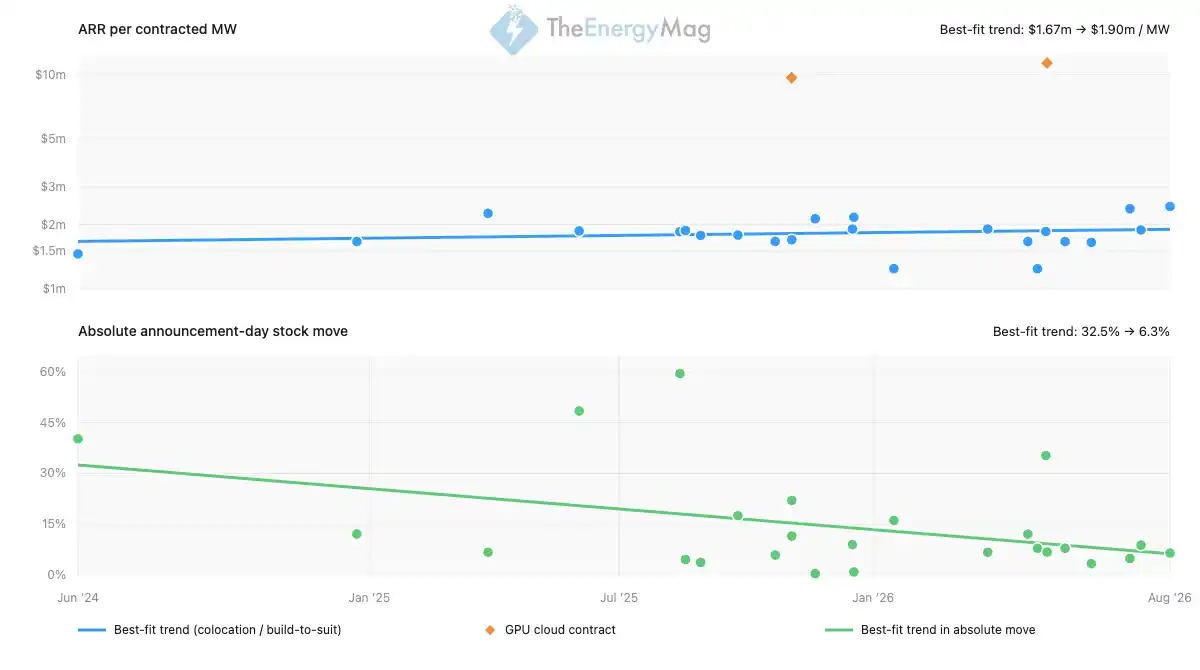
Meanwhile, the commercial value of AI/HPC hosting businesses themselves continues to rise. Data shows the annualized revenue level for related leases has increased from about $1.67 million per megawatt in the early stages to approximately $1.9 million.

This change means the market is no longer buying into the mere slogan of an AI pivot; instead, it's starting to focus on tenant quality, project delivery capabilities, capital expenditure, and the realization of future cash flows. For Bitcoin mining companies, the key to AI transformation has shifted from "storytelling" to the stage of "proving the business model."

As Q2 earnings reports roll out, the AI pivot of Bitcoin miners is entering a new phase of examination. PANews reviewed the latest financial reports of five leading Bitcoin mining companies. In terms of transformation progress and results, some miners are still in the construction phase, with AI businesses yet to contribute revenue; some companies have already generated new revenue through AI/HPC hosting businesses, even starting to reshape their business structure. Overall, most mining companies still face declining revenue, widening losses, and high capital expenditure pressure. The transformation story still has a distance to go before cash flow realization.

Looking at secondary market performance, investor attitudes toward miners' AI pivots are also becoming more rational. Over the past month, most Bitcoin mining stocks have seen varying degrees of correction, which is also influenced by the overall pullback in the global AI sector. However, even when some miners announce large AI/HPC leases or make business progress, the market reaction remains relatively muted.
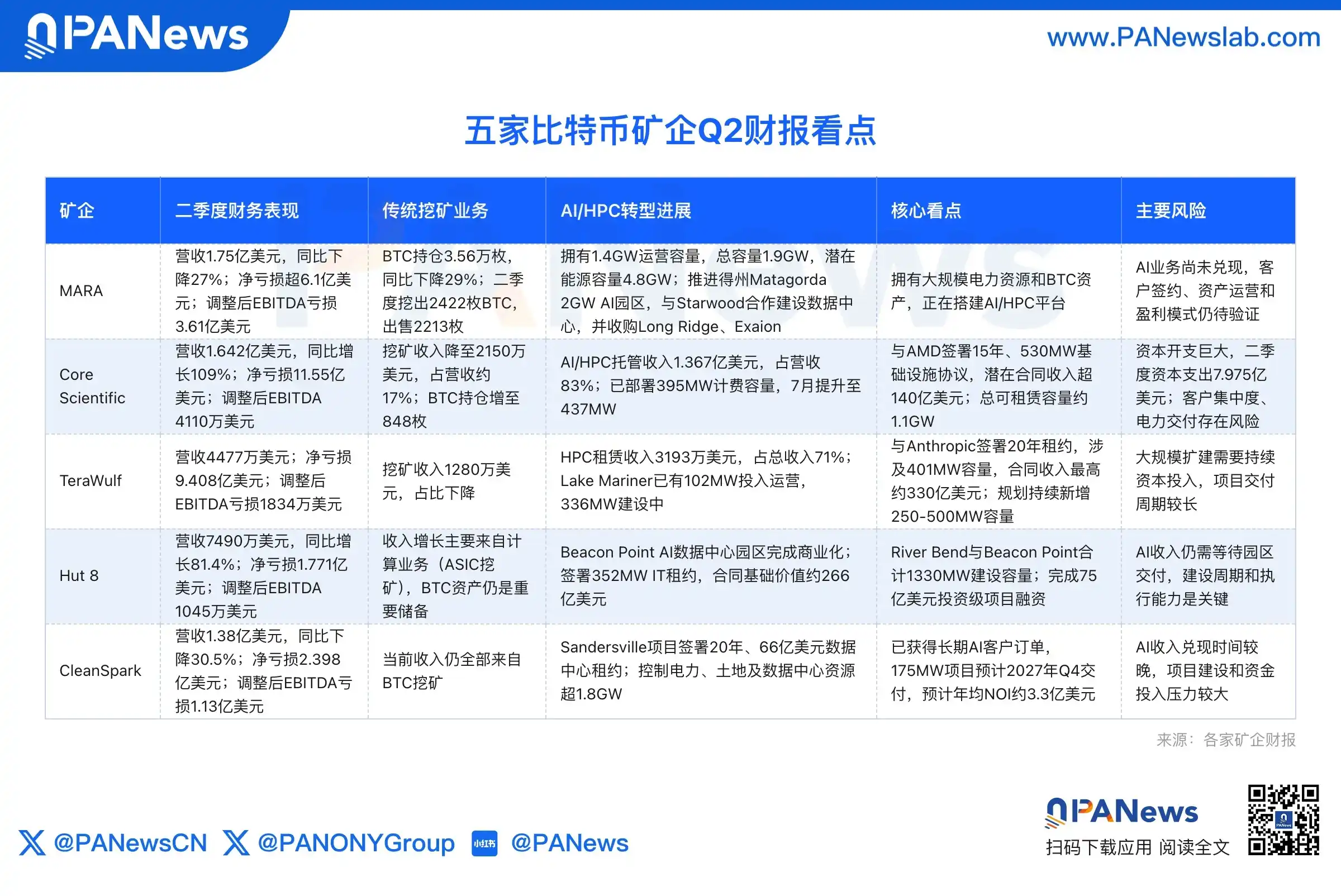
MARA: Losses Widen, AI Pivot Yet to Contribute Revenue

Data shows MARA's stock price fell about 11.6% over the past month, dropping about 5.25% on the day its Q2 earnings were released.

Looking at the latest quarterly report, MARA's traditional mining business remains pressured by the industry cycle, with profit margins continuing to shrink. Its bet on AI/HPC infrastructure remains largely in the setup phase, with the commercialization story yet to materialize.

In Q2 this year, MARA reported revenue of approximately $175 million, a 27% year-over-year decline, significantly down from $238.5 million in the same period last year. In terms of profit, MARA posted a net loss exceeding $610 million in Q2, compared to a profit of about $810 million a year ago. Adjusted EBITDA was a loss of $361 million, a sharp drop from the $1.245 billion profit in the same quarter last year, mainly impacted by approximately $343 million in digital asset impairment due to the decline in Bitcoin's price.

In this earnings report, MARA explicitly outlined its "Three Infrastructure Strategy," encompassing Bitcoin mining, energy resources, and AI computing infrastructure.

Regarding mining operations, as of the end of Q2, MARA held 35,577 BTC, down 29% from 49,951 BTC a year ago. The company mined 2,422 BTC during the quarter and sold 2,213 BTC, with an average selling price of about $73,000. Currently, its combined holdings of cash and BTC assets amount to approximately $2.5 billion.

In terms of the AI/HPC pivot, as of June 2026, MARA had 1.4 GW of operating capacity, with total capacity reaching 1.9 GW and potential energy capacity of about 4.8 GW. The project in Matagorda County, Texas, is a key future transformation node. This project plans to reach up to 2 GW of power capacity and be developed into an AI/HPC computing campus, with construction expected to commence in 2027. Concurrently, MARA partnered with Starwood to establish a data center and acquired the Long Ridge energy asset and French HPC operator Exaion (full-year estimated revenue under eight figures, i.e., millions to around ten million dollars).

Notably, to support energy infrastructure expansion, MARA established a new $100 million credit facility, with 18,750 BTC serving as initial collateral. This indicates the company is enhancing the liquidity and capital efficiency of its Bitcoin assets to provide funding support for subsequent infrastructure investments.

However, AI/HPC currently contributes virtually nothing to MARA's revenue. During the earnings call, MARA management acknowledged this reality, stating that the company's core task in the first half of this year was scaling up and driving the platform transformation. The second half will enter the execution phase, including securing customer agreements, bringing new assets online, and validating the platform's profit potential.

Core Scientific: AI Revenue Exceeds 80%, Starts Accumulating BTC

Data shows Core Scientific's stock price fell about 3.04% over the past month, rising about 0.05% on the day its Q2 earnings were released.

Based on the latest quarterly report, Core Scientific's traditional mining business share has significantly contracted. Its bet on AI/HPC infrastructure has become revenue-dominant, and the commercialization story is largely realized.

In Q2 this year, Core Scientific reported revenue of approximately $164.2 million, a massive year-over-year increase of about 109%. In terms of profitability, the company still recorded a net loss of about $1.155 billion, but adjusted EBITDA reached about $41.1 million, gross profit was about $70 million, with a gross margin of about 43%.

From a business structure perspective, Core Scientific is rapidly reducing its reliance on mining revenue. Q2 mining revenue fell to about $21.5 million, accounting for roughly 17% of total revenue. Meanwhile, Core Scientific's Bitcoin holdings increased from 547 BTC at the end of Q1 to 848 BTC, adding 301 BTC in the quarter. Previously, it sold BTC extensively to support its AI and high-performance computing business transition but began accumulating again in Q2.

The real driver of revenue growth is the AI/HPC infrastructure business. Q2 hosting revenue reached about $136.7 million, far surpassing $10.6 million in the same period last year, accounting for about 83% of total revenue. Currently, the company has deployed approximately 395 MW of billable capacity, further increasing to 437 MW as of mid-July, corresponding to annualized hosting revenue of about $635 million. Concurrently, Core Scientific announced signing a 15-year infrastructure agreement with AMD, covering 530 MW of capacity across five data center campuses, with potential base contract revenue exceeding $14 billion. Currently, Core's total leasable customer power capacity reaches about 1.1 gigawatts, with potential contract revenue over $24 billion.

Of course, this transformation also comes with high capital expenditure. The miner's Q2 capital expenditure was $797.5 million for data center construction and land acquisition, with net cash used in investing activities exceeding $1.18 billion in the first half. It also supplemented funds through issuances like $3.3 billion in senior secured notes, but interest burdens subsequently increased, and balance sheet leverage rose noticeably. Shareholders' equity remains negative, and the volatility of warrant liabilities persists. Additionally, hosting revenue is highly concentrated among a few clients. Construction progress, power availability, and supply chain stability will directly affect delivery timelines and revenue realization capabilities.

Core Scientific management noted in the Q2 earnings call that the transformation inflection point has passed. The company now possesses the capability to continuously create value for customers and shareholders. The subsequent focus is on efficiently delivering computing capacity, strictly controlling project timelines, and allocating capital responsibly.

TeraWulf: Transformation Expectations Shift to Earnings Realization, HPC Business Becomes Revenue Driver

Data shows TeraWulf's stock price fell about 12.97% over the past month, dropping about 4.29% on the day its Q2 earnings were released.

In the same quarter, TeraWulf's traditional mining business was also affected by the industry cycle, contributing less, but its AI/HPC pivot is beginning to show results, starting to generate significant revenue.

Q2 earnings show TeraWulf's total quarterly revenue was approximately $44.77 million. Bitcoin mining revenue was only about $12.8 million, while HPC leasing revenue reached about $31.93 million, accounting for about 71% of total revenue. The net loss widened to approximately $940.8 million, mainly impacted by changes in the fair value of warrants (a loss of $755.7 million). Adjusted EBITDA was a loss of $18.34 million. As of June 30, combined cash and restricted cash totaled about $3 billion, indicating relatively ample liquidity.

On the operational front, progress at the Lake Mariner data center campus is smooth. As of early July, 102 MW of critical IT capacity was operational, with another 336 MW under construction. The cost per MW of critical IT construction remains within the guidance range of $8 million to $10 million. Following the CB-3 delivery, the $600 million credit support from Google for the Fluidstack lease obligation has officially taken effect. Simultaneously, TeraWulf is advancing applications for an additional 250 MW of power capacity. The Lake Hawkeye campus spans about 183 acres with a potential capacity of approximately 320 MW critical IT load and is not expected to be operational before 2029.

Post-quarter, TeraWulf signed a 20-year data center lease with Anthropic, involving about 401 MW of critical IT capacity at the Justified campus in Kentucky. The contract value over its term is about $19 billion, potentially reaching up to approximately $33 billion if Anthropic exercises two five-year renewal options. Initial deliveries are expected to begin in the second half of 2027.

Additionally, TeraWulf sold its 50.1% stake in the Abernathy joint venture for approximately $530 million and acquired the Muskie Data Campus in Kentucky, securing a power services agreement for up to 1 GW. FERC approved the acquisition of the Morgantown power plant in Maryland, clearing a major regulatory hurdle for its subsidiary Chesapeake Data Campus. This campus can scale up to 1 GW, with data center operations expected to commence around 2030. TeraWulf reiterated its target of signing 250 to 500 MW of new critical IT capacity annually, emphasizing the prioritization of opportunities with stable power, clear customer demand, and scalable infrastructure.

TeraWulf CEO Paul Prager stated that the company is shifting from platform building to scaled execution. The model is replicable, with the core lying in controlling power-advantaged infrastructure, securing long-term creditworthy customers, and delivering capacity in phases.

Hut 8: Revenue Surges but Losses Persist, Completes First AI Campus Commercialization

Data shows Hut 8's stock price fell about 6.3% over the past month, dropping about 9.74% on the day its Q2 earnings were released.

In Q2, Hut 8 reported revenue of approximately $74.9 million, an 81.4% year-over-year increase. The main driver of revenue growth was the computing business (primarily ASIC mining), reaching about $72.5 million. Digital infrastructure revenue was $1.3 million, and power revenue was $1.2 million. Despite strong revenue performance, the company posted a net loss of about $177.1 million for the quarter, primarily dragged down by $138.6 million in unrealized losses on digital assets. Adjusted EBITDA was $10.45 million, a 149% year-over-year increase.

In terms of commercialization, Hut 8 completed the commercialization of its first gigawatt-scale AI data center campus, Beacon Point, signing a second 352 MW IT lease after the quarter ended. The base contract period is valued at approximately $26.6 billion, with expected annual Net Operating Income (NOI) exceeding $1.75 billion. This lease covers 949 MW of contracted IT capacity, with tenants primarily being investment-grade counterparties. Meanwhile, the combined under-construction power capacity at the River Bend and Beacon Point campuses is 1,330 MW, targeting first data hall deliveries in Q2 and Q3 2027, respectively. As of the end of Q2, Hut 8's total development pipeline is about 8,660 MW, primarily impacted by $138.6 million in unrealized losses on digital assets.

Regarding financing, Hut 8 secured $7.5 billion in investment-grade project financing within the quarter: $3.3 billion for the River Bend campus and $4.25 billion for Beacon Point Phase 1. These are non-recourse, non-dilutive arrangements, setting a precedent for investment-grade construction financing for single-sponsor data center projects, providing solid funding support for large-scale construction.

Hut 8 CEO Asher Genoot emphasized that the company's core task has shifted from securing orders to project delivery. The focus is on quickly converting contracted capacity into actual operations and stable cash flow, further solidifying the foundation for the transition from mining to AI infrastructure.

CleanSpark: Mining Revenue Drops, $6.6 Billion Lease Becomes Key Highlight

Data shows CleanSpark's stock price rose about 2.16% over the past month, falling about 5.56% on the day its Q2 earnings were released.

For fiscal Q3 2026, CleanSpark's revenue was $138 million, a 30.5% year-over-year decline. The net loss reached $239.8 million, compared to a net profit of $257.4 million in the same period last year. Adjusted EBITDA also dropped sharply from $377.7 million in the prior year to a loss of $113 million.

As of June 30, CleanSpark held $202.6 million in cash, Bitcoin assets valued at approximately $814.9 million, net long-term debt of $1.78 billion, and working capital of $761 million. Overall, CleanSpark maintains strong asset reserves and financing capabilities, but continued expansion of data centers and computing infrastructure also requires significant capital investment.

Notably, this quarter's revenue for CleanSpark still came entirely from Bitcoin mining, with AI/HPC-related businesses yet to contribute actual revenue.

However, the biggest highlight this quarter was CleanSpark's Sandersville project signing a 20-year, $6.6 billion data center lease agreement with an undisclosed global technology company. According to CleanSpark's disclosure, the project adopts a high-specification data center construction plan, with a per-MW construction cost of approximately $10 million to $12 million. The 175 MW capacity corresponds to a total investment of about $1.75 billion to $2.1 billion, with the project expected to generate average annual Net Operating Income (NOI) of about $330 million. However, this revenue still awaits project completion, with deliveries expected to start as early as Q4 2027. CleanSpark also stated that the required equity funding for the project is already secured, and critical long-lead-time equipment procurement and prepayments have been arranged, ensuring subsequent planned operation.

Compared to some miners still touting AI stories, CleanSpark's advantage lies in having accumulated scaled energy resources, land reserves, and data center operational experience. Currently, its controlled power, land, and data center resources in the U.S. exceed 1.8 GW.

Looking at the report cards from various mining companies, this AI transformation is entering a watershed stage. For investors, the focus is no longer on who has the biggest AI story, but on more specific operational metrics. For Bitcoin miners, possessing power, land, and computing resources is just the entry ticket. Ultimately, what determines valuation reassessment is project delivery capability, client quality, and future cash flow realization ability.

Crypto di tendenza

Domande pertinenti

QAccording to the article, why is Wall Street reducing the valuation premium for bitcoin mining companies' AI transformation stories?

AWall Street is reducing the valuation premium because the market's reaction to AI transformation announcements is cooling down. Early AI business announcements used to cause significant stock price volatility, but recent similar deals have a much smaller average impact. The market is no longer paying for the story alone but is instead focusing on tenant quality, project delivery capabilities, capital investment, and the ability to generate future cash flow.

QBased on the Q2 2026 earnings reports reviewed, which company had the largest proportion of its revenue come from AI/HPC hosting?

ACore Scientific had the largest proportion of its revenue come from AI/HPC hosting. In Q2 2026, its hosting revenue reached approximately $136.7 million, accounting for about 83% of its total revenue.

QWhat was the main reason for MARA's significant net loss in Q2 2026, as mentioned in the article?

AThe main reason for MARA's significant net loss in Q2 2026 was a digital asset impairment of approximately $343 million, driven by the decrease in Bitcoin's price. This contributed to a net loss of over $610 million for the quarter.

QWhich company signed a major 20-year, $66 billion data center lease agreement during the quarter, and what is a key feature of this deal?

ACleanSpark signed a major 20-year, $66 billion data center lease agreement with an undisclosed global tech company for its Sandersville project. A key feature is that the required equity funding for the project has already been secured.

QWhat common challenge do most of the profiled bitcoin mining companies face in their AI transformation, despite some generating revenue from it?

AA common challenge is the high capital investment pressure required for building data center and computing infrastructure. Most companies still face declining revenues, widening losses, and the pressure of significant capital expenditures. The transformation story is still some distance from being fully realized in terms of consistent cash flow generation.

Letture associate

The person closest to the Federal Reserve commented on US non-farm payroll data!

The U.S. non-farm sector lost 23,000 jobs in July, indicating the labor market has not yet stabilized following four months of positive growth, although the unemployment rate edged down to 4.1%. Following the weak jobs data, Wall Street Journal reporter Nick Timiraos, known for his close ties to Federal Reserve policy, stated that interpreting the July employment report will be a complex task for the Fed. According to Timiraos, the new data showing the labor market is no longer improving could reduce the need for the Fed to raise interest rates next month. However, the most critical factor determining the direction of the interest rate decision will be inflation data. He noted that market focus will remain on inflation, especially as unemployment continues to fall, with rising or falling price pressures likely to shape the Fed's approach to interest rate policy. Therefore, moderate inflation data could strengthen the argument for the Fed to leave rates unchanged. Specifically, two consecutive months of moderate inflation could be interpreted as a sign that slowing price pressures are becoming a more pronounced trend, not a temporary fluctuation. Conversely, positive inflation data could force the Fed to reconsider its current inflation forecasts and increase the likelihood of a rate hike. Timiraos added that if inflation proves to be high, forecasts of reaching inflation targets without changing interest rates could be questioned by more Fed officials. In such a scenario, support for a rate hike among policymakers could increase.

cryptonews.ru1 h fa

The person closest to the Federal Reserve commented on US non-farm payroll data!

cryptonews.ru1 h fa

Trading

Spot

Articoli Popolari

Cosa è BITCOIN

Comprendere HarryPotterObamaSonic10Inu (ERC-20) e la sua posizione nel mondo delle criptovalute Negli ultimi anni, il mercato delle criptovalute ha assistito a un aumento della popolarità delle meme coin, catturando l'interesse non solo dei trader, ma anche di coloro che cercano coinvolgimento comunitario e valore di intrattenimento. Tra questi token unici c'è HarryPotterObamaSonic10Inu (ERC-20), un progetto intrigante che mescola riferimenti culturali nel tessuto delle criptovalute. Questo articolo esplora gli aspetti chiave di HarryPotterObamaSonic10Inu, analizzando i suoi meccanismi, l'etica guidata dalla comunità e il suo coinvolgimento con il panorama crittografico più ampio. Che cos'è HarryPotterObamaSonic10Inu (ERC-20)? Come suggerisce il suo nome, HarryPotterObamaSonic10Inu è una meme coin costruita sulla blockchain di Ethereum, classificata secondo lo standard ERC-20. A differenza delle criptovalute tradizionali che possono enfatizzare l'utilità pratica o il potenziale investimento, questo token prospera grazie al valore di intrattenimento e alla forza della sua comunità. Il progetto mira a creare un ambiente in cui gli utenti coinvolti possono riunirsi, condividere idee e partecipare ad attività ispirate a diversi fenomeni culturali. Una caratteristica notevole di HarryPotterObamaSonic10Inu è la zero tassa sulle transazioni. Questo elemento allettante tende a incoraggiare il trading e il coinvolgimento della comunità, privo di costi aggiuntivi che possono scoraggiare i trader di piccole dimensioni. L'offerta totale della moneta è fissata a un miliardo di token, un numero che segna la sua intenzione di mantenere una circolazione sostanziale all'interno della comunità. Creatore di HarryPotterObamaSonic10Inu (ERC-20) Le origini di HarryPotterObamaSonic10Inu sono avvolte in un certo mistero; i dettagli sul creatore rimangono sconosciuti. Lo sviluppo di questo token non presenta un team identificabile o un piano esplicito, cosa non rara nel settore delle meme coin. Invece, il progetto è emerso organicamente, con il suo progresso fortemente dipendente dall'entusiasmo e dalla partecipazione della sua comunità. Investitori di HarryPotterObamaSonic10Inu (ERC-20) Per quanto riguarda investimenti esterni e finanziamenti, HarryPotterObamaSonic10Inu rimane ambiguo. Il token non elenca alcuna fondazione di investimento conosciuta o un sostegno organizzativo significativo. Invece, la linfa vitale del progetto è la sua comunità di base, che informa la sua crescita e sostenibilità attraverso azioni collettive e coinvolgimento nello spazio crittografico. Come funziona HarryPotterObamaSonic10Inu (ERC-20)? In quanto meme coin, HarryPotterObamaSonic10Inu opera principalmente al di fuori delle strutture tradizionali che governano spesso il valore degli asset. Ci sono diversi aspetti distintivi che definiscono il funzionamento del progetto: Transazioni senza tasse: Senza costi fiscali sulle transazioni, gli utenti possono comprare e vendere liberamente il token senza preoccuparsi di costi nascosti. Coinvolgimento della comunità: Il progetto prospera sull'interazione della comunità, sfruttando le piattaforme social per creare entusiasmo e facilitare il coinvolgimento. Discussioni, condivisione di contenuti e coinvolgimento sono elementi cruciali che aiutano ad espandere la sua portata e a favorire la lealtà tra i sostenitori. Nessuna utilità pratica: Va notato che HarryPotterObamaSonic10Inu non offre un'utilità concreta all'interno dell'ecosistema finanziario. Piuttosto, è classificato come un token principalmente per attività di intrattenimento e comunitarie. Riferimento culturale: Il token incorpora astutamente elementi della cultura pop per attirare interesse, collegandosi a appassionati di meme e seguaci delle criptovalute. HarryPotterObamaSonic10Inu esemplifica come le meme coin operino in modo diverso rispetto ai progetti di criptovalute più tradizionali, entrando nel mercato come costrutti sociali innovativi piuttosto che come asset utilitari. Cronologia di HarryPotterObamaSonic10Inu (ERC-20) La storia di HarryPotterObamaSonic10Inu è segnata da diversi traguardi notevoli: Creazione: Il token è emerso da un meme virale, catturando l'immaginazione di molti appassionati di criptovalute. Le date di creazione specifiche non sono disponibili, sottolineando la sua crescita organica. Inserimento negli scambi: HarryPotterObamaSonic10Inu ha fatto il suo ingresso in vari scambi, consentendo un accesso e un trading più facili da parte della comunità. Iniziative di coinvolgimento della comunità: Attività in corso volte a migliorare l'interazione della comunità, comprese gare, campagne sui social media e generazione di contenuti da parte di fan e sostenitori. Piani di espansione futura: La tabella di marcia del progetto include il lancio di una collezione NFT, merchandising e un sito di eCommerce relativo ai suoi temi culturali, coinvolgendo ulteriormente la comunità e cercando di aggiungere più dimensioni al suo ecosistema. Punti chiave su HarryPotterObamaSonic10Inu (ERC-20) Natura guidata dalla comunità: Il progetto dà priorità al contributo collettivo e alla creatività, garantendo che il coinvolgimento degli utenti sia al centro del suo sviluppo. Classificazione come meme coin: Rappresenta l'epitome delle criptovalute basate sull'intrattenimento, distinguendosi dai veicoli d'investimento tradizionali. Nessuna affiliazione diretta con Bitcoin: Nonostante la somiglianza nel nome del ticker, HarryPotterObamaSonic10Inu è distintivo e non ha alcuna relazione con Bitcoin o altre criptovalute consolidate. Focus sulla collaborazione: HarryPotterObamaSonic10Inu è progettato per creare uno spazio per la collaborazione e la condivisione di storie tra i suoi detentori, fornendo un canale per la creatività e il legame comunitario. Prospettive future: L'ambizione di espandersi oltre il suo presupposto iniziale verso NFT e merchandising delinea un percorso per il progetto per potenzialmente entrare in strade più mainstream all'interno della cultura digitale. Poiché le meme coin continuano a catturare l'immaginazione della comunità crittografica, HarryPotterObamaSonic10Inu (ERC-20) si distingue per i suoi legami culturali e il suo approccio centrato sulla comunità. Anche se potrebbe non adattarsi al modello tipico di un token orientato all'utilità, la sua essenza risiede nella gioia e nella camaraderia coltivate tra i suoi sostenitori, evidenziando la natura in evoluzione delle criptovalute in un'epoca sempre più digitale. Con la continuazione dello sviluppo del progetto, sarà importante osservare come le dinamiche della comunità influenzano la sua traiettoria nel panorama in continuo cambiamento della tecnologia blockchain.

2.1k Totale visualizzazioniPubblicato il 2024.04.01Aggiornato il 2024.12.03

Cosa è BITCOIN

Come comprare BTC

Benvenuto in HTX.com! Abbiamo reso l'acquisto di Bitcoin (BTC) semplice e conveniente. Segui la nostra guida passo passo per intraprendere il tuo viaggio nel mondo delle criptovalute.Step 1: Crea il tuo Account HTXUsa la tua email o numero di telefono per registrarti il tuo account gratuito su HTX. Vivi un'esperienza facile e sblocca tutte le funzionalità,Crea il mio accountStep 2: Vai in Acquista crypto e seleziona il tuo metodo di pagamentoCarta di credito/debito: utilizza la tua Visa o Mastercard per acquistare immediatamente BitcoinBTC.Bilancio: Usa i fondi dal bilancio del tuo account HTX per fare trading senza problemi.Terze parti: abbiamo aggiunto metodi di pagamento molto utilizzati come Google Pay e Apple Pay per maggiore comodità.P2P: Fai trading direttamente con altri utenti HTX.Over-the-Counter (OTC): Offriamo servizi su misura e tassi di cambio competitivi per i trader.Step 3: Conserva Bitcoin (BTC)Dopo aver acquistato Bitcoin (BTC), conserva nel tuo account HTX. In alternativa, puoi inviare tramite trasferimento blockchain o scambiare per altre criptovalute.Step 4: Scambia Bitcoin (BTC)Scambia facilmente Bitcoin (BTC) nel mercato spot di HTX. Accedi al tuo account, seleziona la tua coppia di trading, esegui le tue operazioni e monitora in tempo reale. Offriamo un'esperienza user-friendly sia per chi ha appena iniziato che per i trader più esperti.

4.6k Totale visualizzazioniPubblicato il 2024.12.12Aggiornato il 2026.06.02

Come comprare BTC

Cosa è $BITCOIN

ORO DIGITALE ($BITCOIN): Un'Analisi Completa Introduzione all'ORO DIGITALE ($BITCOIN) L'ORO DIGITALE ($BITCOIN) è un progetto basato su blockchain che opera sulla rete Solana, con l'obiettivo di combinare le caratteristiche dei metalli preziosi tradizionali con l'innovazione delle tecnologie decentralizzate. Sebbene condivida un nome con Bitcoin, spesso definito “oro digitale” a causa della sua percezione come riserva di valore, l'ORO DIGITALE è un token separato progettato per creare un ecosistema unico all'interno del panorama Web3. Il suo obiettivo è posizionarsi come un asset digitale alternativo valido, anche se i dettagli riguardanti le sue applicazioni e funzionalità sono ancora in fase di sviluppo. Cos'è l'ORO DIGITALE ($BITCOIN)? L'ORO DIGITALE ($BITCOIN) è un token di criptovaluta esplicitamente progettato per l'uso sulla blockchain di Solana. A differenza di Bitcoin, che fornisce un ruolo di stoccaggio di valore ampiamente riconosciuto, questo token sembra concentrarsi su applicazioni e caratteristiche più ampie. Aspetti notevoli includono: Infrastruttura Blockchain: Il token è costruito sulla blockchain di Solana, nota per la sua capacità di gestire transazioni ad alta velocità e a basso costo. Dinamiche di Offerta: L'ORO DIGITALE ha un'offerta massima fissata a 100 quadrilioni di token (100P $BITCOIN), sebbene i dettagli riguardanti la sua offerta circolante siano attualmente non divulgati. Utilità: Sebbene le funzionalità precise non siano esplicitamente delineate, ci sono indicazioni che il token potrebbe essere utilizzato per varie applicazioni, potenzialmente coinvolgendo applicazioni decentralizzate (dApp) o strategie di tokenizzazione degli asset. Chi è il Creatore dell'ORO DIGITALE ($BITCOIN)? Attualmente, l'identità dei creatori e del team di sviluppo dietro l'ORO DIGITALE ($BITCOIN) rimane sconosciuta. Questa situazione è tipica tra molti progetti innovativi nel settore blockchain, in particolare quelli allineati con la finanza decentralizzata e i fenomeni delle meme coin. Sebbene tale anonimato possa favorire una cultura guidata dalla comunità, intensifica le preoccupazioni riguardo alla governance e alla responsabilità. Chi sono gli Investitori dell'ORO DIGITALE ($BITCOIN)? Le informazioni disponibili indicano che l'ORO DIGITALE ($BITCOIN) non ha alcun sostenitore istituzionale noto o investimenti di venture capital prominenti. Il progetto sembra operare su un modello peer-to-peer incentrato sul supporto e sull'adozione della comunità piuttosto che su percorsi di finanziamento tradizionali. La sua attività e liquidità si trovano principalmente su exchange decentralizzati (DEX), come PumpSwap, piuttosto che su piattaforme di trading centralizzate consolidate, evidenziando ulteriormente il suo approccio di base. Come Funziona l'ORO DIGITALE ($BITCOIN) Le meccaniche operative dell'ORO DIGITALE ($BITCOIN) possono essere elaborate in base al suo design blockchain e alle caratteristiche della rete: Meccanismo di Consenso: Sfruttando il proof-of-history (PoH) unico di Solana combinato con un modello di proof-of-stake (PoS), il progetto garantisce una validazione efficiente delle transazioni contribuendo all'alta performance della rete. Tokenomics: Sebbene meccanismi deflazionistici specifici non siano stati dettagliati ampiamente, l'ampia offerta massima di token implica che potrebbe soddisfare microtransazioni o casi d'uso di nicchia che devono ancora essere definiti. Interoperabilità: Esiste il potenziale per l'integrazione con l'ecosistema più ampio di Solana, inclusi vari piattaforme di finanza decentralizzata (DeFi). Tuttavia, i dettagli riguardanti integrazioni specifiche rimangono non specificati. Cronologia degli Eventi Chiave Ecco una cronologia che evidenzia traguardi significativi riguardanti l'ORO DIGITALE ($BITCOIN): 2023: Il dispiegamento iniziale del token avviene sulla blockchain di Solana, contrassegnato dal suo indirizzo di contratto. 2024: L'ORO DIGITALE guadagna visibilità poiché diventa disponibile per il trading su exchange decentralizzati come PumpSwap, consentendo agli utenti di scambiarlo contro SOL. 2025: Il progetto assiste a un'attività di trading sporadica e a un potenziale interesse per impegni guidati dalla comunità, sebbene non siano state documentate partnership significative o avanzamenti tecnici fino ad ora. Analisi Critica Punti di Forza Scalabilità: L'infrastruttura sottostante di Solana supporta alti volumi di transazioni, il che potrebbe migliorare l'utilità di $BITCOIN in vari scenari di transazione. Accessibilità: Il potenziale basso prezzo di trading per token potrebbe attrarre investitori al dettaglio, facilitando una partecipazione più ampia grazie a opportunità di proprietà frazionata. Rischi Mancanza di Trasparenza: L'assenza di sostenitori, sviluppatori o di un processo di audit pubblicamente noti potrebbe generare scetticismo riguardo alla sostenibilità e all'affidabilità del progetto. Volatilità del Mercato: L'attività di trading è fortemente dipendente dal comportamento speculativo, il che può comportare una significativa volatilità dei prezzi e incertezze per gli investitori. Conclusione L'ORO DIGITALE ($BITCOIN) emerge come un progetto intrigante ma ambiguo all'interno dell'evolvente ecosistema di Solana. Sebbene tenti di sfruttare la narrativa dell'“oro digitale”, la sua partenza dal ruolo consolidato di Bitcoin come riserva di valore sottolinea la necessità di una chiara differenziazione della sua utilità e struttura di governance. L'accettazione e l'adozione future dipenderanno probabilmente dall'affrontare l'attuale opacità e dalla definizione più esplicita delle sue strategie operative ed economiche. Nota: Questo rapporto comprende informazioni sintetizzate disponibili a ottobre 2023, e potrebbero essersi verificati sviluppi oltre il periodo di ricerca.

408 Totale visualizzazioniPubblicato il 2025.05.13Aggiornato il 2025.05.13

Cosa è $BITCOIN

Discussioni

Benvenuto nella Community HTX. Qui puoi rimanere informato sugli ultimi sviluppi della piattaforma e accedere ad approfondimenti esperti sul mercato. Le opinioni degli utenti sul prezzo di BTC BTC sono presentate come di seguito.

活动图片