Mining Artificial Intelligence: Why Bitcoin Miners Are Changing Their Business Model

cryptonews.ruPubblicato 2026-08-15Pubblicato ultima volta 2026-08-15

Introduzione

"Bitcoin miners pivot to AI: Economic pressures and new opportunities drive business model shift." Major publicly-traded US bitcoin mining companies are shifting their business model away from solely cryptocurrency mining. They are repurposing their infrastructure for artificial intelligence (AI) and high-performance computing (HPC). This move is driven by rising mining costs and declining profitability following the 2024 halving and a 2025 BTC price drop. According to a CoinShares report, the average cost to mine one BTC exceeded its market price in late 2025, making operations unprofitable for many. Companies like IREN, HUT 8, and TerraWulf are now leveraging their existing data centers, power access, and cooling systems to provide infrastructure for AI firms. This transition is facilitated by multi-billion dollar contracts with tech giants; for example, HUT 8 secured a $7 billion deal, and IREN partnered with Microsoft for $9.7 billion. While this pivot requires replacing specialized ASIC mining hardware with GPUs suitable for AI computations, it offers a more stable and potentially lucrative revenue stream. The shift has temporarily reduced Bitcoin's hash rate, but a recovery is expected. Most mining companies' stock prices have risen significantly since the announcement of their AI ventures. Analysts predict that AI-related income could soon constitute the majority of these firms' revenue, fundamentally changing their core business from cryptocurrency mining to AI inf...

Many large public American (and not only) mining companies are moving away from the model involving almost exclusively cryptocurrency mining. They have repurposed their activities towards developing infrastructure for artificial intelligence-based developments and high-performance computing (HPC). The largest players are IREN (formerly Iris Energy), HUT 8, TerraWulf, Riot Platforms, Bitdeer, and Cipher Digital.

The Rising Cost of Mining

Any business, including mining, must first and foremost be profitable. Certain difficulties with profitability have emerged in the Bitcoin mining market following the 2024 halving and the decline in the value of $BTC in late 2025.

According to a report from investment company CoinShares, mining the largest cryptocurrency by market capitalization was unprofitable for public American companies in the last quarter of last year. The average cost to mine 1 $BTC was $79,995, while the market price was around $70,000. For TerraWulf, mining one coin at a certain point even cost $385,000. In other words, revenue did not cover expenses at all.

No less telling data is shown by the Bitcoin Hash Price Index, which indicates the expected daily revenue for a miner from one petahash per second of computing power. As of August this year, the indicator is near its historically low values around $32. This is almost half of what it was a year earlier, more than ten times lower than the peak in 2021, and more than a hundred times lower than the 2017 peak. In short, the same amount of power brings less revenue to miners each year.
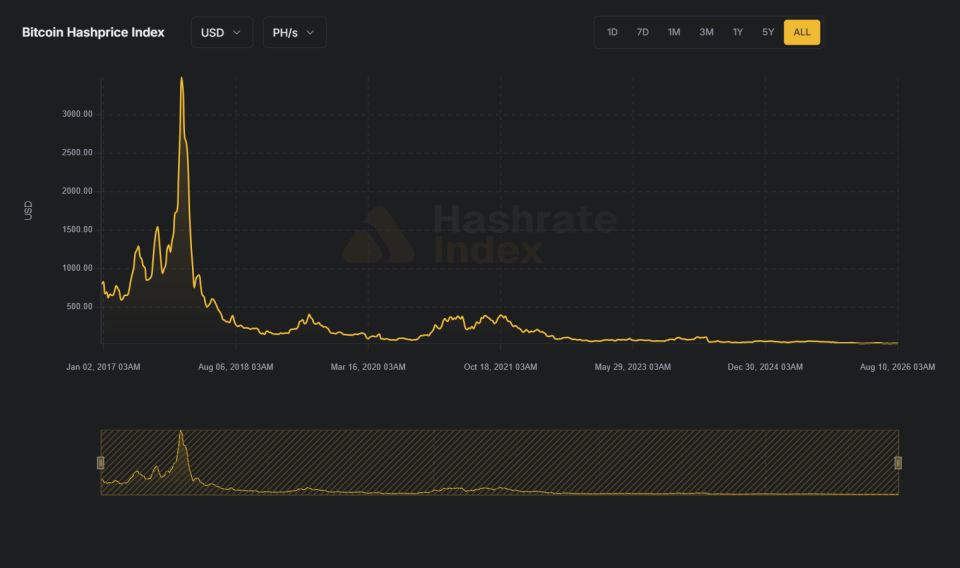
Source: hashrateindex.com

It turns out that large mining companies have faced realities where the economic feasibility of cryptocurrency mining has been called into question. Of course, the metrics above do not allow us to claim that Bitcoin mining suddenly became completely unprofitable everywhere. It's worth considering that miners in different countries and regions incur different costs: electricity and ASIC device prices vary, as do associated expenses like taxes, rent, and salaries for maintenance personnel. Equipment does not stand still and evolves, requiring timely replacement. Mining $BTC becomes less profitable for players unable to efficiently cover such costs.

However, there are other reasons for the shift to artificial intelligence.

Capital Availability

Let's clarify immediately: miners who previously mined Bitcoin do not themselves become AI operators. They merely provide their infrastructure to meet the needs of companies directly involved in artificial intelligence.

For providing their data centers, miners will receive very good money, which they did not have access to before. For example, HUT 8 signed a $7 billion deal to lease out its capacity, including the River Bend farm in Louisiana. The technical partners in the deal are the firm Anthropic, creator of the Claude neural network, and the cloud platform Fluidstack, with funding provided by tech giant Google and banks J.P. Morgan and Goldman Sachs.

IREN struck a deal with the world's largest software developer, Microsoft, for $9.7 billion. Microsoft thereby gains access to AI systems based on Nvidia GB-300 chips in Texas. And IREN will additionally purchase graphics processing units (GPUs) worth $5.8 billion from Dell Technologies, which is expected to bring in another $1.9 billion in annual revenue.

Economic Feasibility

Companies that have been exclusively mining cryptocurrency for years already have a certain infrastructure: specialized buildings, access to electricity, cooling systems. It's easier to repurpose a hypothetical data center from mining needs to AI needs than to build everything from scratch for the same Microsoft or Google. It's quite possible that fintech companies will someday switch to their own infrastructure, but that's not happening yet.

Speaking about converting mining farms for AI needs, it's necessary to understand that this doesn't happen in 100% of cases. New specialized data campuses will appear somewhere. Nevertheless, even here miners have it easier, as they know the specifics of data centers and have experience in organizational, operational-financial, and management issues. In other words, it is sometimes more profitable for large capital to delegate such matters to specialized companies.

Among the examples of infrastructure repurposing is the Bitdeer campus in the Norwegian municipality of Tydal.

ASIC Nuances

Modern large-scale cryptocurrency mining occurs primarily using highly specialized ASICs—equipment designed specifically for mining. Generally, an ASIC (Application Specific Integrated Circuit) is a special-purpose integrated circuit designed to solve one specific task. Such microchips can be implemented not only in mining but also in other fields where there is a need to minimize the cost of producing such equipment for specific needs.

ASIC miners themselves are different, which is related to the hashing algorithms used by specific coins. For example, Bitcoin uses the SHA-256 hashing algorithm, while Litecoin uses Scrypt. Manufacturers of such devices offer different and most often non-interchangeable units.

For instance, the manufacturer Bitmain releases the Antminer S21 model for the SHA-256 algorithm, the Antminer L9 for the Scrypt algorithm, and the Antminer D9—already for the X11 hashing algorithm. To explain in the simplest terms, an ASIC miner is a computing device from which everything unnecessary has been removed, increasing efficiency in mining cryptocurrencies and thereby reducing production costs.

On the other hand, advanced AI computations also require their own special technical capabilities. Moreover, even the efficiency of individual computations using graphics processing units (GPUs) varies depending on the manufacturer and specific model because their architectures differ fundamentally.

In other words, it's not enough to simply take down the "Mining" sign and hang up a new one—"Artificial Intelligence"—from a facility where coin mining previously took place and the corresponding ASICs stood. The equipment used will have to be replaced.

But did the reorientation of major American miners deal a decisive blow to Bitcoin?

What Happened to the Hashrate

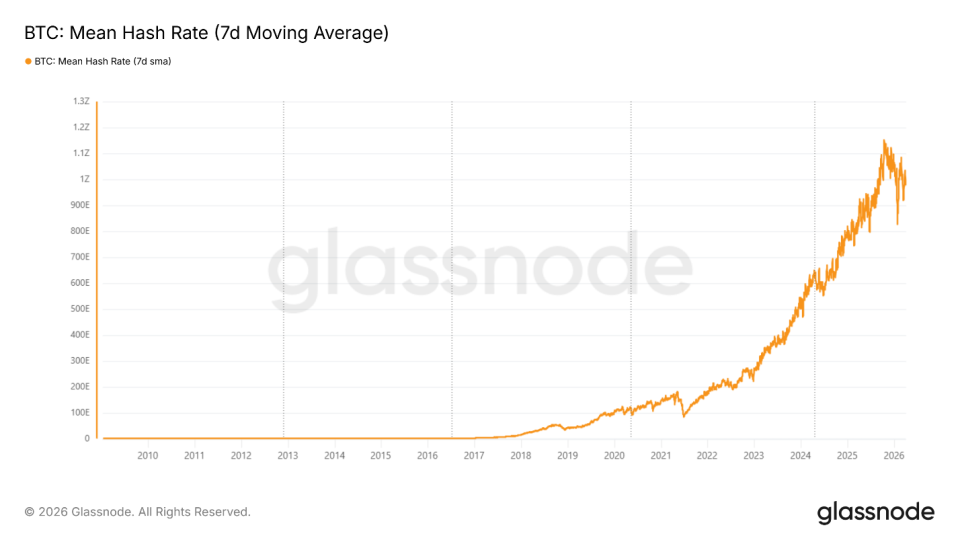
The $BTC hashrate has definitely been influenced by miners moving into AI. From October 2025 to January 2026, the seven-day moving average of the hashrate fell by 28%, dropping from 1.15 EH/s to 0.83 EH/s. However, such dynamics shouldn't be too surprising, considering that American mining companies account for up to 40% of Bitcoin's total hashrate.
Source: studio.glassnode.com

By August 2026, some recovery in hashrate is already being observed. Its value fluctuates around 0.9 EH/s. Furthermore, according to CoinShares forecasts, the 1.8 EH/s mark should be broken by the end of the year, and by the end of 2027—2 EH/s.

It's worth remembering that reorienting towards AI does not mean miners are completely abandoning mining. In most cases, they are merely scaling back financial investments in this direction against the backdrop of expectations of greater profits from AI.

And how many bitcoins could miners potentially have mined if they hadn't reoriented to AI?

The Number of Missed Bitcoins

Actually, it's hardly possible to answer this question.

  • First, how to calculate it all? If miners had not started working on AI infrastructure, they would not have secured large contracts. Accordingly, this money cannot be factored into the potential expansion of the monetary base for mining. Similarly, the credit funds actively attracted by mining companies. From this angle—it seems the companies themselves may have earned even more than they could have without AI computing.

  • Second, the question: who missed out and how much? If we refer, for example, to Riot Platforms' report for the first quarter (data for the second quarter is not yet available), this company mined 1,473 $BTC. This is only 57 coins less than during the same period in 2025 (a 3.7% decrease). The change is more in the nature of a statistical error than a structural shift. Additionally, miners, without ceasing mining, are able to abandon further expansion in the field of mining and develop the AI direction as a short-term, highly profitable venture.

It is also worth considering here: if hypothetical IREN, TerraWulf, or HUT 8 did not mine $BTC, it means that only their balance sheets were not replenished. Bitcoin is still being mined as before, it's just that new coins went not to these companies' wallets but to other miners. The block reward remains fixed with predictable reduction during halvings and only the amount of network transaction fees changes. Moreover, if some major players suddenly switch off their power, it will become slightly easier for other participants to mine the cryptocurrency during the next network difficulty recalculation. In other words, these "bitcoins not mined by others" will still be mined somewhere in the world.

Miner Revenue

Amidst current economic/geopolitical instability, unfortunately, it's not yet possible to talk about exact figures. There are only forecast values. CoinShares believes that revenue from AI for mining companies will reach 70%, while at the beginning of the year it accounted for only 30%. In other words, the growth will be twofold. Essentially, if mining was the main activity for companies before, now it will become auxiliary. On the other hand, this doesn't mean mining will be abandoned for sure. Priorities will likely just be reassessed.

And how have such large-scale changes affected the stocks of cryptocurrency mining organizations?

Stocks and the Transition to AI

In most cases, the impact has been positive. Since the beginning of the year, the shares of five companies have shown price increases: IREN — 5.69%, Terra Wulf — 45.92%, MARA Holdings — 9.49%, Riot Platforms — 57.72%, Cipher Digital — 14.76%. The exception is Bitdeer, whose securities fell by 4.73%.

However, certain investor concerns regarding the transition to AI remain.

  • First, it's still unclear how successful this entire venture will be in the future. Will miners really be able to generate profits that cover all current and future costs?

  • Second, the transition from mining to developing infrastructure for artificial intelligence has forced a number of organizations to borrow huge sums. For TerraWulf — it's $5.7 billion, for IREN — $3.7 billion. Such a significant scale of debt load growth cannot but worry shareholders.

Conclusion

Large mining companies are transitioning from exclusively mining cryptocurrency to earning from AI due to economic feasibility and the availability of necessary infrastructure/management models. According to some forecasts, by the end of the year, the majority of their income will come from payments from AI operators, not from mining. The Bitcoin hashrate, after such companies reoriented their business, declined insignificantly and briefly but is already recovering. The stocks of most public miners are demonstrating price growth against the backdrop of business repurposing.

This material and the information in it are not individual or any other recommendation. The opinion of the editorial staff may not coincide with the opinions of analytical portals and experts.


end-content

Crypto di tendenza

Domande pertinenti

QWhy are major Bitcoin mining companies shifting their business model away from pure cryptocurrency mining?

AThey are shifting due to the decreasing profitability of Bitcoin mining after events like the 2024 halving and the 2025 price drop, and the emergence of more lucrative opportunities in providing infrastructure for artificial intelligence (AI) and high-performance computing (HPC) for companies like Microsoft and Google.

QWhat are the key financial challenges that made Bitcoin mining less profitable for public US companies, according to the article?

AAccording to a CoinShares report, the average cost to mine one Bitcoin in the last quarter of the past year was $79,995, while the market price was around $70,000, making it unprofitable. Companies like TerraWulf even faced costs as high as $385,000 per coin at one point.

QHow do Bitcoin mining companies benefit from providing infrastructure for AI development?

AThey secure large, lucrative contracts by leasing their data centers and expertise. For example, HUT 8 secured a $7 billion deal, and IREN secured a $9.7 billion deal with Microsoft, providing them with revenue streams that were previously unavailable from mining alone.

QWhat was the impact on Bitcoin's hashrate when major miners began transitioning to AI, and what is the forecast?

ABitcoin's seven-day moving average hashrate dropped by 28%, from 1.15 EH/s to 0.83 EH/s between October 2025 and January 2026. However, it has since recovered to around 0.9 EH/s by August 2026. Forecasts predict it will reach 1.8 EH/s by the end of 2026 and 2 EH/s by the end of 2027.

QHow has the stock performance of major mining companies been affected by their pivot towards AI infrastructure?

AThe stock performance has been largely positive. Since the beginning of the year, shares of IREN, TerraWulf, MARA Holdings, Riot Platforms, and Cipher Digital have increased by 5.69%, 45.92%, 9.49%, 57.72%, and 14.76% respectively. Only Bitdeer's stock decreased by 4.73%.

Letture associate

Robert Kiyosaki Shares His Mentor's Predictions About the Emergence of Bitcoin and AI

American entrepreneur and author of "Rich Dad Poor Dad," Robert Kiyosaki, discussed the influence of futurist R. Buckminster Fuller on his worldview, linking Fuller's past technological predictions to the emergence of Bitcoin and the development of artificial intelligence. In an X post, Kiyosaki also reflected on personal purpose, sharing his journey from the music business—where he worked with bands like The Police and Iron Maiden—to creating the "Cashflow" board game and writing his famous book. He described feeling an inner emptiness despite his success, a turning point that came after meeting Fuller, whom he studied with for three summers. Kiyosaki described Fuller as a "friendly genius" who foresaw world-changing developments like Bitcoin and AI. However, the core of his post focused on Fuller's philosophical impact, particularly a quote about belonging to the universe and finding purpose by dedicating one's life to the maximum benefit of others. The entrepreneur remains a vocal advocate for cryptocurrencies. He regularly advises buying Bitcoin during market panics, viewing it and assets like Ethereum, gold, and silver as hedges against traditional financial system failures. Kiyosaki has predicted a major market crash by 2026, seeing it as an opportunity for prepared investors, with long-term price targets including $750,000 for Bitcoin and $95,000 for Ethereum.

cryptonews.ru43 min fa

Robert Kiyosaki Shares His Mentor's Predictions About the Emergence of Bitcoin and AI

cryptonews.ru43 min fa

Etherealize CEO Calls Wall Street's Private Blockchains a 'Race to the Bottom'

Etherealize co-founder and CEO Vivek Raman criticized Wall Street's growing interest in private, permissioned blockchains, calling them a "race to the bottom." In an interview with CoinDesk, Raman argued that consortium networks fragment liquidity and return the industry to the siloed systems that blockchain technology was meant to overcome. He stated that closed networks do not interoperate, undermining two key advantages of the technology: system compatibility and liquidity concentration. Etherealize promotes Ethereum as an open, foundational layer for institutional players. Raman insists that privacy and access restrictions should be built on top of public infrastructure—at the application or L2 level—rather than creating separate, closed networks. He compared Ethereum to HTTP as a base layer, with additional permissioned and private layers akin to HTTPS. Examples of this new wave of "closed" solutions mentioned include Canton Network from Digital Asset, Circle's Arc project, and Stripe's Tempo. Raman termed this trend "consortium chains 2.0," recalling earlier initiatives like the R3 interbank consortium and the Hyperledger corporate ecosystem from 2016 that failed to gain significant traction. He reiterated his firm belief that a global, open, permissionless infrastructure is necessary as a foundational base layer. Raman previously noted in June that traditional financial institutions had begun implementing Ethereum-based solutions into real business processes.

cryptonews.ru45 min fa

Etherealize CEO Calls Wall Street's Private Blockchains a 'Race to the Bottom'

cryptonews.ru45 min fa

Trading

Spot

Articoli Popolari

Cosa è BITCOIN

Comprendere HarryPotterObamaSonic10Inu (ERC-20) e la sua posizione nel mondo delle criptovalute Negli ultimi anni, il mercato delle criptovalute ha assistito a un aumento della popolarità delle meme coin, catturando l'interesse non solo dei trader, ma anche di coloro che cercano coinvolgimento comunitario e valore di intrattenimento. Tra questi token unici c'è HarryPotterObamaSonic10Inu (ERC-20), un progetto intrigante che mescola riferimenti culturali nel tessuto delle criptovalute. Questo articolo esplora gli aspetti chiave di HarryPotterObamaSonic10Inu, analizzando i suoi meccanismi, l'etica guidata dalla comunità e il suo coinvolgimento con il panorama crittografico più ampio. Che cos'è HarryPotterObamaSonic10Inu (ERC-20)? Come suggerisce il suo nome, HarryPotterObamaSonic10Inu è una meme coin costruita sulla blockchain di Ethereum, classificata secondo lo standard ERC-20. A differenza delle criptovalute tradizionali che possono enfatizzare l'utilità pratica o il potenziale investimento, questo token prospera grazie al valore di intrattenimento e alla forza della sua comunità. Il progetto mira a creare un ambiente in cui gli utenti coinvolti possono riunirsi, condividere idee e partecipare ad attività ispirate a diversi fenomeni culturali. Una caratteristica notevole di HarryPotterObamaSonic10Inu è la zero tassa sulle transazioni. Questo elemento allettante tende a incoraggiare il trading e il coinvolgimento della comunità, privo di costi aggiuntivi che possono scoraggiare i trader di piccole dimensioni. L'offerta totale della moneta è fissata a un miliardo di token, un numero che segna la sua intenzione di mantenere una circolazione sostanziale all'interno della comunità. Creatore di HarryPotterObamaSonic10Inu (ERC-20) Le origini di HarryPotterObamaSonic10Inu sono avvolte in un certo mistero; i dettagli sul creatore rimangono sconosciuti. Lo sviluppo di questo token non presenta un team identificabile o un piano esplicito, cosa non rara nel settore delle meme coin. Invece, il progetto è emerso organicamente, con il suo progresso fortemente dipendente dall'entusiasmo e dalla partecipazione della sua comunità. Investitori di HarryPotterObamaSonic10Inu (ERC-20) Per quanto riguarda investimenti esterni e finanziamenti, HarryPotterObamaSonic10Inu rimane ambiguo. Il token non elenca alcuna fondazione di investimento conosciuta o un sostegno organizzativo significativo. Invece, la linfa vitale del progetto è la sua comunità di base, che informa la sua crescita e sostenibilità attraverso azioni collettive e coinvolgimento nello spazio crittografico. Come funziona HarryPotterObamaSonic10Inu (ERC-20)? In quanto meme coin, HarryPotterObamaSonic10Inu opera principalmente al di fuori delle strutture tradizionali che governano spesso il valore degli asset. Ci sono diversi aspetti distintivi che definiscono il funzionamento del progetto: Transazioni senza tasse: Senza costi fiscali sulle transazioni, gli utenti possono comprare e vendere liberamente il token senza preoccuparsi di costi nascosti. Coinvolgimento della comunità: Il progetto prospera sull'interazione della comunità, sfruttando le piattaforme social per creare entusiasmo e facilitare il coinvolgimento. Discussioni, condivisione di contenuti e coinvolgimento sono elementi cruciali che aiutano ad espandere la sua portata e a favorire la lealtà tra i sostenitori. Nessuna utilità pratica: Va notato che HarryPotterObamaSonic10Inu non offre un'utilità concreta all'interno dell'ecosistema finanziario. Piuttosto, è classificato come un token principalmente per attività di intrattenimento e comunitarie. Riferimento culturale: Il token incorpora astutamente elementi della cultura pop per attirare interesse, collegandosi a appassionati di meme e seguaci delle criptovalute. HarryPotterObamaSonic10Inu esemplifica come le meme coin operino in modo diverso rispetto ai progetti di criptovalute più tradizionali, entrando nel mercato come costrutti sociali innovativi piuttosto che come asset utilitari. Cronologia di HarryPotterObamaSonic10Inu (ERC-20) La storia di HarryPotterObamaSonic10Inu è segnata da diversi traguardi notevoli: Creazione: Il token è emerso da un meme virale, catturando l'immaginazione di molti appassionati di criptovalute. Le date di creazione specifiche non sono disponibili, sottolineando la sua crescita organica. Inserimento negli scambi: HarryPotterObamaSonic10Inu ha fatto il suo ingresso in vari scambi, consentendo un accesso e un trading più facili da parte della comunità. Iniziative di coinvolgimento della comunità: Attività in corso volte a migliorare l'interazione della comunità, comprese gare, campagne sui social media e generazione di contenuti da parte di fan e sostenitori. Piani di espansione futura: La tabella di marcia del progetto include il lancio di una collezione NFT, merchandising e un sito di eCommerce relativo ai suoi temi culturali, coinvolgendo ulteriormente la comunità e cercando di aggiungere più dimensioni al suo ecosistema. Punti chiave su HarryPotterObamaSonic10Inu (ERC-20) Natura guidata dalla comunità: Il progetto dà priorità al contributo collettivo e alla creatività, garantendo che il coinvolgimento degli utenti sia al centro del suo sviluppo. Classificazione come meme coin: Rappresenta l'epitome delle criptovalute basate sull'intrattenimento, distinguendosi dai veicoli d'investimento tradizionali. Nessuna affiliazione diretta con Bitcoin: Nonostante la somiglianza nel nome del ticker, HarryPotterObamaSonic10Inu è distintivo e non ha alcuna relazione con Bitcoin o altre criptovalute consolidate. Focus sulla collaborazione: HarryPotterObamaSonic10Inu è progettato per creare uno spazio per la collaborazione e la condivisione di storie tra i suoi detentori, fornendo un canale per la creatività e il legame comunitario. Prospettive future: L'ambizione di espandersi oltre il suo presupposto iniziale verso NFT e merchandising delinea un percorso per il progetto per potenzialmente entrare in strade più mainstream all'interno della cultura digitale. Poiché le meme coin continuano a catturare l'immaginazione della comunità crittografica, HarryPotterObamaSonic10Inu (ERC-20) si distingue per i suoi legami culturali e il suo approccio centrato sulla comunità. Anche se potrebbe non adattarsi al modello tipico di un token orientato all'utilità, la sua essenza risiede nella gioia e nella camaraderia coltivate tra i suoi sostenitori, evidenziando la natura in evoluzione delle criptovalute in un'epoca sempre più digitale. Con la continuazione dello sviluppo del progetto, sarà importante osservare come le dinamiche della comunità influenzano la sua traiettoria nel panorama in continuo cambiamento della tecnologia blockchain.

2.3k Totale visualizzazioniPubblicato il 2024.04.01Aggiornato il 2024.12.03

Cosa è BITCOIN

Come comprare BTC

Benvenuto in HTX.com! Abbiamo reso l'acquisto di Bitcoin (BTC) semplice e conveniente. Segui la nostra guida passo passo per intraprendere il tuo viaggio nel mondo delle criptovalute.Step 1: Crea il tuo Account HTXUsa la tua email o numero di telefono per registrarti il tuo account gratuito su HTX. Vivi un'esperienza facile e sblocca tutte le funzionalità,Crea il mio accountStep 2: Vai in Acquista crypto e seleziona il tuo metodo di pagamentoCarta di credito/debito: utilizza la tua Visa o Mastercard per acquistare immediatamente BitcoinBTC.Bilancio: Usa i fondi dal bilancio del tuo account HTX per fare trading senza problemi.Terze parti: abbiamo aggiunto metodi di pagamento molto utilizzati come Google Pay e Apple Pay per maggiore comodità.P2P: Fai trading direttamente con altri utenti HTX.Over-the-Counter (OTC): Offriamo servizi su misura e tassi di cambio competitivi per i trader.Step 3: Conserva Bitcoin (BTC)Dopo aver acquistato Bitcoin (BTC), conserva nel tuo account HTX. In alternativa, puoi inviare tramite trasferimento blockchain o scambiare per altre criptovalute.Step 4: Scambia Bitcoin (BTC)Scambia facilmente Bitcoin (BTC) nel mercato spot di HTX. Accedi al tuo account, seleziona la tua coppia di trading, esegui le tue operazioni e monitora in tempo reale. Offriamo un'esperienza user-friendly sia per chi ha appena iniziato che per i trader più esperti.

4.8k Totale visualizzazioniPubblicato il 2024.12.12Aggiornato il 2026.06.02

Come comprare BTC

Cosa è $BITCOIN

ORO DIGITALE ($BITCOIN): Un'Analisi Completa Introduzione all'ORO DIGITALE ($BITCOIN) L'ORO DIGITALE ($BITCOIN) è un progetto basato su blockchain che opera sulla rete Solana, con l'obiettivo di combinare le caratteristiche dei metalli preziosi tradizionali con l'innovazione delle tecnologie decentralizzate. Sebbene condivida un nome con Bitcoin, spesso definito “oro digitale” a causa della sua percezione come riserva di valore, l'ORO DIGITALE è un token separato progettato per creare un ecosistema unico all'interno del panorama Web3. Il suo obiettivo è posizionarsi come un asset digitale alternativo valido, anche se i dettagli riguardanti le sue applicazioni e funzionalità sono ancora in fase di sviluppo. Cos'è l'ORO DIGITALE ($BITCOIN)? L'ORO DIGITALE ($BITCOIN) è un token di criptovaluta esplicitamente progettato per l'uso sulla blockchain di Solana. A differenza di Bitcoin, che fornisce un ruolo di stoccaggio di valore ampiamente riconosciuto, questo token sembra concentrarsi su applicazioni e caratteristiche più ampie. Aspetti notevoli includono: Infrastruttura Blockchain: Il token è costruito sulla blockchain di Solana, nota per la sua capacità di gestire transazioni ad alta velocità e a basso costo. Dinamiche di Offerta: L'ORO DIGITALE ha un'offerta massima fissata a 100 quadrilioni di token (100P $BITCOIN), sebbene i dettagli riguardanti la sua offerta circolante siano attualmente non divulgati. Utilità: Sebbene le funzionalità precise non siano esplicitamente delineate, ci sono indicazioni che il token potrebbe essere utilizzato per varie applicazioni, potenzialmente coinvolgendo applicazioni decentralizzate (dApp) o strategie di tokenizzazione degli asset. Chi è il Creatore dell'ORO DIGITALE ($BITCOIN)? Attualmente, l'identità dei creatori e del team di sviluppo dietro l'ORO DIGITALE ($BITCOIN) rimane sconosciuta. Questa situazione è tipica tra molti progetti innovativi nel settore blockchain, in particolare quelli allineati con la finanza decentralizzata e i fenomeni delle meme coin. Sebbene tale anonimato possa favorire una cultura guidata dalla comunità, intensifica le preoccupazioni riguardo alla governance e alla responsabilità. Chi sono gli Investitori dell'ORO DIGITALE ($BITCOIN)? Le informazioni disponibili indicano che l'ORO DIGITALE ($BITCOIN) non ha alcun sostenitore istituzionale noto o investimenti di venture capital prominenti. Il progetto sembra operare su un modello peer-to-peer incentrato sul supporto e sull'adozione della comunità piuttosto che su percorsi di finanziamento tradizionali. La sua attività e liquidità si trovano principalmente su exchange decentralizzati (DEX), come PumpSwap, piuttosto che su piattaforme di trading centralizzate consolidate, evidenziando ulteriormente il suo approccio di base. Come Funziona l'ORO DIGITALE ($BITCOIN) Le meccaniche operative dell'ORO DIGITALE ($BITCOIN) possono essere elaborate in base al suo design blockchain e alle caratteristiche della rete: Meccanismo di Consenso: Sfruttando il proof-of-history (PoH) unico di Solana combinato con un modello di proof-of-stake (PoS), il progetto garantisce una validazione efficiente delle transazioni contribuendo all'alta performance della rete. Tokenomics: Sebbene meccanismi deflazionistici specifici non siano stati dettagliati ampiamente, l'ampia offerta massima di token implica che potrebbe soddisfare microtransazioni o casi d'uso di nicchia che devono ancora essere definiti. Interoperabilità: Esiste il potenziale per l'integrazione con l'ecosistema più ampio di Solana, inclusi vari piattaforme di finanza decentralizzata (DeFi). Tuttavia, i dettagli riguardanti integrazioni specifiche rimangono non specificati. Cronologia degli Eventi Chiave Ecco una cronologia che evidenzia traguardi significativi riguardanti l'ORO DIGITALE ($BITCOIN): 2023: Il dispiegamento iniziale del token avviene sulla blockchain di Solana, contrassegnato dal suo indirizzo di contratto. 2024: L'ORO DIGITALE guadagna visibilità poiché diventa disponibile per il trading su exchange decentralizzati come PumpSwap, consentendo agli utenti di scambiarlo contro SOL. 2025: Il progetto assiste a un'attività di trading sporadica e a un potenziale interesse per impegni guidati dalla comunità, sebbene non siano state documentate partnership significative o avanzamenti tecnici fino ad ora. Analisi Critica Punti di Forza Scalabilità: L'infrastruttura sottostante di Solana supporta alti volumi di transazioni, il che potrebbe migliorare l'utilità di $BITCOIN in vari scenari di transazione. Accessibilità: Il potenziale basso prezzo di trading per token potrebbe attrarre investitori al dettaglio, facilitando una partecipazione più ampia grazie a opportunità di proprietà frazionata. Rischi Mancanza di Trasparenza: L'assenza di sostenitori, sviluppatori o di un processo di audit pubblicamente noti potrebbe generare scetticismo riguardo alla sostenibilità e all'affidabilità del progetto. Volatilità del Mercato: L'attività di trading è fortemente dipendente dal comportamento speculativo, il che può comportare una significativa volatilità dei prezzi e incertezze per gli investitori. Conclusione L'ORO DIGITALE ($BITCOIN) emerge come un progetto intrigante ma ambiguo all'interno dell'evolvente ecosistema di Solana. Sebbene tenti di sfruttare la narrativa dell'“oro digitale”, la sua partenza dal ruolo consolidato di Bitcoin come riserva di valore sottolinea la necessità di una chiara differenziazione della sua utilità e struttura di governance. L'accettazione e l'adozione future dipenderanno probabilmente dall'affrontare l'attuale opacità e dalla definizione più esplicita delle sue strategie operative ed economiche. Nota: Questo rapporto comprende informazioni sintetizzate disponibili a ottobre 2023, e potrebbero essersi verificati sviluppi oltre il periodo di ricerca.

520 Totale visualizzazioniPubblicato il 2025.05.13Aggiornato il 2025.05.13

Cosa è $BITCOIN

Discussioni

Benvenuto nella Community HTX. Qui puoi rimanere informato sugli ultimi sviluppi della piattaforma e accedere ad approfondimenti esperti sul mercato. Le opinioni degli utenti sul prezzo di BTC BTC sono presentate come di seguito.

活动图片