Mingo Secures Exclusive 54-Country Ticketing Deal on Hedera

TheNewsCryptoPubblicato 2026-01-16Pubblicato ultima volta 2026-01-16

Introduzione

MINGO has launched MINGO Tickets, a digital ticketing platform built on the Hedera network, and expanded its services across 54 countries. The platform aims to address major challenges in live event ticketing, including fraud, duplicate tickets, high fees, and poor fan experiences. Designed as a progressive web app, it operates seamlessly across devices without downloads, offering verifiable tickets, predictable low fees, and tools for fan engagement. A key partnership with African Boxing and the Yucateco Boxing League will support events across Africa, a mobile-first market. MINGO selected Hedera for its speed, security, and scalability. Executives from MINGO and partner organizations highlighted the platform’s potential to reduce fraud, improve accessibility, and support the growth of sports like boxing and MuayThai globally. This rollout is the first phase of MINGO’s broader international expansion strategy.

Gibraltar, Gibraltar, January 16th, 2026, Chainwire

MINGO today announced the launch of MINGO Tickets, its digital ticketing platform, alongside its expansion across 54 countries. Designed to make event access verifiable and reliable, the platform improves the fan experience while giving organisers greater confidence and control over ticketing.

Live event ticketing continues to face major challenges worldwide, from ticket fraud and duplicated access to high fees and poor fan experiences. As demand for live events grows globally, organisers are under increasing pressure to adopt systems that are secure, scalable, and accessible across multiple markets.

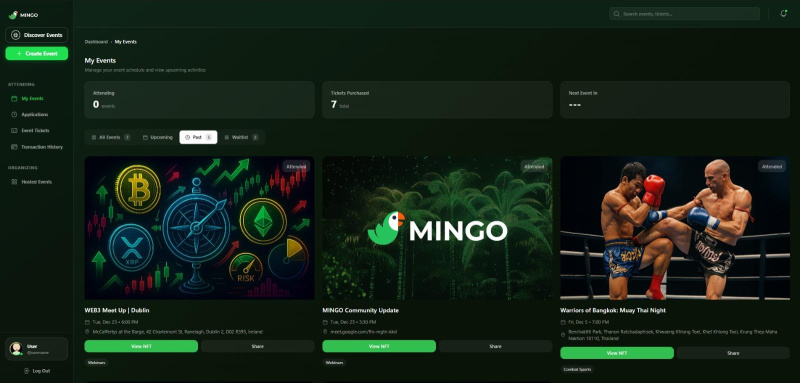
Built as a progressive web app and powered by enterprise grade infrastructure on the Hedera network, MINGO Tickets works seamlessly across devices without app downloads. It addresses core ticketing issues such as fraud and duplication, supporting high volume events with predictable costs, fast performance, and built in integrity.
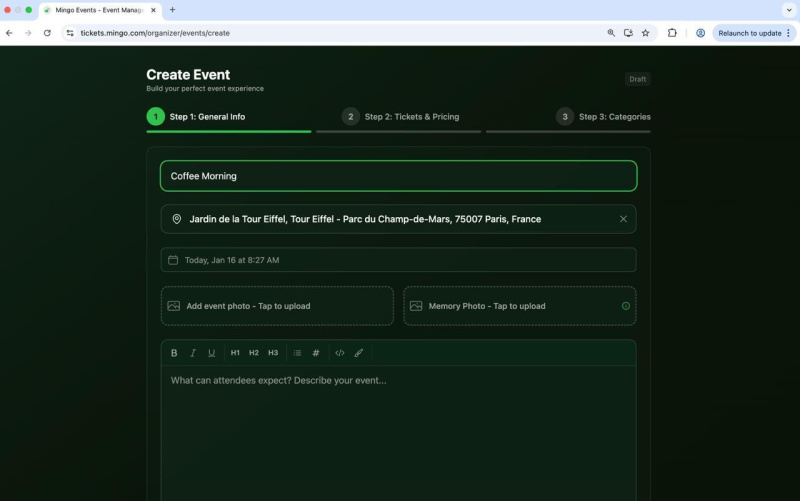
As part of this expansion, MINGO is rolling out MINGO Tickets across Africa through a partnership with African Boxing and the Yucateco Boxing League, supporting live events across 54 nations and one of the world’s fastest growing sports markets.

Africa represents a mobile first environment where accessibility and reliability are critical. MINGO Tickets is designed to operate across diverse markets while helping reduce ticket fraud by issuing verifiable digital tickets that make authenticity provable rather than assumed.

MINGO was one of the earliest builders on Hedera, selecting the network to support real world utility at scale. Hedera’s speed, security, sustainability, and predictable fees enable MINGO Tickets to operate effectively from grassroots events to major international promotions.

A Practical Approach to Event Access

  • Verifiable digital tickets that help prevent fraud and duplication
  • Lower, predictable ticketing fees for organisers
  • Simple mobile first access through a progressive web app
  • Tools that allow organisers to engage fans beyond the event

Joe Arthur, CEO of Mingo, said:

“As live events scale globally, the systems behind them need to scale too. MINGO Tickets is about improving access, reducing fraud, and giving organisers a platform they can rely on, while keeping the experience simple for fans. Expanding across 54 countries is a major step in proving that this model works.”

Hon. Omonlei Yakubu Imadu, CEO of Yucateco Boxing Promotions and Vice President of African Boxing, hailed the partnership as a turning point for African sports:

“Our vision has always been to elevate African boxing to the global stage, but we lacked the digital highway to connect our 54 nations. MINGO is not just a ticketing app; it is the operating system for the future of our sport. By integrating ticketing, fighter payments, and fan engagement into one sovereign platform, we are finally unlocking the true economic power of the African continent.”

Kevin Noone, Secretary General of The WBC Asian Boxing Council and Secretary General of WBC MuayThai, added:

“This partnership is a step in the right direction. Making events more accessible for fans, while protecting the integrity of the sport, is hugely important. MINGO Tickets achieves both by delivering a simple, secure, and fair ticketing experience—exactly what the boxing and MuayThai industries need as they continue to grow around the world.”
Built for Scale and Global Use

The rollout across 54 countries marks the first phase of MINGO’s wider international expansion. Future developments will continue to focus on improving access, reducing friction, and supporting organisers and fans with infrastructure designed for real world events at global scale.

About MINGO

MINGO is a digital infrastructure company building tools for live events, including ticketing and fan engagement. Built on the Hedera network, MINGO is designed to address long-standing issues in the ticketing industry such as fraud and scalping, while improving access and reducing friction for organisers and fans across global markets

Contact and Information

MINGO is actively onboarding events of all sizes worldwide. Anyone who introduces an event organiser, promoter, or venue to the platform may be eligible to participate as part of MINGO’s global expansion.

To get involved, users can get in touch at events@mingo.com

Mingo Online

X: @mingoapps

Telegram: https://t.me/mingobroadcast

Website: tickets.mingo.com

Contact

Marketing Manager
Cillian Arthur
MINGO
cillian@mingoapps.com

Domande pertinenti

QWhat is the name of the new digital ticketing platform launched by MINGO?

AMINGO Tickets

QOn which network is the MINGO Tickets platform built to ensure speed, security, and predictable fees?

AThe Hedera network

QThrough which partnership is MINGO rolling out its ticketing service across 54 African nations?

AA partnership with African Boxing and the Yucateco Boxing League

QWhat are two major challenges in live event ticketing that MINGO Tickets aims to address?

ATicket fraud and duplicated access

QWhat type of application is MINGO Tickets, which allows it to work across devices without downloads?

AA progressive web app

Letture associate

Claude Code Introduces Dynamic Workflows: Enabling AI to Form Teams and Collaborate

Claude Code introduces dynamic workflows, enabling AI to coordinate teams of specialized agents for complex tasks. This transforms Claude from a code assistant into a programmable workbench. Workflows address key limitations of single-agent systems: agentic laziness (premature task completion), self-preferential bias (favoring own outputs), and goal drift (losing sight of original objectives). The system allows Claude to dynamically create execution frameworks using JavaScript. It can split tasks, dispatch parallel agents for isolated work (e.g., in separate worktrees), implement adversarial validation, run tournaments, and synthesize results. This multi-agent approach is valuable for tasks requiring deep research, factual verification, code migration, root cause analysis, large-scale triage, and qualitative sorting. Key patterns include: classify-and-route, fan-out-and-synthesize, adversarial verification, generate-and-filter, tournaments, and loop-until-done. While token usage is higher, workflows excel where tasks resemble programming—needing problem decomposition, isolated context, hypothesis testing, and handling many details. They extend Claude Code's utility beyond technical work to areas like business plan review, resume screening, and naming brainstorm. The feature is not a universal solution but points to a future where AI tool competitiveness depends on organizing reliable, reusable, and auditable execution flows for complex goals.

marsbit36 min fa

Claude Code Introduces Dynamic Workflows: Enabling AI to Form Teams and Collaborate

marsbit36 min fa

Hyperliquid, Wall Street's 24/7 Trading Convenience Store

Hyperliquid: The 24/7 Trading "Convenience Store" for Wall Street Hyperliquid, a decentralized cryptocurrency exchange, has become a go-to platform for Wall Street traders seeking to trade around the clock, especially during traditional market closures. Founded by Jeff Yan, a former quantitative trader, after the FTX collapse, the platform emphasizes user self-custody of assets. It offers a wide range of perpetual contracts—leveraged derivatives with no expiry—on assets from Bitcoin and crude oil to the S&P 500 and even pre-IPO companies like SpaceX. A notable example involves a hedge fund trader who capitalized on geopolitical news over a weekend, securing a 243% return on oil derivatives before markets reopened. The platform, run by just 11 employees, generated approximately $800 million in revenue last year, and its native token HYPE has seen significant growth. Its rise highlights the merging of traditional finance and crypto. While U.S. users are currently restricted, recent CFTC rule changes could open access. The platform is known for its transparency, having processed $10 billion in liquidations during a market crash while competitors faltered. Regulators warn of the high risks and complexity of perpetual contracts for retail investors. Key to its appeal is a strong community culture, direct engagement with founders, and a simple interface. Despite rules against VPN use, it attracts global users with its permissionless approach. Hyperliquid plans to expand into prediction markets and options, aiming to eventually host all financial activity.

marsbit37 min fa

Hyperliquid, Wall Street's 24/7 Trading Convenience Store

marsbit37 min fa

Who Funds the Agents?

**Summary: Who Funds AI Agents?** OpenAI recently shut down a feature allowing AI agents to shop for users, highlighting the challenge of creating a secure and regulated environment for agent-driven transactions. While payment infrastructure exists, a crucial governance layer—defining spending limits, fraud detection, tax handling, and return policies—is largely missing. The potential is enormous: AI agents already processed $73M across 176M transactions last year, with McKinsey forecasting this could grow to $3-5T in global consumer commerce by 2030. The core competition isn't just about processing payments, which can be very cheap (especially with crypto-based settlement), but about controlling the rules that govern agent spending. Key players like Stripe and Coinbase are racing to dominate this governance layer. Stripe's acquisition of wallet provider Privy allows it to set spending policies, identity checks, and human-in-the-loop approvals directly at the wallet level. Similarly, Coinbase's stack, including its x402 protocol and AgentKit, embeds governance rules. This vertical integration across settlement, wallet, and governance layers is becoming the dominant strategy. Control over the governance layer is where significant future value lies. If agents handle trillions in transactions, even a small fee for managing compliance, fraud prevention, and policy enforcement could generate billions in annual revenue. The companies that successfully integrate across the payment stack will capture value from idle agent balances, transaction fees, and governance services, positioning themselves as the foundational banks of the AI agent economy.

marsbit1 h fa

Who Funds the Agents?

marsbit1 h fa

Trading

Spot
Futures
活动图片