Mingo Secures Exclusive 54-Country Ticketing Deal on Hedera

TheNewsCryptoPubblicato 2026-01-16Pubblicato ultima volta 2026-01-16

Introduzione

MINGO has launched MINGO Tickets, a digital ticketing platform built on the Hedera network, and expanded its services across 54 countries. The platform aims to address major challenges in live event ticketing, including fraud, duplicate tickets, high fees, and poor fan experiences. Designed as a progressive web app, it operates seamlessly across devices without downloads, offering verifiable tickets, predictable low fees, and tools for fan engagement. A key partnership with African Boxing and the Yucateco Boxing League will support events across Africa, a mobile-first market. MINGO selected Hedera for its speed, security, and scalability. Executives from MINGO and partner organizations highlighted the platform’s potential to reduce fraud, improve accessibility, and support the growth of sports like boxing and MuayThai globally. This rollout is the first phase of MINGO’s broader international expansion strategy.

Gibraltar, Gibraltar, January 16th, 2026, Chainwire

MINGO today announced the launch of MINGO Tickets, its digital ticketing platform, alongside its expansion across 54 countries. Designed to make event access verifiable and reliable, the platform improves the fan experience while giving organisers greater confidence and control over ticketing.

Live event ticketing continues to face major challenges worldwide, from ticket fraud and duplicated access to high fees and poor fan experiences. As demand for live events grows globally, organisers are under increasing pressure to adopt systems that are secure, scalable, and accessible across multiple markets.

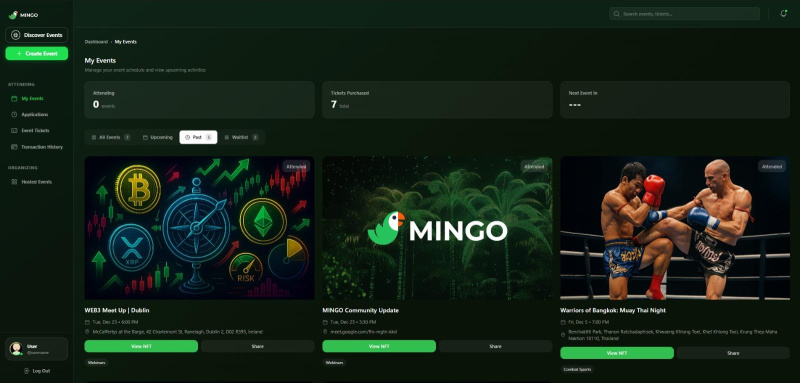
Built as a progressive web app and powered by enterprise grade infrastructure on the Hedera network, MINGO Tickets works seamlessly across devices without app downloads. It addresses core ticketing issues such as fraud and duplication, supporting high volume events with predictable costs, fast performance, and built in integrity.
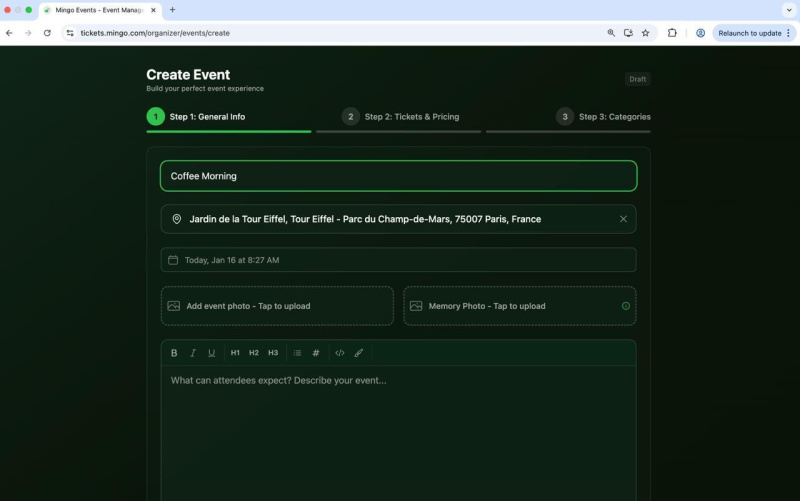
As part of this expansion, MINGO is rolling out MINGO Tickets across Africa through a partnership with African Boxing and the Yucateco Boxing League, supporting live events across 54 nations and one of the world’s fastest growing sports markets.

Africa represents a mobile first environment where accessibility and reliability are critical. MINGO Tickets is designed to operate across diverse markets while helping reduce ticket fraud by issuing verifiable digital tickets that make authenticity provable rather than assumed.

MINGO was one of the earliest builders on Hedera, selecting the network to support real world utility at scale. Hedera’s speed, security, sustainability, and predictable fees enable MINGO Tickets to operate effectively from grassroots events to major international promotions.

A Practical Approach to Event Access

  • Verifiable digital tickets that help prevent fraud and duplication
  • Lower, predictable ticketing fees for organisers
  • Simple mobile first access through a progressive web app
  • Tools that allow organisers to engage fans beyond the event

Joe Arthur, CEO of Mingo, said:

“As live events scale globally, the systems behind them need to scale too. MINGO Tickets is about improving access, reducing fraud, and giving organisers a platform they can rely on, while keeping the experience simple for fans. Expanding across 54 countries is a major step in proving that this model works.”

Hon. Omonlei Yakubu Imadu, CEO of Yucateco Boxing Promotions and Vice President of African Boxing, hailed the partnership as a turning point for African sports:

“Our vision has always been to elevate African boxing to the global stage, but we lacked the digital highway to connect our 54 nations. MINGO is not just a ticketing app; it is the operating system for the future of our sport. By integrating ticketing, fighter payments, and fan engagement into one sovereign platform, we are finally unlocking the true economic power of the African continent.”

Kevin Noone, Secretary General of The WBC Asian Boxing Council and Secretary General of WBC MuayThai, added:

“This partnership is a step in the right direction. Making events more accessible for fans, while protecting the integrity of the sport, is hugely important. MINGO Tickets achieves both by delivering a simple, secure, and fair ticketing experience—exactly what the boxing and MuayThai industries need as they continue to grow around the world.”
Built for Scale and Global Use

The rollout across 54 countries marks the first phase of MINGO’s wider international expansion. Future developments will continue to focus on improving access, reducing friction, and supporting organisers and fans with infrastructure designed for real world events at global scale.

About MINGO

MINGO is a digital infrastructure company building tools for live events, including ticketing and fan engagement. Built on the Hedera network, MINGO is designed to address long-standing issues in the ticketing industry such as fraud and scalping, while improving access and reducing friction for organisers and fans across global markets

Contact and Information

MINGO is actively onboarding events of all sizes worldwide. Anyone who introduces an event organiser, promoter, or venue to the platform may be eligible to participate as part of MINGO’s global expansion.

To get involved, users can get in touch at [email protected]

Mingo Online

X: @mingoapps

Telegram: https://t.me/mingobroadcast

Website: tickets.mingo.com

Contact

Marketing Manager
Cillian Arthur
MINGO
[email protected]

Domande pertinenti

QWhat is the name of the new digital ticketing platform launched by MINGO?

AMINGO Tickets

QOn which network is the MINGO Tickets platform built to ensure speed, security, and predictable fees?

AThe Hedera network

QThrough which partnership is MINGO rolling out its ticketing service across 54 African nations?

AA partnership with African Boxing and the Yucateco Boxing League

QWhat are two major challenges in live event ticketing that MINGO Tickets aims to address?

ATicket fraud and duplicated access

QWhat type of application is MINGO Tickets, which allows it to work across devices without downloads?

AA progressive web app

Letture associate

OpenAI Post-Training Engineer Weng Jiayi Proposes a New Paradigm Hypothesis for Agentic AI

OpenAI engineer Weng Jiayi's "Heuristic Learning" experiments propose a new paradigm for Agentic AI, suggesting that intelligent agents can improve not just by training neural networks, but also by autonomously writing and refining code based on environmental feedback. In the experiment, a coding agent (powered by Codex) was tasked with developing and maintaining a programmatic strategy for the Atari game Breakout. Starting from a basic prompt, the agent iteratively wrote code, ran the game, analyzed logs and video replays to identify failures, and then modified the code. Through this engineering loop of "code-run-debug-update," it evolved a pure Python heuristic strategy that achieved a perfect score of 864 in Breakout and performed competitively with deep reinforcement learning (RL) algorithms in MuJoCo control tasks like Ant and HalfCheetah. This approach, termed Heuristic Learning (HL), contrasts with Deep RL. In HL, experience is captured in readable, modifiable code, tests, logs, and configurations—a software system—rather than being encoded solely into opaque neural network weights. This offers potential advantages in explainability, auditability for safety-critical applications, easier integration of regression tests to combat catastrophic forgetting, and more efficient sample use in early learning stages, as demonstrated in broader tests on 57 Atari games. However, the blog acknowledges clear limitations. Programmatic strategies struggle with tasks requiring long-horizon planning or complex perception (e.g., Montezuma's Revenge), areas where neural networks excel. The future vision is a hybrid architecture: specialized neural networks for fast perception (System 1), HL systems for rules, safety, and local recovery (also System 1), and LLM agents providing high-level feedback and learning from the HL system's data (System 2). The core proposition is that in the era of capable coding agents, a significant portion of an AI's learned experience could be maintained as an auditable, evolving software system.

marsbit19 min fa

OpenAI Post-Training Engineer Weng Jiayi Proposes a New Paradigm Hypothesis for Agentic AI

marsbit19 min fa

Your Claude Will Dream Tonight, Don't Disturb It

This article explores the recent phenomenon of AI companies increasingly using anthropomorphic language—like "thinking," "memory," "hallucination," and now "dreaming"—to describe machine learning processes. Focusing on Anthropic's newly announced "Dreaming" feature for its Claude Agent platform, the piece explains that this function is essentially an automated, offline batch processing of an agent's operational logs. It analyzes past task sessions to identify patterns, optimize future actions, and consolidate learnings into a persistent memory system, akin to a form of reinforcement learning and self-correction. The article draws parallels to similar features in other AI agent systems like Hermes Agent and OpenClaw, which also implement mechanisms for reviewing historical data, extracting reusable "skills," and strengthening long-term memory. It notes a key difference from human dreaming: these AI "dreams" still consume computational resources and user tokens. Further context is provided by discussing the technical challenges of managing AI "memory" or context, highlighting the computational expense of large context windows and innovations like Subquadratic's new model claiming drastically longer contexts. The core critique argues that this strategic use of human-centric vocabulary does more than market products; it subtly reshapes user perception. By framing algorithms with terms associated with consciousness, companies blur the line between tool and autonomous entity. This linguistic shift can influence user expectations, tolerance for errors, and even perceptions of responsibility when systems fail, potentially diverting scrutiny from the companies and engineers behind the technology. The article concludes by speculating that terms like "daydreaming" for predictive task simulation might be next, continuing this trend of embedding the idea of an "inner life" into computational processes.

marsbit21 min fa

Your Claude Will Dream Tonight, Don't Disturb It

marsbit21 min fa

Trading

Spot
Futures
活动图片