MEV trading returns to court in Pump.fun class-action lawsuit

cointelegraphPubblicato 2025-12-18Pubblicato ultima volta 2025-12-18

Introduzione

A US court has allowed new evidence to be incorporated into a class-action lawsuit against memecoin platform Pump.fun, MEV infrastructure firm Jito Labs, and the Solana Foundation. The amended complaint includes over 5,000 internal chat logs provided by a confidential informant, allegedly revealing coordinated discussions about an MEV scheme. The lawsuit, originally filed in July, accuses Pump.fun of misleading retail investors by marketing “fair” memecoin launches while allegedly colluding with validators to use maximal extractable value (MEV) techniques to front-run retail traders. Plaintiffs claim insiders received preferential access to tokens at low prices before dumping them on retail users. The case could set a significant US legal precedent regarding MEV, a complex and ethically debated practice in crypto. This development follows a recent mistrial in a separate MEV bot case, underscoring the legal system's challenges in adjudicating such technically intricate matters.

A US court is once again being asked to weigh in on maximal extractable value practices after a judge allowed new evidence to be added to a class-action lawsuit tied to a memecoin platform.

The judge granted a motion to amend and refile to include new evidence a class-action lawsuit against memecoin launch platform Pump.fun, the maximal extractable value (MEV) infrastructure company Jito Labs, the Solana Foundation, which is the nonprofit organization behind the Solana ecosystem, and others.

The motion said over 5,000 pieces of evidence in the form of internal chat logs were submitted by a “confidential informant” in September that were previously unavailable. The filing said:

“Plaintiffs assert that the logs contain contemporaneous discussions among Pump.fun, Solana Labs, Jito Labs, and others concerning the alleged scheme, and that they materially clarify the enterprise's management, coordination, and communications.”
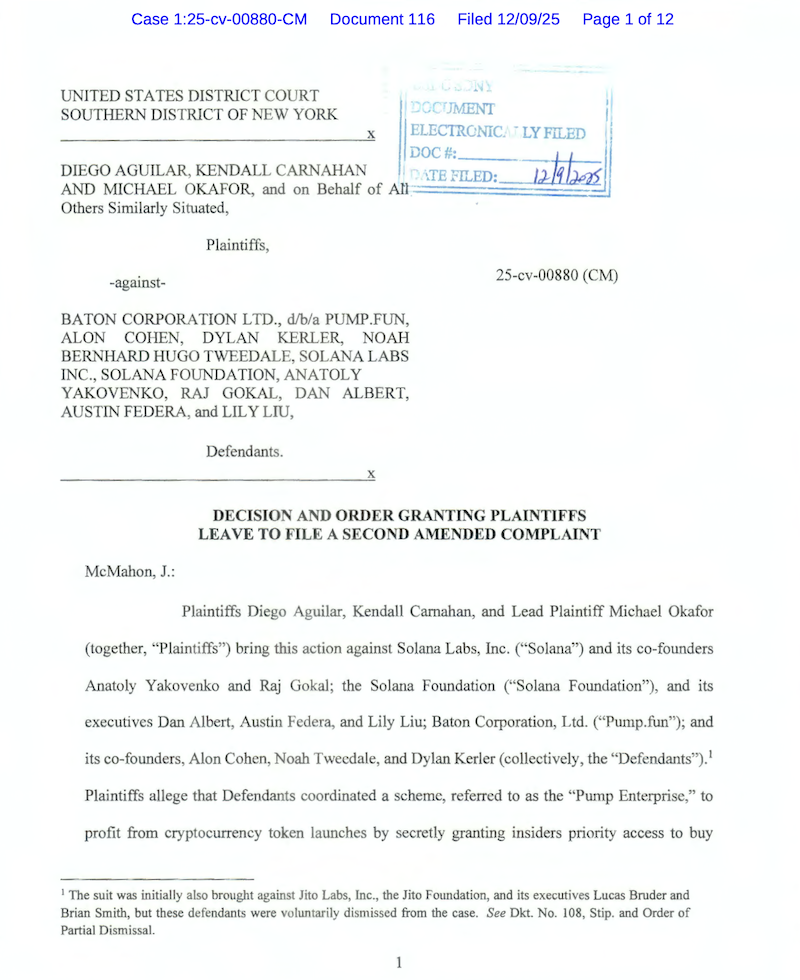
The first page of the motion to amend the case to include new evidence, which was granted. Source: Burwick Law

The lawsuit, originally filed in July, alleges that the Pump.fun platform deliberately misled retail investors by marketing memecoin launches as “fair,” but engaged in a scheme with Solana validators to front-run retail participants through maximal extractable value (MEV).

Maximal extractable value is a technique that involves reordering transactions within a block to maximize profit for MEV arbitrageurs and validators.

The plaintiffs allege that Pump.fun used MEV techniques to give insiders preferential access to new tokens at a low value, which were then pumped and dumped onto retail participants, who were used as exit liquidity by insiders.

Cointelegraph reached out to Burwick Law, the legal firm representing the plaintiffs, as well as Pump.fun, Jito Labs and the Solana Foundation, but did not receive any responses by the time of publication.
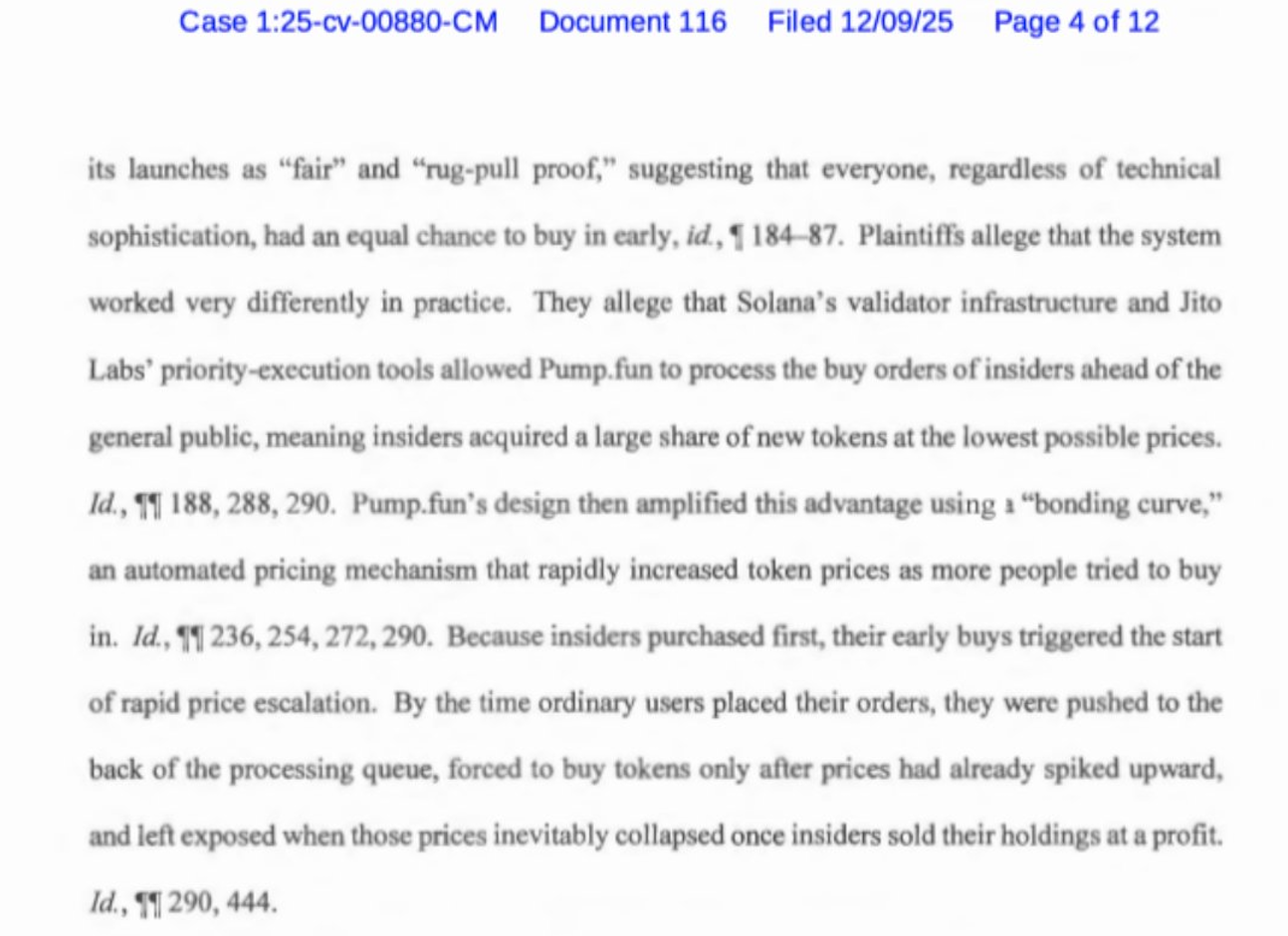
The allegations in the original lawsuit filing. Source: Burwick Law

The lawsuit could set a precedent for MEV cases in the United States, as the ethics of the practice continue to be debated within the crypto industry and legal bodies struggle to define proper regulations about the highly technical subject.

Related: Pump.fun co-founder denies $436M cash out, claims it was ‘treasury management’

The MEV bot trial leaves questions unanswered

Anton and James Peraire-Bueno, the brothers accused of using a MEV trading bot to make millions of dollars in profit, went to trial in November in the US.

Prosecutors argued that the brothers tricked victims out of their funds, but defense attorneys said that they were executing a legitimate trading strategy and did not do anything illegal.

The jury struggled to reach a verdict in the case, and several jurors requested additional information to clarify the complexities surrounding the technical specifics of blockchain technology.

The case ended in a mistrial after the jury was deadlocked and failed to reach a verdict, highlighting the complexity of adjudicating legal disputes surrounding the application of nascent financial technology.

Magazine: Meet the onchain crypto detectives fighting crime better than the cops


Crypto di tendenza

Domande pertinenti

QWhat is the main subject of the class-action lawsuit discussed in the article?

AThe class-action lawsuit is against memecoin launch platform Pump.fun, MEV infrastructure company Jito Labs, the Solana Foundation, and others. It alleges they engaged in a scheme using Maximal Extractable Value (MEV) to front-run retail investors, misleading them about the fairness of memecoin launches.

QWhat significant new evidence was added to the lawsuit, and how was it obtained?

AOver 5,000 pieces of evidence in the form of internal chat logs were submitted by a 'confidential informant' in September. The plaintiffs assert these logs contain contemporaneous discussions among the defendants that clarify the management, coordination, and communications of the alleged scheme.

QHow does the article describe the practice of Maximal Extractable Value (MEV)?

AMaximal Extractable Value (MEV) is described as a technique that involves reordering transactions within a block to maximize profit for MEV arbitrageurs and validators.

QWhat was the outcome of the recent trial involving the Peraire-Bueno brothers and an MEV trading bot?

AThe trial of Anton and James Peraire-Bueno ended in a mistrial after the jury was deadlocked and failed to reach a verdict, highlighting the complexity of adjudicating legal disputes involving this nascent financial technology.

QWhy is this lawsuit considered potentially precedent-setting according to the article?

AThe lawsuit could set a precedent for MEV cases in the United States as legal bodies struggle to define proper regulations for this highly technical subject, and the ethics of the practice continue to be debated within the crypto industry.

Letture associate

Besu Patches Vulnerabilities in 5 Components: What Node Operators Need to Know

The Ethereum client Besu, developed by the Hyperledger community, has patched five security vulnerabilities discovered by blockchain security firm CertiK. These vulnerabilities, detailed in four security advisories on August 14, were all addressed in version 26.7.1, an urgent security update initially released on July 27. The intentional delay between the patch release and the public disclosure of details gave node operators a crucial window to update. JiaLiang Chang, CertiK's Director of Security Engineering, explained this "patch first, details later" model provides defenders a time advantage, allowing them to identify affected systems, test the update, and coordinate deployments—particularly important for institutional or permissioned blockchain networks requiring formal change management. The vulnerabilities, found through CertiK's "Chain Scan" attack methodology, involved issues in block announcement handling, consensus proposal buffering, WebSocket subscription limits, and JSON-RPC filter creation. If exploited, they could have allowed an attacker to exhaust a node's memory or thread resources, compromising its availability and the consensus process. Chang highlighted that while the open-source ecosystem is moving toward more formalized security testing (like differential fuzzing and bug bounty programs), coverage remains uneven. Testing often focuses more on protocol compliance than on continuous resource exhaustion, race conditions, or deployment-specific failures. He emphasized that third-party research remains vital for uncovering attack vectors beyond routine development, advocating for a mature, cumulative security model combining continuous integration, multi-node attack testing, independent audits, and regression testing for each confirmed vulnerability.

cryptonews.ru9 min fa

Besu Patches Vulnerabilities in 5 Components: What Node Operators Need to Know

cryptonews.ru9 min fa

Hack of Term Finance: Attacker Withdraws $8.5 Million Through Governance System Vulnerability

Decentralized lending protocol Term Finance lost $8.5 million due to an exploit of its governance mechanism, not a smart contract hack. The attacker manipulated the low voter turnout in the Meta Vaults system. By depositing just 0.5 ETH, they received a token (tmvETH) representing a share in the vault. Most users did not convert this token into a separate voting token (gtmvETH). The attacker did, gaining control of 90.66% of the issued voting power despite owning only 0.017% of the vault's capital. The attacker created a legitimate governance proposal to disable the 7-day withdrawal timelock and add their own contract to receive user funds. The proposal, publicly viewable for about 145 hours, passed due to a quorum requirement of only 5% and simple majority rule. After voting ended on August 23, 2026, the proposal was executed, allowing the immediate theft of 2,841 WETH and 1.68 million USDC (later swapped for DAI) from several vaults. The incident highlights systemic risks in decentralized governance when voting rights are separated from economic stake and low participation thresholds exist. Security mechanisms like timelocks were ineffective as the attacker could disable them from within the proposal itself. In response, Term Labs irrevocably closed all Meta Vaults and revoked DAO roles. The core lending protocol remained unaffected. The attack underscores the need for governance designs where security parameters are protected from modification through ordinary proposals.

cryptonews.ru9 min fa

Hack of Term Finance: Attacker Withdraws $8.5 Million Through Governance System Vulnerability

cryptonews.ru9 min fa

Trading

Spot

Articoli Popolari

Come comprare PUMP

Benvenuto in HTX.com! Abbiamo reso l'acquisto di Pump.fun (PUMP) semplice e conveniente. Segui la nostra guida passo passo per intraprendere il tuo viaggio nel mondo delle criptovalute.Step 1: Crea il tuo Account HTXUsa la tua email o numero di telefono per registrarti il tuo account gratuito su HTX. Vivi un'esperienza facile e sblocca tutte le funzionalità,Crea il mio accountStep 2: Vai in Acquista crypto e seleziona il tuo metodo di pagamentoCarta di credito/debito: utilizza la tua Visa o Mastercard per acquistare immediatamente Pump.funPUMP.Bilancio: Usa i fondi dal bilancio del tuo account HTX per fare trading senza problemi.Terze parti: abbiamo aggiunto metodi di pagamento molto utilizzati come Google Pay e Apple Pay per maggiore comodità.P2P: Fai trading direttamente con altri utenti HTX.Over-the-Counter (OTC): Offriamo servizi su misura e tassi di cambio competitivi per i trader.Step 3: Conserva Pump.fun (PUMP)Dopo aver acquistato Pump.fun (PUMP), conserva nel tuo account HTX. In alternativa, puoi inviare tramite trasferimento blockchain o scambiare per altre criptovalute.Step 4: Scambia Pump.fun (PUMP)Scambia facilmente Pump.fun (PUMP) nel mercato spot di HTX. Accedi al tuo account, seleziona la tua coppia di trading, esegui le tue operazioni e monitora in tempo reale. Offriamo un'esperienza user-friendly sia per chi ha appena iniziato che per i trader più esperti.

478 Totale visualizzazioniPubblicato il 2024.12.12Aggiornato il 2026.07.09

Come comprare PUMP

Discussioni

Benvenuto nella Community HTX. Qui puoi rimanere informato sugli ultimi sviluppi della piattaforma e accedere ad approfondimenti esperti sul mercato. Le opinioni degli utenti sul prezzo di PUMP PUMP sono presentate come di seguito.

活动图片