MEV trading returns to court in Pump.fun class-action lawsuit

cointelegraphPubblicato 2025-12-18Pubblicato ultima volta 2025-12-18

Introduzione

A US court has allowed new evidence to be incorporated into a class-action lawsuit against memecoin platform Pump.fun, MEV infrastructure firm Jito Labs, and the Solana Foundation. The amended complaint includes over 5,000 internal chat logs provided by a confidential informant, allegedly revealing coordinated discussions about an MEV scheme. The lawsuit, originally filed in July, accuses Pump.fun of misleading retail investors by marketing “fair” memecoin launches while allegedly colluding with validators to use maximal extractable value (MEV) techniques to front-run retail traders. Plaintiffs claim insiders received preferential access to tokens at low prices before dumping them on retail users. The case could set a significant US legal precedent regarding MEV, a complex and ethically debated practice in crypto. This development follows a recent mistrial in a separate MEV bot case, underscoring the legal system's challenges in adjudicating such technically intricate matters.

A US court is once again being asked to weigh in on maximal extractable value practices after a judge allowed new evidence to be added to a class-action lawsuit tied to a memecoin platform.

The judge granted a motion to amend and refile to include new evidence a class-action lawsuit against memecoin launch platform Pump.fun, the maximal extractable value (MEV) infrastructure company Jito Labs, the Solana Foundation, which is the nonprofit organization behind the Solana ecosystem, and others.

The motion said over 5,000 pieces of evidence in the form of internal chat logs were submitted by a “confidential informant” in September that were previously unavailable. The filing said:

“Plaintiffs assert that the logs contain contemporaneous discussions among Pump.fun, Solana Labs, Jito Labs, and others concerning the alleged scheme, and that they materially clarify the enterprise's management, coordination, and communications.”
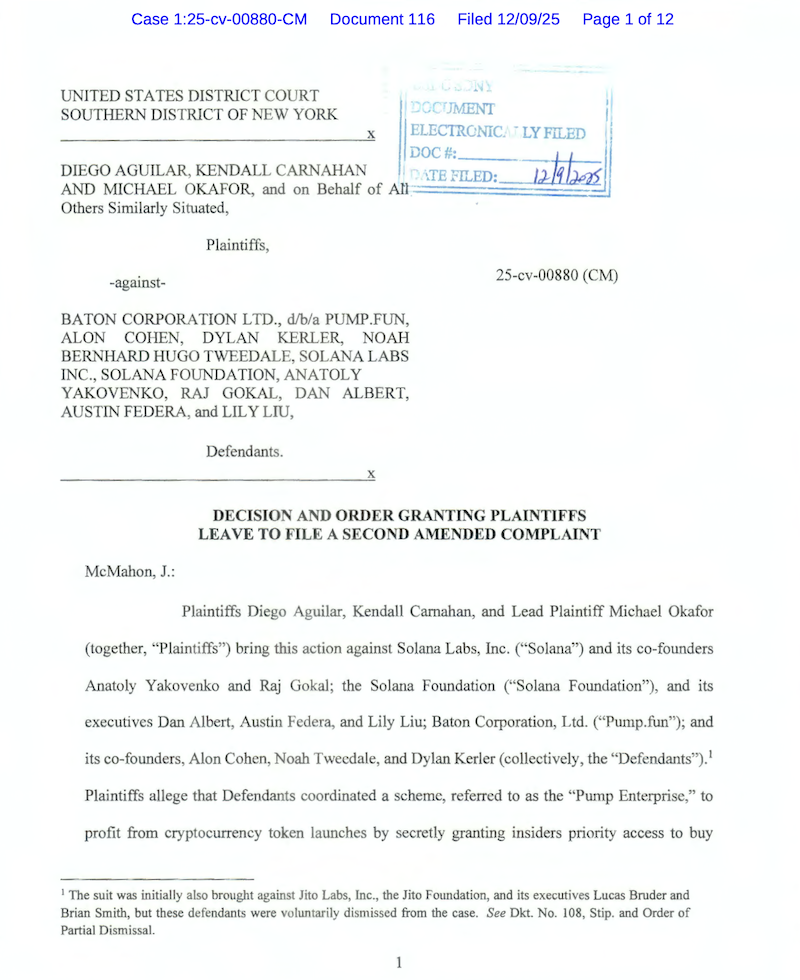
The first page of the motion to amend the case to include new evidence, which was granted. Source: Burwick Law

The lawsuit, originally filed in July, alleges that the Pump.fun platform deliberately misled retail investors by marketing memecoin launches as “fair,” but engaged in a scheme with Solana validators to front-run retail participants through maximal extractable value (MEV).

Maximal extractable value is a technique that involves reordering transactions within a block to maximize profit for MEV arbitrageurs and validators.

The plaintiffs allege that Pump.fun used MEV techniques to give insiders preferential access to new tokens at a low value, which were then pumped and dumped onto retail participants, who were used as exit liquidity by insiders.

Cointelegraph reached out to Burwick Law, the legal firm representing the plaintiffs, as well as Pump.fun, Jito Labs and the Solana Foundation, but did not receive any responses by the time of publication.

The allegations in the original lawsuit filing. Source: Burwick Law

The lawsuit could set a precedent for MEV cases in the United States, as the ethics of the practice continue to be debated within the crypto industry and legal bodies struggle to define proper regulations about the highly technical subject.

Related: Pump.fun co-founder denies $436M cash out, claims it was ‘treasury management’

The MEV bot trial leaves questions unanswered

Anton and James Peraire-Bueno, the brothers accused of using a MEV trading bot to make millions of dollars in profit, went to trial in November in the US.

Prosecutors argued that the brothers tricked victims out of their funds, but defense attorneys said that they were executing a legitimate trading strategy and did not do anything illegal.

The jury struggled to reach a verdict in the case, and several jurors requested additional information to clarify the complexities surrounding the technical specifics of blockchain technology.

The case ended in a mistrial after the jury was deadlocked and failed to reach a verdict, highlighting the complexity of adjudicating legal disputes surrounding the application of nascent financial technology.

Magazine: Meet the onchain crypto detectives fighting crime better than the cops


Domande pertinenti

QWhat is the main subject of the class-action lawsuit discussed in the article?

AThe class-action lawsuit is against memecoin launch platform Pump.fun, MEV infrastructure company Jito Labs, the Solana Foundation, and others. It alleges they engaged in a scheme using Maximal Extractable Value (MEV) to front-run retail investors, misleading them about the fairness of memecoin launches.

QWhat significant new evidence was added to the lawsuit, and how was it obtained?

AOver 5,000 pieces of evidence in the form of internal chat logs were submitted by a 'confidential informant' in September. The plaintiffs assert these logs contain contemporaneous discussions among the defendants that clarify the management, coordination, and communications of the alleged scheme.

QHow does the article describe the practice of Maximal Extractable Value (MEV)?

AMaximal Extractable Value (MEV) is described as a technique that involves reordering transactions within a block to maximize profit for MEV arbitrageurs and validators.

QWhat was the outcome of the recent trial involving the Peraire-Bueno brothers and an MEV trading bot?

AThe trial of Anton and James Peraire-Bueno ended in a mistrial after the jury was deadlocked and failed to reach a verdict, highlighting the complexity of adjudicating legal disputes involving this nascent financial technology.

QWhy is this lawsuit considered potentially precedent-setting according to the article?

AThe lawsuit could set a precedent for MEV cases in the United States as legal bodies struggle to define proper regulations for this highly technical subject, and the ethics of the practice continue to be debated within the crypto industry.

Letture associate

USDC Begins Nested Issuance, Coinbase Launches Custom Stablecoin Branding Service

Coinbase has launched its "Custom Stablecoins" platform, enabling businesses to offer branded stablecoins. The first client is Flipcash, a social payments app, which has introduced USDF. USDF is a Solana-based stablecoin, pegged 1:1 to USDC, and is designed to serve as a stable pricing and settlement unit for Flipcash's user-created community currencies. This move shifts the focus of stablecoins from being standalone assets or investment products to becoming embedded payment and settlement components within broader applications. For businesses like Flipcash, the core need is not to become a stablecoin issuer, but to integrate stable, reliable digital cash functionality—handling pricing, payments, and settlements—without managing the complex underlying infrastructure of issuance, reserves, on-chain contracts, fiat on-ramps, and compliance. Coinbase's platform provides this infrastructure as a service, positioning the exchange as a stablecoin infrastructure provider. While USDC remains the foundational reserve asset, the branded token (e.g., USDF) offers applications a tailored, user-facing financial tool. This development highlights a potential path for stablecoins to become ubiquitous backend utilities in social, gaming, and e-commerce applications, though it also brings significant regulatory and operational complexities associated with handling real user funds.

链捕手16 min fa

USDC Begins Nested Issuance, Coinbase Launches Custom Stablecoin Branding Service

链捕手16 min fa

Detained for 37 Days: The First Wave of People Who Got Rich from 'AI Gateways' Are Starting to Go to Jail

A prominent AI proxy service operator was reportedly detained for 37 days and is now on bail pending trial, highlighting the legal risks in China's booming but unregulated AI intermediary market. These services act as "AI scalpers," providing domestic users with access to restricted overseas models (like OpenAI, Claude) by bundling APIs, handling payments, and bypassing network blocks, all for a fee. Their controversial profitability stems from practices like bulk-registering accounts to resell free credits, exploiting refund policies, overcharging for tokens, substituting cheaper models, and illegally selling user conversation data. Major figures, including cryptocurrency entrepreneurs, are now entering this space. Legally, these operations face severe risks. Their core model often involves unauthorized API access and operating without required telecom licenses, potentially constituting illegal business operations. They fail to meet data security obligations for the vast amounts of user data they process, risking charges for failing to fulfill network security duties. Crucially, the unauthorized collection and sale of user data, which can include personal and commercial secrets, easily meets the threshold for the crime of infringing on personal information. The case underscores a critical juncture for the AI industry. While proxies lower access barriers, they expose user data to unsecured middlemen and undermine the business models of AI developers, forcing them to divert resources to security and distorting market value perceptions. The article argues that the industry's sustainable future depends on building trust, protecting data, and fostering compliant competition, moving away from its current "wild growth" phase.

marsbit43 min fa

Detained for 37 Days: The First Wave of People Who Got Rich from 'AI Gateways' Are Starting to Go to Jail

marsbit43 min fa

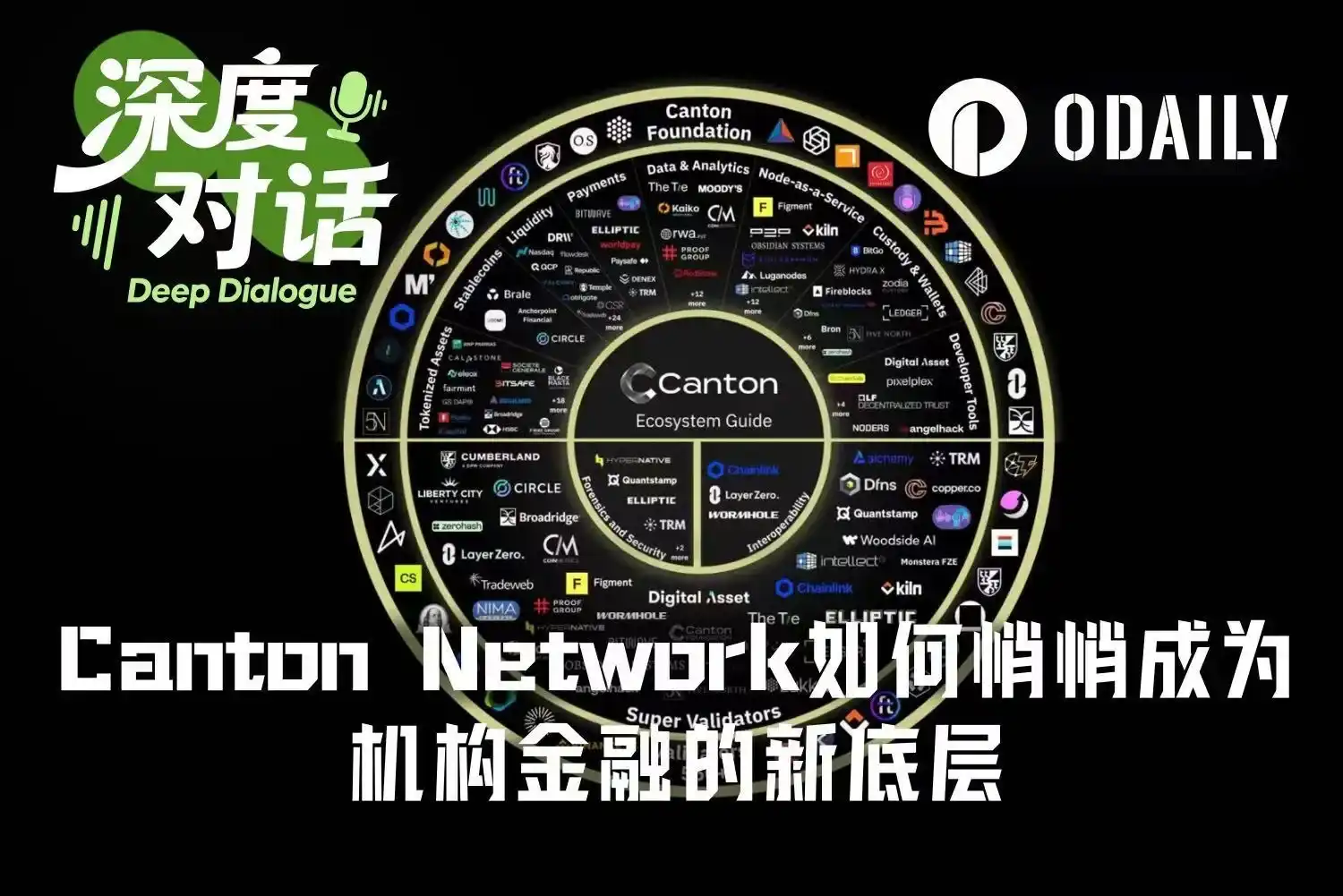
Putting Markets On-Chain: Canton Network Quietly Becomes the New Backbone of Institutional Finance

**Title: Letting the Market Itself Go On-Chain: Canton Network Quietly Becomes the New Backbone for Institutional Finance** **Summary:** The Canton Network, a blockchain platform designed for institutional finance, is gaining significant traction. A key sign of its maturity was Visa's recent entry as a super-validator, a proposal approved in just three days—highlighting prior, extensive collaboration between traditional finance and crypto. Unlike public chains like Ethereum that prioritize transparency and asset onboarding, Canton focuses on enabling confidential, compliant business operations for regulated institutions. Its core design features built-in **data visibility control**, meaning transaction details are only shared between direct counterparties. This privacy is fundamental, allowing competing institutions (like banks Goldman Sachs, JPMorgan, and BNP Paribas, all validators) to interact on the same network without exposing sensitive positions or strategies. Developed by Wall Street veterans at Digital Asset, Canton has taken a slow, deliberate approach to onboard real financial activity. It now handles over **$9 trillion monthly** in transaction volume, primarily from real-world institutional use cases like **tokenized repo agreements**, Treasury settlements, and collateral mobility. Major live applications include **JPM Coin** for institutional payments and **DTCC's tokenized U.S. Treasuries** project. Canton's native token, **CC**, is framed as a "network utility asset" with zero pre-mine or VC allocations. Its value is intended to be driven by the volume of real financial activity on the network. Looking ahead, Canton aims to become the invisible foundational layer for global finance—enabling atomic settlement (where payment and asset delivery occur simultaneously), 24/7 capital flows, and the native issuance and settlement of various asset classes, from corporate bonds to potentially equities. The main challenges are no longer technical but involve navigating fragmented global regulations and integrating with legacy financial systems.

marsbit1 h fa

Putting Markets On-Chain: Canton Network Quietly Becomes the New Backbone of Institutional Finance

marsbit1 h fa

It's Bankless That Needs Ethereum, Not Ethereum That Needs Bankless

Titled "Bankless Needs Ethereum, Not the Other Way Around," this article analyzes the significant recent news involving Bankless, a prominent crypto media outlet. Bankless co-founder David Hoffman announced the sale of all his ETH holdings, while the company also reportedly underwent major layoffs, with its founders parting ways. The news, likened to a high-profile defection, initially sent shockwaves through the Ethereum community, given Bankless's historical role as a key evangelist and "semi-official" narrative builder for Ethereum. For years, through its podcasts and writings, Bankless championed core Ethereum ideas like "ultrasound money" and the blockchain's role as a new financial settlement layer, acting as a crucial community hub and belief system during its growth phase. However, the article argues this development is not necessarily negative for Ethereum. It suggests Bankless's "first mission"—serving as Ethereum's passionate, inward-facing "propaganda department"—has largely been completed. As Ethereum matures and moves towards mainstream, institutional adoption, the narrative baton has shifted. Today, the value propositions of ETH are increasingly communicated to traditional finance by asset managers like BlackRock and VanEck, public companies adding ETH to their treasuries, and established financial figures. This represents a natural evolution towards a more decentralized, professional, and institutionally-focused narrative network. Therefore, while Bankless's retreat marks the end of an era, it signifies Ethereum's growing resilience and its reduced reliance on any single entity for belief, as its story is now carried forward by a broader and more mature ecosystem of advocates.

链捕手1 h fa

It's Bankless That Needs Ethereum, Not Ethereum That Needs Bankless

链捕手1 h fa

Trading

Spot
Futures

Articoli Popolari

Come comprare PUMP

Benvenuto in HTX.com! Abbiamo reso l'acquisto di Pump.fun (PUMP) semplice e conveniente. Segui la nostra guida passo passo per intraprendere il tuo viaggio nel mondo delle criptovalute.Step 1: Crea il tuo Account HTXUsa la tua email o numero di telefono per registrarti il tuo account gratuito su HTX. Vivi un'esperienza facile e sblocca tutte le funzionalità,Crea il mio accountStep 2: Vai in Acquista crypto e seleziona il tuo metodo di pagamentoCarta di credito/debito: utilizza la tua Visa o Mastercard per acquistare immediatamente Pump.funPUMP.Bilancio: Usa i fondi dal bilancio del tuo account HTX per fare trading senza problemi.Terze parti: abbiamo aggiunto metodi di pagamento molto utilizzati come Google Pay e Apple Pay per maggiore comodità.P2P: Fai trading direttamente con altri utenti HTX.Over-the-Counter (OTC): Offriamo servizi su misura e tassi di cambio competitivi per i trader.Step 3: Conserva Pump.fun (PUMP)Dopo aver acquistato Pump.fun (PUMP), conserva nel tuo account HTX. In alternativa, puoi inviare tramite trasferimento blockchain o scambiare per altre criptovalute.Step 4: Scambia Pump.fun (PUMP)Scambia facilmente Pump.fun (PUMP) nel mercato spot di HTX. Accedi al tuo account, seleziona la tua coppia di trading, esegui le tue operazioni e monitora in tempo reale. Offriamo un'esperienza user-friendly sia per chi ha appena iniziato che per i trader più esperti.

314 Totale visualizzazioniPubblicato il 2024.12.12Aggiornato il 2026.05.09

Come comprare PUMP

Discussioni

Benvenuto nella Community HTX. Qui puoi rimanere informato sugli ultimi sviluppi della piattaforma e accedere ad approfondimenti esperti sul mercato. Le opinioni degli utenti sul prezzo di PUMP PUMP sono presentate come di seguito.

活动图片