Metrics Ventures: Why Are Gold, the Renminbi, and Bitcoin the Same Answer?

marsbitPubblicato 2026-01-28Pubblicato ultima volta 2026-01-28

Introduzione

Metrics Ventures analyzes the shifting global monetary and geopolitical order, arguing that gold, the Chinese yuan, and Bitcoin are all responses to the same underlying trend: a loss of faith in the existing international system and governance structures. The article begins by noting the surge in gold demand, particularly from central banks, which signals a deeper repricing of sovereign currency credit and global governance effectiveness rather than mere inflation hedging. This sentiment was a key theme at the Davos forum, where leaders discussed the breakdown of the "rules-based international order." As trust in multilateral institutions wanes, nations are rationally shifting towards strategic autonomy and risk management, preparing for uncertainty rather than operating within old assumptions. This erosion of trust is penetrating financial markets. Sovereign debt and currencies are no longer just economic tools but are now discounted for a state's governance capability and political constraints. The core of the issue is identified as structural within the dollar-centric system, which requires the U.S. to run persistent deficits to supply the world with "risk-free" dollar assets. This imbalance was sustainable as long as dollar assets were seen as uniquely safe, but the weaponization of financial tools and declining governance trust is forcing a repricing. The piece contrasts the responses of two major surplus economies: Japan and China. Japan absorbed adjustment costs thr...

Authored by: Metrics Ventures

Over the past year, gold's performance has been particularly striking. More importantly, the demand structure has undergone significant changes: the willingness of central banks and sovereign entities to allocate has noticeably increased. This can no longer be simply explained as inflation hedging or short-term safe-haven trading. A more reasonable understanding is that gold is responding to a deeper change—a repricing of sovereign monetary credit and the effectiveness of global governance.

This change was repeatedly discussed at this year's Davos Forum. Whether in formal agendas or private discussions, phrases like "imbalance in the world governance structure," "the old order is breaking," and "we are entering a phase from which there is no return" almost became the common context. On Tuesday, Canadian Prime Minister Mark Carney's speech at Davos clearly articulated this sense of unease pervading the venue. He bluntly stated that the so-called "rules-based international order" is disintegrating, and humanity is moving from a once useful, albeit fictional, narrative towards a harsher reality: great power competition is no longer constrained, economic integration is being weaponized, and rules are selectively applied in the face of power.

Carney did not simply blame a single country but pointed to a more widespread change in circumstances. When tariffs, financial infrastructure, supply chains, and even security commitments can be used as bargaining chips, the multilateral institutions—whether the WTO, the UN, or other rule-based frameworks—on which medium-sized powers and open economies rely for survival are losing their binding force. In such an environment, continuing to pretend that the rules are still functioning normally becomes a form of self-deception. He used Havel's metaphor of "living within a lie" to remind countries: the real risk is not that the order is changing, but that people are still acting according to the language and assumptions of the old order.

More notably, what Carney repeatedly emphasized was not ideological confrontation but a shift in governance choices. When rules no longer automatically provide security, nations turn to another rationality: enhancing strategic autonomy, diversifying dependencies, and building "pressure-resistant" capabilities. In his view, this is a typical risk management logic, not a betrayal of values. But it is precisely here that the foundation sustaining the old order begins to loosen—because once countries no longer believe the system can consistently provide public goods, they will instead buy "insurance" for themselves.

If we abstract the Davos discussions from specific countries, we find a deeper common direction: countries have not suddenly become more conservative but have begun to tacitly accept that a key assumption is failing—that the existing global governance system can long-term coordinate fiscal, monetary, and international responsibilities. When this premise is no longer widely believed, national behavior shifts from "division of labor within rules" to "preparing for uncertainty." And this shift will ultimately be reflected in the most fundamental areas: debt, fiscal policy, and currency.

It is here that the cracks in world governance begin to penetrate financial pricing. National debt is no longer just a macro-control tool but is re-examined as a discount of governance capacity and political constraints; sovereign currency is no longer just a medium of exchange but is required to simultaneously bear the functions of intertemporal commitment, international responsibility, and crisis buffer. Once the market begins to doubt whether these roles can still be fulfilled simultaneously, the impact on monetary credit is no longer an extreme scenario but a gradual yet irreversible process.

And all this does not stem from the fiscal mistakes of a particular country but is embedded within the current international monetary system. The dollar-centric system dictates that the world must have a long-term deficit center that absorbs external savings, and it also dictates that surpluses and deficits are not accidental but a role division solidified by the system. The US dollar is both a sovereign currency of the United States and the basis for global reserves, pricing, and safe assets. This means that global demand for "risk-free dollar assets" further intensifies when uncertainty rises. To provide these assets to the world, the US can only fulfill this role by continuously incurring external liabilities.

In an environment of financialization and free capital flows, this division of labor is constantly amplified. Surpluses are no longer primarily digested through adjustments in commodity prices or exchange rates but are transformed into long-term allocations to US Treasury bonds and dollar-denominated financial assets; deficits are no longer immediately constrained but are postponed and absorbed through the financial system and central bank intervention. As long as the world still believes that dollar assets possess irreplaceable safety in a crisis, this imbalance can persist long-term, even being seen as a source of systemic stability.

But when governance trust declines, rule constraints weaken, and financial tools are frequently weaponized, this structural imbalance begins to be repriced. Surpluses and deficits are no longer just macroeconomic phenomena but become risk exposures themselves. It is also against this backdrop that Japan and China, both surplus countries, have gradually moved towards different paths.
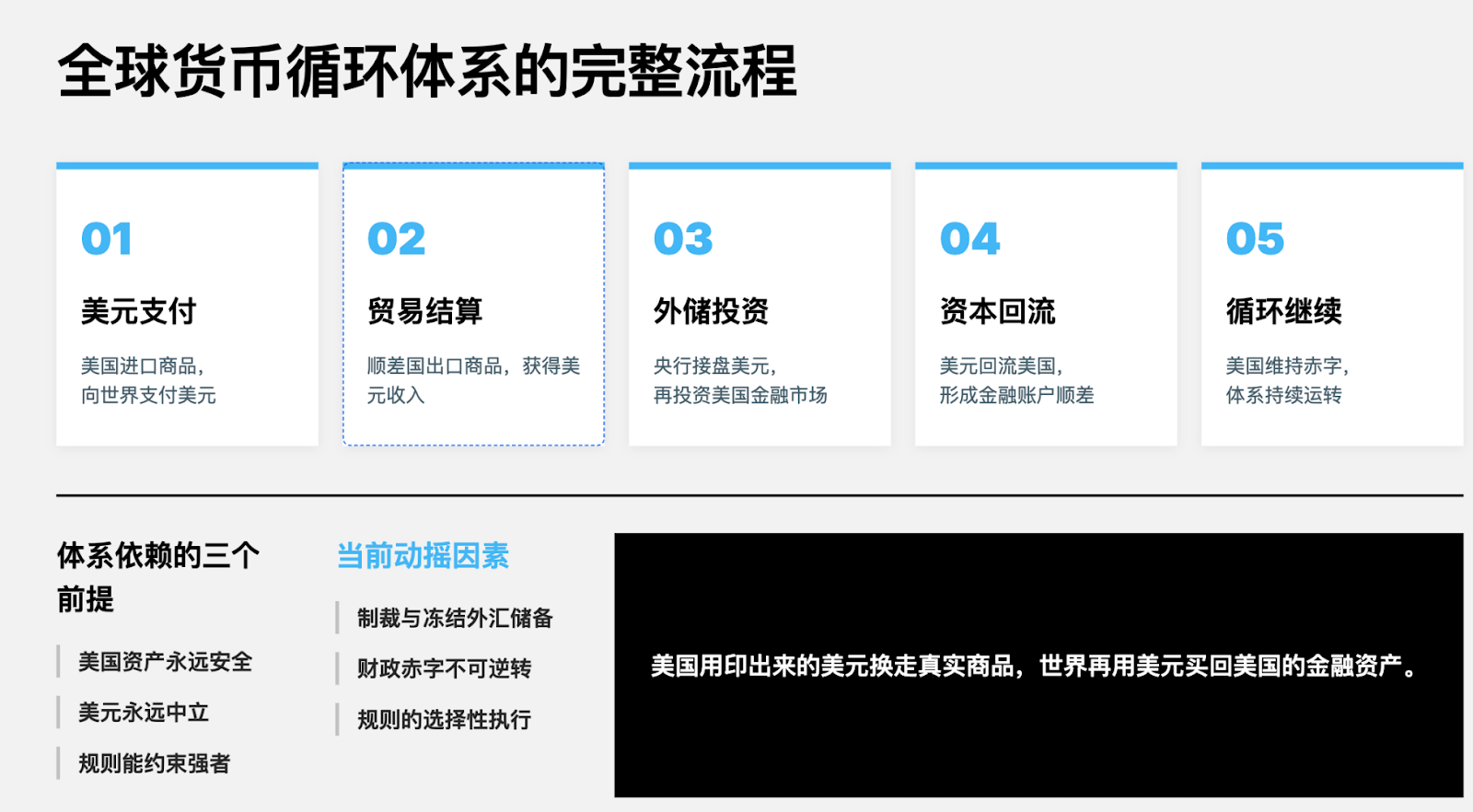
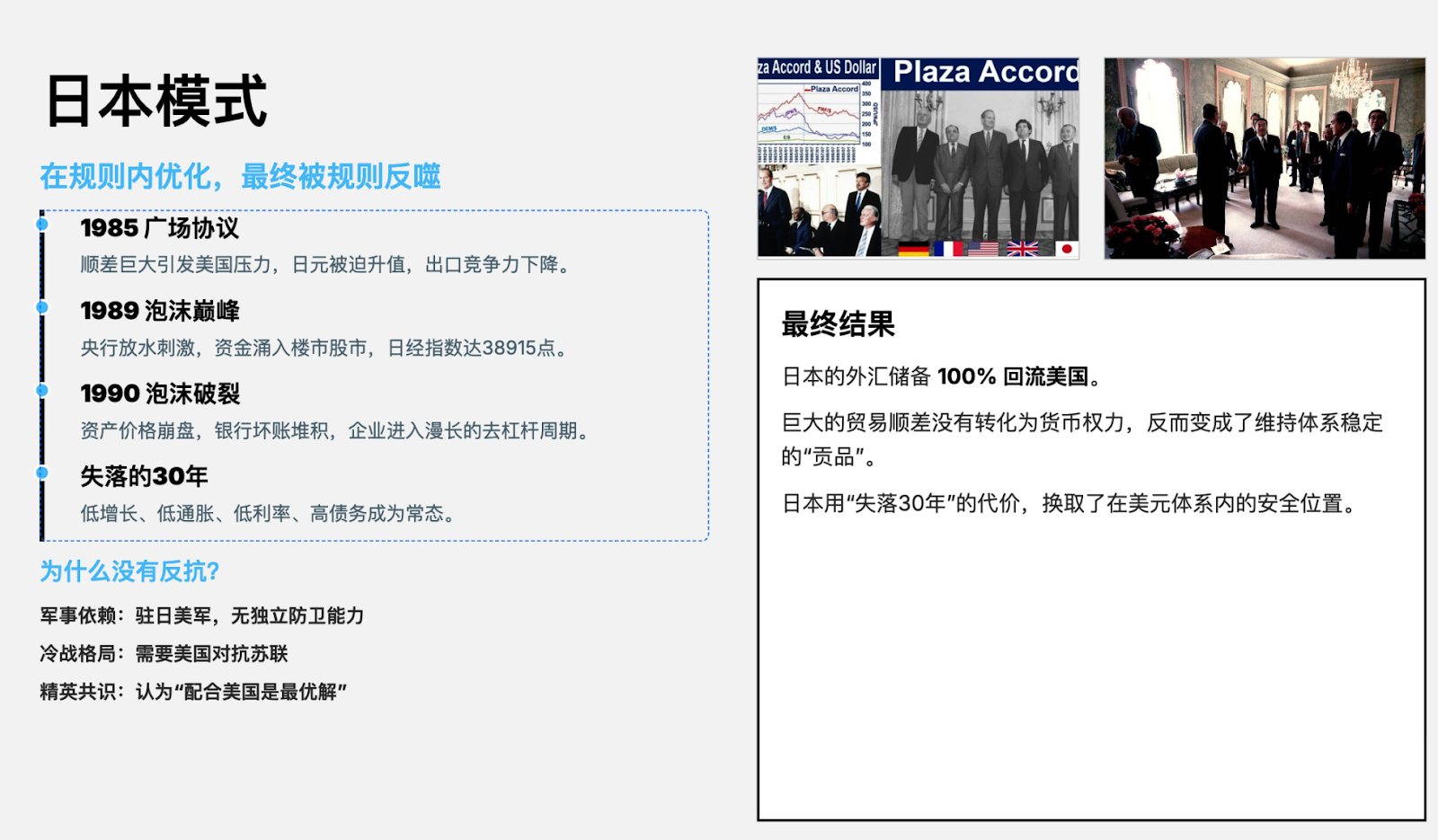
Japan has played the most typical and "cooperative" surplus country role in this system. Under external pressure and rule constraints, Japan chose to absorb adjustment costs through currency appreciation, financial liberalization, and long-term accommodative policies, thereby maintaining the stability of the overall order. This strategy reduced friction in the short term but transformed structural adjustments into domestic low growth, high debt, and deep central bank intervention. The surplus did not disappear but was internalized as the cost of long-term stagnation; Japan's monetary internationalization capacity was also significantly limited in this process.
China entered this system later, and its stage of development and internal constraints were significantly different from Japan's. Faced with surplus expansion and external pressure, China did not fully choose to clear rapidly through price and financial channels but, within the framework of exchange rate management, capital account controls, and industrial upgrading, sought to preserve policy autonomy as much as possible. This choice has long placed China in controversy, accused of "distorting rules" or "free-riding," but from a governance perspective, it appears more like a strategic arrangement to buy time and space for internal transformation within the existing system, rather than simple institutional arbitrage.

More importantly, this path did not stop at "maintaining a surplus" but quietly changed the structure of renminbi demand. As China's position in global trade, manufacturing, and key supply chains has risen, the renminbi is no longer just a settlement tool but is increasingly seen by more economies as a practical option for reducing external dependence and diversifying currency risk. Against the backdrop of intensified geopolitics and the instrumentalization of financial sanctions, sole reliance on the dollar system itself begins to be seen as a risk exposure, giving demand for renminbi settlement, renminbi financing, and renminbi asset allocation a clear strategic motivation.

Once renminbi demand shifts from passive use to active allocation, its impact is no longer limited to the trade level but transmits to the financial level. More frequent and stable usage scenarios mean the market needs a deeper and more liquid renminbi asset pool to accommodate this demand. Increased liquidity, in turn, affects how assets are priced, gradually moving renminbi assets from "domestic policy pricing" towards "a logic closer to international marginal pricing." This process does not rely on complete capital liberalization but is更多的是 pulled by real demand, representing a gradual yet hard-to-reverse change.
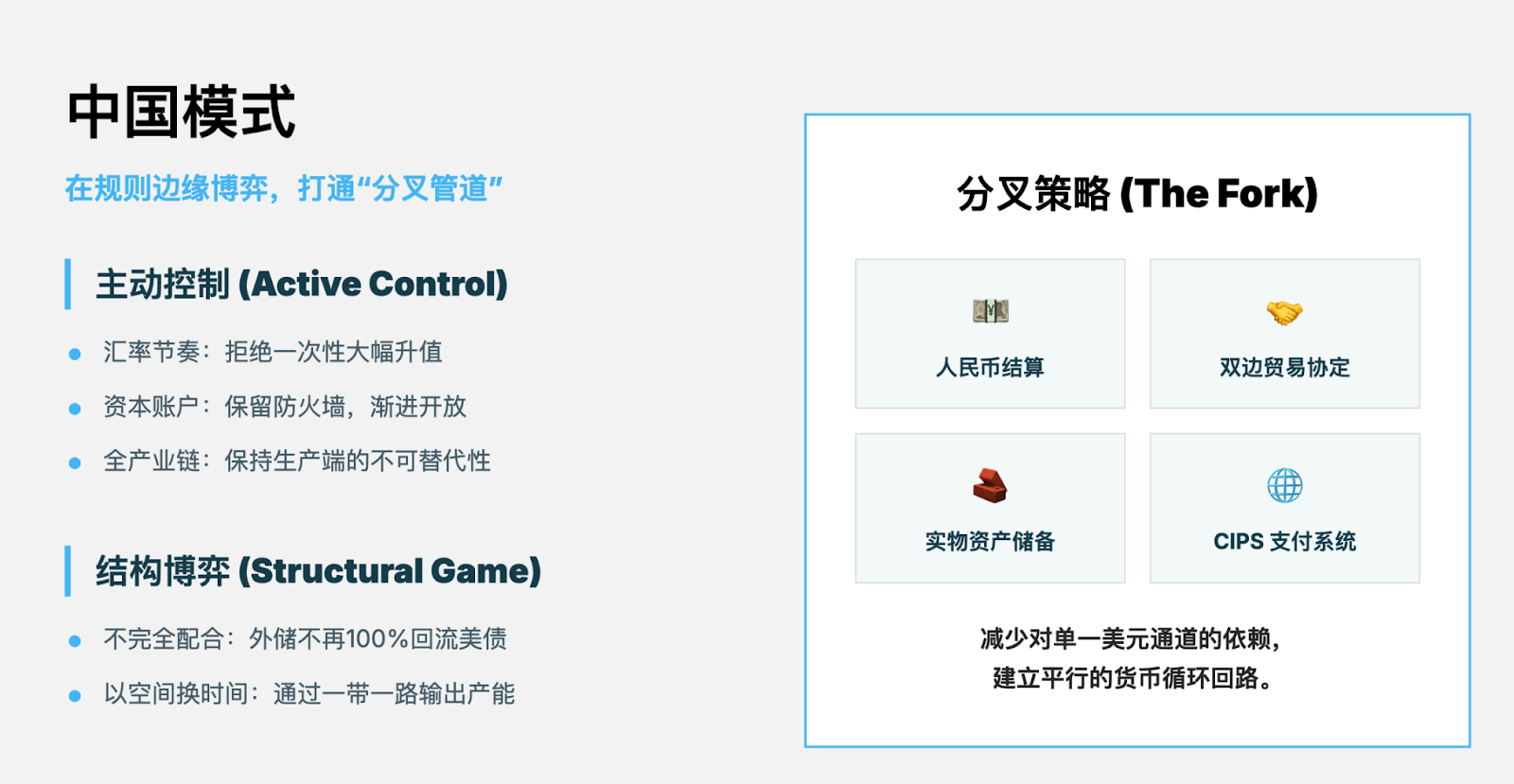
It is also in this contrast that "the East rises while the West declines" has once again become a proposition that can be seriously discussed in recent years. It is no longer an emotional judgment about the rise and fall of a particular country but a reflection of the changing costs of systemic roles. As the self-healing capacity of the dollar system declines, the space for the deficit center to continue absorbing imbalances through debt and financial expansion is shrinking; meanwhile, the importance of surplus economies in industrial chains, security, and regional arrangements is rising. In this process, China, by not fully replicating Japan's adjustment path, has retained industrial, policy, and monetary space, giving it higher strategic elasticity in systemic restructuring.

But this change does not mean a new single hegemonic currency is forming. A more realistic picture is the monetary system moving towards a multi-center and coexisting structure. The centrality of the US dollar may be weakened but will not disappear quickly; the status of the renminbi in trade settlement, regional finance, and liquidity provision will gradually increase, yet not necessarily predicated on full free floatation, but more reliant on trade networks, industrial chain depth, and policy credibility. Monetary internationalization here is no longer an institutional label but an outcome that is used into existence.

In such systemic evolution, the logic of reserve assets also changes accordingly. Gold's return to a core position is not because it can provide yield, but because it does not rely on any country's tax base, political stability, or international commitments; it is a direct response to governance uncertainty. It provides countries with a de-sovereign, de-credit reserve option, particularly suited to function in an environment lacking consensus and with weakened rule constraints.

Bitcoin represents another tier of de-sovereign asset. Although its performance has lagged behind gold and some traditional assets over the past year and a half, its core logic has not been disproven. As a digital, scarce asset not attached to any single governance system, it更像 is more like a long-term option on future monetary forms. As monetary system restructuring becomes more explicit and liquidity is reallocated, its pricing logic is more likely to catch up in later stages rather than lead in the early phases.

If these clues are finally gathered together, one finds that what this as-yet-unnamed order migration is truly changing is not short-term power comparisons, but the preconditions for the validity of assets. When rules no longer automatically provide safety, when monetary credit itself becomes a risk that needs to be hedged, the core question of asset allocation is no longer betting on who wins, but how to remain valid in a world where uncertainty has become the norm.

Against this backdrop, gold is a defensive response, while more directional choices are embodied in the renminbi and Bitcoin. The renminbi represents the real liquidity embedded in the new order, a bet on monetary restructuring pulled by trade, industry, and real demand; Bitcoin represents the ultimate hedge against governance uncertainty, a long-term option detached from any single sovereign system. Choosing them is not a statement of stance, but a largely self-consistent outcome of asset allocation under the premise that the cracks in world governance have already become explicit.

History does not announce itself with dramatic events. It is often only at a moment when looking back that people realize the order has already, imperceptibly, migrated.

Domande pertinenti

QAccording to the article, why is gold experiencing a resurgence in demand from central banks and sovereign entities?

AThe demand is not just a simple inflation hedge or short-term safe-haven trade. It is a response to a deeper structural change: a repricing of sovereign currency credit and the perceived declining effectiveness of global governance. Gold provides a non-sovereign, non-credit-based reserve asset that acts as a direct hedge against governance uncertainty.

QWhat fundamental flaw in the current international monetary system does the article identify as the root cause of instability?

AThe article identifies the dollar-centric system as the root cause. This system structurally requires a permanent deficit center (the U.S.) to absorb global savings by issuing debt, while surplus countries accumulate dollar assets. This imbalance is institutionalized, and its stability relies on the unwavering global belief in the safety of dollar assets, a belief that is now eroding due to geopolitical weaponization of financial tools and declining trust in governance.

QHow does the strategic response of China to its trade surplus differ from that of Japan, as described in the article?

AJapan absorbed the costs of adjustment through currency appreciation, financial liberalization, and long-term easing policies to maintain the existing order, which led to domestic stagnation and high debt. China, however, used capital controls and managed exchange rates to retain policy autonomy, focusing on internal transformation and industrial upgrading. This path has given China greater strategic elasticity and is now shifting RMB demand from passive use to active strategic configuration by other nations.

QWhat role does the article assign to Bitcoin in the evolving monetary landscape?

ABitcoin is described as a long-term option on future monetary forms. It is a digital, scarce asset that is not dependent on any single governance system. It represents the ultimate hedge against governance uncertainty. Its pricing logic is expected to catch up later in the cycle of monetary system restructuring rather than lead in the early stages.

QWhat is the common answer that gold, the RMB, and Bitcoin provide, according to the article's conclusion?

AThey are all responses to a world where the 'rules-based international order' is fracturing and monetary credit itself has become a risk that needs to be hedged. Gold is the defensive response. The RMB represents a bet on a new monetary structure embedded in real trade and industrial demand. Bitcoin is the ultimate, long-term hedge against sovereign system uncertainty. Choosing them is a coherent asset allocation result in a world where uncertainty is the new constant.

Letture associate

Why Hasn't the U.S. Seen the Rise of 'Huabei' or 'Jiebei'?

The article explores why the U.S. lacks large-scale consumer credit products like China's "Huabei" and "Jiebei," despite having a developed financial sector. Key reasons include: 1. **Structural Barriers**: A fragmented federal and state regulatory system, reinforced by post-2008 reforms like the Dodd-Frank Act, raises compliance costs and protects traditional banks, stifling fintech innovation. 2. **Credit Card Dominance**: Credit cards, used by 70-80% of adults, form a $1.28 trillion debt market with high APRs (avg. 22.3%). This system cross-subsidizes users who pay in full with those carrying balances, creating a predatory yet entrenched ecosystem. 3. **Data Privacy Laws**: Strict regulations (e.g., FCRA, CCPA) prevent tech giants from leveraging behavioral data for credit scoring, unlike in China where such data fuels fintech models. 4. **Capital Market Disincentives**: Wall Street penalizes tech firms entering finance due to lower valuations associated with heavy regulation and risk, as seen in Apple’s failure with Apple Card. 5. **Banking Oligopoly**: Major banks control consumer lending, leveraging lobbying power and consumer habits to maintain high-cost credit, while alternatives like payday loans (400% APR) or "unbanked" services remain niche or exploitative. Ultimately, regulatory, structural, and corporate interests collectively block the emergence of accessible, low-cost digital lending in the U.S.

Odaily星球日报16 min fa

Why Hasn't the U.S. Seen the Rise of 'Huabei' or 'Jiebei'?

Odaily星球日报16 min fa

More and More 'Model Supermarkets' Are Opening: ByteDance, Alibaba, and Tencent Compete to Integrate

Chinese tech giants like ByteDance, Alibaba, and Tencent are accelerating the rollout of integrated AI model subscription services—dubbed “model supermarkets”—to provide developers with bundled access to multiple leading domestic large language models (LLMs). ByteDance’s Volcengine recently upgraded its "Coding Plan" by adding newer models like GLM-5.1, Minimax M2.7, and Kimi k2.6, allowing subscribers to use various top models under a single monthly fee starting at ¥40. However, user feedback reveals significant issues, including rapid consumption of usage limits (e.g., hitting caps within hours), frequent server errors (like HTTP 429), and slow response times during peak hours. Complaints about misleading deduction rates—where calls to advanced models consume more quota—are also common. The trend is industry-wide: Alibaba, Tencent, and Baidu have all launched similar multi-model coding plans. While these platforms reduce trial costs for developers, they also expose challenges in balancing affordability with service quality and computational stability. Amid this shift, independent AI companies like Zhipu, MiniMax, and Moonlight Face (Kimi) are developing strategies to avoid becoming mere “pipes” in this ecosystem—focusing on vertical applications, autonomous agents, and long-context models to retain competitiveness. Analysts suggest that, while platform aggregation may pressure model firms in the short term, specialized and vertical AI capabilities will remain differentiated in the long run.

marsbit19 min fa

More and More 'Model Supermarkets' Are Opening: ByteDance, Alibaba, and Tencent Compete to Integrate

marsbit19 min fa

Trading

Spot
Futures

Articoli Popolari

Cosa è $S$

Comprendere SPERO: Una Panoramica Completa Introduzione a SPERO Mentre il panorama dell'innovazione continua a evolversi, l'emergere delle tecnologie web3 e dei progetti di criptovaluta gioca un ruolo fondamentale nel plasmare il futuro digitale. Un progetto che ha attirato l'attenzione in questo campo dinamico è SPERO, denotato come SPERO,$$s$. Questo articolo mira a raccogliere e presentare informazioni dettagliate su SPERO, per aiutare gli appassionati e gli investitori a comprendere le sue basi, obiettivi e innovazioni nei domini web3 e crypto. Che cos'è SPERO,$$s$? SPERO,$$s$ è un progetto unico all'interno dello spazio crypto che cerca di sfruttare i principi della decentralizzazione e della tecnologia blockchain per creare un ecosistema che promuove l'impegno, l'utilità e l'inclusione finanziaria. Il progetto è progettato per facilitare interazioni peer-to-peer in modi nuovi, fornendo agli utenti soluzioni e servizi finanziari innovativi. Al suo interno, SPERO,$$s$ mira a responsabilizzare gli individui fornendo strumenti e piattaforme che migliorano l'esperienza dell'utente nello spazio delle criptovalute. Questo include la possibilità di metodi di transazione più flessibili, la promozione di iniziative guidate dalla comunità e la creazione di percorsi per opportunità finanziarie attraverso applicazioni decentralizzate (dApps). La visione sottostante di SPERO,$$s$ ruota attorno all'inclusività, cercando di colmare le lacune all'interno della finanza tradizionale mentre sfrutta i vantaggi della tecnologia blockchain. Chi è il Creatore di SPERO,$$s$? L'identità del creatore di SPERO,$$s$ rimane piuttosto oscura, poiché ci sono risorse pubblicamente disponibili limitate che forniscono informazioni dettagliate sul suo fondatore o fondatori. Questa mancanza di trasparenza può derivare dall'impegno del progetto per la decentralizzazione—un ethos che molti progetti web3 condividono, dando priorità ai contributi collettivi rispetto al riconoscimento individuale. Centrando le discussioni attorno alla comunità e ai suoi obiettivi collettivi, SPERO,$$s$ incarna l'essenza dell'empowerment senza mettere in evidenza individui specifici. Pertanto, comprendere l'etica e la missione di SPERO rimane più importante che identificare un creatore singolo. Chi sono gli Investitori di SPERO,$$s$? SPERO,$$s$ è supportato da una varietà di investitori che vanno dai capitalisti di rischio agli investitori angelici dedicati a promuovere l'innovazione nel settore crypto. Il focus di questi investitori generalmente si allinea con la missione di SPERO—dando priorità a progetti che promettono avanzamenti tecnologici sociali, inclusività finanziaria e governance decentralizzata. Queste fondazioni di investitori sono tipicamente interessate a progetti che non solo offrono prodotti innovativi, ma contribuiscono anche positivamente alla comunità blockchain e ai suoi ecosistemi. Il supporto di questi investitori rafforza SPERO,$$s$ come un concorrente degno di nota nel dominio in rapida evoluzione dei progetti crypto. Come Funziona SPERO,$$s$? SPERO,$$s$ impiega un framework multifunzionale che lo distingue dai progetti di criptovaluta convenzionali. Ecco alcune delle caratteristiche chiave che sottolineano la sua unicità e innovazione: Governance Decentralizzata: SPERO,$$s$ integra modelli di governance decentralizzati, responsabilizzando gli utenti a partecipare attivamente ai processi decisionali riguardanti il futuro del progetto. Questo approccio favorisce un senso di proprietà e responsabilità tra i membri della comunità. Utilità del Token: SPERO,$$s$ utilizza il proprio token di criptovaluta, progettato per servire varie funzioni all'interno dell'ecosistema. Questi token abilitano transazioni, premi e la facilitazione dei servizi offerti sulla piattaforma, migliorando l'impegno e l'utilità complessivi. Architettura Stratificata: L'architettura tecnica di SPERO,$$s$ supporta la modularità e la scalabilità, consentendo un'integrazione fluida di funzionalità e applicazioni aggiuntive man mano che il progetto evolve. Questa adattabilità è fondamentale per mantenere la rilevanza nel panorama crypto in continua evoluzione. Coinvolgimento della Comunità: Il progetto enfatizza iniziative guidate dalla comunità, impiegando meccanismi che incentivano la collaborazione e il feedback. Nutrendo una comunità forte, SPERO,$$s$ può affrontare meglio le esigenze degli utenti e adattarsi alle tendenze di mercato. Focus sull'Inclusione: Offrendo basse commissioni di transazione e interfacce user-friendly, SPERO,$$s$ mira ad attrarre una base utenti diversificata, inclusi individui che potrebbero non aver precedentemente interagito nello spazio crypto. Questo impegno per l'inclusione si allinea con la sua missione generale di empowerment attraverso l'accessibilità. Cronologia di SPERO,$$s$ Comprendere la storia di un progetto fornisce preziose intuizioni sulla sua traiettoria di sviluppo e sui traguardi. Di seguito è riportata una cronologia suggerita che mappa eventi significativi nell'evoluzione di SPERO,$$s$: Fase di Concettualizzazione e Ideazione: Le idee iniziali che formano la base di SPERO,$$s$ sono state concepite, allineandosi strettamente con i principi di decentralizzazione e focus sulla comunità all'interno dell'industria blockchain. Lancio del Whitepaper del Progetto: Dopo la fase concettuale, è stato rilasciato un whitepaper completo che dettaglia la visione, gli obiettivi e l'infrastruttura tecnologica di SPERO,$$s$ per suscitare interesse e feedback dalla comunità. Costruzione della Comunità e Prime Interazioni: Sono stati effettuati sforzi attivi di outreach per costruire una comunità di early adopters e potenziali investitori, facilitando discussioni attorno agli obiettivi del progetto e ottenendo supporto. Evento di Generazione del Token: SPERO,$$s$ ha condotto un evento di generazione del token (TGE) per distribuire i propri token nativi ai primi sostenitori e stabilire una liquidità iniziale all'interno dell'ecosistema. Lancio della Prima dApp: La prima applicazione decentralizzata (dApp) associata a SPERO,$$s$ è stata attivata, consentendo agli utenti di interagire con le funzionalità principali della piattaforma. Sviluppo Continuo e Partnership: Aggiornamenti e miglioramenti continui alle offerte del progetto, inclusi partnership strategiche con altri attori nello spazio blockchain, hanno plasmato SPERO,$$s$ in un concorrente competitivo e in evoluzione nel mercato crypto. Conclusione SPERO,$$s$ rappresenta una testimonianza del potenziale del web3 e delle criptovalute di rivoluzionare i sistemi finanziari e responsabilizzare gli individui. Con un impegno per la governance decentralizzata, il coinvolgimento della comunità e funzionalità progettate in modo innovativo, apre la strada verso un panorama finanziario più inclusivo. Come per qualsiasi investimento nello spazio crypto in rapida evoluzione, si incoraggiano potenziali investitori e utenti a ricercare approfonditamente e a impegnarsi in modo riflessivo con gli sviluppi in corso all'interno di SPERO,$$s$. Il progetto mostra lo spirito innovativo dell'industria crypto, invitando a ulteriori esplorazioni delle sue innumerevoli possibilità. Mentre il percorso di SPERO,$$s$ è ancora in fase di sviluppo, i suoi principi fondamentali potrebbero effettivamente influenzare il futuro di come interagiamo con la tecnologia, la finanza e tra di noi in ecosistemi digitali interconnessi.

75 Totale visualizzazioniPubblicato il 2024.12.17Aggiornato il 2024.12.17

Cosa è $S$

Cosa è AGENT S

Agent S: Il Futuro dell'Interazione Autonoma in Web3 Introduzione Nel panorama in continua evoluzione di Web3 e criptovalute, le innovazioni stanno costantemente ridefinendo il modo in cui gli individui interagiscono con le piattaforme digitali. Uno di questi progetti pionieristici, Agent S, promette di rivoluzionare l'interazione uomo-computer attraverso il suo framework agentico aperto. Aprendo la strada a interazioni autonome, Agent S mira a semplificare compiti complessi, offrendo applicazioni trasformative nell'intelligenza artificiale (AI). Questa esplorazione dettagliata approfondirà le complessità del progetto, le sue caratteristiche uniche e le implicazioni per il dominio delle criptovalute. Cos'è Agent S? Agent S si presenta come un innovativo framework agentico aperto, progettato specificamente per affrontare tre sfide fondamentali nell'automazione dei compiti informatici: Acquisizione di Conoscenze Specifiche del Dominio: Il framework apprende in modo intelligente da varie fonti di conoscenza esterne ed esperienze interne. Questo approccio duale gli consente di costruire un ricco repository di conoscenze specifiche del dominio, migliorando le sue prestazioni nell'esecuzione dei compiti. Pianificazione su Lungo Orizzonte di Compiti: Agent S impiega una pianificazione gerarchica potenziata dall'esperienza, un approccio strategico che facilita la suddivisione e l'esecuzione efficiente di compiti complessi. Questa caratteristica migliora significativamente la sua capacità di gestire più sottocompiti in modo efficiente ed efficace. Gestione di Interfacce Dinamiche e Non Uniformi: Il progetto introduce l'Interfaccia Agente-Computer (ACI), una soluzione innovativa che migliora l'interazione tra agenti e utenti. Utilizzando Modelli Linguistici Multimodali di Grandi Dimensioni (MLLM), Agent S può navigare e manipolare senza sforzo diverse interfacce grafiche utente. Attraverso queste caratteristiche pionieristiche, Agent S fornisce un framework robusto che affronta le complessità coinvolte nell'automazione dell'interazione umana con le macchine, preparando il terreno per innumerevoli applicazioni nell'AI e oltre. Chi è il Creatore di Agent S? Sebbene il concetto di Agent S sia fondamentalmente innovativo, informazioni specifiche sul suo creatore rimangono elusive. Il creatore è attualmente sconosciuto, il che evidenzia sia la fase embrionale del progetto sia la scelta strategica di mantenere i membri fondatori sotto anonimato. Indipendentemente dall'anonimato, l'attenzione rimane sulle capacità e sul potenziale del framework. Chi sono gli Investitori di Agent S? Poiché Agent S è relativamente nuovo nell'ecosistema crittografico, informazioni dettagliate riguardanti i suoi investitori e sostenitori finanziari non sono documentate esplicitamente. La mancanza di approfondimenti pubblicamente disponibili sulle fondazioni di investimento o sulle organizzazioni che supportano il progetto solleva interrogativi sulla sua struttura di finanziamento e sulla roadmap di sviluppo. Comprendere il supporto è cruciale per valutare la sostenibilità del progetto e il suo potenziale impatto sul mercato. Come Funziona Agent S? Al centro di Agent S si trova una tecnologia all'avanguardia che gli consente di funzionare efficacemente in contesti diversi. Il suo modello operativo è costruito attorno a diverse caratteristiche chiave: Interazione Uomo-Computer Simile a Quella Umana: Il framework offre una pianificazione AI avanzata, cercando di rendere le interazioni con i computer più intuitive. Mimando il comportamento umano nell'esecuzione dei compiti, promette di elevare le esperienze degli utenti. Memoria Narrativa: Utilizzata per sfruttare esperienze di alto livello, Agent S utilizza la memoria narrativa per tenere traccia delle storie dei compiti, migliorando così i suoi processi decisionali. Memoria Episodica: Questa caratteristica fornisce agli utenti una guida passo-passo, consentendo al framework di offrire supporto contestuale mentre i compiti si sviluppano. Supporto per OpenACI: Con la capacità di funzionare localmente, Agent S consente agli utenti di mantenere il controllo sulle proprie interazioni e flussi di lavoro, allineandosi con l'etica decentralizzata di Web3. Facile Integrazione con API Esterne: La sua versatilità e compatibilità con varie piattaforme AI garantiscono che Agent S possa adattarsi senza problemi agli ecosistemi tecnologici esistenti, rendendolo una scelta attraente per sviluppatori e organizzazioni. Queste funzionalità contribuiscono collettivamente alla posizione unica di Agent S all'interno dello spazio crittografico, poiché automatizza compiti complessi e multi-fase con un intervento umano minimo. Man mano che il progetto evolve, le sue potenziali applicazioni in Web3 potrebbero ridefinire il modo in cui si svolgono le interazioni digitali. Cronologia di Agent S Lo sviluppo e le tappe di Agent S possono essere riassunti in una cronologia che evidenzia i suoi eventi significativi: 27 Settembre 2024: Il concetto di Agent S è stato lanciato in un documento di ricerca completo intitolato “Un Framework Agentico Aperto che Usa i Computer Come un Umano”, mostrando le basi per il progetto. 10 Ottobre 2024: Il documento di ricerca è stato reso pubblicamente disponibile su arXiv, offrendo un'esplorazione approfondita del framework e della sua valutazione delle prestazioni basata sul benchmark OSWorld. 12 Ottobre 2024: È stata rilasciata una presentazione video, fornendo un'idea visiva delle capacità e delle caratteristiche di Agent S, coinvolgendo ulteriormente potenziali utenti e investitori. Questi indicatori nella cronologia non solo illustrano i progressi di Agent S, ma indicano anche il suo impegno per la trasparenza e il coinvolgimento della comunità. Punti Chiave su Agent S Man mano che il framework Agent S continua a evolversi, diversi attributi chiave si distinguono, sottolineando la sua natura innovativa e il potenziale: Framework Innovativo: Progettato per fornire un uso intuitivo dei computer simile all'interazione umana, Agent S porta un approccio nuovo all'automazione dei compiti. Interazione Autonoma: La capacità di interagire autonomamente con i computer attraverso GUI segna un passo avanti verso soluzioni informatiche più intelligenti ed efficienti. Automazione di Compiti Complessi: Con la sua metodologia robusta, può automatizzare compiti complessi e multi-fase, rendendo i processi più veloci e meno soggetti a errori. Miglioramento Continuo: I meccanismi di apprendimento consentono ad Agent S di migliorare dalle esperienze passate, migliorando continuamente le sue prestazioni e la sua efficacia. Versatilità: La sua adattabilità attraverso diversi ambienti operativi come OSWorld e WindowsAgentArena garantisce che possa servire un'ampia gamma di applicazioni. Man mano che Agent S si posiziona nel panorama di Web3 e delle criptovalute, il suo potenziale per migliorare le capacità di interazione e automatizzare i processi segna un significativo avanzamento nelle tecnologie AI. Attraverso il suo framework innovativo, Agent S esemplifica il futuro delle interazioni digitali, promettendo un'esperienza più fluida ed efficiente per gli utenti in vari settori. Conclusione Agent S rappresenta un audace passo avanti nell'unione tra AI e Web3, con la capacità di ridefinire il modo in cui interagiamo con la tecnologia. Sebbene sia ancora nelle sue fasi iniziali, le possibilità per la sua applicazione sono vaste e coinvolgenti. Attraverso il suo framework completo che affronta sfide critiche, Agent S mira a portare le interazioni autonome al centro dell'esperienza digitale. Man mano che ci addentriamo nei regni delle criptovalute e della decentralizzazione, progetti come Agent S giocheranno senza dubbio un ruolo cruciale nel plasmare il futuro della tecnologia e della collaborazione uomo-computer.

416 Totale visualizzazioniPubblicato il 2025.01.14Aggiornato il 2025.01.14

Cosa è AGENT S

Come comprare S

Benvenuto in HTX.com! Abbiamo reso l'acquisto di Sonic (S) semplice e conveniente. Segui la nostra guida passo passo per intraprendere il tuo viaggio nel mondo delle criptovalute.Step 1: Crea il tuo Account HTXUsa la tua email o numero di telefono per registrarti il tuo account gratuito su HTX. Vivi un'esperienza facile e sblocca tutte le funzionalità,Crea il mio accountStep 2: Vai in Acquista crypto e seleziona il tuo metodo di pagamentoCarta di credito/debito: utilizza la tua Visa o Mastercard per acquistare immediatamente SonicS.Bilancio: Usa i fondi dal bilancio del tuo account HTX per fare trading senza problemi.Terze parti: abbiamo aggiunto metodi di pagamento molto utilizzati come Google Pay e Apple Pay per maggiore comodità.P2P: Fai trading direttamente con altri utenti HTX.Over-the-Counter (OTC): Offriamo servizi su misura e tassi di cambio competitivi per i trader.Step 3: Conserva Sonic (S)Dopo aver acquistato Sonic (S), conserva nel tuo account HTX. In alternativa, puoi inviare tramite trasferimento blockchain o scambiare per altre criptovalute.Step 4: Scambia Sonic (S)Scambia facilmente Sonic (S) nel mercato spot di HTX. Accedi al tuo account, seleziona la tua coppia di trading, esegui le tue operazioni e monitora in tempo reale. Offriamo un'esperienza user-friendly sia per chi ha appena iniziato che per i trader più esperti.

833 Totale visualizzazioniPubblicato il 2025.01.15Aggiornato il 2025.03.21

Come comprare S

Discussioni

Benvenuto nella Community HTX. Qui puoi rimanere informato sugli ultimi sviluppi della piattaforma e accedere ad approfondimenti esperti sul mercato. Le opinioni degli utenti sul prezzo di S S sono presentate come di seguito.

活动图片