Metaplanet Strengthens Bitcoin Treasury Position Amid Yen Weakness

TheNewsCryptoPubblicato 2026-01-05Pubblicato ultima volta 2026-01-05

Introduzione

Metaplanet, a Japanese firm, is strategically leveraging significant Bitcoin holdings to counter the weakening yen and national debt pressures. With 35,102 BTC on its balance sheet, the company benefits as Bitcoin's value appreciates strongly against the depreciating yen, effectively reducing the real cost of its yen-denominated debt. This unique financial position is further supported by recent capital restructuring efforts, including issuing preferred shares, to attract institutional investment and enhance long-term stability.

Metaplanet has been identified to greatly benefit from the depreciated value of the Japanese currency, given that a change in the value of the Bitcoin-focused balance sheet is dependent on the value of the currency that the company uses to repay its debts. Analysts indicate that companies that possess Bitcoin and repay debts in the form of the Japanese Yen may notice a drop in the costs of their debts due to the devaluation of the local currency.

Bitcoin analyst Adam Livingston highlighted the case of Japan, which has a government debt of around 250% of its GDP, as one of the factors that has been pressuring the Japanese yen. These kinds of factors help create a situation where companies involved in hard assets like Bitcoin may have different financial dynamics compared to those involved in strong fiat currencies.
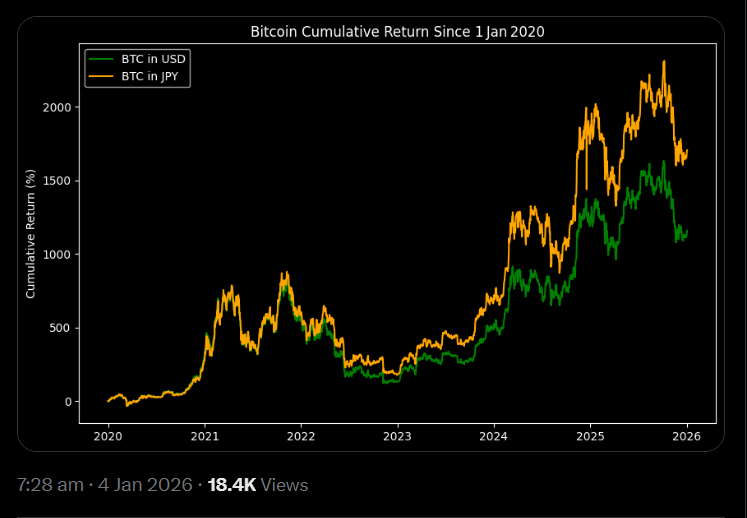
Data indicates that the appreciation of Bitcoin against the U.S. dollar is approximately 1,159% since 2020. Compared to the Japanese yen, the appreciation is higher, standing at 1,704% appreciation, thus indicating the rising discrepancy concerning the appreciation of value in the Japanese currency compared to Bitcoin.

Debt Costs and Treasury Position

As observed by analysts, Metaplanet is servicing a reported coupon of 4.9% with a currency that is constantly depreciating against Bitcoin. This means that the actual costs associated with such payments keep on lowering. This is opposed to the liabilities associated with the cryptocurrency treasuries that service a higher coupon with a stronger currency.

As of data from Bitcoin Treasuries, Metaplanet currently has a total of approximately 35,102 BTC, which makes it one of the top companies that have Bitcoin as a corporate asset. In fact, it recently expanded its holdings by approximately 4,279 BTC through a purchase worth $451 million.

Capital Restructuring to Attract Institutions

In December 2025, Metaplanet affirmed the modification of its capital structure to enhance access to long-term capital. The firm authorized the issuance of dividend-bearing preference stocks. This is in a bid to attract institutional investors.

The director of Bitcoin strategy at the company, Dylan LeClair, has confirmed that investors have approved proposals regarding preferred share issuance and alternative dividend arrangements, as well as possible share repurchase actions by reclassification of capital reserves.

The relevance of Metaplanet’s strategy is because the firm is affected by macroeconomic variables such as the value of Yen against the US dollar. For MetaPlanet, the presence of Yen–dominated liabilities in addition to the growth in the value of Bitcoin presents a paradigm with a unique balance sheet that is quite different from the rest globally.

In this respect, however, the increased Bitcoin reserves and capital structure of Metaplanet also imply a strategic, institutional, and flexible focus. As the cryptocurrency treasury market also grapples with market volatility and valuation challenges, the corporate structure of Metaplanet also signifies the increasing relevance of currency exposure, debt, and capital strategy in cryptocurrency adoption.

Highlighted Crypto News:

‌BTC and ETH Note Upswings as Respective ETFs See Inflows; Tides Turning?

TagsBitcoinbitcoin treasuryBTCmetaplanet

Domande pertinenti

QWhy does Metaplanet benefit from the depreciated Japanese Yen according to the article?

AMetaplanet benefits because it holds Bitcoin as a corporate asset and repays its debts in Japanese Yen. As the Yen depreciates, the real cost of servicing its debt decreases, making it cheaper for the company to pay back its loans.

QWhat is the appreciation of Bitcoin against the Japanese Yen since 2020, as stated in the article?

AThe appreciation of Bitcoin against the Japanese Yen since 2020 is 1,704%.

QHow much Bitcoin does Metaplanet currently hold in its treasury?

AMetaplanet currently holds a total of approximately 35,102 BTC in its treasury.

QWhat recent capital restructuring move did Metaplanet make to attract institutional investors?

AIn December 2025, Metaplanet authorized the issuance of dividend-bearing preference stocks as part of a modification to its capital structure to attract institutional investors.

QAccording to the article, what is one of the major factors pressuring the Japanese Yen?

AOne of the major factors pressuring the Japanese Yen is Japan's high government debt, which is around 250% of its GDP.

Letture associate

Huang Renxun Dramatically 'Saves' South Korean Stock Market

In early June, South Korea's stock market experienced a sharp decline, with the KOSPI index dropping over 5% and triggering a trading halt. Amid this volatility, NVIDIA CEO Jensen Huang's visit to Seoul provided a dramatic boost to market sentiment. During his trip, Huang held a dinner meeting with SK Group Chairman Chey Tae-won and SK Hynix CEO Kwak Noh-Jung. He announced that NVIDIA's new Vera CPU would utilize SK Hynix DRAM and confirmed a multi-year technical collaboration between the two companies. This partnership aims to co-develop next-generation memory for NVIDIA's AI infrastructure roadmap, covering products from data center supercomputers to personal AI devices. Huang also publicly commented that AI company stocks were attractively priced. A key announcement was that NVIDIA's upcoming Vera Rubin AI supercomputer systems will use HBM4 memory, with supply qualifications granted to all three major suppliers: SK Hynix, Samsung Electronics, and Micron Technology. Despite this multi-sourcing strategy, Huang warned that the industry-wide chip shortage, affecting everything from wafers to packaging, is expected to persist for several years due to relentless demand from global AI factory construction. The collaboration extends beyond memory supply. SK Hynix will employ NVIDIA's AI platforms and Omniverse digital twin technology to enhance its own semiconductor design, simulation, and manufacturing processes, aiming for more autonomous factory operations. This visit builds upon a prior October 2025 agreement for SK Group to build a large-scale AI data center using over 50,000 NVIDIA GPUs. Huang's itinerary also included meetings with other Korean giants like Hyundai, LG, and Samsung, indicating NVIDIA's broader strategy to deepen ties with South Korea's tech industry.

链捕手4 h fa

Huang Renxun Dramatically 'Saves' South Korean Stock Market

链捕手4 h fa

When Inference Becomes a Scarce Resource, Who Captures the Value?

When Inference Becomes the Scarce Resource, Who Captures the Value? The core AI bottleneck has shifted from model training to inference (runtime execution). While concerns persisted about an "AI compute gap"—initially a $200B, now a $600B problem—the market is now recognizing that the solution and value lie in the inference layer. Nvidia's financial restructuring around "serving tokens" and Cerebras's successful IPO highlight this shift. Inference is a recurring, usage-based cost, estimated to be 10-50x larger than the one-time training market, especially with the rise of agentic AI. The inference stack spans six layers: silicon (e.g., Nvidia), bare metal (e.g., CoreWeave), GPU rental/aggregation, deployment/optimization, model APIs, and end applications. Most companies operate in one layer. However, Hyperbolic uniquely spans three layers (GPU rental, deployment, and model APIs) without owning any hardware. It aggregates fragmented GPU supply from multiple cloud providers into a standardized pool, offering developers the cheapest available compute through intelligent routing. Its multi-cloud aggregation creates a data moat and a flywheel: more supply leads to better pricing data and liquidity, attracting more developers and providers. In contrast, applications like Venice operate at the top of the stack, reselling privacy-wrapped inference but remaining dependent on and constrained by the underlying compute costs they purchase. As inference demand explodes, value accrues not just to consumer applications but increasingly to the aggregation and routing layer that captures their cost of revenue. The coming potential GPU oversupply reinforces this dynamic. While hardware owners may suffer from depreciation, asset-light aggregators like Hyperbolic benefit from price arbitrage, routing workloads to the cheapest available capacity. The ultimate winner in the inference economy may not be the entity with the most GPUs, but the one that can most efficiently discover, aggregate, and route the world's fragmented compute.

链捕手4 h fa

When Inference Becomes a Scarce Resource, Who Captures the Value?

链捕手4 h fa

Trading

Spot
Futures
活动图片