Meme Wrapped Contracts: Is alt.fun Real Innovation or Pseudo-Demand?

Odaily星球日报Pubblicato 2026-05-18Pubblicato ultima volta 2026-05-18

Introduzione

"Last week, the new Meme token launch platform alt.fun on Hyperliquid gained significant attention. Its flagship token ALT reached a peak market cap of $8.8 million. The platform's novelty lies in combining the mechanics of Pump.fun with leveraged trading on Hyperliquid. When a user creates a Meme token on alt.fun, they must also open a leveraged long/short position (2x, 3x, or 5x) on an underlying asset like HYPE. The platform then mints a corresponding leveraged token (LT) on BounceTech, which represents that perpetual contract position. Essentially, users are trading a tokenized derivative. This creates a dual price driver: the token's value is influenced both by market buying/selling via a bonding curve and by the performance of its underlying leveraged position. Hence the slogan: 'Your token pumps even when nobody's buying.' Tokens 'graduate' to a liquidity pool when their market cap (effectively the LT's value) reaches $9,000, achievable through either mechanism. However, this model faces key challenges. Gains are amplified only in strong, one-directional markets for the underlying asset. In volatile conditions, the mandatory 'rebalancing' of LTs leads to value decay. More fundamentally, alt.fun struggles to foster the community consensus vital for Meme tokens. Investment is driven primarily by price speculation on the underlying asset, not by narrative or cultural appeal. With limited underlying assets, token differentiation is low. The article concludes that while m...

Original | Odaily Planet Daily (@OdailyChina)

Author | Golem (@web3_golem)
Last week, a new Meme launch platform on the Hyperliquid ecosystem called alt.fun attracted significant attention from Meme players. Within just one week of launch, its leading token ALT reached a peak market cap of $8.8 million. Its price has since retraced, with the market cap currently hovering around $6.7 million.

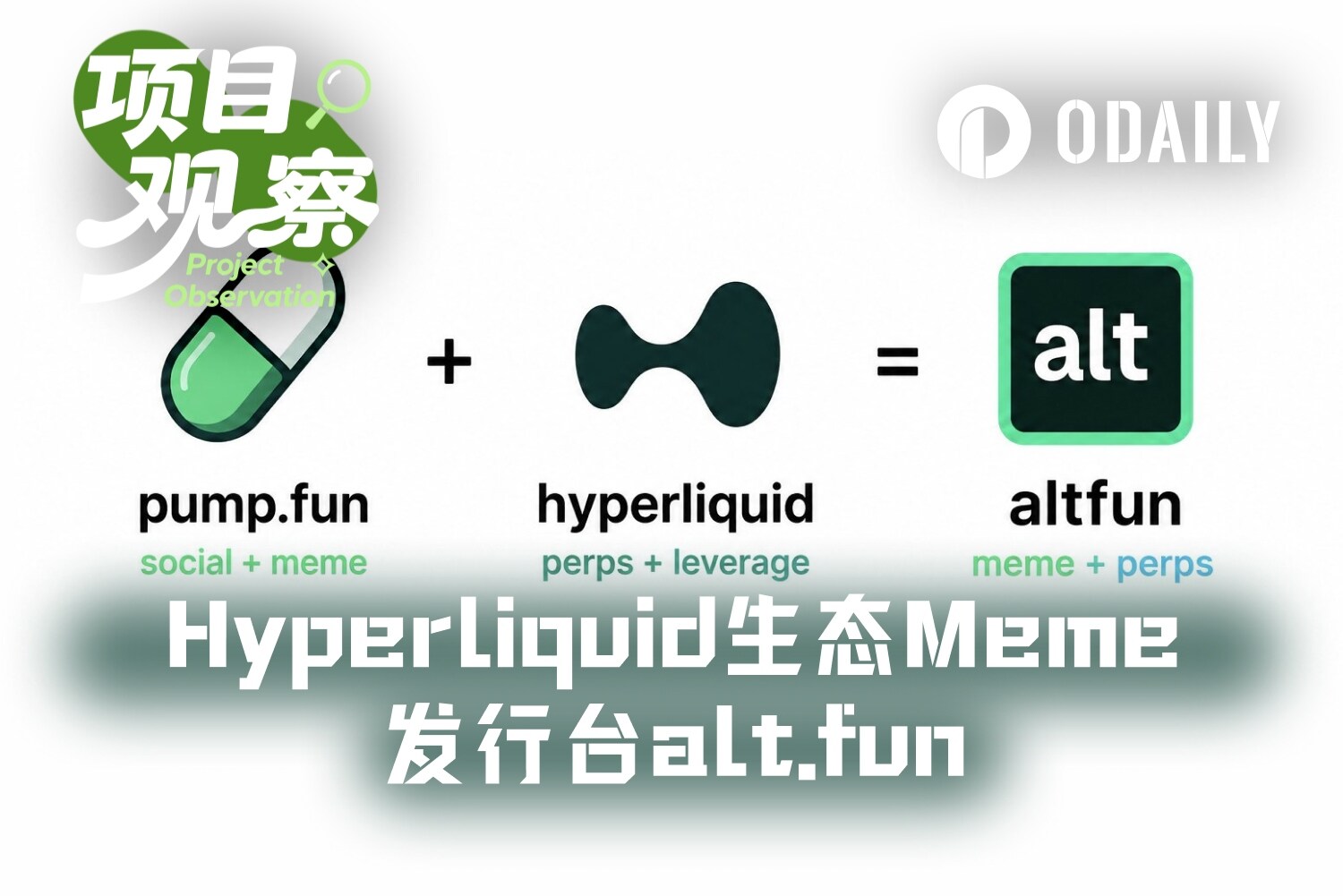
The novelty of alt.fun can be understood as a combination of Pump.fun and Hyperliquid, allowing users on this platform to experience the dual thrill of playing with Memes and opening leveraged contracts simultaneously.

Introduction to the alt.fun Platform Mechanism

Specifically, each Meme token launched on alt.fun has a corresponding contract position on Hyperliquid as its underlying asset.

Similar to Pump.fun, any user can launch a Meme coin on HyperEVM with one click via the alt.fun platform. The token price is still influenced by a bonding curve. The total supply of a created Meme coin is 1 billion tokens. When 75% of the tokens are sold, the token successfully "graduates" and is migrated to the HyperSwap V2 liquidity pool.

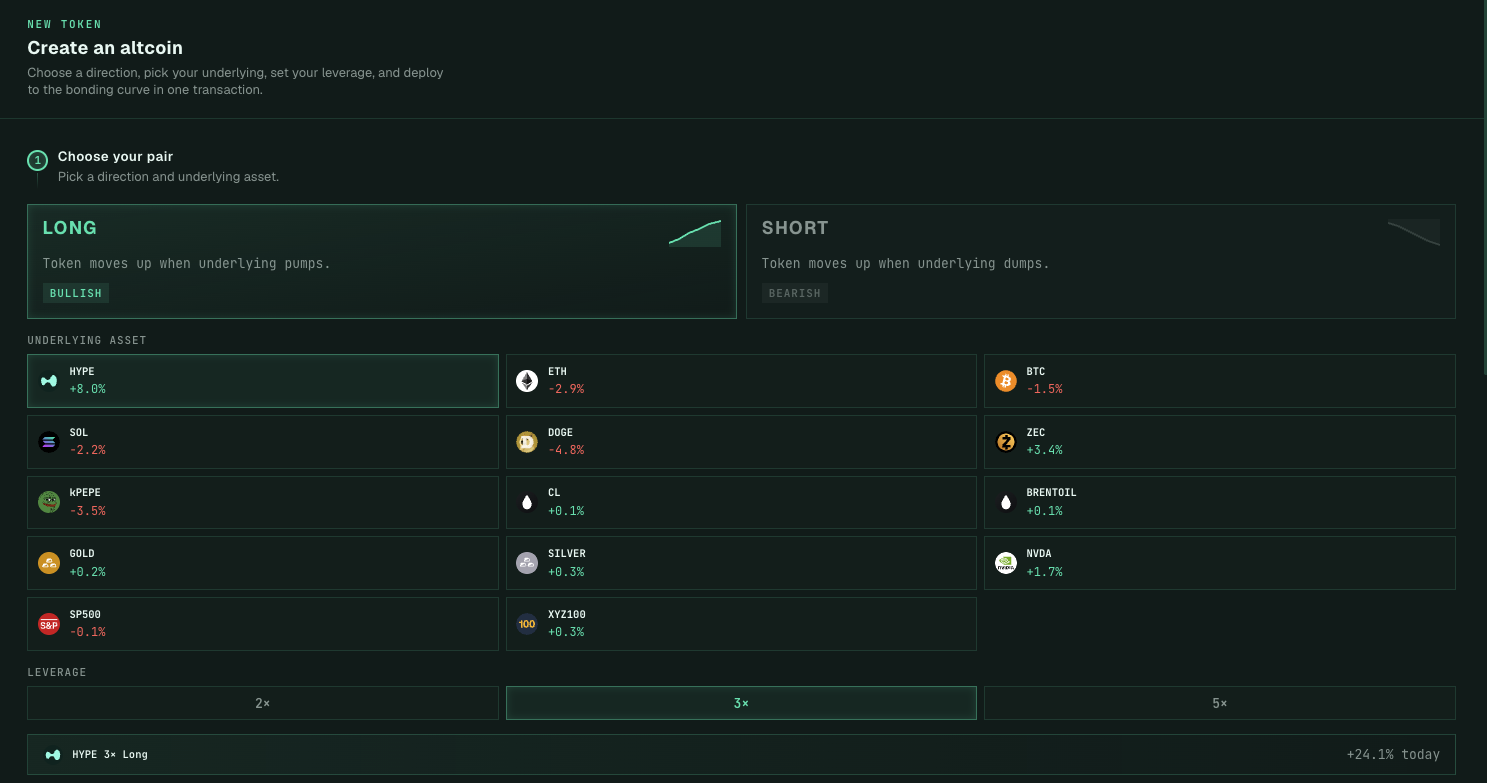
The difference from Pump.fun is that when creating a token on alt.fun, the user also needs to select an underlying asset and specify a leverage level (2x/3x/5x) for a short/long position. At the exact moment of token creation, the platform mints a corresponding amount of Leveraged Tokens (LT) on BounceTech(Odaily note: a permissionless leveraged token platform on Hyperliquid) and sends them to the user. These leveraged tokens represent perpetual contract positions on Hyperliquid. For example, if a user chooses to create a token based on a 3x long HYPE position, what they receive is essentially a leveraged token tracking the returns of a 3x long HYPE position.

As shown in the figure below, currently on alt.fun, users can choose from 14 underlying assets when creating a token. Similarly, when a player buys a Meme coin on this platform, the platform also mints the corresponding leveraged tokens on BounceTech. If a player sells, this process is reversed—the leveraged tokens are redeemed, and the user receives the corresponding USDC.
This model of packaging leveraged tokens as underlying assets and then selling them is similar to the securitization of specific risk exposures like futures and options in traditional finance, such as 3x short Nasdaq ETF, 5x short crude oil products, etc. In this process, the alt.fun platform acts as a role similar to an asset management company, managing the long-term positions behind the leveraged tokens for users.

The core price of such financial products follows the net asset value. However, because the token price on the alt.fun platform is also simultaneously influenced by the Meme coin bonding curve mechanism, the graduation model and price drivers for tokens on this platform are not singular.

Dual Graduation Modes and Price Driving Factors

This also means that token prices on the alt.fun platform are influenced by two factors: first, by market sentiment from buying and selling; second, by the performance of the underlying asset. So now you might understand the meaning of alt.fun's slogan, "Your token pumps even when nobody's buying."

For example, if a user creates a token based on a 3x long HYPE position with an initial investment of $20 (the platform's minimum buy-in size), and subsequently HYPE rises by 10%, then even if no one else buys the token, the user's holding value increases by 30% to $26.

Based on this dual price driver, the graduation model for tokens on the alt.fun platform is also not limited to one method. Specifically, the graduation condition for its tokens is reaching a market cap of $9,000. This essentially calculates the value of the leveraged token. Besides achieving graduation through token purchases, if the token's own value driven by the underlying asset's rise reaches a $9,000 market cap, it can also graduate smoothly. Therefore, whether a token reaches the graduation threshold is often a combined result of both price mechanisms.

Of course, ideally, the underlying asset's rise drives the leveraged token's increase, which, combined with the emotional catalyst from the Meme market, might cause the token's price to spiral upward rapidly. However, once the underlying asset falls, the leveraged token's value continues to shrink, potentially causing market panic and a sell-off, leading to the token's price crashing instantly.

Therefore, although alt.fun's mechanism can effectively leverage amplification effects, this only works in one-directional market trends and requires users to accurately catch the trend. If encountering volatile market conditions for the underlying asset, users must also bear the decay loss from leverage. This is because when the underlying asset price fluctuates, the platform needs to perform "rebalancing" to manage positions to avoid liquidation. This means that even if the underlying asset falls and then recovers to its original price, the leveraged token will suffer losses and gradually depreciate due to forced position reductions during the dip.

Furthermore, in cases of sudden price spikes or flash crashes, the platform might fail to react in time, potentially leading the leveraged token's value to zero.

Meme or not Meme

The alt.fun platform currently has a total of 41 graduated tokens. Only two have a market cap exceeding one million: ALT (based on 5x long HYPE) and STONKS (based on 5x long S&P 500). The total number of users is around just over 1,000. Although alt.fun is still in its early stages, we can already identify its current development bottlenecks.

First, the platform has too few underlying assets. With the current 14 underlying assets, there can be at most 84 different combinations of leveraged tokens. alt.fun has already seen leveraged tokens with the same leverage level (short/long) on the same underlying asset. For instance, the current top token ALT is based on 5x long HYPE, while another token, ATH, with a certain market cap, is also based on 5x long HYPE. Apart from the token name and creation time, there is no difference between them. In that case, why wouldn't an investor buy the lower-market-cap ATH?

Although alt.fun may support more underlying assets in the future, its core pain point is its inability to foster Meme coin community consensus.

The essential reason investors choose to buy leveraged tokens on the alt.fun platform instead of opening leveraged positions directly on Hyperliquid is to obtain greater price leverage and, because the platform manages position rebalancing on the backend, individual users can act as "hands-off managers," not worrying about individual liquidation risks.

But this is also the issue. Investors buying an alt.fun token are essentially doing so based on future price expectations for its underlying asset, not based on narrative, market games, attention—these "meaningless things" that ironically are the core value supporting Memes. A Meme's ability to rise or gain market recognition often isn't due to any actual value backing or financial design behind it; what's more important is its community propagation attribute.

As a Meme player, it's difficult for me to develop a love for a leveraged token similar to the passion for a particular Meme community's culture. If someone truly has faith in the underlying asset of a leveraged token, they might as well issue their own leveraged token rather than buying an existing one and bearing unnecessary premiums.

Therefore, the mechanism of the alt.fun platform appears novel, but in my view, it's merely a mechanical innovation. If alt.fun focuses on developing towards a DeFi platform in the future, there might be an opportunity. However, if it insists on forcing its way into the Meme launch platform track, it is destined to be a flash in the pan.


Crypto di tendenza

Domande pertinenti

QAccording to the article, what is the core innovation of the alt.fun platform and which two platforms does it combine?

AThe core innovation of the alt.fun platform is that it packages leveraged tokens as underlying assets and sells them as meme coins, combining the meme coin launch mechanism of Pump.fun with the perpetual contract (leveraged trading) functionality of Hyperliquid.

QWhat are the two main factors that drive the price of a meme coin on the alt.fun platform?

AThe price of a meme coin on the alt.fun platform is driven by two main factors: 1) Market sentiment and buying/selling pressure on the meme coin itself (via the bonding curve). 2) The performance of the underlying asset that the coin's leveraged token is tracking (e.g., if the coin is based on a 5x long position on HYPE, its value is affected by HYPE's price movement).

QWhat is one of the key risks or disadvantages mentioned regarding the alt.fun leveraged token model, especially in volatile market conditions?

AA key risk is the potential for "leverage decay." In volatile or choppy market conditions where the underlying asset price fluctuates up and down, the platform must perform "rebalancing" to manage the leveraged position. This process can cause the leveraged token to slowly lose value over time, even if the underlying asset's price eventually returns to its original level.

QWhat is identified in the article as the core dilemma or fundamental weakness of alt.fun's approach to being a meme coin platform?

AThe core weakness is that alt.fun's model lacks the ability to build true meme coin community consensus. Investors buy these tokens primarily based on price expectations for the underlying financial asset, not for the narrative, cultural elements, or community hype that are essential to sustaining a successful meme coin. It's more of a packaged financial product than a true community-driven meme.

QWhat are the two conditions under which a meme coin on alt.fun can 'graduate' (be successfully launched into a liquidity pool)?

AA meme coin on alt.fun graduates when its market capitalization reaches $9,000. This can happen in two ways: 1) Through purchases on the bonding curve, which increases the token's price and market cap. 2) Through the increase in value of the underlying leveraged token itself, driven by favorable price movement of the underlying asset, even without new buyers on the bonding curve.

Letture associate

Base Under Pressure

**Title: The Pressure Mounts for Base** Base, the Ethereum Layer 2 scaling solution backed by Coinbase, is facing significant pressure and public scrutiny from its leadership following the launch of Robinhood Chain. Base co-founder Jesse Pollak recently acknowledged strategic missteps, admitting that the chain's past focus on social and creator tokens (e.g., through Farcaster, Zora) failed to deliver sustainable adoption. He has refocused on core infrastructure, handing leadership of the Base App back to Coinbase's Cobie. While Base remains a top L2 contender alongside OP Mainnet and Arbitrum, and boasts the highest TVL (nearly $12B), its weaknesses are being highlighted by the new competitor. Key criticisms include its slow progress on decentralization. Base has faced issues with its single sequencer causing block production halts, and L2BEAT is reportedly considering downgrading its decentralization rating from Stage 1 to Stage 0. This contrasts sharply with the rapid initial success of Robinhood Chain, whose DEX quickly entered the top five by volume. The leadership styles of the parent companies are also being compared: Robinhood's CEO actively engages with new projects, while a recent incident where Coinbase's Brian Armstrong briefly changed his profile picture—sparking and then crashing a related meme token—drew community ire and mockery. Pollak stated Base is working with Coinbase on tokenized stocks backed 1:1 by real equity, differentiating it from Robinhood's derivatives model. However, the article argues that Base's most urgent task is to address its long-standing technical and trust issues. With more traditional finance players likely to emulate Robinhood's path, Base must use this competitive pressure to solidify its position as long-term financial infrastructure.

Foresight News13 min fa

Base Under Pressure

Foresight News13 min fa

White House Concession Removes Ethical Hurdle, Clarity Act Races Against Final Window Before Recess?

On July 21st, industry sources reported that the Trump administration has agreed to include an ethics provision in the "Clarity Act" (Digital Asset Market Clarity Act of 2025). This concession addresses the long-standing conflict-of-interest concerns regarding government officials and the crypto industry, potentially removing the final major obstacle to the bill's progress. Additionally, Patrick Witt, the executive director of the White House's Digital Asset Advisory Committee, confirmed he will remain in his role to help finalize the bill, alleviating previous concerns about his potential departure. The Clarity Act aims to establish a unified federal regulatory framework for the U.S. digital asset market. Its core objective is to resolve regulatory ambiguity by defining different types of digital assets (digital commodities, investment contract assets, and permitted payment stablecoins) and clarifying the respective oversight roles of the SEC and CFTC. This would end the long-running jurisdictional dispute between the two agencies and provide clearer compliance paths for the industry. With the ethics issue moving toward resolution, the most urgent challenge now is time. The U.S. Congress is set to begin its August recess in mid-August, leaving only a few working weeks to finalize the text and advance the bill through the Senate. Industry advocates, like the Blockchain Association's Kristin Smith, stress that this is a critical moment. If negotiations conclude successfully in the coming weeks, the Clarity Act could pass a key hurdle before the recess; otherwise, it may face significant delays. If enacted, the Clarity Act could mark a historic turning point in crypto regulation. By providing a clearer and more predictable legal framework, it aims to reduce uncertainty for businesses, developers, and traditional financial institutions looking to enter the digital asset space, potentially setting a global benchmark for market structure regulation.

Odaily星球日报18 min fa

White House Concession Removes Ethical Hurdle, Clarity Act Races Against Final Window Before Recess?

Odaily星球日报18 min fa

AI Era, Industrial Revolution, and Future Civilization Interview — Zhang Dingwen: The Future Does Not Belong to Chasers

"AI Era, Industrial Revolution and Future Civilization: An Interview with Zhang Dingwen – The Future Does Not Belong to Those Who Chase" In this interview, entrepreneur Zhang Dingwen reflects on his entrepreneurial journey and philosophy, moving beyond discussions of financing or success to emphasize understanding the "era" itself. He argues that true entrepreneurs should not chase short-term trends ("winds"), but position themselves in the direction of long-term technological and societal evolution. Zhang shares key lessons from his early days, including the realization that user value does not automatically translate to commercial value. For him, the core of entrepreneurship is not building a company but constantly upgrading one's own "cognition" – the ability to interpret information, ask the right questions, and understand the underlying "causes" behind business outcomes, not just the effects. His thinking has evolved from a focus on creating good products to a strategic focus on building "entrances" – platforms that naturally connect users to digital services. He sees smart wearables, like watches, not merely as hardware but as potential future gateways combining technological, financial, social, and even fashion attributes to create sustained user relationships and ecosystems. Ultimately, Zhang's vision transcends individual products or companies. He discusses business competition in three stages: product, platform, and finally, "civilization" – where the greatest companies influence how society operates by defining new rules and ways of life. He believes the mission of a truly great enterprise is to solve problems of its time, build enduring trust, and contribute lasting value, leaving behind not just wealth but a positive impact on how the world works. The future, he concludes, belongs not to the fastest, but to those with the correct long-term direction and a commitment to continuous learning and evolution.

marsbit30 min fa

AI Era, Industrial Revolution, and Future Civilization Interview — Zhang Dingwen: The Future Does Not Belong to Chasers

marsbit30 min fa

Cryptocurrency & Stock Market Barometer丨Strategy Cash Reserves Increase to $3.23 Billion, Halting BTC Purchases; Vanguard and Other Asset Managers Increase Holdings in Strategy Stock (July 21)

Market Overview & Warnings: The article warns of high volatility in South Korean stocks and continued dependence on U.S. stocks on geopolitics. Chinese A-shares remain under pressure. It advises against using leverage in current equity markets. For crypto-linked stocks, most have limited growth except Robinhood, with caution advised. U.S. Stock Market: Bearish bets on U.S. stocks, particularly targeting AI-related companies, have reached record highs since 2010, signaling deep skepticism about the sustainability of the AI-driven rally. Tech and chip stocks led a market decline, with the Philadelphia Semiconductor Index potentially entering a bear market. Increased expectations for Federal Reserve interest rate hikes and geopolitical tensions contributed to the negative sentiment. Bitcoin Treasury Company Updates: * Strategy: Increased its cash reserves to $3.23 billion and paused Bitcoin purchases. Several major asset managers, including Vanguard Group and Capital Group, increased their holdings of Strategy (MSTR) stock. * Global corporate Bitcoin buying slowed significantly to just $1.33 million last week. * Other notable activity: Strive purchased 21 BTC; ORANGE JUICE raised $40 million for Bitcoin acquisitions; Bitcoin Japan Corp. raised $60 million, allocating $4.08 million for its first BTC purchase. Other Crypto Treasury Holdings: * Ethereum: BitMine increased its ETH holdings to 5.78 million, nearing its 5% of supply goal. Its total crypto assets, cash, and securities are valued at $11.5 billion. * Solana: No significant corporate treasury activity reported. * Altcoins: HypeStrat made no adjustments to its treasury; its mNAV ratio fell to a long-term low. (Note: This summary is for informational purposes only and does not constitute investment advice.)

marsbit30 min fa

Cryptocurrency & Stock Market Barometer丨Strategy Cash Reserves Increase to $3.23 Billion, Halting BTC Purchases; Vanguard and Other Asset Managers Increase Holdings in Strategy Stock (July 21)

marsbit30 min fa

Trading

Spot

Articoli Popolari

Cosa è MEME 2.0

Memecoin 2.0: L'Ascesa di $MEME 2.0 nel Mondo delle Criptovalute Introduzione Nel panorama in continua evoluzione delle criptovalute, è emerso un nuovo contendente. Memecoin 2.0, simboleggiato come $MEME 2.0, porta il concetto di meme coin a un livello emozionante. Come prodotto derivato dal Memecoin originale, questo progetto ha catturato l'attenzione della comunità crypto spostando il focus da incentivi finanziari tipici a un'esperienza coinvolgente e divertente. Operando sulla blockchain di Ethereum, Memecoin 2.0 ridefinisce audacemente l'impegno della comunità nella sfera crypto. Che cos'è Memecoin 2.0, $MEME 2.0? Alla base, Memecoin 2.0 è un progetto di criptovaluta che dà priorità allo spirito di comunità e al divertimento associato alla cultura meme. A differenza delle criptovalute convenzionali, che si concentrano su casi d'uso pratici e benefici tangibili, Memecoin 2.0 si distingue abbracciando il lato più leggero della moneta digitale. Il progetto esiste senza promesse di utilità, una roadmap strutturata o ritorni finanziari, concentrandosi invece sulla creazione di una comunità vibrante incentrata sui meme e sul divertimento condiviso. Facendo così, attinge alla crescente tendenza della cultura meme nello spazio online, rendendola un giocatore unico nel mondo degli asset digitali. Creatore di Memecoin 2.0, $MEME 2.0 Nonostante ricerche approfondite sulle origini di Memecoin 2.0, l'identità esplicita del suo creatore rimane sconosciuta. Questa anonimità non è rara nella comunità crypto, dove molti progetti sono guidati da individui o gruppi che preferiscono rimanere dietro le quinte. La mancanza di informazioni pubblicamente disponibili sul creatore potrebbe essere vista come una mossa strategica, mettendo in evidenza l'impegno della comunità piuttosto che la notorietà individuale all'interno dello spazio. Investitori di Memecoin 2.0, $MEME 2.0 Le informazioni riguardanti gli investitori o il supporto finanziario per Memecoin 2.0 sono scarse. Questa assenza di dettagli potrebbe suggerire che il progetto sia autofinanziato o che il suo focus sulla comunità piuttosto che sulle strutture d'investimento tradizionali abbia attratto un tipo diverso di sostenitore. Poiché il mondo delle meme coin coinvolge tipicamente un maggior coinvolgimento di base piuttosto che investimenti istituzionali, questo approccio si allinea con l'etica dei progetti guidati dalla comunità. Come funziona Memecoin 2.0, $MEME 2.0? Memecoin 2.0 opera interamente sulla blockchain di Ethereum, capitalizzando le sue robuste caratteristiche di sicurezza e scalabilità. Sfruttando i punti di forza di Ethereum, Memecoin 2.0 può offrire un ambiente sicuro per le interazioni degli utenti garantendo che le transazioni siano sia efficienti che convenienti. Uno degli attributi unici di Memecoin 2.0 risiede nella sua struttura guidata dalla comunità. Il valore e la popolarità del token $MEME 2.0 derivano dalla partecipazione attiva dei suoi utenti, piuttosto che dalla utilità intrinseca. Questo design rinforza il focus del progetto sull'aspetto dell'intrattenimento delle criptovalute, implicando che la risata e l'impegno della comunità siano le vere monete che guidano il suo successo. Inoltre, il progetto si inserisce all'interno dell'ecosistema più ampio delle meme coin, dove il valore di ciascuna meme coin oscilla in base alla cultura, alle tendenze e all'impegno della comunità piuttosto che ai principi economici tradizionali. Cronologia di Memecoin 2.0, $MEME 2.0 Per comprendere meglio l'evoluzione e le pietre miliari di Memecoin 2.0, ecco una cronologia che evidenzia eventi significativi nella sua storia: 2024: L'inizio di Memecoin 2.0 è riconosciuto come un ramo del Memecoin originale, affermandosi all'interno del contesto fiorente delle meme coin mentre opera sulla blockchain di Ethereum. 13 luglio 2024: Memecoin 2.0 si posiziona ufficialmente come una meme coin incentrata sulla comunità sulla rete Ethereum, enfatizzando il suo approccio centrato sull'intrattenimento che invita gli utenti a impegnarsi e partecipare alla sua crescita. Punti Chiave su Memecoin 2.0, $MEME 2.0 Diverse caratteristiche critiche definiscono Memecoin 2.0: Approccio Centrico alla Comunità: La missione principale di Memecoin 2.0 è creare un'esperienza comunitaria divertente e coinvolgente, capitalizzando il piacere collettivo derivante dalla cultura memetica. Costruita su Ethereum: Operare sulla blockchain di Ethereum fornisce al progetto un'infrastruttura essenziale che garantisce sicurezza e scalabilità. Mancanza di Utilità o Roadmap: In una marcata deviazione dalle criptovalute tradizionali, Memecoin 2.0 non promette alcuna caratteristica utilitaria o ritorni finanziari, riaffermando il suo impegno per il coinvolgimento della comunità e l'impegno sociale. Focus sulla Cultura Memetica: Abbracciando gli aspetti umoristici e culturali del fenomeno meme, Memecoin 2.0 offre una piattaforma per gli utenti per interagire con la crypto offline e online. Ulteriore Contesto: L'Importanza delle Meme Coin Le meme coin sono emerse come una classe distinta di criptovaluta, spesso guidata dall'umorismo e da un approccio spensierato al trading. Queste monete generalmente mancano di significative utilità o roadmap di sviluppo, attirando gli utenti con la promessa di divertimento, interazione comunitaria e rilevanza culturale. Nel panorama del più ampio ecosistema crypto, le meme coin rianimano l'importanza dell'impegno della comunità, opponendosi ad approcci esclusivamente orientati al profitto. Progetti come Memecoin 2.0 danno il via a un'era in cui l'intrattenimento può armonizzarsi con le aspirazioni finanziarie, trasformando la blockchain in un parco giochi per la creatività e l'interazione sociale. Conclusione Memecoin 2.0, o $MEME 2.0, incarna una nuova ondata di criptovaluta che dà priorità all'impegno della comunità rispetto a rigidi strutture finanziarie. Con un focus sull'umorismo e l'interazione sociale, capitalizza sulla fascinazione circondante la cultura meme. Operando sulla blockchain di Ethereum, Memecoin 2.0 sfrutta le capacità della tecnologia mantenendo fermo il suo impegno per il valore ricreativo della valuta digitale. Mentre lo spazio delle criptovalute continua a evolversi, Memecoin 2.0 serve come testimonianza della nozione che il futuro degli asset digitali potrebbe ben dipendere da esperienze condivise, risate e solidi legami comunitari. Nel mondo imprevedibile delle crypto, forse la gioia può essere altrettanto preziosa quanto il guadagno finanziario tradizionale.

132 Totale visualizzazioniPubblicato il 2024.04.04Aggiornato il 2024.12.03

Cosa è MEME 2.0

Come comprare MEME

Benvenuto in HTX.com! Abbiamo reso l'acquisto di Memeland (MEME) semplice e conveniente. Segui la nostra guida passo passo per intraprendere il tuo viaggio nel mondo delle criptovalute.Step 1: Crea il tuo Account HTXUsa la tua email o numero di telefono per registrarti il tuo account gratuito su HTX. Vivi un'esperienza facile e sblocca tutte le funzionalità,Crea il mio accountStep 2: Vai in Acquista crypto e seleziona il tuo metodo di pagamentoCarta di credito/debito: utilizza la tua Visa o Mastercard per acquistare immediatamente MemelandMEME.Bilancio: Usa i fondi dal bilancio del tuo account HTX per fare trading senza problemi.Terze parti: abbiamo aggiunto metodi di pagamento molto utilizzati come Google Pay e Apple Pay per maggiore comodità.P2P: Fai trading direttamente con altri utenti HTX.Over-the-Counter (OTC): Offriamo servizi su misura e tassi di cambio competitivi per i trader.Step 3: Conserva Memeland (MEME)Dopo aver acquistato Memeland (MEME), conserva nel tuo account HTX. In alternativa, puoi inviare tramite trasferimento blockchain o scambiare per altre criptovalute.Step 4: Scambia Memeland (MEME)Scambia facilmente Memeland (MEME) nel mercato spot di HTX. Accedi al tuo account, seleziona la tua coppia di trading, esegui le tue operazioni e monitora in tempo reale. Offriamo un'esperienza user-friendly sia per chi ha appena iniziato che per i trader più esperti.

323 Totale visualizzazioniPubblicato il 2024.12.12Aggiornato il 2026.06.02

Come comprare MEME

Discussioni

Benvenuto nella Community HTX. Qui puoi rimanere informato sugli ultimi sviluppi della piattaforma e accedere ad approfondimenti esperti sul mercato. Le opinioni degli utenti sul prezzo di MEME MEME sono presentate come di seguito.

活动图片