Meme Wrapped Contracts: Is alt.fun Real Innovation or a Pseudo-Need?

marsbitPubblicato 2026-05-18Pubblicato ultima volta 2026-05-18

Introduzione

A new platform called alt.fun on Hyperliquid has gained attention by merging meme coin creation with leveraged futures trading. Unlike typical meme platforms like Pump.fun, alt.fun requires creators to select an underlying asset (like HYPE or S&P 500) and a leverage level (2x, 3x, or 5x) to take a long or short position. The issued meme token is directly linked to a corresponding leveraged token (LT) on BounceTech, which represents that perpetual contract position. This means the token's price is driven by both the standard bonding curve (community buying/selling) and the performance of its leveraged underlying asset, allowing value to increase even without new purchases. The platform's "graduation" to a DEX pool requires a市值 of $9,000, achievable through market demand or underlying asset growth. While this mechanism can amplify gains in trending markets, it also introduces significant risks from asset volatility, leverage decay during rebalancing, and potential liquidation during sharp price moves. Despite early traction—with its top token ALT reaching an $8.8M market cap—alt.fun faces challenges. Its limited selection of 14 underlying assets constrains variety, leading to tokens with identical financial profiles. More fundamentally, critics argue it misunderstands the meme coin ethos: its tokens are primarily financial instruments tied to asset performance, lacking the community-driven narratives and cultural appeal essential for sustaining meme coin value. The article co...

Original | Odaily Planet Daily (@OdailyChina)

Author | Golem (@web3_golem)
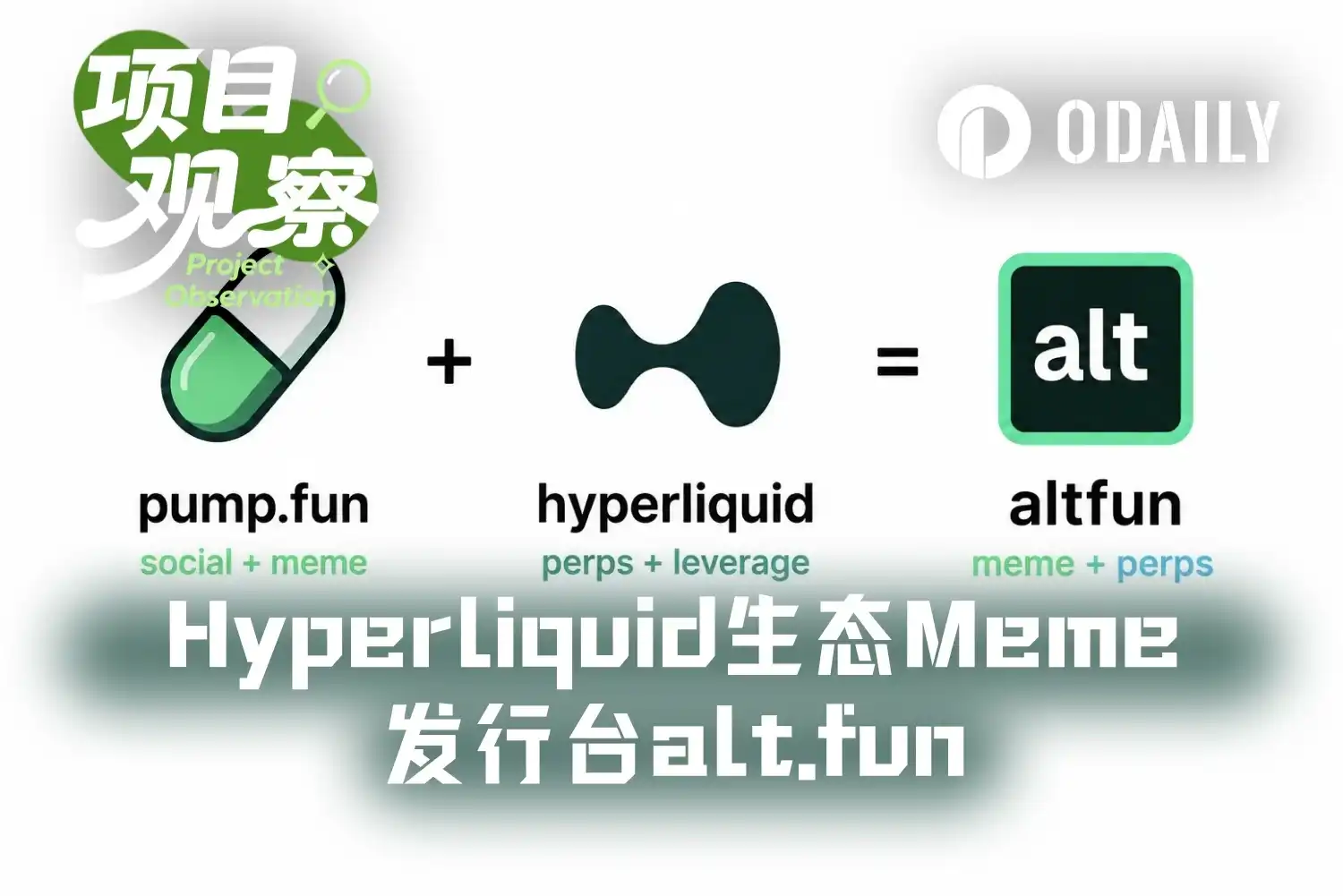
Last week, a new Meme issuance platform named alt.fun in the Hyperliquid ecosystem garnered significant attention from Meme players. Within just one week of launch, its leading token ALT reached a peak market cap of $8.8 million, with the current price having retraced, maintaining a market cap around $6.7 million.

The novelty of alt.fun can be understood as a combination of Pump.fun and Hyperliquid, where users can simultaneously experience the dual thrill of playing with Memes and opening contracts.

Introduction to the alt.fun Platform Mechanism

Specifically, each Meme token issued on alt.fun has a corresponding contract position matched on Hyperliquid at its core.

Similar to Pump.fun, any user can issue a Meme coin with one click on HyperEVM through the alt.fun platform. The token price is still influenced by a bonding curve. The total supply of the created Meme coin is 1 billion tokens, and when 75% of the tokens are sold, the token successfully "graduates" and is migrated to a HyperSwap V2 liquidity pool.

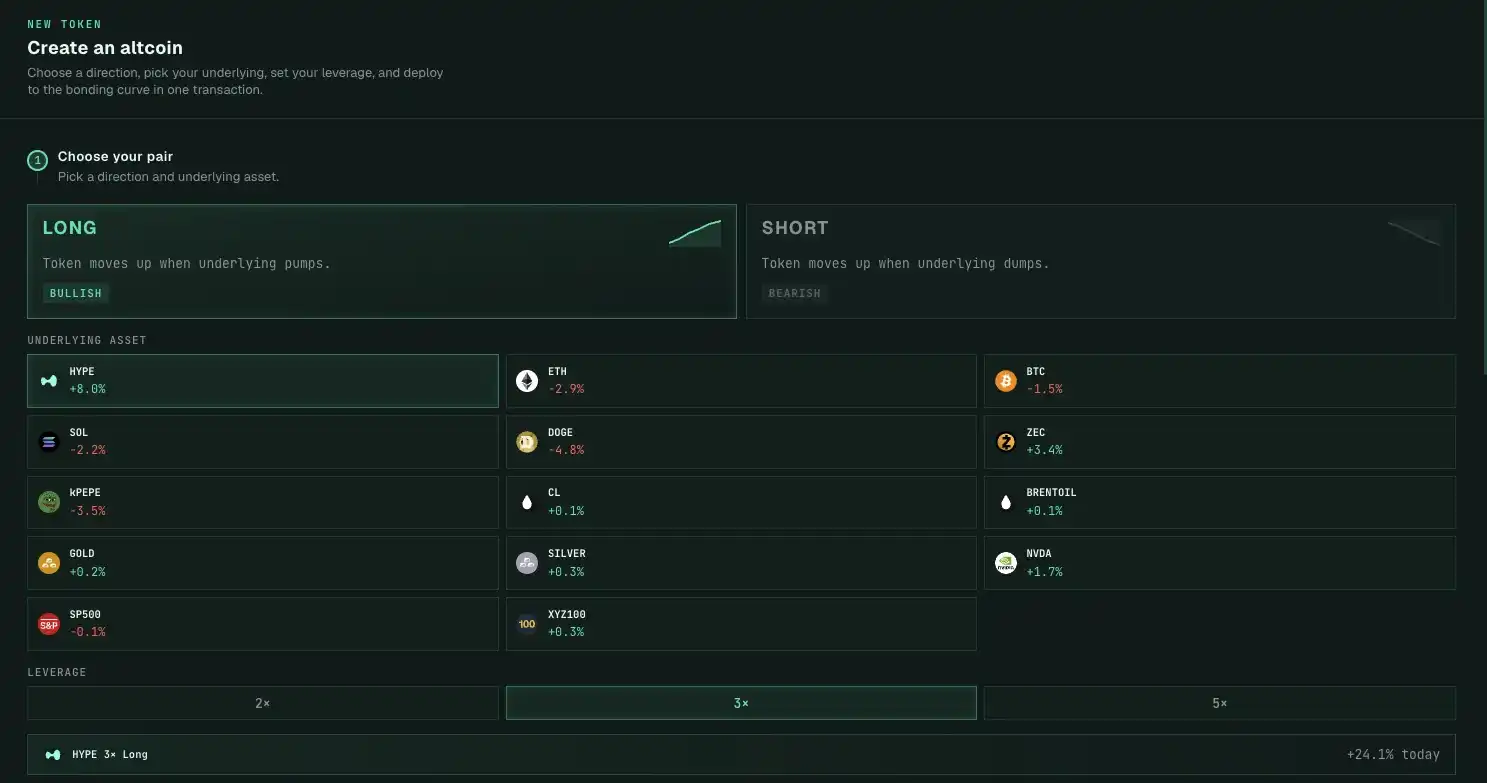
The difference from Pump.fun is that when creating a token on alt.fun, users also need to select an underlying asset and choose a limited leverage multiple (2x/3x/5x) to go short/long. At the same moment of token creation, the platform mints a corresponding amount of leveraged tokens (LT) on BounceTech(Odaily note: a permissionless leveraged token platform on Hyperliquid) and sends them to the user. This leveraged token corresponds to establishing a perpetual contract position on Hyperliquid. For example, if a user chooses to create a token based on a 3x long position on HYPE, what they receive is essentially a leveraged token that tracks the gains of a 3x long HYPE position.

As shown in the figure below, currently on alt.fun, users can choose from 14 types of underlying assets when creating a token. Similarly, when players buy Meme coins on this platform, the platform also mints corresponding leveraged tokens on BounceTech. If a player sells, this process is reversed—the leveraged token is redeemed, and the user receives the corresponding USDC.
This model of packaging and then selling leveraged tokens as underlying assets is similar to the securitization of specific risk exposures like futures and options in traditional finance, such as 3x inverse Nasdaq ETFs or 5x inverse crude oil products. In this process, the alt.fun platform acts like an asset management company, managing the long-term positions behind the leveraged tokens for users.

The price of such financial products primarily follows the net asset value. However, since the token price issued by the alt.fun platform is also simultaneously influenced by the bonding curve mechanism of Meme coins, the graduation mode and price drivers of tokens on this platform are not singular either.

Dual Graduation Modes and Price Drivers

This means that the price of tokens on the alt.fun platform is influenced by two factors: one is market sentiment driven by buying and selling, and the other is the performance of the underlying asset. So now you might understand what alt.fun's slogan "Your token pumps even when nobody's buying" means.

For instance, if a user creates a token based on a 3x long HYPE position with an initial investment of $20 (the platform's minimum buy-in size), and subsequently HYPE rises by 10%, then even if no one buys the token, the user's holding value increases by 30% to $26.

Based on this dual driver of price, the token graduation mode on the alt.fun platform is not limited to one method either. Specifically, its token graduation condition is reaching a market cap of $9,000, which essentially calculates the value of the leveraged token. Besides achieving graduation through buying tokens, if the token itself reaches a market cap of $9,000 due to the rise of its underlying asset, it can also graduate successfully. Therefore, whether a token reaches the graduation threshold is often a combined result of the two pricing mechanisms.

Of course, ideally, a rise in the underlying asset drives up the leveraged token, and combined with the emotional catalysis of the Meme market, the token might soar step by step. But once the underlying asset falls, the value of the leveraged token continuously shrinks, the market might panic-sell, and the token price could potentially crash instantly.

Thus, while alt.fun's mechanism can effectively leverage amplification effects, this only works in a one-sided market trend and requires users to accurately time the trend. If encountering volatile conditions in the underlying asset, users also have to bear leverage decay losses. This is because when the underlying asset price fluctuates, the platform needs to perform "rebalancing" to manage positions to avoid liquidation. This means that even if the underlying asset drops and then recovers, the leveraged token will suffer depreciation due to forced position reduction during the decline.

Moreover, in the case of wick or flash crash events, the platform might fail to react in time, potentially leading the leveraged token value to zero.

Meme or not Meme

Currently, the alt.fun platform has a total of 41 graduated tokens, with only two having a market cap exceeding one million: ALT (based on 5x long HYPE) and STONKS (based on 5x long S&P 500). The total number of users is around over 1,000. Although alt.fun is still in its early stages, we can also discern its current development bottlenecks from this.

First, the platform has too few underlying assets. Based on the current 14 types of underlying assets, there can be at most 84 different combinations of leveraged tokens. alt.fun has already seen leveraged tokens with the same leverage multiple shorting/longing the same underlying asset. For example, the current highest token ALT is based on 5x long HYPE, while another token with the ticker ATH is also based on 5x long HYPE. Apart from the token name and creation time, there is no difference between the two. If so, why wouldn't investors buy the lower market cap ATH?

Although alt.fun may support more underlying assets in the future, its core pain point is its inability to coalesce Meme coin community consensus.

The fundamental reason investors choose to buy leveraged tokens on the alt.fun platform instead of opening leverage directly on Hyperliquid themselves is essentially to gain greater price leverage. Moreover, because the platform manages position rebalancing in the backend for users, individual users can be "hands-off landlords," not having to worry about individual liquidation risks.

But this is also the problem. Investors buying an alt.fun token are essentially still basing their decision on future price expectations for its underlying asset, rather than on narratives, market games, or attention—these "meaningless things" are precisely what support the core value of a Meme. A Meme's ability to rise or gain market recognition is often not due to any practical value backing or financial design behind it; more importantly, it's the community propagation attribute.

As a Meme player, it's difficult for me to develop a love for a leveraged token similar to the affection for a particular Meme's community culture. If one truly has conviction in the underlying asset of a leveraged token, it might be better to issue one's own leveraged token rather than buy an existing one and bear unnecessary premiums.

Therefore, while the mechanism of the alt.fun platform appears novel, in my eyes, it's merely a mechanical innovation. If alt.fun pivots towards developing as a DeFi platform in the future, there might still be opportunities. But if it insists on forcefully entering the Meme issuance platform track, it is destined to be a flash in the pan.


Domande pertinenti

QWhat is the core innovation of the alt.fun platform as described in the article?

AThe core innovation is combining a Meme token launchpad (similar to Pump.fun) with leveraged perpetual contracts on Hyperliquid. Each Meme token created on alt.fun has an underlying leveraged token position on Hyperliquid, allowing token value to be influenced by both market buying/selling and the performance of the chosen leveraged asset.

QAccording to the article, what is one major drawback or criticism of the alt.fun model?

AA major drawback is its perceived inability to build genuine Meme community consensus. The token's value is fundamentally tied to the performance of a leveraged financial product rather than narrative, culture, or community hype, which are considered the true drivers of Meme value. It risks being a 'mechanical innovation' lacking the social dynamics essential for Meme success.

QHow can a token on alt.fun 'graduate' or be considered successful besides being bought by others?

AA token can graduate if its market capitalization (calculated as the value of the underlying leveraged tokens) reaches $9,000. This can happen not only through direct purchases but also if the value of the underlying leveraged position increases significantly due to favorable price movement of the base asset (e.g., HYPE or S&P 500).

QWhat role does the BounceTech platform play in the alt.fun ecosystem?

ABounceTech is the permissionless leveraged token platform on Hyperliquid. When a user creates or buys a Meme token on alt.fun, the platform mints a corresponding leveraged token (LT) on BounceTech and sends it to the user. This LT represents a perpetual contract position on Hyperliquid. Selling the Meme token reverses the process, redeeming the LT for USDC.

QWhat potential risks does an investor face when holding a token from alt.fun?

AInvestors face several risks: 1) Exposure to the high volatility and potential liquidation of the underlying leveraged position. 2) Leverage decay during volatile or sideways markets due to mandatory 'rebalancing' of the position, which can erode value. 3) The risk of the leveraged token's value going to zero during extreme market events like a flash crash. 4) The premium paid for the Meme token layer on top of the leveraged token's intrinsic value.

Letture associate

Claude Code Introduces Dynamic Workflows: Enabling AI to Form Teams and Collaborate

Claude Code introduces dynamic workflows, enabling AI to coordinate teams of specialized agents for complex tasks. This transforms Claude from a code assistant into a programmable workbench. Workflows address key limitations of single-agent systems: agentic laziness (premature task completion), self-preferential bias (favoring own outputs), and goal drift (losing sight of original objectives). The system allows Claude to dynamically create execution frameworks using JavaScript. It can split tasks, dispatch parallel agents for isolated work (e.g., in separate worktrees), implement adversarial validation, run tournaments, and synthesize results. This multi-agent approach is valuable for tasks requiring deep research, factual verification, code migration, root cause analysis, large-scale triage, and qualitative sorting. Key patterns include: classify-and-route, fan-out-and-synthesize, adversarial verification, generate-and-filter, tournaments, and loop-until-done. While token usage is higher, workflows excel where tasks resemble programming—needing problem decomposition, isolated context, hypothesis testing, and handling many details. They extend Claude Code's utility beyond technical work to areas like business plan review, resume screening, and naming brainstorm. The feature is not a universal solution but points to a future where AI tool competitiveness depends on organizing reliable, reusable, and auditable execution flows for complex goals.

marsbit35 min fa

Claude Code Introduces Dynamic Workflows: Enabling AI to Form Teams and Collaborate

marsbit35 min fa

Hyperliquid, Wall Street's 24/7 Trading Convenience Store

Hyperliquid: The 24/7 Trading "Convenience Store" for Wall Street Hyperliquid, a decentralized cryptocurrency exchange, has become a go-to platform for Wall Street traders seeking to trade around the clock, especially during traditional market closures. Founded by Jeff Yan, a former quantitative trader, after the FTX collapse, the platform emphasizes user self-custody of assets. It offers a wide range of perpetual contracts—leveraged derivatives with no expiry—on assets from Bitcoin and crude oil to the S&P 500 and even pre-IPO companies like SpaceX. A notable example involves a hedge fund trader who capitalized on geopolitical news over a weekend, securing a 243% return on oil derivatives before markets reopened. The platform, run by just 11 employees, generated approximately $800 million in revenue last year, and its native token HYPE has seen significant growth. Its rise highlights the merging of traditional finance and crypto. While U.S. users are currently restricted, recent CFTC rule changes could open access. The platform is known for its transparency, having processed $10 billion in liquidations during a market crash while competitors faltered. Regulators warn of the high risks and complexity of perpetual contracts for retail investors. Key to its appeal is a strong community culture, direct engagement with founders, and a simple interface. Despite rules against VPN use, it attracts global users with its permissionless approach. Hyperliquid plans to expand into prediction markets and options, aiming to eventually host all financial activity.

marsbit35 min fa

Hyperliquid, Wall Street's 24/7 Trading Convenience Store

marsbit35 min fa

Who Funds the Agents?

**Summary: Who Funds AI Agents?** OpenAI recently shut down a feature allowing AI agents to shop for users, highlighting the challenge of creating a secure and regulated environment for agent-driven transactions. While payment infrastructure exists, a crucial governance layer—defining spending limits, fraud detection, tax handling, and return policies—is largely missing. The potential is enormous: AI agents already processed $73M across 176M transactions last year, with McKinsey forecasting this could grow to $3-5T in global consumer commerce by 2030. The core competition isn't just about processing payments, which can be very cheap (especially with crypto-based settlement), but about controlling the rules that govern agent spending. Key players like Stripe and Coinbase are racing to dominate this governance layer. Stripe's acquisition of wallet provider Privy allows it to set spending policies, identity checks, and human-in-the-loop approvals directly at the wallet level. Similarly, Coinbase's stack, including its x402 protocol and AgentKit, embeds governance rules. This vertical integration across settlement, wallet, and governance layers is becoming the dominant strategy. Control over the governance layer is where significant future value lies. If agents handle trillions in transactions, even a small fee for managing compliance, fraud prevention, and policy enforcement could generate billions in annual revenue. The companies that successfully integrate across the payment stack will capture value from idle agent balances, transaction fees, and governance services, positioning themselves as the foundational banks of the AI agent economy.

marsbit1 h fa

Who Funds the Agents?

marsbit1 h fa

Trading

Spot
Futures

Articoli Popolari

Cosa è MEME 2.0

Memecoin 2.0: L'Ascesa di $MEME 2.0 nel Mondo delle Criptovalute Introduzione Nel panorama in continua evoluzione delle criptovalute, è emerso un nuovo contendente. Memecoin 2.0, simboleggiato come $MEME 2.0, porta il concetto di meme coin a un livello emozionante. Come prodotto derivato dal Memecoin originale, questo progetto ha catturato l'attenzione della comunità crypto spostando il focus da incentivi finanziari tipici a un'esperienza coinvolgente e divertente. Operando sulla blockchain di Ethereum, Memecoin 2.0 ridefinisce audacemente l'impegno della comunità nella sfera crypto. Che cos'è Memecoin 2.0, $MEME 2.0? Alla base, Memecoin 2.0 è un progetto di criptovaluta che dà priorità allo spirito di comunità e al divertimento associato alla cultura meme. A differenza delle criptovalute convenzionali, che si concentrano su casi d'uso pratici e benefici tangibili, Memecoin 2.0 si distingue abbracciando il lato più leggero della moneta digitale. Il progetto esiste senza promesse di utilità, una roadmap strutturata o ritorni finanziari, concentrandosi invece sulla creazione di una comunità vibrante incentrata sui meme e sul divertimento condiviso. Facendo così, attinge alla crescente tendenza della cultura meme nello spazio online, rendendola un giocatore unico nel mondo degli asset digitali. Creatore di Memecoin 2.0, $MEME 2.0 Nonostante ricerche approfondite sulle origini di Memecoin 2.0, l'identità esplicita del suo creatore rimane sconosciuta. Questa anonimità non è rara nella comunità crypto, dove molti progetti sono guidati da individui o gruppi che preferiscono rimanere dietro le quinte. La mancanza di informazioni pubblicamente disponibili sul creatore potrebbe essere vista come una mossa strategica, mettendo in evidenza l'impegno della comunità piuttosto che la notorietà individuale all'interno dello spazio. Investitori di Memecoin 2.0, $MEME 2.0 Le informazioni riguardanti gli investitori o il supporto finanziario per Memecoin 2.0 sono scarse. Questa assenza di dettagli potrebbe suggerire che il progetto sia autofinanziato o che il suo focus sulla comunità piuttosto che sulle strutture d'investimento tradizionali abbia attratto un tipo diverso di sostenitore. Poiché il mondo delle meme coin coinvolge tipicamente un maggior coinvolgimento di base piuttosto che investimenti istituzionali, questo approccio si allinea con l'etica dei progetti guidati dalla comunità. Come funziona Memecoin 2.0, $MEME 2.0? Memecoin 2.0 opera interamente sulla blockchain di Ethereum, capitalizzando le sue robuste caratteristiche di sicurezza e scalabilità. Sfruttando i punti di forza di Ethereum, Memecoin 2.0 può offrire un ambiente sicuro per le interazioni degli utenti garantendo che le transazioni siano sia efficienti che convenienti. Uno degli attributi unici di Memecoin 2.0 risiede nella sua struttura guidata dalla comunità. Il valore e la popolarità del token $MEME 2.0 derivano dalla partecipazione attiva dei suoi utenti, piuttosto che dalla utilità intrinseca. Questo design rinforza il focus del progetto sull'aspetto dell'intrattenimento delle criptovalute, implicando che la risata e l'impegno della comunità siano le vere monete che guidano il suo successo. Inoltre, il progetto si inserisce all'interno dell'ecosistema più ampio delle meme coin, dove il valore di ciascuna meme coin oscilla in base alla cultura, alle tendenze e all'impegno della comunità piuttosto che ai principi economici tradizionali. Cronologia di Memecoin 2.0, $MEME 2.0 Per comprendere meglio l'evoluzione e le pietre miliari di Memecoin 2.0, ecco una cronologia che evidenzia eventi significativi nella sua storia: 2024: L'inizio di Memecoin 2.0 è riconosciuto come un ramo del Memecoin originale, affermandosi all'interno del contesto fiorente delle meme coin mentre opera sulla blockchain di Ethereum. 13 luglio 2024: Memecoin 2.0 si posiziona ufficialmente come una meme coin incentrata sulla comunità sulla rete Ethereum, enfatizzando il suo approccio centrato sull'intrattenimento che invita gli utenti a impegnarsi e partecipare alla sua crescita. Punti Chiave su Memecoin 2.0, $MEME 2.0 Diverse caratteristiche critiche definiscono Memecoin 2.0: Approccio Centrico alla Comunità: La missione principale di Memecoin 2.0 è creare un'esperienza comunitaria divertente e coinvolgente, capitalizzando il piacere collettivo derivante dalla cultura memetica. Costruita su Ethereum: Operare sulla blockchain di Ethereum fornisce al progetto un'infrastruttura essenziale che garantisce sicurezza e scalabilità. Mancanza di Utilità o Roadmap: In una marcata deviazione dalle criptovalute tradizionali, Memecoin 2.0 non promette alcuna caratteristica utilitaria o ritorni finanziari, riaffermando il suo impegno per il coinvolgimento della comunità e l'impegno sociale. Focus sulla Cultura Memetica: Abbracciando gli aspetti umoristici e culturali del fenomeno meme, Memecoin 2.0 offre una piattaforma per gli utenti per interagire con la crypto offline e online. Ulteriore Contesto: L'Importanza delle Meme Coin Le meme coin sono emerse come una classe distinta di criptovaluta, spesso guidata dall'umorismo e da un approccio spensierato al trading. Queste monete generalmente mancano di significative utilità o roadmap di sviluppo, attirando gli utenti con la promessa di divertimento, interazione comunitaria e rilevanza culturale. Nel panorama del più ampio ecosistema crypto, le meme coin rianimano l'importanza dell'impegno della comunità, opponendosi ad approcci esclusivamente orientati al profitto. Progetti come Memecoin 2.0 danno il via a un'era in cui l'intrattenimento può armonizzarsi con le aspirazioni finanziarie, trasformando la blockchain in un parco giochi per la creatività e l'interazione sociale. Conclusione Memecoin 2.0, o $MEME 2.0, incarna una nuova ondata di criptovaluta che dà priorità all'impegno della comunità rispetto a rigidi strutture finanziarie. Con un focus sull'umorismo e l'interazione sociale, capitalizza sulla fascinazione circondante la cultura meme. Operando sulla blockchain di Ethereum, Memecoin 2.0 sfrutta le capacità della tecnologia mantenendo fermo il suo impegno per il valore ricreativo della valuta digitale. Mentre lo spazio delle criptovalute continua a evolversi, Memecoin 2.0 serve come testimonianza della nozione che il futuro degli asset digitali potrebbe ben dipendere da esperienze condivise, risate e solidi legami comunitari. Nel mondo imprevedibile delle crypto, forse la gioia può essere altrettanto preziosa quanto il guadagno finanziario tradizionale.

93 Totale visualizzazioniPubblicato il 2024.04.04Aggiornato il 2024.12.03

Cosa è MEME 2.0

Come comprare MEME

Benvenuto in HTX.com! Abbiamo reso l'acquisto di Memeland (MEME) semplice e conveniente. Segui la nostra guida passo passo per intraprendere il tuo viaggio nel mondo delle criptovalute.Step 1: Crea il tuo Account HTXUsa la tua email o numero di telefono per registrarti il tuo account gratuito su HTX. Vivi un'esperienza facile e sblocca tutte le funzionalità,Crea il mio accountStep 2: Vai in Acquista crypto e seleziona il tuo metodo di pagamentoCarta di credito/debito: utilizza la tua Visa o Mastercard per acquistare immediatamente MemelandMEME.Bilancio: Usa i fondi dal bilancio del tuo account HTX per fare trading senza problemi.Terze parti: abbiamo aggiunto metodi di pagamento molto utilizzati come Google Pay e Apple Pay per maggiore comodità.P2P: Fai trading direttamente con altri utenti HTX.Over-the-Counter (OTC): Offriamo servizi su misura e tassi di cambio competitivi per i trader.Step 3: Conserva Memeland (MEME)Dopo aver acquistato Memeland (MEME), conserva nel tuo account HTX. In alternativa, puoi inviare tramite trasferimento blockchain o scambiare per altre criptovalute.Step 4: Scambia Memeland (MEME)Scambia facilmente Memeland (MEME) nel mercato spot di HTX. Accedi al tuo account, seleziona la tua coppia di trading, esegui le tue operazioni e monitora in tempo reale. Offriamo un'esperienza user-friendly sia per chi ha appena iniziato che per i trader più esperti.

291 Totale visualizzazioniPubblicato il 2024.12.12Aggiornato il 2026.06.02

Come comprare MEME

Discussioni

Benvenuto nella Community HTX. Qui puoi rimanere informato sugli ultimi sviluppi della piattaforma e accedere ad approfondimenti esperti sul mercato. Le opinioni degli utenti sul prezzo di MEME MEME sono presentate come di seguito.

活动图片