Matrixdock Releases Latest Semi-Annual Physical Gold Audit Report, Strengthening Transparency Practices for Physical Gold

marsbitPubblicato 2026-01-15Pubblicato ultima volta 2026-01-15

Introduzione

Matrixdock, the RWA platform under Matrixport, has released its H2 2025 semi-annual physical gold audit report for its XAUm token. The audit, conducted by an independent third party, verified 482 LBMA-approved 1kg gold bars held across Brink’s Hong Kong, Brink’s Singapore, and Malca-Amit Singapore vaults. The total reserve amounts to approximately 482 kg (15,595.336 oz), valued at around $71.75 million based on the audit date gold price. No discrepancies were found between the physical gold and recorded assets. Compared to the H1 2025 audit, an additional 61 gold bars were added to the reserve. Matrixdock employs a dual-verification mechanism, combining physical audits with on-chain validation tools, allowing XAUm holders to verify the gold backing their tokens via a Web3 wallet. Each 1kg gold bar corresponds to approximately 32.148 XAUm tokens. The platform emphasizes transparency and institutional-grade operations to build trust in digital gold assets.

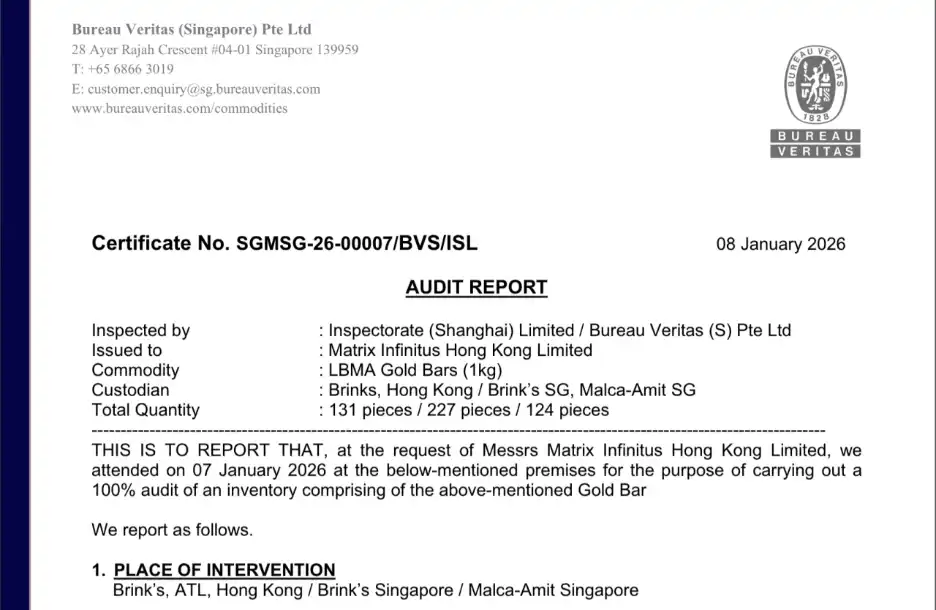
Matrixdock, the RWA platform under Matrixport, recently released its semi-annual physical gold audit report for the second half (H2) of 2025. The report discloses details about the physical gold reserves corresponding to the XAUm token, reflecting Matrixdock's ongoing commitment to physical asset verification and information transparency.

The audit was conducted by an independent third-party professional agency according to institutional-grade standards, providing a comprehensive inspection of the physical gold reserves corresponding to the XAUm token. The audit strictly followed leading industry standards for gold ETF audits, covering all elements including weight, purity, serial numbers, and vault custody information, achieving item-by-item verification of each physical gold bar.

Matrixdock's XAUm gold token employs a "dual-layer verification" mechanism: on one hand, it relies on an independent physical audit process; on the other hand, it combines on-chain real-time verification tools, enabling investors to transparently and continuously observe the mapping relationship between token supply and the corresponding gold reserves.

Audit Coverage and Key Data

● Audit execution date: January 7, 2026

● Physical gold reserves: 482 LBMA-approved 1-kilogram gold bars

● Total weight: 482 kilograms (approximately 15,595.336 ounces)

● Custody vaults: Brink’s Hong Kong, Brink’s Singapore, Malca-Amit Singapore

● Market value of the relevant physical gold, estimated at the audit time point: approximately $71.75 million

● The audit results showed no discrepancies between the physical gold and the related records.

Furthermore, compared to the audit for the first half of 2025, the number of physical gold bars covered in this audit increased by 61.
Enhancing the Verifiability of Tokenized Gold Through On-Chain Tools

Additionally, Matrixdock's gold allocation query tool allows XAUm holders to view the specific gold bar information corresponding to their tokens via a Web3 wallet. For example, one standard 1-kilogram gold bar corresponds to approximately 32.148 XAUm tokens, providing a more intuitive asset mapping method for tokenized gold.

As tokenized assets transition from innovation to infrastructure building, investor trust will increasingly rely on verifiable facts rather than verbal promises. Matrixdock stated that it will continue to advance reserve transparency and institutionalized operational standards, committed to providing global investors with more trustworthy and secure digital asset solutions for gold.

Audit report link: https://matrixdock.gitbook.io/matrixdock-docs/english/gold-token-xaum/physical-gold-vault-audit


Domande pertinenti

QWhat is the main purpose of Matrixdock's recently released semi-annual physical gold audit report?

AThe main purpose is to disclose the status of the physical gold reserves backing the XAUm tokens, demonstrating Matrixdock's ongoing commitment to physical asset verification and information transparency.

QHow many physical gold bars were verified in the audit, and what was their total weight?

AThe audit verified 482 LBMA-approved 1-kilogram gold bars, with a total weight of 482 kilograms (approximately 15,595.336 troy ounces).

QWhich independent third-party standards were followed for the physical gold audit?

AThe audit was conducted by an independent third-party professional agency according to institutional-grade standards, strictly referencing the leading gold ETF audit standards in the industry.

QWhat is the 'dual-layer verification' mechanism used for the XAUm gold token?

AThe 'dual-layer verification' mechanism combines an independent physical audit process with an on-chain real-time verification tool, allowing investors to transparently and continuously see the mapping relationship between the token supply and the corresponding gold reserves.

QHow can XAUm token holders verify which specific gold bars their tokens are backed by?

AXAUm holders can use Matrixdock's gold allocation query tool via a Web3 wallet to view the specific information of the gold bars corresponding to their tokens.

Letture associate

Bitcoin Withdrawals Continue: 8 Years of Storage in a Coldcard Cold Wallet Ended in Zero

Coldcard Hardware Wallet Hacked: Losses Mount Due to Vulnerable Seed Generation A critical vulnerability in Coldcard hardware wallets has led to a continued wave of fund thefts. According to Galaxy Research, the total stolen has reached 1,367.05 BTC (approx. $88.6 million) from 4,585 addresses, a significant increase from the initial 594.5 BTC reported on July 30, 2026. Most of the stolen funds remain on the attackers' addresses. The issue is not with the current firmware, which Coinkite has updated, but with seed phrases generated on vulnerable devices between March 2021 and the release of fixed firmware versions. Due to a programmer error, devices switched from using a hardware random number generator to the software-based Yasmarang generator, which was initialized with publicly accessible data like the chip's serial number. This made the seed phrases predictable through offline brute-force attacks, meaning wallets remain at risk until funds are moved to a new wallet generated with the patched firmware. Affected devices include Mk2/Mk3 with firmware 4.0.1–4.1.9 (and up to 5.0.3), Mk4/Mk5 up to version 5.6.0, and Q models up to 1.5.0Q. The only exceptions are seeds created with a high-entropy method like at least 50 independent dice rolls or a strong unique BIP-39 passphrase. All other owners must generate a new seed on the fixed firmware and transfer their assets. A case highlighting the human impact involves a 39-year-old long-term investor who lost 2 BTC (approx. $130,000) in minutes. He had accumulated the Bitcoin over eight years through physical labor, viewing it as a financial lifeline and a retirement plan in a country suffering from hyperinflation. His story underscores that even conservative "buy and hold in cold storage" strategies can be compromised by such underlying technical flaws. From a technical perspective, this incident echoes historical failures where weak random number generators undermined cryptographic security, challenging the assumption that offline storage is automatically foolproof.

cryptonews.ru2 h fa

Bitcoin Withdrawals Continue: 8 Years of Storage in a Coldcard Cold Wallet Ended in Zero

cryptonews.ru2 h fa

Trading

Spot
活动图片




