Matrixdock Launches Silver Token XAGm, Building On-Chain Silver Reserve Asset Based on FRS Standard

marsbitPubblicato 2026-03-17Pubblicato ultima volta 2026-03-17

Introduzione

Matrixdock, a leading RWA platform, has launched XAGm, an institutional-grade silver token backed by fully allocated physical silver. The token is supported by LBMA Good Delivery standard silver bars, enabling this widely traded precious metal to enter the on-chain financial ecosystem. XAGm expands Matrixdock’s on-chain precious metals system, supporting use cases such as trading, collateralization, and DeFi applications. Unlike gold, which primarily serves as a store of value, silver possesses both investment and industrial demand, introducing stronger cyclical dynamics and diversified utility in on-chain markets. XAGm is one of the few institutional-grade tokenized silver products, with verifiable asset backing held in professional vaults. The token is issued under Matrixdock’s FRS (Fungible Reserve Standard) framework, which ensures transparent and sustainable alignment between on-chain tokens and underlying physical assets. Initially deployed on Ethereum, XAGm is set to expand to other blockchain ecosystems to improve accessibility and liquidity. This launch further develops Matrixdock’s Reserve Layer, combining gold and silver to create a more resilient and diversified on-chain asset base for the decentralized financial system.

Matrixdock, a leading global RWA platform, today announced the launch of the silver token XAGm for institutional use. This product is backed by fully allocated physical silver as the underlying asset and incorporates silver bar assets that comply with the LBMA Good Delivery standard, enabling silver—a widely traded precious metal commodity in traditional markets—to enter the on-chain financial system.
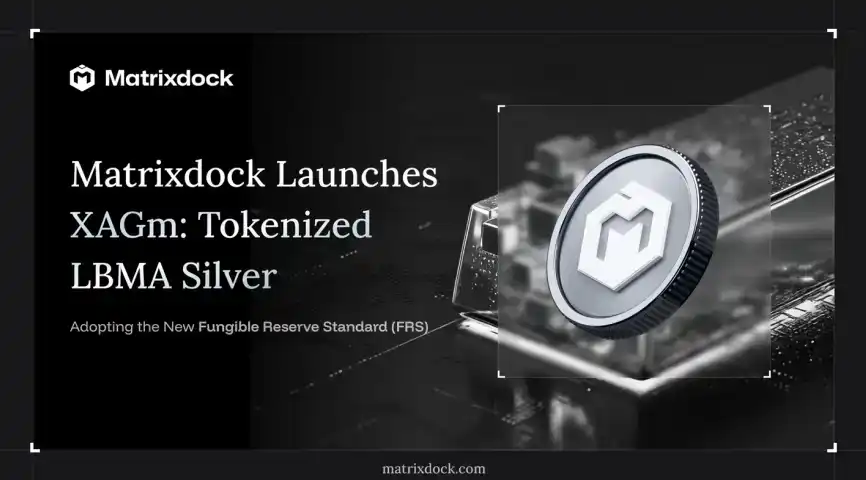
The launch of XAGm further enriches Matrixdock's on-chain precious metal asset system, allowing silver, a precious metal asset that has long played a significant role in traditional markets, to enter a programmable on-chain financial environment. It supports various financial application scenarios such as collateralization, trading, capital allocation, and DeFi.

As real-world assets continue to enter the blockchain financial system, market focus is gradually shifting from "whether assets can be on-chain" to "which assets can operate stably on-chain in the long term." Against this backdrop, precious metal assets with mature market structures, stable value foundations, and global liquidity are becoming important asset types in the on-chain financial system, featuring institutional-grade structural design.

Combining Investment and Industrial Attributes, Silver Expands On-Chain Trading and Collateral Scenarios

Unlike gold, which primarily serves as a store of value, silver is influenced by both investment demand and industrial consumption, resulting in more pronounced cyclical characteristics. This dual nature as both a financial asset and an industrial commodity enables silver to support more diverse trading, collateral, and asset allocation scenarios in the on-chain market.

If gold provides a stable value anchor for reserve assets in the on-chain financial system, then silver introduces greater market activity and cyclical characteristics to this system. The two form a complementary relationship, providing a more complete structural foundation for the on-chain precious metal asset system.

As one of the few tokenized silver products in the current market with an institutional-grade structural design, XAGm is backed by physical silver in the form of LBMA Good Delivery standard silver bars, stored in professional institutional vault facilities. Through clear asset allocation arrangements and information disclosure mechanisms, the correspondence between XAGm tokens and the underlying silver assets can be independently verified within the established framework, providing institutional participants with an auditable and verifiable channel for on-chain silver asset allocation.

FRS Issuance Framework: Supporting the Long-Term Operation of Real Assets On-Chain

In terms of asset structure design, XAGm adopts Matrixdock's FRS (Fungible Reserve Standard) issuance framework. FRS is an issuance mechanism designed by Matrixdock for RWA on-chain, establishing a transparent and verifiable correspondence between the on-chain token supply structure and the underlying asset holding structure through programmable means, enabling tokens to continuously reflect the economic attributes of the held real assets. While maintaining the integrity of the underlying assets' economic attributes, FRS also incorporates long-term operational costs such as custody and auditing into the mechanism design, thereby providing a more sustainable structural model for long-term RWA assets.

XAGm will first be deployed on the Ethereum network, with plans to gradually expand to more blockchain ecosystems in the future to further enhance the accessibility and liquidity of assets in different on-chain financial environments.

The launch of XAGm also marks the continuous expansion of Matrixdock's Reserve Layer system. With the successive introduction of gold and silver as two types of precious metal assets, Matrixdock is building an on-chain reserve structure composed of assets driven by different economic cycles, providing a more stable and diversified asset infrastructure for the on-chain financial system.

Eva Meng, Head of Matrixdock, stated: "There are still relatively few tokenized silver products in the current market that truly meet institutional-grade standards. With XAGm, we are bringing fully allocated silver assets, custodied by professional institutional vaults, on-chain, operating within a clear and verifiable framework. Gold primarily serves as a store of wealth, while silver plays a complementary role driven by both industrial demand and monetary attributes. Together, they will provide a more complete and resilient asset foundation for on-chain precious metal infrastructure."

In the future, Matrixdock will continue to expand into more high-quality real-world assets, including precious metals and other commodity assets with mature market structures, to promote the construction of a more transparent and resilient on-chain reserve asset system, providing long-term sustainable infrastructure support for the development of the on-chain financial ecosystem.


Domande pertinenti

QWhat is the name of the new silver token launched by Matrixdock and what standard is it built on?

AThe new silver token is called XAGm, and it is built on the FRS (Fungible Reserve Standard).

QWhat is the primary purpose of the FRS (Fungible Reserve Standard) framework used for XAGm?

AThe FRS framework is designed to establish a transparent and verifiable correspondence between the on-chain token supply structure and the underlying asset holding structure, ensuring the token continuously reflects the economic attributes of the real asset while incorporating long-term operational costs like custody and auditing.

QHow does the role of silver (XAGm) differ from that of gold in the on-chain financial system according to the article?

AGold primarily serves as a store of value, while silver, influenced by both investment demand and industrial consumption, introduces stronger market activity and cyclical characteristics, creating a complementary relationship within the on-chain precious metals system.

QWhat specific standard do the physical silver bars backing XAGm comply with, and how is the asset's authenticity verified?

AThe physical silver bars backing XAGm comply with the LBMA Good Delivery standard. The correspondence between the tokens and the underlying silver is independently verifiable within a defined framework through clear asset allocation arrangements and information disclosure mechanisms.

QOn which blockchain network will XAGm be initially deployed, and what are the plans for its future expansion?

AXAGm will first be deployed on the Ethereum network, with future plans to expand to more blockchain ecosystems to enhance its accessibility and liquidity across different on-chain financial environments.

Letture associate

South Korean Stock Market Sees Sharp Rebound After Forceful De-leveraging, SK Hynix Rises 30%

On July 31, South Korean stocks staged a historic rebound. The benchmark KOSPI index surged 18.27%, with chipmaker SK Hynix hitting a 30% gain limit. This followed a brutal, near-40% decline in the KOSPI over the previous month, driven largely by a deleveraging spiral involving leveraged ETFs. Analysts attributed the sharp sell-off to structural liquidity issues rather than deteriorating corporate fundamentals. The rally was triggered by a confluence of positive catalysts. Firstly, strong earnings from U.S. cloud giants Microsoft and Amazon alleviated fears of an "AI bubble burst," boosting global tech sentiment. Secondly, SK Group Chairman Chey Tae-won made a rare personal purchase of SK Hynix shares, seen as a strong vote of confidence. Thirdly, the South Korean government announced a 20 trillion won ($139 billion) AI investment fund. In response to the market turmoil, South Korean regulators are tightening controls on leveraged ETFs, admitting oversight shortcomings. Measures include raising minimum cash保证金 requirements for散户 investors and suspending new product launches. While the rebound signals eased liquidity pressure, analysts note deep structural issues remain. The market's future stability is seen as dependent on global tech capital expenditure trends and memory chip price cycles, with some viewing the surge as a technical correction rather than a definitive trend reversal.

marsbit12 min fa

South Korean Stock Market Sees Sharp Rebound After Forceful De-leveraging, SK Hynix Rises 30%

marsbit12 min fa

Cryptocurrency Company Wintermute Makes Pessimistic Statements Regarding Expected Altcoin Growth! Here are the Details

Crypto market maker Wintermute has made a pessimistic assessment regarding the anticipated altcoin season, suggesting that any upcoming rally may benefit only a limited number of projects. The company reports a record 72% of its spot OTC trading volume in H1 2026 came from institutional clients, whose capital is becoming more selective and concentrated. Data shows institutional traders act quickly on price spikes, while retail interest lasts longer. This selective behavior indicates the classic altcoin season, where hundreds of tokens rise simultaneously, may be changing. Wintermute believes only projects with strong use cases, high liquidity, and institutional appeal will stand out. Supporting this view, CryptoQuant data shows altcoin trading volume against Bitcoin is near its lowest since 2021, with the top 10 altcoins (excluding stablecoins) holding about 80.5% of the total altcoin market cap. Similarly, Kaiko reports that the top 10 altcoins now account for 63% of total altcoin trading volume, up from ~50% a few months ago, indicating capital concentration. Analysts suggest that in the current cautious institutional climate, projects with advanced technology, liquidity, and robust ecosystems will attract disproportionate attention. Therefore, any potential new altcoin season may be less broad than past bull markets, with gains concentrated in a narrower set of promising tokens.

cryptonews.ru12 min fa

Cryptocurrency Company Wintermute Makes Pessimistic Statements Regarding Expected Altcoin Growth! Here are the Details

cryptonews.ru12 min fa

UNI Activates Fee Switch: Uniswap Completes Commercial Debut, Faces First Test in September

Uniswap's Fee Switch activation on V4 has driven a surge in protocol revenue, with daily income jumping from $118,000 to $318,000. The newly launched Robinhood Chain has become the primary contributor, accounting for over 52% of total revenue, largely fueled by meme coin trading. This revenue fuels a new tokenomic "flywheel": fees accumulate in a pool, incentivizing arbitrageurs to buy and burn UNI tokens, creating deflationary pressure and boosting the token's price. However, concerns loom beneath the surface. Uniswap's revenue is now highly concentrated and dependent on the speculative, volatile activity on Robinhood Chain, which is currently subsidized by free gas fees. This subsidy is set to expire in late September, posing a significant test for sustained transaction volume and, consequently, protocol revenue. Furthermore, UNI's high valuation faces pressure if growth expectations aren't met. Debate also centers on the Fee Switch's impact. While Uniswap founder Hayden Adams clarified that the protocol fee is an "add-on" for traders and does not cut into Liquidity Providers' (LPs) existing share, questions remain about whether higher overall trading costs could indirectly reduce volume and LP earnings over time. Despite these challenges, Uniswap's Fee Switch marks a major step in protocol monetization, with its long-term success hinging on cultivating more sustainable usage beyond speculative trading.

marsbit20 min fa

UNI Activates Fee Switch: Uniswap Completes Commercial Debut, Faces First Test in September

marsbit20 min fa

Trading

Spot
活动图片