Mastercard Snags BVNK After Failed $2 Billion Coinbase Deal

bitcoinistPubblicato 2026-03-18Pubblicato ultima volta 2026-03-18

Introduzione

Mastercard has acquired stablecoin infrastructure firm BVNK for up to $1.8 billion, including $300 million in contingent payments. This follows BVNK’s earlier failed $2 billion merger talks with Coinbase. The acquisition aims to expand Mastercard’s capabilities in digital assets and on-chain payments, integrating fiat rails with blockchain-based transactions. BVNK operates in over 130 countries and previously partnered with Visa to enable stablecoin payments. The deal, pending regulatory approval, is expected to close by year-end. Meanwhile, the stablecoin market has seen slowed growth recently but remains resilient despite broader crypto market volatility. Bitcoin is trading around $74,700, up 7% over the past week.

Mastercard has announced an acquisition of stablecoins infrastructure firm BVNK, which was previously in talks with Coinbase over a $2 billion deal.

Mastercard Will Be Acquiring BVNK For Up To $1.8 Billion

As announced in a press release, Mastercard has reached a definitive agreement to acquire BVNK for up to $1.8 billion, including $300 million in contingent payments.

BVNK is an enterprise stablecoins infrastructure solutions provider that operates across more than 130 countries. Last year, the company was in discussion with cryptocurrency exchange Coinbase over a merger, but in November, the deal fell through.

Now, it would appear that Mastercard has been successful in obtaining a signature from the stablecoins infrastructure firm. “The deal further expands Mastercard’s end-to-end support of digital assets and value movement across currencies, rails and regions,” noted the press release.

In January, another major payments card provider, Visa, also formed a partnership with BVNK, seeking its expertise to enable stablecoin payments on the Visa Direct platform.

Mastercard is also eyeing an integration of its fiat rails with on-chain payments in this acquisition. Jorn Lambert, Mastercard Chief Product Officer, said:

This acquisition reinforces what we have always done, using innovation and technology to power economies and empower people. Adding on-chain rails to our network will support speed and programmability for virtually every type of transaction.

Stablecoins, which are cryptocurrencies tied to fiat currencies, have been gaining adoption around the world in recent years, owing to positive regulation like the United States’ GENIUS Act. “We expect that most financial institutions and fintechs will in time provide digital currency services, be it with stablecoins or tokenized deposits,” noted Lambert.

Mastercard’s transaction with BVNK is expected to close before the end of the year, but according to the statement, it’s subject to regulatory review and other customary closing conditions.

Jesse Hemson-Struthers, BVNK co-founder and CEO, said:

This deal brings together complementary capabilities to define and deliver the future of money. Together, we’re able to deliver an unprecedented infrastructure for digital currency-based financial services.

During 2024 and most of 2025, the stablecoin sector enjoyed a notable uptrend, with the combined market cap of these tokens ballooning in size. Since October, however, the slowdown in the wider cryptocurrency market has also affected the fiat-pegged coins, as data from DefiLlama shows.
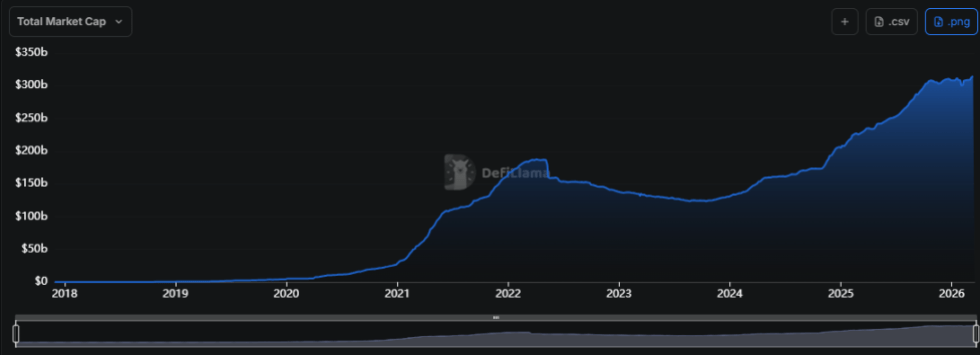
The value of the metric seems to have been moving sideways over the last few months | Source: DefiLlama

From the chart, it’s visible that the stablecoin market cap has seen its growth stall in recent months. However, unlike the rest of the sector, these assets haven’t actually faced any drawdown, at least not yet. As such, stablecoins have still been holding up relatively well in the wider context.

Bitcoin Price

At the time of writing, Bitcoin is trading around $74,700, up nearly 7% over the past week.

Looks like the price of the coin has shot up in the last couple of days | Source: BTCUSDT on TradingView


Domande pertinenti

QWhat company did Mastercard announce the acquisition of, and for how much?

AMastercard announced the acquisition of stablecoins infrastructure firm BVNK for up to $1.8 billion, including $300 million in contingent payments.

QWhy did the previous deal between BVNK and Coinbase not go through?

AThe previous merger deal between BVNK and cryptocurrency exchange Coinbase fell through in November of last year, though the specific reasons were not detailed in the article.

QHow does Mastercard's Chief Product Officer, Jorn Lambert, believe this acquisition will benefit their network?

AJorn Lambert stated that adding on-chain rails to Mastercard's network will support speed and programmability for virtually every type of transaction.

QWhat recent partnership did Visa, another major payments provider, form with BVNK?

AIn January, Visa formed a partnership with BVNK to leverage its expertise to enable stablecoin payments on the Visa Direct platform.

QWhat is the current trend in the stablecoin market cap according to data from DefiLlama?

AAccording to DefiLlama, the stablecoin market cap has seen its growth stall and has been moving sideways in recent months, though it has not faced a significant drawdown.

Letture associate

Gensyn AI: Don't Let AI Repeat the Mistakes of the Internet

In recent months, the rapid growth of the AI industry has attracted significant talent from the crypto sector. A persistent question among researchers intersecting both fields is whether blockchain can become a foundational part of AI infrastructure. While many previous AI and Crypto projects focused on application layers (like AI Agents, on-chain reasoning, data markets, and compute rentals), few achieved viable commercial models. Gensyn differentiates itself by targeting the most critical and expensive layer of AI: model training. Gensyn aims to organize globally distributed GPU resources into an open AI training network. Developers can submit training tasks, nodes provide computational power, and the network verifies results while distributing incentives. The core issue addressed is not decentralization for its own sake, but the increasing centralization of compute power among tech giants. In the era of large models, access to GPUs (like the H100) has become a decisive bottleneck, dictating the pace of AI development. Major AI companies are heavily dependent on large cloud providers for compute resources. Gensyn's approach is significant for several reasons: 1) It operates at the core infrastructure layer (model training), the most resource-intensive and technically demanding part of the AI value chain. 2) It proposes a more open, collaborative model for compute, potentially increasing resource utilization by dynamically pooling idle GPUs, similar to early cloud computing logic. 3) Its technical moat lies in solving complex challenges like verifying training results, ensuring node honesty, and maintaining reliability in a distributed environment—making it more of a deep-tech infrastructure company. 4) It targets a validated, high-growth market with genuine demand, rather than pursuing blockchain integration without purpose. Ultimately, the boundaries between Crypto and AI are blurring. AI requires global resource coordination, incentive mechanisms, and collaborative systems—areas where crypto-native solutions excel. Gensyn represents a step toward making advanced training capabilities more accessible and collaborative, moving beyond a niche controlled by a few giants. If successful, it could evolve into a fundamental piece of AI infrastructure, where the most enduring value in the AI era is often created.

marsbit9 h fa

Gensyn AI: Don't Let AI Repeat the Mistakes of the Internet

marsbit9 h fa

Why is China's AI Developing So Fast? The Answer Lies Inside the Labs

A US researcher's visit to China's top AI labs reveals distinct cultural and organizational factors driving China's rapid AI development. While talent, data, and compute are similar to the West, Chinese labs excel through a pragmatic, execution-focused culture: less emphasis on individual stardom and conceptual debate, and more on teamwork, engineering optimization, and mastering the full tech stack. A key advantage is the integration of young students and researchers who approach model-building with fresh perspectives and low ego, prioritizing collective progress over personal credit. This contrasts with the US culture of self-promotion and "star scientist" narratives. Chinese labs also exhibit a strong "build, don't buy" mentality, preferring to develop core capabilities—like data pipelines and environments—in-house rather than relying on external services. The ecosystem feels more collaborative than tribal, with mutual respect among labs. While government support exists, its scale is unclear, and technical decisions appear driven by labs, not state mandates. Chinese companies across sectors, from platforms to consumer tech, are building their own foundational models to control their tech destiny, reflecting a broader cultural drive for technological sovereignty. Demand for AI is emerging, with spending patterns potentially mirroring cloud infrastructure more than traditional SaaS. Despite challenges like a less mature data industry and GPU shortages, Chinese labs are propelled by vast talent, rapid iteration, and deep integration with the open-source community. The competition is evolving beyond a pure model race into a contest of organizational execution, developer ecosystems, and industrial pragmatism.

marsbit11 h fa

Why is China's AI Developing So Fast? The Answer Lies Inside the Labs

marsbit11 h fa

3 Years, 5 Times: The Rebirth of a Century-Old Glass Factory

Corning, a 175-year-old glass company, is experiencing a dramatic revival as a key player in AI infrastructure, driven by surging demand for high-performance optical fiber in data centers. AI data centers require vastly more fiber than traditional ones—5 to 10 times as much per rack—to handle high-speed data transmission between GPUs. This structural demand shift, coupled with supply constraints from the lengthy expansion cycle for fiber preforms, has created a significant supply-demand gap. Nvidia has invested in Corning, along with Lumentum and Coherent, in a $4.5 billion total commitment to secure the optical supply chain for AI. Corning's competitive edge lies in its expertise in producing ultra-low-loss, high-density, and bend-resistant specialty fiber, which is critical for 800G+ and future 1.6T data rates. Its deep involvement in co-packaged optics (CPO) with partners like Nvidia further solidifies its position. While not the largest fiber manufacturer globally, Corning's revenue from enterprise/data center clients now exceeds 40% of its optical communications sales, and it has secured multi-year supply agreements with major hyperscalers including Meta and Nvidia. Financially, Corning's optical communications revenue has surged, doubling from $1.3 billion in 2023 to over $3 billion in 2025. Its stock price has risen nearly 6-fold since late 2023. Key future catalysts include the rollout of Nvidia's CPO products and the scale of undisclosed customer agreements. However, risks include high current valuations and potential disruption from next-generation technologies like hollow-core fiber. The company's long-term bet on light over electricity, maintained even through the telecom bubble crash, is now being validated by the AI boom.

marsbit11 h fa

3 Years, 5 Times: The Rebirth of a Century-Old Glass Factory

marsbit11 h fa

Trading

Spot
Futures
活动图片




