Market Liquidity Survey: Under Diminishing Liquidity, Retail Investors 'Buy Lottery Tickets', Main Players 'Purchase Insurance'

marsbitPubblicato 2025-12-15Pubblicato ultima volta 2025-12-15

Introduzione

Following the sharp market decline on October 11, the crypto market has entered a period of low activity and structural divergence. Analysis of order book depth, derivatives data, and stablecoin flows reveals a clear trend: liquidity is deteriorating, institutional players are adopting defensive strategies, while retail investors remain in a wait-and-see mode. Order book depth on major exchanges like Binance has weakened significantly, with both bid and ask liquidity thinning out. Altcoin open interest and trading volumes have also declined, indicating a lack of retail participation and speculative interest. A notable shift is observed in the options market. Bitcoin options now dominate trading activity, with put options—particularly those concentrated around the $85,000 strike—carrying significantly higher premiums than calls. This suggests that while retail traders are buying cheap, out-of-the-money call options (like “lottery tickets”), institutions are paying high premiums for downside protection, reflecting a bearish or defensive stance. The max pain point for December is around $100,000, indicating a key level where option sellers would profit most. Stablecoin data further highlights this divide. USDT reserves on exchanges have reached an all-time high, suggesting available capital from retail and non-compliant players waiting to enter. In contrast, USDC—predominantly used by U.S. institutions—has seen a sharp 40% withdrawal from exchanges, signaling institutional ex...

Author: Frank, PANews

After the sharp downturn in the crypto market on October 11th, the market seems to have entered a prolonged "cooling-off period." For most investors, rather than predicting price movements, it might be more important to understand how much the current market liquidity has recovered since the heavy blow on 10.11. Additionally, how do the dominant funds in the market view the future direction?

In response, PANews attempts to analyze the current capital structure of the market through several data points, including order book depth, the options market, and stablecoins. The final conclusion is: the market does not seem to have truly recovered; instead, it has fallen into a state of structural fragmentation with continuously diminishing liquidity and accelerated defensive moves by institutional funds.

Micro Liquidity: Fragile Balance and Disappearing Support Orders

To understand the current liquidity situation, the order depth difference is the most direct indicator.

Taking the depth chart of the Binance BTC/USDT perpetual trading pair as an example, it is clear that since October, the depth of the buy order book has been decreasing, dropping from previously普遍 above $200 million to the $100–200 million range. The depth of sell orders has similarly decreased significantly, remaining below $200 million.
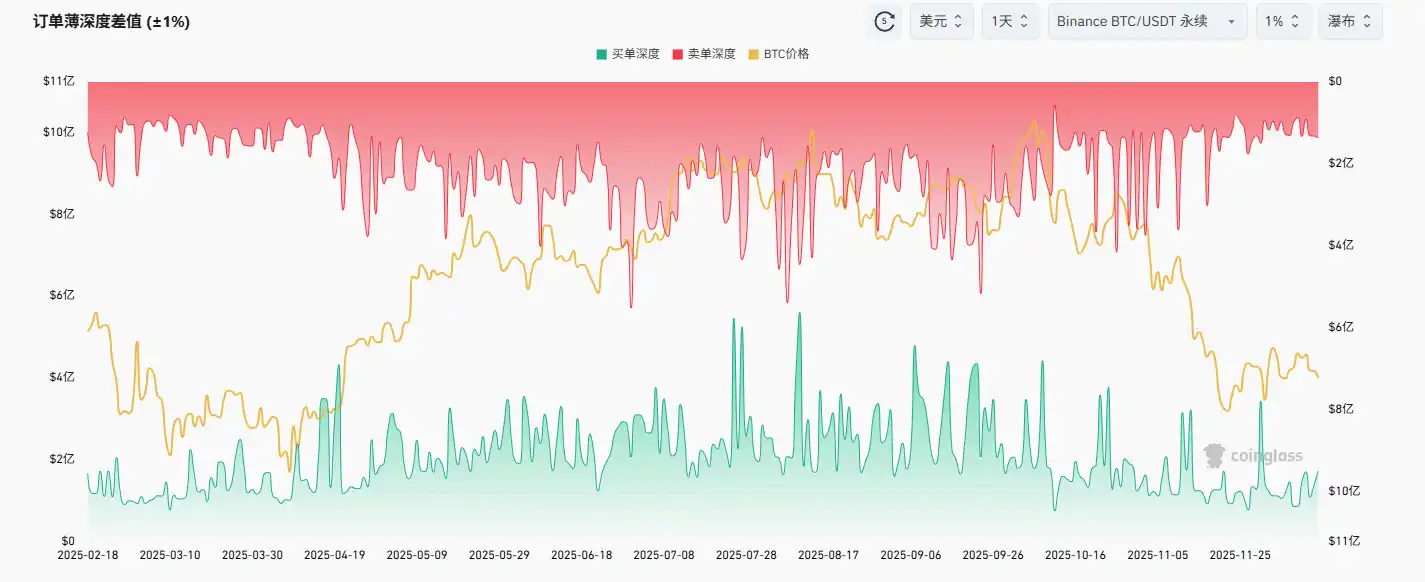
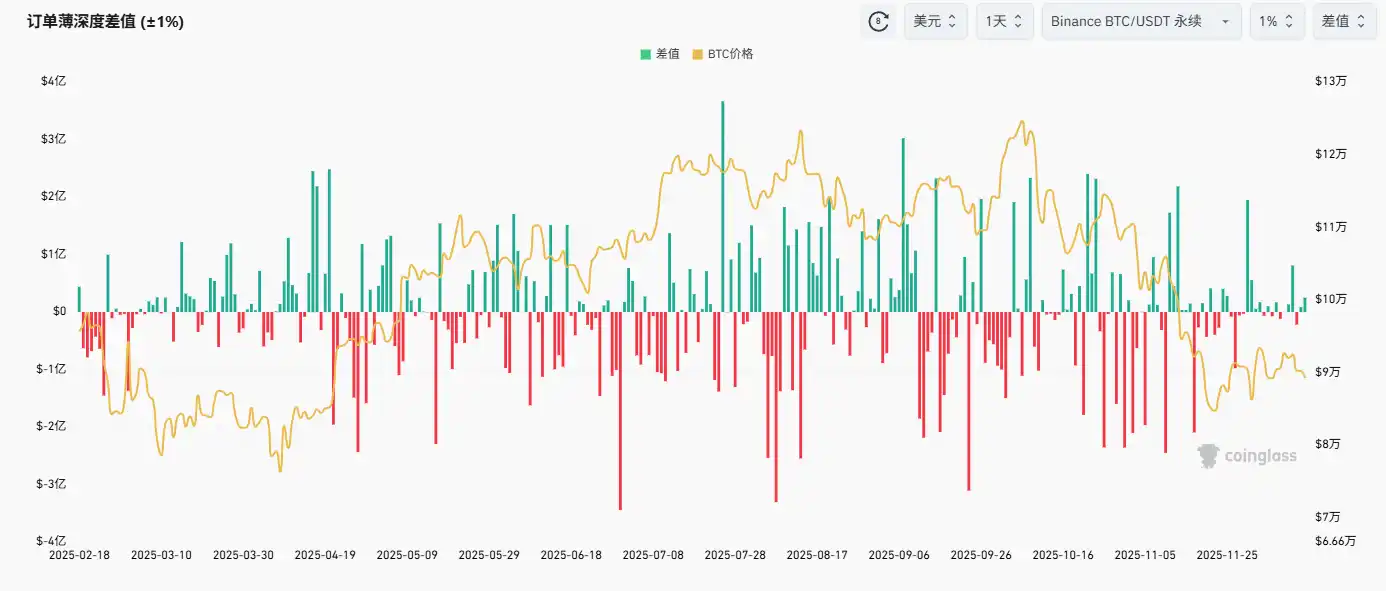
In terms of the difference, the gap between long and short order depths has recently become more balanced, with the difference on many days in November being only around $10 million. These data indicate that the entire market has entered a state of relative balance between long and short positions, but with continuously diminishing liquidity.
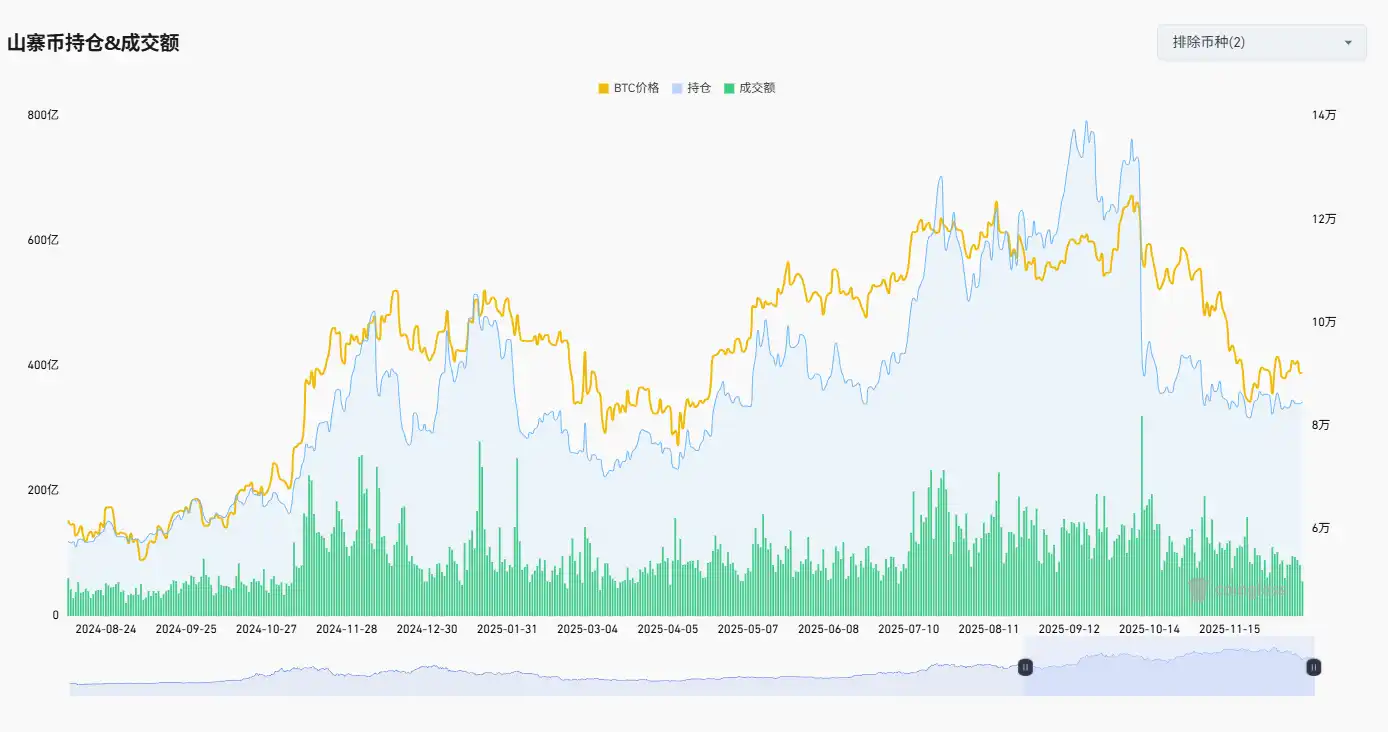
In terms of open interest, the total open interest of altcoins (excluding BTC and ETH) has not shown growth as prices hit lows but has instead also been declining. In contrast, the entire market experienced a deep correction in April, but at that time, after prices hit lows, the market's open interest saw a significant rebound (and this rebound even occurred提前 before prices reached the lowest point).

At the same time, the trading volume in the altcoin futures market is also shrinking, with no significant increase in volume triggered by bottom-fishing. From these data, the altcoin market seems to have entered a state of neglect.
Options Market: Retail Buys Lottery Tickets, Main Players Bet on Decline

Another set of data is quite interesting. The crypto options/crypto futures open interest ratio shows that the proportion of BTC options has been soaring since the beginning of the year, even exceeding 100% at its peak, and currently remains around 90%. Before this, the proportion of BTC options had long been maintained at around 60%. In other words, the BTC market has completely shifted from being dominated by futures contracts to being dominated by options contracts. However, the crypto options/crypto futures open interest ratio for ETH has dropped to a very low level this year, around 30%.
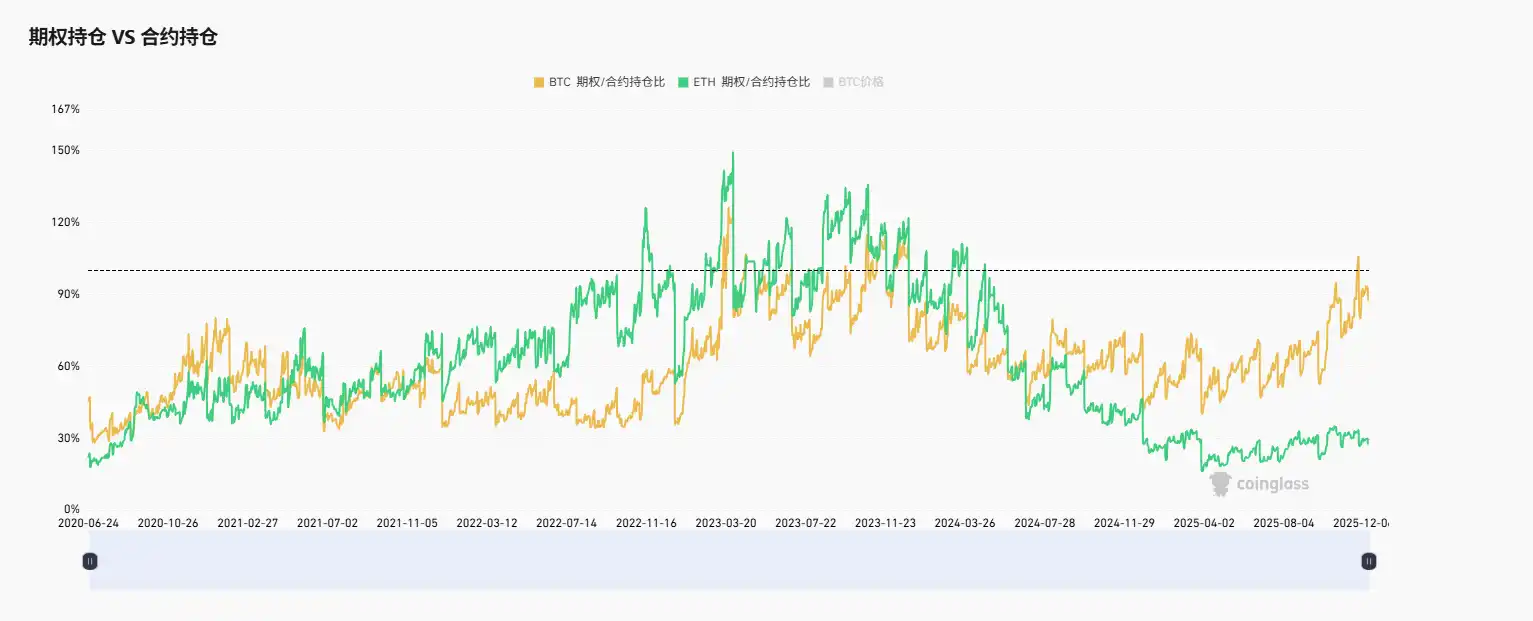
Behind this data, two issues are confirmed. One is that the dominance of the BTC market has been completely seized by institutions and hedge funds, while ETH and other altcoins no longer seem to be trading options for these institutions and hedge funds. Another key point is that in predicting the BTC market, options market data has become more important. We can also see this trend from the total open interest of BTC options; even as prices fall, open interest remains high.
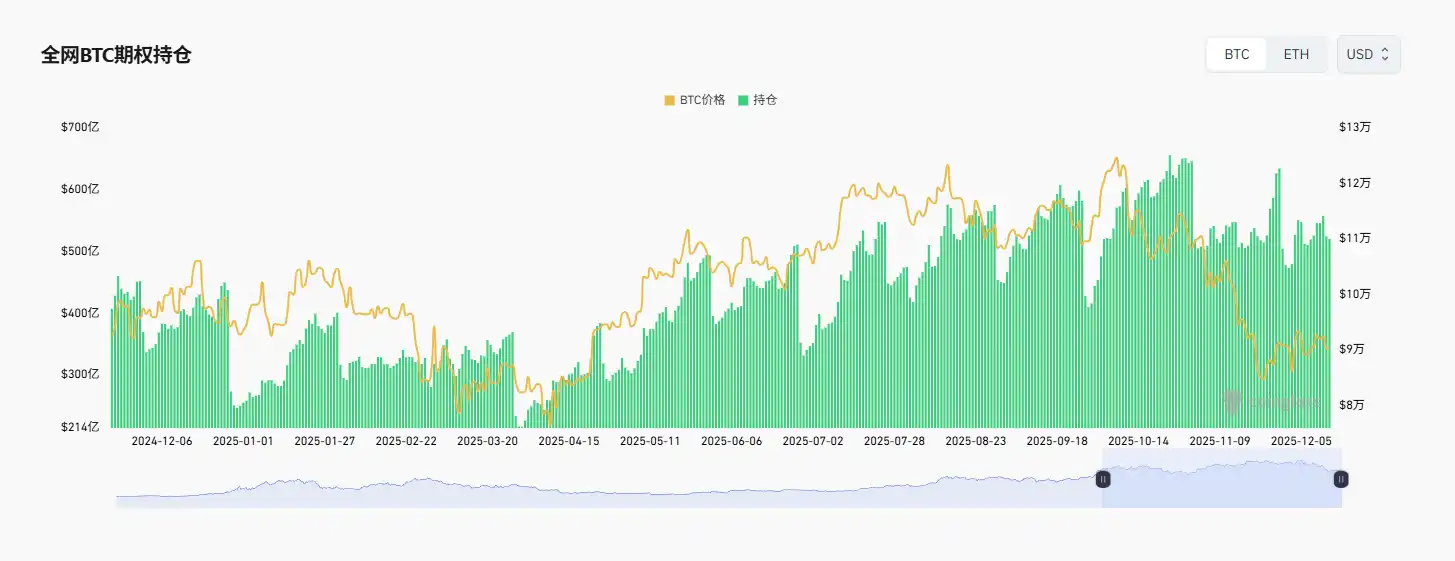
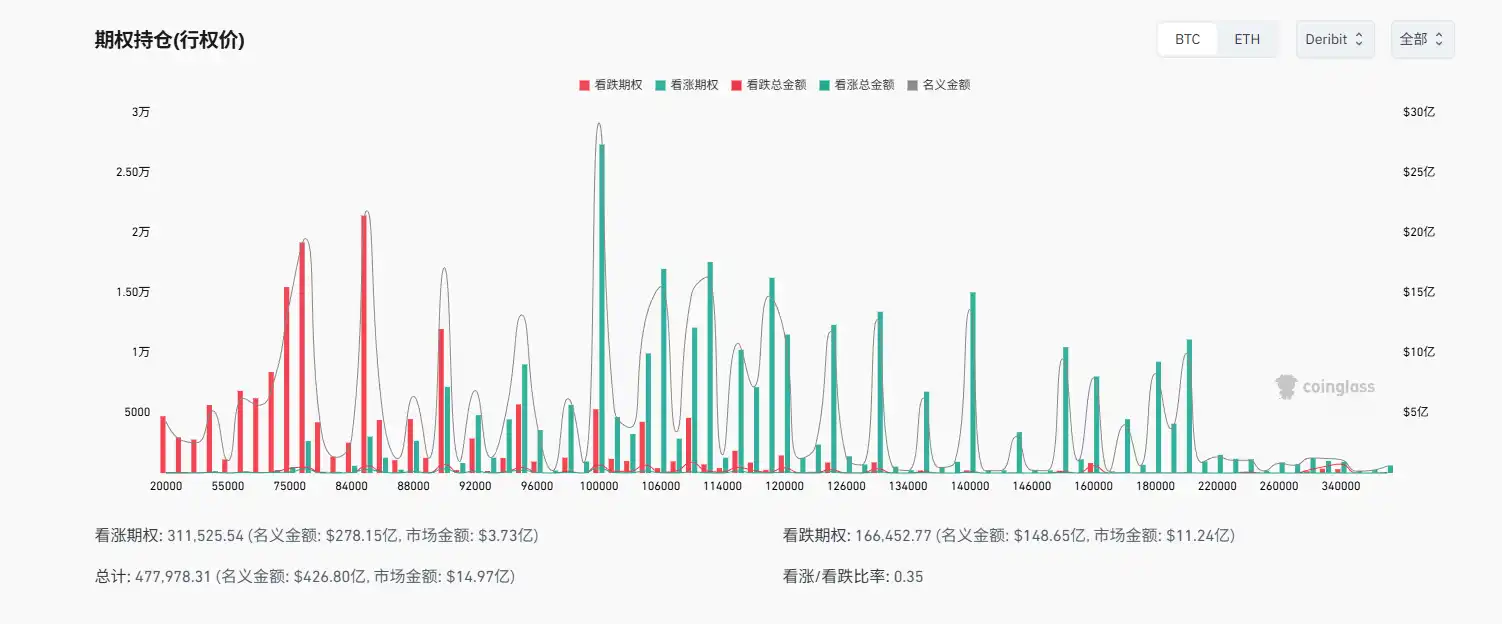
Therefore, options expiration dates and max pain points have become important reference indicators for the current BTC market. According to current data, the next important options expiration date is December 26th. At this point, the total volume of call options reaches 192,000, while the total volume of put options is only 74,200. However, the total notional value of these put options is as high as $508 million, while the total notional value of call options is only $71.25 million. This inverted data indicates that current call options are very cheap (about $370), while put options are very expensive (up to $6800).
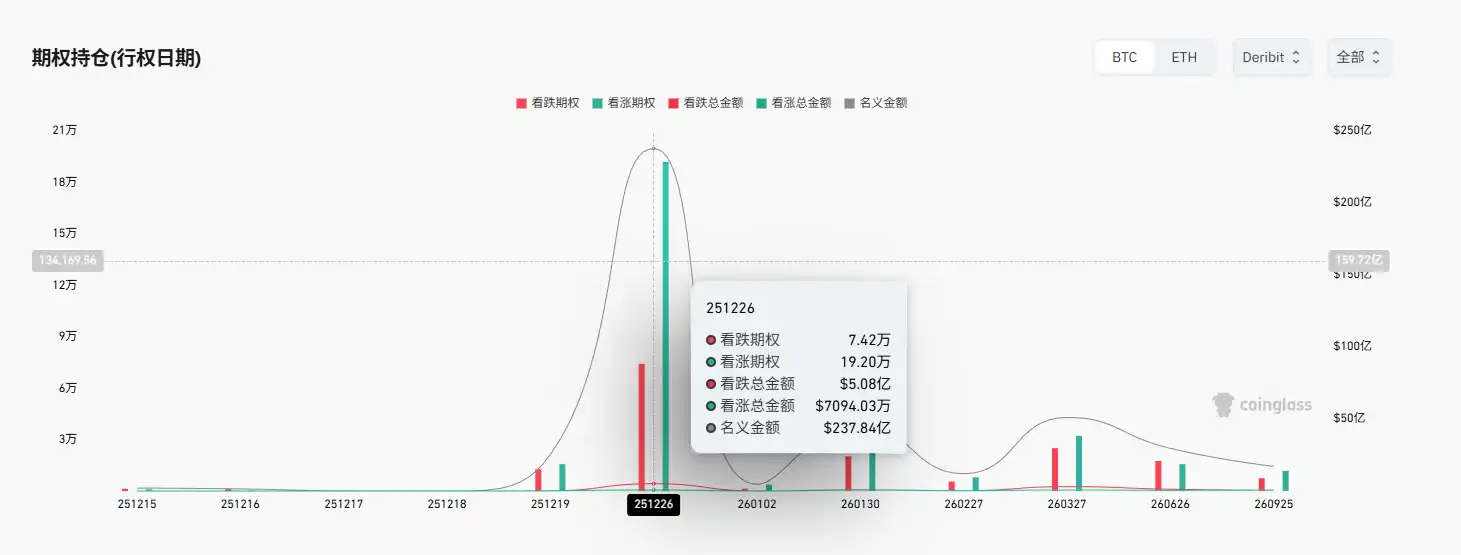
Combined with the distribution of strike prices, we can see that most call options are distributed above the $100,000 price, which makes it very unlikely that these options will be exercised on December 26th. Therefore, although the number of call options is large, they are more偏向于 "lottery ticket"-style speculative targets. A large number of put options have strike prices concentrated at $85,000 and below. At the same time, the market value of put options reached $1.124 billion, while the market value of call options was only $373 million (the premium paid by investors to purchase options). In summary, although there are more people betting on a rise,实际上 more funds (about 75%) are betting on or hedging against a decline.
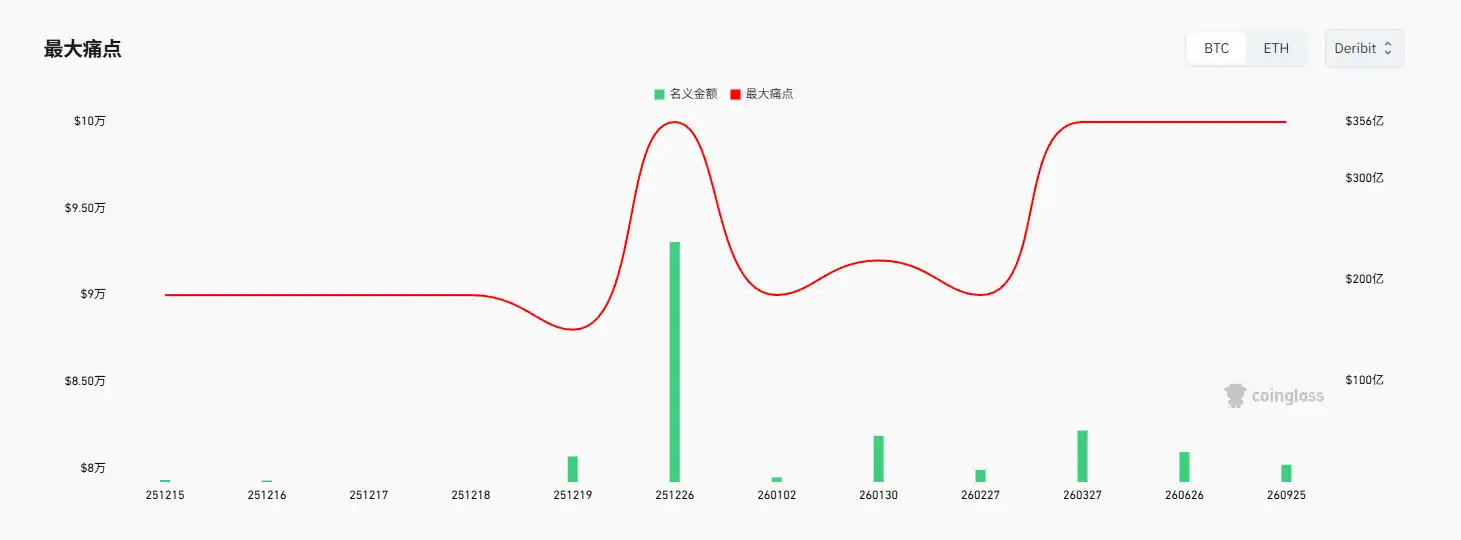
Additionally, the current max pain point is the $100,000 mark. This also indicates that the $100,000 price may become the focus of competition between option sellers and buyers this month. For market makers (option sellers), they are likely the main bulls in the current market; as long as the price can be pushed to around $100,000, they will be the biggest winners.

However, for institutions that have heavily invested in purchasing put options, most may be hedging against the downside risk of their spot holdings. Although本质上 they are mostly defensive in choosing to bet on a decline, the fact that they still put funds into put options despite the high cost indicates that their sentiment towards the future market trend is significantly pessimistic.
Stablecoins: Compliant Retreat, Hot Money Watches and Waits

Besides options data and order book data, stablecoin data is also an important indicator for judging current market liquidity and direction. Especially the flow of stablecoins to exchanges. However, this data also reveals significant divergences in the market.

According to CryptoQuant data, the exchange reserves of USDT have been on an upward trend this year and have maintained this momentum recently. On December 4th, USDT reserves on exchanges reached a historical peak of $60.4 billion. And they currently remain near the high of $60 billion. As the main pricing benchmark for non-compliant exchanges within the market, the continuous growth of USDT exchange reserves indicates that a large amount of speculative capital remains in a state of betting or preparing to buy the dip. Combined with the current decline in open interest, it can be felt that a large amount of speculative capital is in a wait-and-see mode.
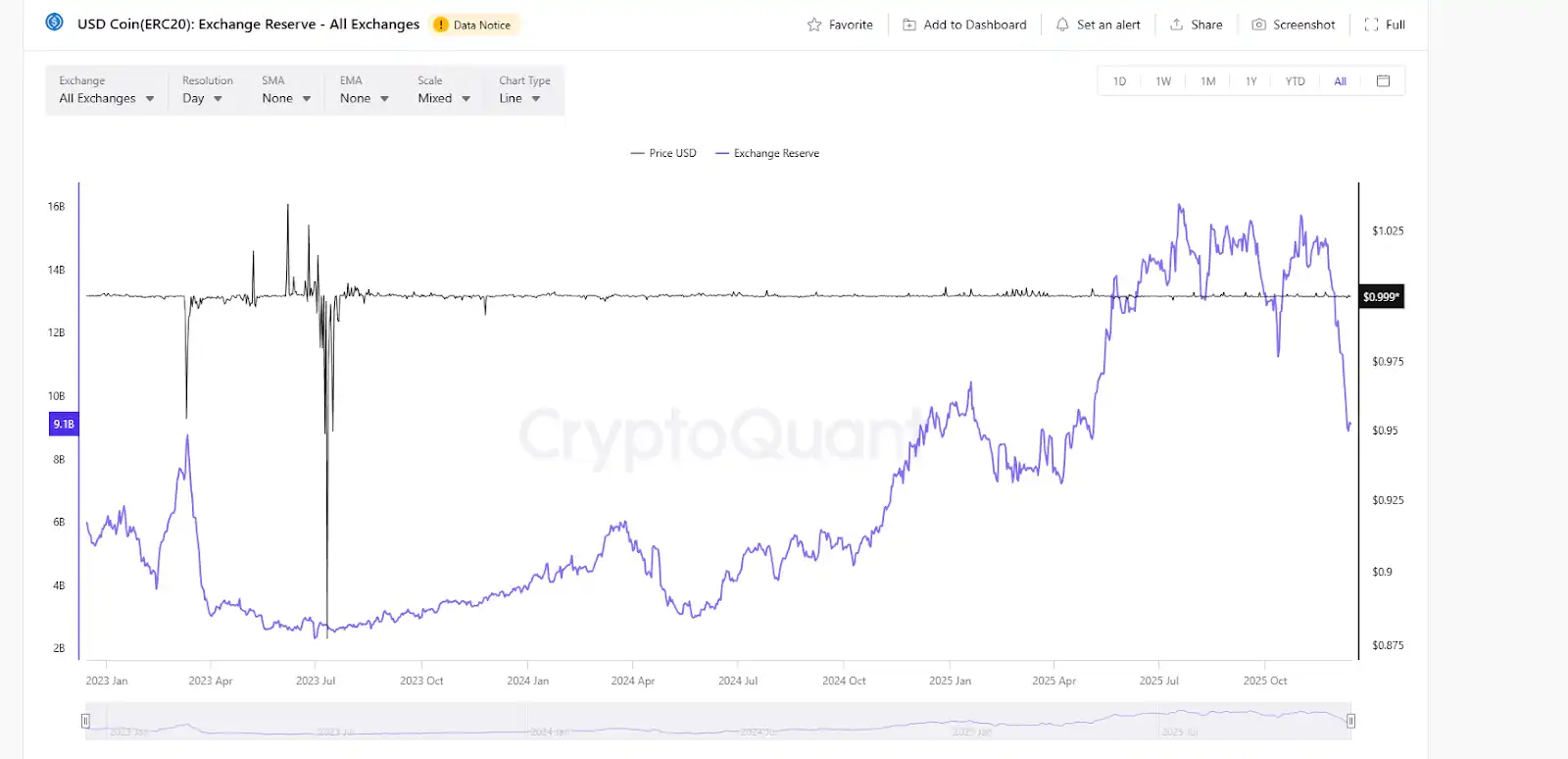
USDC shows a completely different picture. Since the end of November, a large amount of USDC has been withdrawn from exchanges, with exchange reserves plummeting from $15 billion to around $9 billion, a drop of 40%. As the leading compliant stablecoin, USDC's main users are来自 US institutions, compliant funds, etc. They are the representatives of the institutional faction in the market. Currently, it is clear that this group is accelerating their exit.
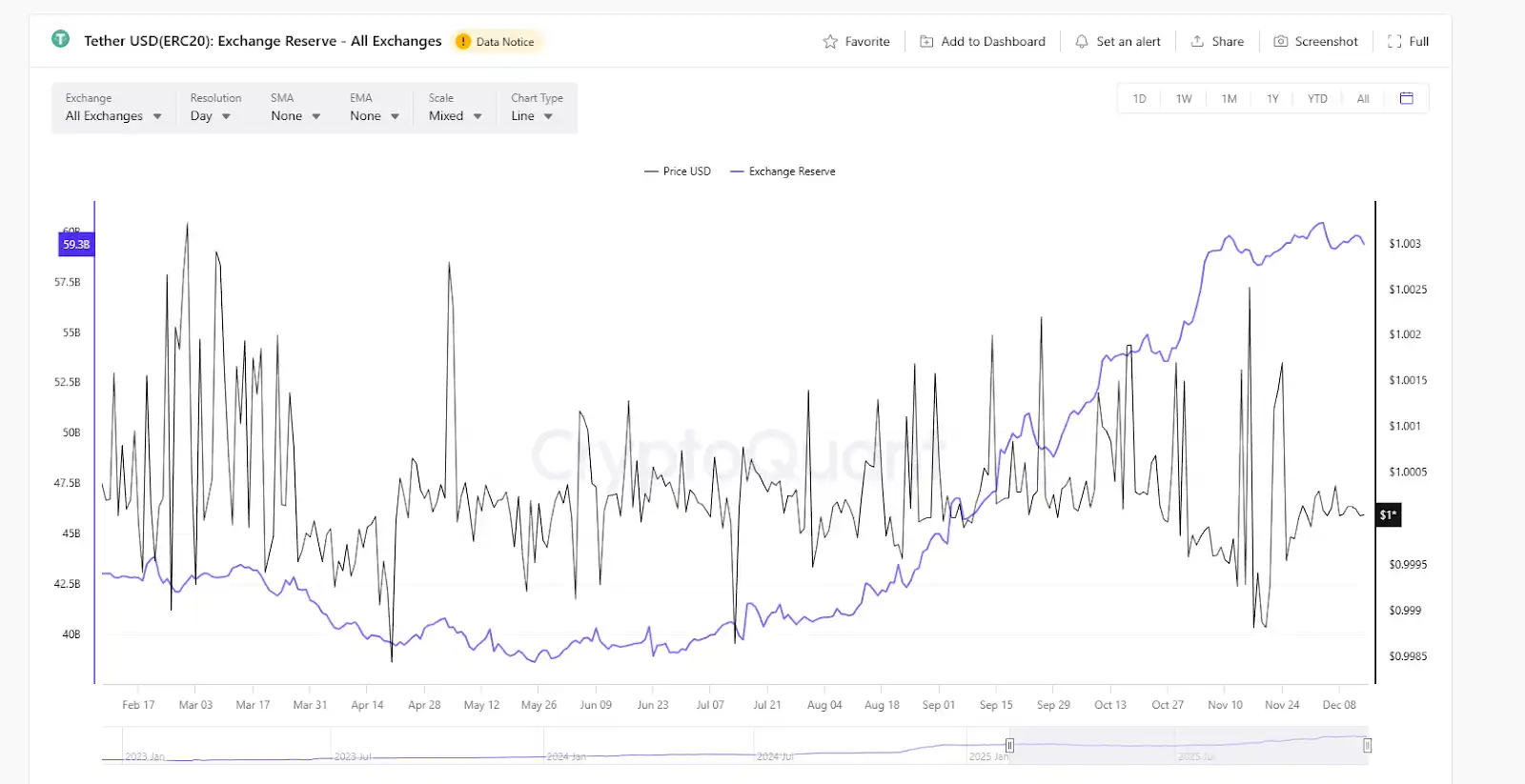
From the contrasting changes of these two, the current market seems to have retail investors and hot money waiting to buy the dip, while compliant institutions are retreating. This point also forms a similar conclusion to the changes in the BTC options market described earlier. Of course, another possibility is that under the downward risk of the market, a large amount of funds are converting crypto asset holdings into stablecoins for避险.

In fact, there are far more data and indicators to judge the market than those mentioned above, but overall, they almost all lead to similar conclusions. That is, the market after the 10.11 crash has not truly recovered; what we are seeing is a market with insufficient liquidity and significant divergence between main players and retail investors. Retail investors and hot money hold筹码观望 within the market, while compliant institutions or main funds are accelerating their withdrawal on the spot side and building short defenses in the options market by paying high premiums.

The current market does not seem to be a bottom gathering momentum for a takeoff, but更像 a defensive battle of "institutions exiting, hot money gambling." At this time, paying attention to whether the institutional defense line below $85,000 is breached is far more practical than expecting a breakthrough above $100,000.


Domande pertinenti

QWhat does the article suggest about the current state of market liquidity after the October 11 crash?

AThe article indicates that the market has not truly recovered but is in a state of continuous liquidity decay, with structural fragmentation where institutional funds are accelerating defensive strategies.

QHow has the order book depth for BTC/USDT perpetual contracts on Binance changed recently?

AThe order book depth for both buy and sell orders has significantly decreased, with buy order depth dropping from over $200 million to the $100-200 million range, and sell order depth also falling below $200 million, indicating reduced liquidity.

QWhat trend is observed in the options market for BTC, and what does it imply about institutional sentiment?

ABTC options now dominate the market with an options/open interest ratio around 90%, up from 60%, showing institutional dominance. However, 75% of the capital in options is betting on or hedging against a decline, reflecting a pessimistic and defensive institutional sentiment.

QWhat divergence is seen in stablecoin flows between USDT and USDC on exchanges?

AUSDT reserves on exchanges have reached a historical high of over $60 billion, indicating speculative capital is waiting on the sidelines, while USDC reserves have dropped 40% from $15 billion to $9 billion, showing compliant institutions are withdrawing from the market.

QWhat is the maximum pain point for BTC options expiring on December 26, and why is it important?

AThe maximum pain point is $100,000, which is a key price level where option sellers (market makers) would profit the most if the market moves to that point, making it a focal point for buyer-seller competition in the options market.

Letture associate

Podcast Notes | Conversation with GSR Asset Management Head: To Determine if This Crypto Rally is Real, Just Watch the Lending Rates on Aave

Podcast Summary: Dialogue with GSR's Head of Asset Management: To Determine if This Crypto Rally is Real, Just Check Lending Rates on Aave Andy Baehr, Managing Director of Asset Management at GSR, discusses the current crypto market, characterizing it as stuck in a state of "ambivalence" with short-lived, unsustainable rallies. He outlines a simple framework: the market moves between "ambivalence" and "conviction" (sustained upward momentum). Currently, every rally resembles a single-stage rocket booster that quickly fizzles out. Baehr identifies three key signals to watch: 1) DeFi lending rates, 2) the potential passage of the CLARITY Act, and 3) the market forming a consensus on the "Fed hawkish peak." He emphasizes that the most immediate indicator for the sustainability of the recent CPI-triggered rally is the USDC borrowing rate on Aave, currently around 3.75%—close to U.S. Treasury yields. The absence of a credit spread indicates low leverage demand and a lack of market energy. He explains that a healthy, sustained rally requires layered buying pressure. Last year's rally progressed from an ETH short squeeze to crypto-native trader influx and finally to ETF inflows. Currently, this structure is missing. Other potential structural buyers like Digital Asset Treasury (DAT) companies are absent, and ETF flows have proven transient. Baehr notes that while small-cap crypto tokens outperformed large caps in Q2—a potential sign of capitation in major assets—capital is also flowing to more exciting opportunities like AI stocks and tech IPOs, leaving crypto sidelined. Regarding DeFi, he highlights that platforms like Aave provide a clear, real-time signal of leverage demand through their supply/demand-driven interest rates. A significant, sustained rate increase would signal genuine market conviction. He also observes the quiet emergence of fixed-income-like products and vaults in DeFi. On regulation, the probability of the CLARITY Act passing before the August 7th deadline has dropped linearly from 75% to below 40% on Polymarket. Baehr suggests its passage would be treated as a bullish surprise, a potent driver for price movement. However, political hurdles, including ethical clause debates and disclosures about the First Family's crypto profits, remain significant obstacles. Ultimately, the market awaits clarity on the Fed's terminal rate under Chair Warsh. Until the "Fed Solstice"—the point where the market collectively understands the peak of hawkish policy—sustained conviction will be difficult to achieve.

marsbit6 min fa

Podcast Notes | Conversation with GSR Asset Management Head: To Determine if This Crypto Rally is Real, Just Watch the Lending Rates on Aave

marsbit6 min fa

7 Months After the Collapse of Huiwang, Southeast Asia's Escrow Platforms Undergo a Major Reshuffle

Following the collapse of Huione Pay—dubbed the "Alipay of Southeast Asia"—seven months ago, the region's underground financial guarantee platform sector is undergoing a significant reshuffle. This power vacuum has been swiftly filled by emerging platforms such as XinBi, Tiger/Navigator, JinBei (renamed JinBo), Dali/Tiancheng, and FullyLight. These platforms, operating largely via Telegram and offering services like escrow for illicit transactions, have absorbed the vast user base and markets left behind by Huione. While positioning themselves as "trust intermediaries," their primary clientele consists of networks involved in online scams, money laundering, illegal gambling, and even human trafficking. For instance, the Tiger/Navigator platform explicitly provides "escrow" services for kidnapping-for-ransom operations ("强押车交易"). Data underscores the immense scale: Huione alone processed over $103 billion in cryptocurrency payments and facilitated over $31 billion through its escrow market before its downfall, linking it to Cambodia's notorious Prince Group. Since its collapse, competitors have seen explosive growth. For example, the XinBi platform has accumulated over $1.6 billion in total USDT revenue, while platforms like NewPay, OkPay (under Dali), and FullyLight Wallet collectively processed over $4.8 billion in USDT in a single year. This ecosystem thrives in regions like Cambodia and Myanmar, where regulatory gaps allow these platforms to act as critical financial infrastructure for sprawling cybercrime industries, from scam compounds to online casinos. The article concludes that the moniker "Southeast Asian Alipay" is a misnomer, obscuring the platforms' fundamental role in enabling serious criminal enterprises rather than representing legitimate financial innovation.

Odaily星球日报1 h fa

7 Months After the Collapse of Huiwang, Southeast Asia's Escrow Platforms Undergo a Major Reshuffle

Odaily星球日报1 h fa

The Changing Landscape: What Are Crypto VCs Experiencing?

Title: The Shifting Landscape of Crypto Venture Capital The era of dedicated crypto venture capital funds is undergoing a significant transformation. Once essential for navigating the sector's complexity and high risk, these specialized funds are now facing an identity crisis as the market matures. This shift mirrors historical patterns in other specialized investment classes like cleantech and SPACs, where initial information advantages dissipate as technologies become mainstream and integrated into existing industry frameworks. The article argues that crypto is reaching a critical inflection point, transitioning from a "building phase" to an "integration phase." Major players like Stripe, BlackRock, and Visa now engage with crypto not for its novel mechanics but as a foundational financial infrastructure. Their needs—regulatory compliance, banking partnerships, distribution channels—align with traditional fintech, a domain easily understood by large, generalist funds like Sequoia and Founders Fund. This evolution creates a "barbell effect" within the VC landscape. On one end are massive, diversified platforms that can incorporate crypto as one vertical among many. On the other are small, nimble funds focused on niche, experimental projects. The middle ground—medium-sized dedicated crypto funds—is being squeezed out. Their typical fund size makes it impossible to generate sufficient returns solely from early-stage crypto bets, yet they cannot compete with giants for later-stage deals. Consequently, leading crypto-native firms like Paradigm and Framework Ventures are expanding into AI, robotics, and other sectors, driven partly by LP pressure for better returns amid a broader VC DPI crisis. Others, like Dragonfly and a16z, have narrowed their crypto focus predominantly to financial infrastructure like stablecoins, reframing the sector's core narrative. For crypto entrepreneurs, this consolidation presents challenges. While generalist funds offer larger checks and broader resources, crypto projects now compete fiercely with AI for attention and capital within these firms. Furthermore, the long-term, non-commercial foundational work that built the ecosystem—funded by dedicated crypto VCs—is less likely to attract generalist capital focused on direct returns. The conclusion is that "crypto investor" as a standalone category is becoming obsolete, akin to "internet investor." Crypto is becoming a baseline infrastructure layer. The future will see a barbell structure: large-scale growth financing handled by generalist funds, while pioneering, speculative projects are funded by small, specialized vehicles. The dedicated crypto funds of the 2017-2021 boom, which incubated core infrastructure, are giving way to this new, bifurcated reality.

Foresight News1 h fa

The Changing Landscape: What Are Crypto VCs Experiencing?

Foresight News1 h fa

Trading

Spot
活动图片




