Mapping RIVER’s path to $22 and beyond as volume surges 45%

ambcryptoPubblicato 2026-03-31Pubblicato ultima volta 2026-03-31

Introduzione

RIVER's price surged 22.48% to $17.12, supported by a 45.24% increase in trading volume, indicating strong buyer participation. Despite the rally, the price remains within a broader range-bound structure, with key resistance levels at $22.68 and $32.83. The RSI has recovered to 47.43 but remains below the bullish threshold of 50-60, suggesting the uptrend is not yet fully confirmed. Negative exchange netflows of -$111.44K indicate accumulation and reduced selling pressure, while a 26.45% rise in Open Interest reflects growing leveraged positions, adding potential volatility. The move shows strength but requires sustained demand to break above resistance and confirm a continued upward trend.

River’s [RIVER] rally accelerated as the price jumped 22.48% to $17.12 at press time, while market cap reached $335.65 million, supported by a 45.24% surge in trading volume. This sharp expansion reflects strong participation entering the market as buyers step in with conviction.

Volume also climbed to $48.19 million, which strengthens the credibility of the move rather than suggesting a weak spike. However, this surge is unfolding within a broader range structure, which keeps the breakout narrative incomplete.

As participation rises and the RIVER price pushes higher, the focus now shifts toward whether this expansion can sustain itself beyond short-term demand.

Can RIVER reclaim higher resistance levels now?

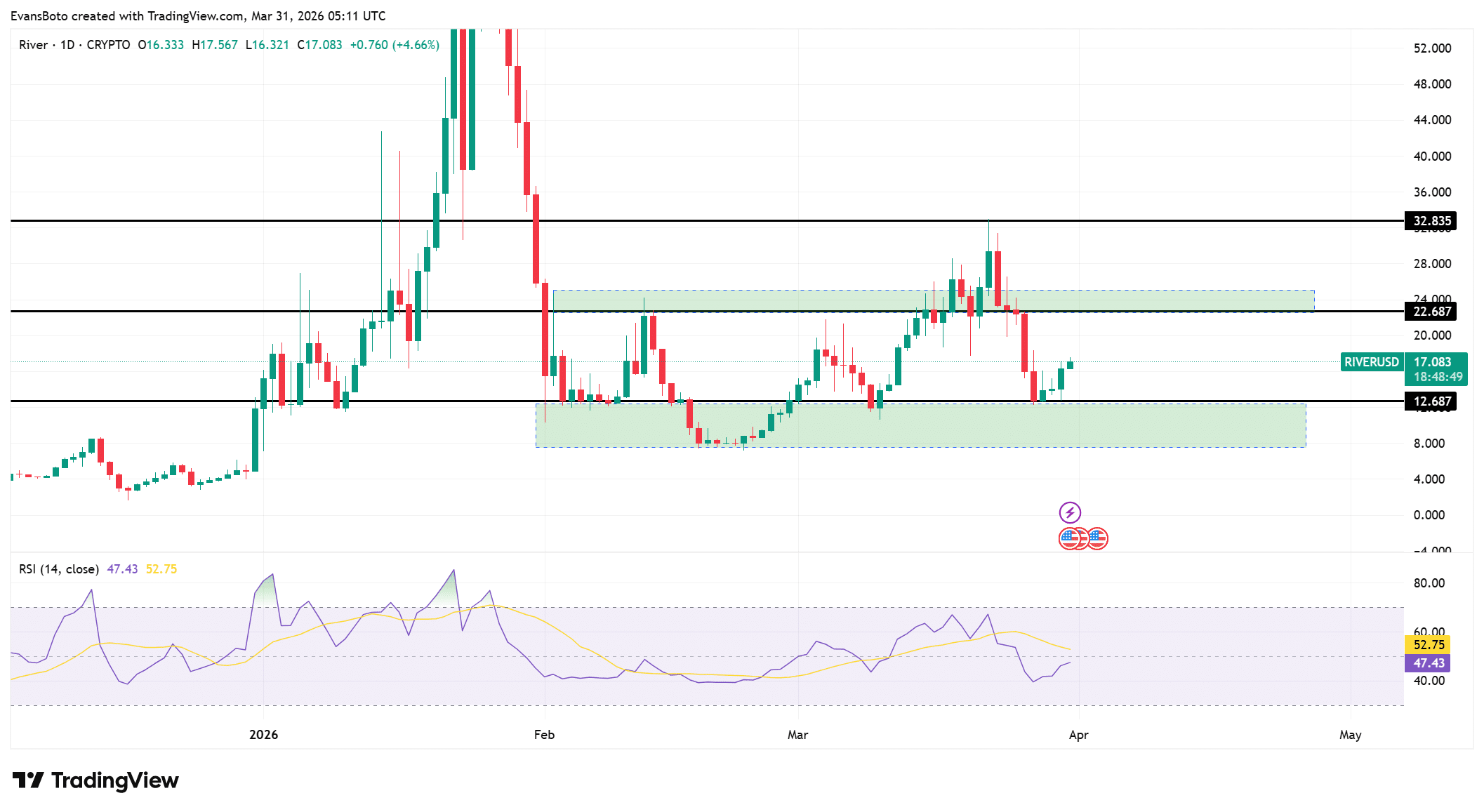
RIVER has rebounded from the $12.68 demand zone and is now pushing toward the $22.68 mid-range resistance. This recovery reflects renewed buying interest after the previous decline. However, the structure remains range-bound, with $32.83 acting as the next major resistance above.

The current move shows strength, yet it still sits within the established range rather than confirming a breakout. As price approaches this mid-range level, sellers could begin to re-enter the market. However, sustained pressure from buyers would be required to absorb this supply and extend the move higher.

At the time of writing, the RSI climbed to 47.43 after rebounding from lower levels, which reflects easing bearish pressure. This recovery suggests that selling intensity has weakened as buyers regain some influence over price direction. However, RSI remains below the key 50–60 zone, which typically signals stronger bullish control.

Such positioning shows that buyers have not fully taken over the trend. As a result, the current recovery appears constructive but incomplete. If RSI continues rising toward higher thresholds, it would reinforce the case for a stronger push toward resistance levels.
Source: TradingView

Exchange outflows support tightening supply narrative

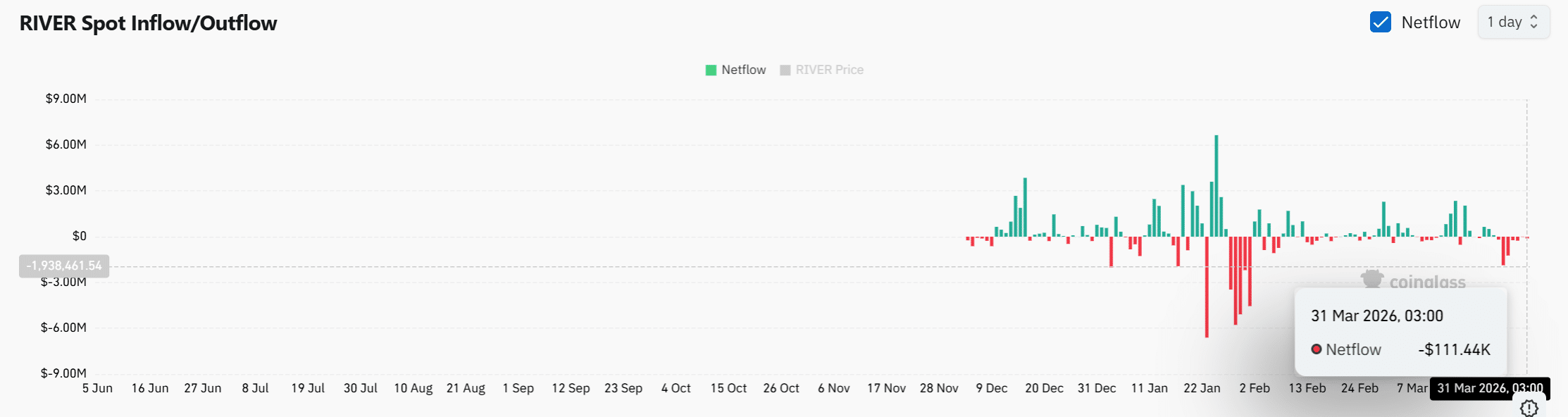
Negative spot netflows printed at -$111.44K as of writing, confirming that tokens are leaving exchanges rather than entering them. This behavior reflects ongoing withdrawals into private wallets, which reduces immediate sell-side availability.

Such outflows often align with accumulation, especially when they occur during a price recovery phase. As supply on exchanges tightens, buyers face less overhead pressure from sellers.

However, the sustainability of this trend remains critical, as continued outflows would support further upside, while any reversal could quickly shift market dynamics.
Source: CoinGlass

Leverage builds as RIVER open interest expands sharply

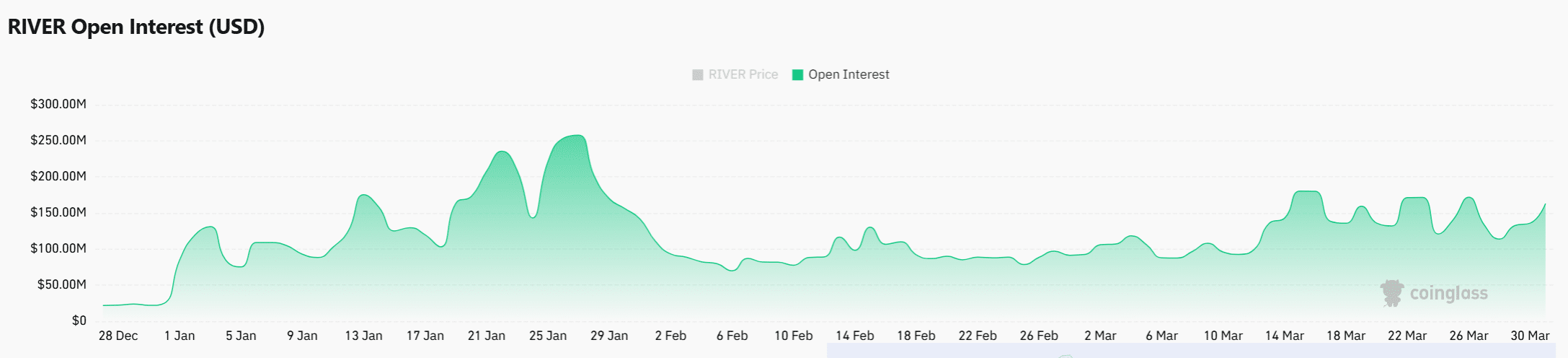
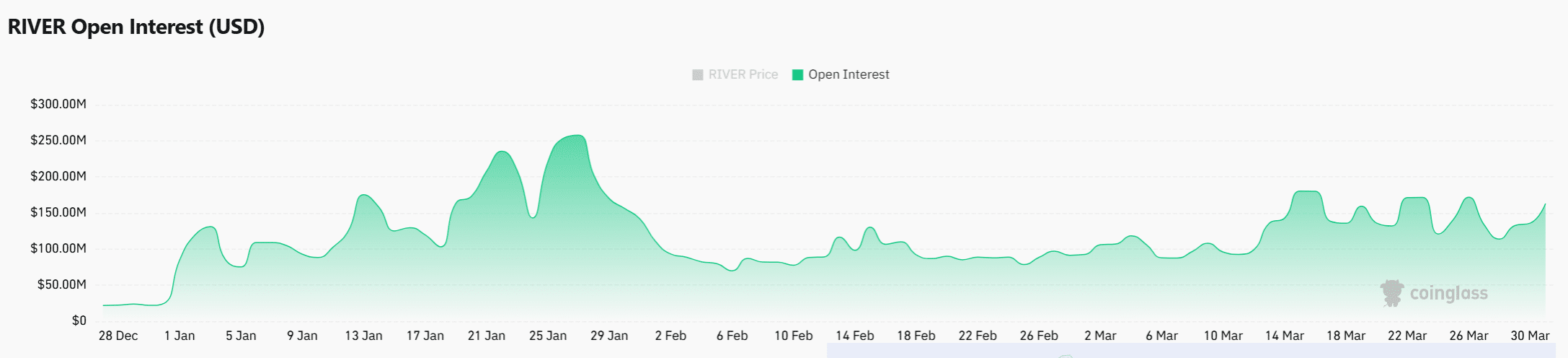
At press time, Open Interest (OI) has risen 26.45% to $173.07 million, which signals that traders are actively increasing their positions during the rally. This expansion shows that market participants are not exiting but instead committing more capital to the move.

Rising OI alongside price growth often reflects strong conviction, yet it also introduces additional risk. If positions become overcrowded, even small price fluctuations could trigger volatility through liquidations.

As leveraged exposure continues to build, price stability will depend on whether spot demand can support this growing speculative positioning.
Source: CoinGlass

RIVER’s rally reflects real demand supported by tightening supply and rising participation. However, price still trades within a range, which limits confirmation of a breakout. RSI has not yet confirmed full bullish control, while rising OI introduces risk.

The current structure suggests strength, yet it requires sustained demand to push beyond resistance and validate continuation.


Final Summary

  • RIVER’s recovery shows strengthening demand, yet resistance ahead could still limit upside without sustained buyer pressure.
  • Rising leverage alongside price growth introduces instability, which could quickly shift direction if conviction weakens unexpectedly.


Domande pertinenti

QWhat was the percentage increase in RIVER's price and its trading volume as mentioned in the article?

ARIVER's price increased by 22.48% and its trading volume surged by 45.24%.

QWhat are the key resistance levels that RIVER is approaching according to the analysis?

ARIVER is pushing toward the $22.68 mid-range resistance, with $32.83 acting as the next major resistance above.

QWhat does the RSI level of 47.43 indicate about the market sentiment for RIVER?

AAn RSI of 47.43 reflects easing bearish pressure and suggests that selling intensity has weakened, but it remains below the key 50-60 zone which signals stronger bullish control, indicating the recovery is constructive but incomplete.

QHow do the exchange netflows and open interest data support the current market narrative for RIVER?

ANegative spot netflows of -$111.44K indicate tokens are leaving exchanges, reducing sell-side availability and supporting the accumulation narrative. Meanwhile, a 26.45% rise in Open Interest to $173.07 million shows traders are increasing positions, reflecting conviction but also introducing leverage risk.

QWhat are the main factors that could limit or jeopardize RIVER's continued price rally?

AThe price is still within a range-bound structure, lacking a confirmed breakout. Rising leverage introduces instability and potential volatility from liquidations. Sustained buyer pressure is required to overcome resistance levels, and a reversal in exchange outflows or weakening conviction could quickly shift market dynamics.

Letture associate

a16z: AI's 'Amnesia', Can Continuous Learning Cure It?

The article "a16z: AI's 'Amnesia' – Can Continual Learning Cure It?" explores the limitations of current large language models (LLMs), which, like the protagonist in the film *Memento*, are trapped in a perpetual present—unable to form new memories after training. While methods like in-context learning (ICL), retrieval-augmented generation (RAG), and external scaffolding (e.g., chat history, prompts) provide temporary solutions, they fail to enable true internalization of new knowledge. The authors argue that compression—the core of learning during training—is halted at deployment, preventing models from generalizing, discovering novel solutions (e.g., mathematical proofs), or handling adversarial scenarios. The piece introduces *continual learning* as a critical research direction to address this, categorizing approaches into three paths: 1. **Context**: Scaling external memory via longer context windows, multi-agent systems, and smarter retrieval. 2. **Modules**: Using pluggable adapters or external memory layers for specialization without full retraining. 3. **Weights**: Enabling parameter updates through sparse training, test-time training, meta-learning, distillation, and reinforcement learning from feedback. Challenges include catastrophic forgetting, safety risks, and auditability, but overcoming these could unlock models that learn iteratively from experience. The conclusion emphasizes that while context-based methods are effective, true breakthroughs require models to compress new information into weights post-deployment, moving from mere retrieval to genuine learning.

marsbit1 h fa

a16z: AI's 'Amnesia', Can Continuous Learning Cure It?

marsbit1 h fa

Can a Hair Dryer Earn $34,000? Deciphering the Reflexivity Paradox in Prediction Markets

An individual manipulated a weather sensor at Paris Charles de Gaulle Airport with a portable heat source, causing a Polymarket weather market to settle at 22°C and earning $34,000. This incident highlights a fundamental issue in prediction markets: when a market aims to reflect reality, it also incentivizes participants to influence that reality. Prediction markets operate on two layers: platform rules (what outcome counts as a win) and data sources (what actually happened). While most focus on rules, the real vulnerability lies in the data source. If reality is recorded through a specific source, influencing that source directly affects market settlement. The article categorizes markets by their vulnerability: 1. **Single-point physical data sources** (e.g., weather stations): Easily manipulated through physical interference. 2. **Insider information markets** (e.g., MrBeast video details): Insiders like team members use non-public information to trade. Kalshi fined a剪辑师 $20,000 for insider trading. 3. **Actor-manipulated markets** (e.g., Andrew Tate’s tweet counts): The subject of the market can control the outcome. Evidence suggests Tate’sociated accounts coordinated to profit. 4. **Individual-action markets** (e.g., WNBA disruptions): A single person can execute an event to profit from their pre-placed bets. Kalshi and Polymarket handle these issues differently. Kalshi enforces strict KYC, publicly penalizes insider trading, and reports to regulators. Polymarket, with its anonymous wallet-based system, has historically been more permissive, arguing that insider information improves market accuracy. However, it cooperated with authorities in the "Van Dyke case," where a user traded on classified government information. The core paradox is reflexivity: prediction markets are designed to discover truth, but their financial incentives can distort reality. The more valuable a prediction becomes, the more likely participants are to influence the event itself. The market ceases to be a mirror of reality and instead shapes it.

marsbit2 h fa

Can a Hair Dryer Earn $34,000? Deciphering the Reflexivity Paradox in Prediction Markets

marsbit2 h fa

Trading

Spot
Futures

Articoli Popolari

Come comprare RIVER

Benvenuto in HTX.com! Abbiamo reso l'acquisto di River (RIVER) semplice e conveniente. Segui la nostra guida passo passo per intraprendere il tuo viaggio nel mondo delle criptovalute.Step 1: Crea il tuo Account HTXUsa la tua email o numero di telefono per registrarti il tuo account gratuito su HTX. Vivi un'esperienza facile e sblocca tutte le funzionalità,Crea il mio accountStep 2: Vai in Acquista crypto e seleziona il tuo metodo di pagamentoCarta di credito/debito: utilizza la tua Visa o Mastercard per acquistare immediatamente RiverRIVER.Bilancio: Usa i fondi dal bilancio del tuo account HTX per fare trading senza problemi.Terze parti: abbiamo aggiunto metodi di pagamento molto utilizzati come Google Pay e Apple Pay per maggiore comodità.P2P: Fai trading direttamente con altri utenti HTX.Over-the-Counter (OTC): Offriamo servizi su misura e tassi di cambio competitivi per i trader.Step 3: Conserva River (RIVER)Dopo aver acquistato River (RIVER), conserva nel tuo account HTX. In alternativa, puoi inviare tramite trasferimento blockchain o scambiare per altre criptovalute.Step 4: Scambia River (RIVER)Scambia facilmente River (RIVER) nel mercato spot di HTX. Accedi al tuo account, seleziona la tua coppia di trading, esegui le tue operazioni e monitora in tempo reale. Offriamo un'esperienza user-friendly sia per chi ha appena iniziato che per i trader più esperti.

519 Totale visualizzazioniPubblicato il 2026.01.16Aggiornato il 2026.01.16

Come comprare RIVER

Discussioni

Benvenuto nella Community HTX. Qui puoi rimanere informato sugli ultimi sviluppi della piattaforma e accedere ad approfondimenti esperti sul mercato. Le opinioni degli utenti sul prezzo di RIVER RIVER sono presentate come di seguito.

活动图片