Making a Fortune of $10.32 Million: The World Cup Money-Printing Tactic of a Polymarket Whale

Foresight NewsPubblicato 2026-07-13Pubblicato ultima volta 2026-07-13

Introduzione

**Earning $10.32 Million: A Polymarket Whale's World Cup Profit Strategy** While teams battle for the World Cup trophy, a hidden whale nicknamed "swisstony" has been quietly making a fortune on the prediction market Polymarket. This account, created around July 2025, boasts total profits of $18.62 million, with $10.33 million earned in the past month alone. With a 52.9% win rate, it has placed over 139,600 predictions, averaging about 380 trades per day—indicating it is likely a high-frequency quantitative bot. The account's signature "trash panda" aptly describes its strategy: sifting through vast market data and tiny price discrepancies to build wealth. Its current holdings are heavily concentrated on the France vs. Spain semi-final, including a roughly $160,000 bet against France. Analysis shows two core tactics driving its success: 1. **High-Volume "Anti-Favorite" Bets:** Placing large wagers (often $400k-$1M) against overvalued favorites like Germany or England, buying "No" shares at favorable prices when market-implied win probability is 46%-64%. It has recorded over 17 individual profits exceeding $1 million using this method. 2. **"Lottery-Ticket" Bets on Extreme Long Shots:** Allocating small amounts (thousands of dollars) to buy shares priced as low as 0.2¢-1.2¢ on outcomes deemed nearly impossible. While most of these bets lose, the occasional win—like those with payouts over 100x—generates significant profits (over $100,000 per hit) that boost overall returns...


Written by: Ma He, Foresight News


On the World Cup field, while teams fiercely compete for the championship trophy, a hidden whale has been quietly making a fortune on the prediction market.


An account on Polymarket with the nickname swisstony has a total historical profit of $18.62 million, with nearly $10.33 million earned in the last month alone. The account was first registered around July 2025, a relatively short time ago, but due to its astonishing profits, its profile page views have surged to 922,200.
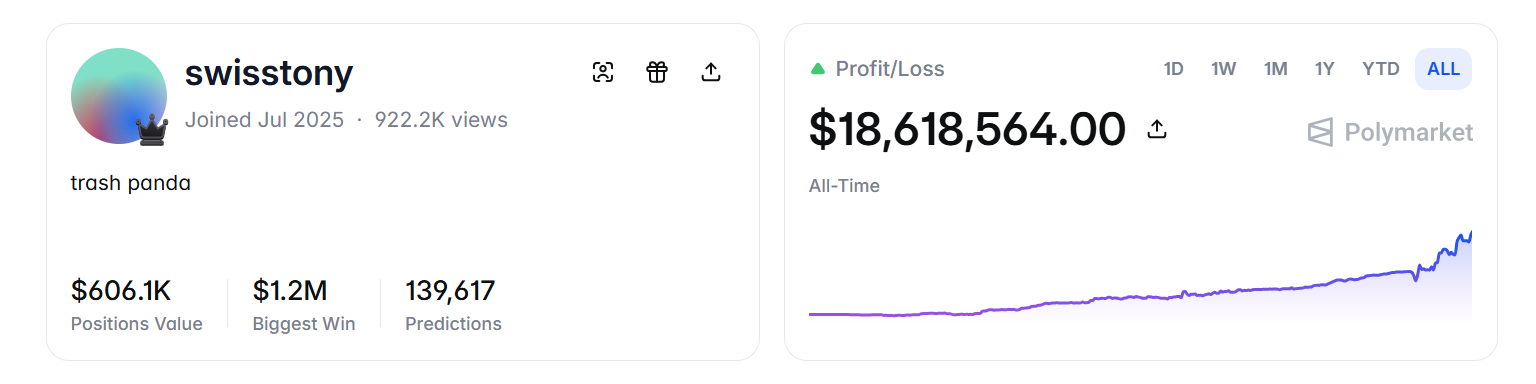


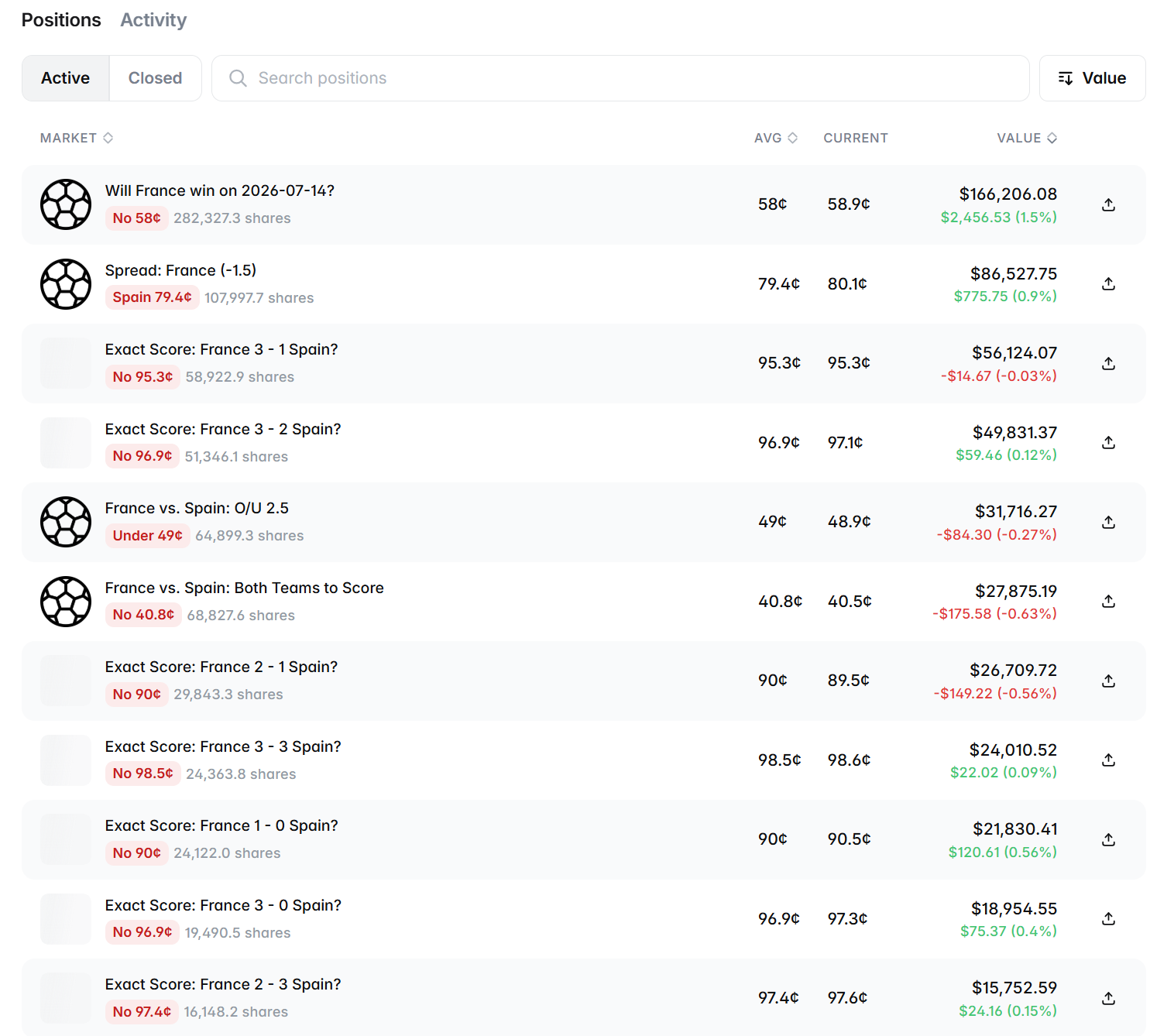
As of July 13, the account has made a total of 139,617 predictions, with its current portfolio valued at approximately $606,100. Notably, its current holdings are almost entirely concentrated on the FIFA World Cup semi-final match between France and Spain on July 14, 2026. This includes a bet of around $160,000 on France losing the match. Additionally, it has placed numerous bets, primarily "NO" positions, on specific score details, aiming for 5%-10% returns.


The account's win rate is maintained around 52.9%, with total trading positions exceeding 245,000 and trading volume reaching hundreds of millions of dollars. These figures place it in the top tier within the overall Polymarket ecosystem. Public research indicates that most retail addresses incur long-term losses, while a few high-frequency, systematic accounts achieve significant positive returns through scaled execution. swisstony's data win rate is not extremely high, but combined with extremely high trading frequency and position management, it amplifies its positive EV (Expected Value) edge.


Since creating the account about a year ago, this address has completed 139,617 prediction operations. On average, this translates to about 380 trades per day, 16 per hour, operating 24/7 without rest. It is highly likely an API-driven, ultra-high-frequency quantitative trading bot.


Its profile description reads "trash panda." In North American culture, raccoons are survival experts known for rummaging through trash bins. This signature perfectly summarizes its core strategy: making money from the vast data garbage and tiny price discrepancies on Polymarket, ultimately building a multi-million dollar empire.


Over 17 Profits Exceeding $1 Million


Looking through the account's profit history, its astonishing aspect is that it has recorded over 17 instances where profits exceeded $1 million. The largest single profit came from a bet on Germany's match on June 25. The whale bet "NO," earning $2,221,241 with a return of 111.67%.
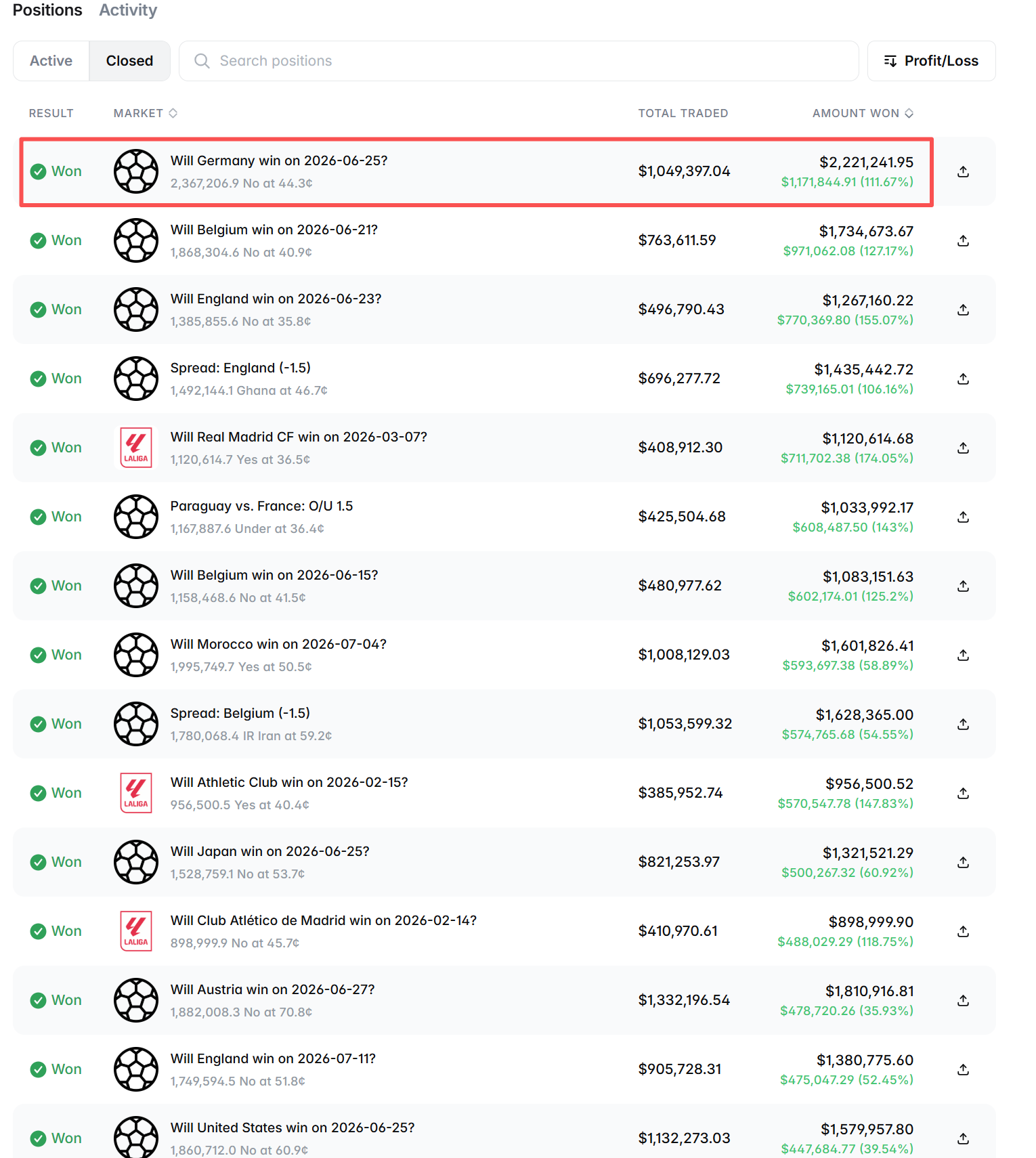


The ROI shown in the screenshot is generally very high, with clear advantages in entry prices. The investment scale is substantial, with single bets often in the $400,000 to $1 million range.


This whale favors placing large "NO" bets (against winning) on strong teams perceived as overvalued by the market: Germany, Paraguay (multiple appearances), England, and Japan. Entry prices mostly ranged from 35.8¢ to 53.7¢, implying market-implied win probabilities for these strong teams between 46% and 64% at the time, but the actual result was that they lost or did not win. This is a classic anti-favorite strategy.


100x Returns


On prediction markets, when events deemed impossible by the market actually occur, the profit returns can be extremely exaggerated. This whale excels not only at winning big with big bets but also demonstrates high skill in winning big with small bets.


Taking the matches in the image as examples, the entry prices were extremely low: 0.2¢ to 1.2¢ (market-implied probability only 0.2% to 1.2%). The invested capital per bet was mostly only a few thousand dollars, yet each contributed profits exceeding $100,000.
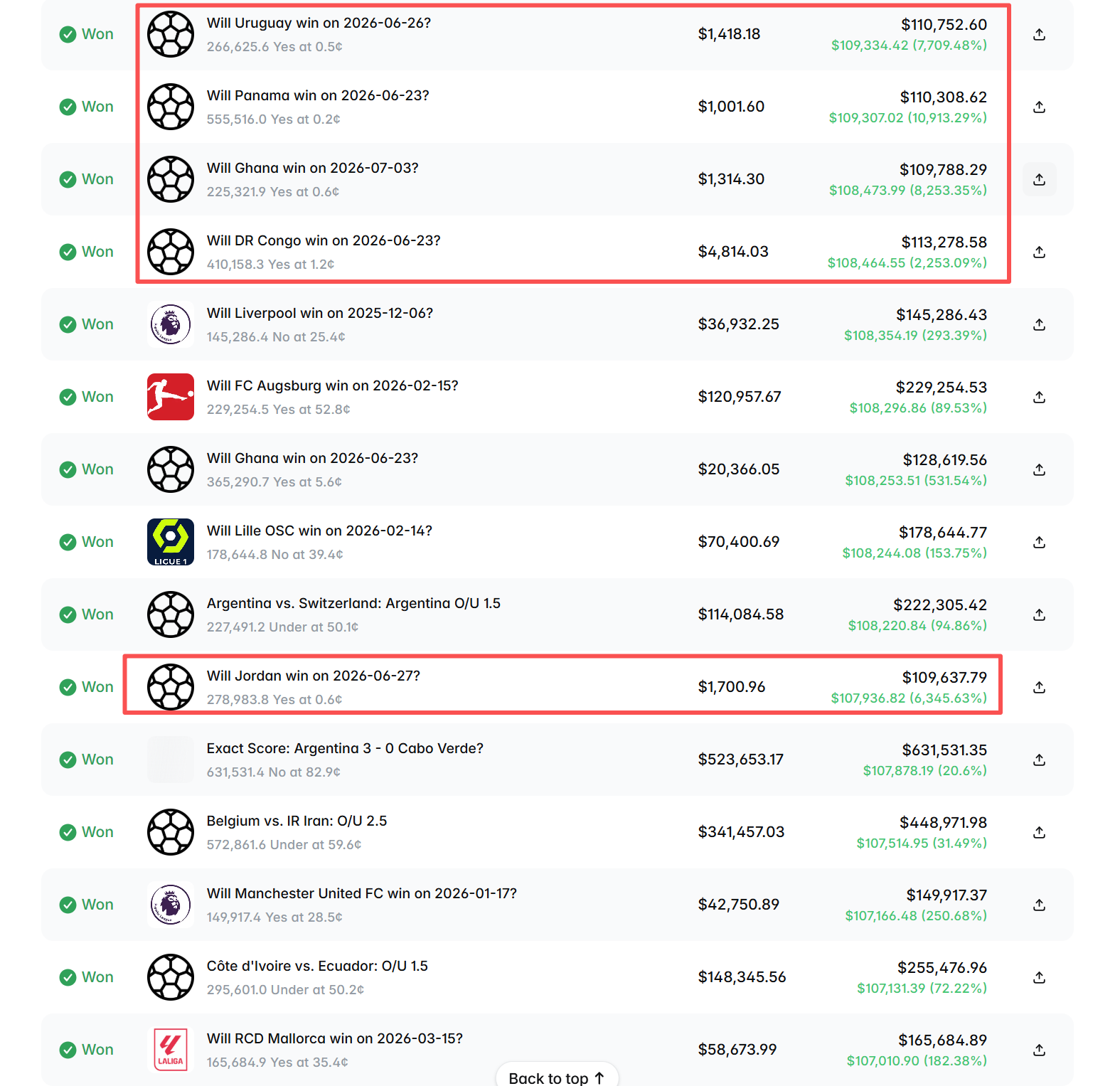


These events, originally considered nearly impossible by the market, actually happened. The account captured high returns with minimal cost.


Deploying small capital on extremely low-probability events is akin to a systematic "lottery ticket" approach. When it hits, it can contribute profits of $100,000+ with very low cost, serving as an excellent supplement to overall profitability. Although the risk capital per trade in such high-multiple trades is low, the win rate is extremely low. Most similar bets would lose all capital.


Even though most such bets will lose (because the probabilities are indeed very low), as long as a few hit occasionally, they can significantly boost total profit without costing too much principal.


Overall, it's highly likely that the account's automated system covers a large number of niche, low-liquidity markets where severe mispricing is more likely to occur. It then executes a dual-track strategy for profitability.


Large capital bets against popular strong teams, and small capital bets on extreme underdogs. The combination of both ensures stable, substantial profits while also enhancing overall returns through high-multiple trades.


Domande pertinenti

QWhat is the total profit and recent one-month profit of the Polymarket account 'swisstony'?

AThe total historical profit of the Polymarket account 'swisstony' is 18.62 million USD, with a recent one-month profit of 10.33 million USD.

QWhat are the key characteristics of 'swisstony's' trading strategy on Polymarket?

A'swisstony' likely uses an API-driven, ultra-high-frequency quantitative trading bot. The strategy is characterized by high transaction frequency (approximately 380 trades per day), a focus on anti-favorite bets against overestimated strong teams, and a dual-track approach combining large, steady bets with small, high-multiplier 'lottery-style' bets on extreme longshots.

QHow many trades has the 'swisstony' account completed, and what does this imply about its operation?

AThe 'swisstony' account has completed 139,617 prediction trades. This implies the operation is highly automated, averaging about 380 trades per day or 16 trades per hour, running continuously.

QWhat is the significance of the 'trash panda' signature in the account's profile?

AIn North American culture, a 'trash panda' (raccoon) is a survival expert that forages in garbage bins. This signature metaphorically summarizes the account's core strategy: profiting from the vast amount of data 'trash' and tiny price discrepancies on Polymarket to build a multi-million dollar empire.

QDescribe the dual-track betting strategy mentioned in the article for generating profits.

AThe dual-track strategy involves two parallel approaches: 1) Using large amounts of capital to place 'No' bets (betting against victory) on overvalued favorite teams, securing stable, substantial profits. 2) Allocating small amounts of capital to place bets on extremely low-probability, high-odds outcomes (like specific match scores), aiming for massive, lottery-like returns when these longshots hit, thereby boosting the overall return rate.

Letture associate

Chainlink Tests Support As CCIP Moves From Hype To Usage

Chainlink's LINK token is testing key support levels as market focus shifts from the hype around its Cross-Chain Interoperability Protocol (CCIP) to assessing its real-world usage and adoption. While Chainlink maintains a strong position as core crypto infrastructure—providing oracles, data feeds, and automation—the market is increasingly demanding measurable evidence that its services, particularly CCIP, are gaining sustained traction. CCIP is central to Chainlink's long-term value proposition, aiming to solve critical cross-chain messaging and asset transfer challenges for institutions, DeFi, and multi-chain applications. The protocol's narrative is strong, but traders are now looking beyond announcements and integrations to metrics like transaction volume, value transferred, and developer adoption in production environments. Despite its utility, LINK's price action remains influenced by broader altcoin market cycles. The current support test blends technical factors with fundamental questions about CCIP's growth. If LINK holds support alongside clear evidence of increasing CCIP usage, it could reinforce its status as a leading infrastructure play. However, if support fails without corresponding usage growth, trader caution may persist. The key for Chainlink is transitioning CCIP from a promising concept into a widely used standard, turning its established market role into consistent token demand.

bitcoinist3 h fa

Chainlink Tests Support As CCIP Moves From Hype To Usage

bitcoinist3 h fa

Trading

Spot
活动图片