LINK Has Fallen More Than Half From Its High, But Someone Quietly Hoarded 100 Million Tokens During the 'October 11 Crash'

marsbitPubblicato 2026-01-29Pubblicato ultima volta 2026-01-29

Introduzione

Based on in-depth on-chain analysis, 48 wallets were identified holding nearly identical amounts of LINK (around 2 million each), all created between August and November 2025 and receiving funds from the same Coinbase hot wallet. These wallets, showing highly synchronized accumulation pattern, are believed to belong to a single entity that acquired approximately 100 million LINK (10% of total supply) during this period. The entity executed a carefully designed strategy to avoid market impact, leveraging the October 10 market crash—caused by API failures and panic selling—to accumulate during high liquidity. Most wallets (39) were created in October and November, coinciding with a sharp drop in exchange balances. Possible buyers include institutional players like BlackRock or JPMorgan, given their strategic interest in tokenization and use of Chainlink's infrastructure. Chainlink Labs is less likely due to contradictory public positioning. The scale and precision suggest institutional involvement rather than individual speculation. This accumulation—amounting to exactly 1/10 of total supply—implies long-term strategic intent, potentially preparing for future utility in financial infrastructure. While bullish, it also introduces concentration risk. The event marks one of the most significant on-chain patterns in LINK's history.

According to in-depth on-chain data analysis, while researching the top 100 wallets by LINK holdings, I discovered an unusual pattern.

Multiple wallets hold almost exactly the same amount of LINK, approximately 2 million tokens each, and hold no other assets. Initially, I identified 8 to 9 such wallets, but further investigation revealed these were just the tip of the iceberg.

Ultimately, I found a total of 48 wallets with nearly identical LINK balances and highly consistent transaction patterns. Based on this consistency, I believe they are all controlled by the same entity.

In other words, between August 2025 and January 2026, a certain entity accumulated approximately 100 million LINK, accounting for 10% of its total supply.

Clearly, this entity went to great lengths to remain hidden. Its accumulation strategy was meticulously designed to avoid drawing attention or affecting the market price.

Why Conclude These Wallets Belong to the Same Entity?

Several key pieces of evidence support this:

· Each wallet holds about 2 million LINK.

· All wallets were created between August and November 2025.

· All purchases originated from the same Coinbase hot wallet address: 0xA9D1e08C7793af67e9d92fe308d5697FB81d3E43.

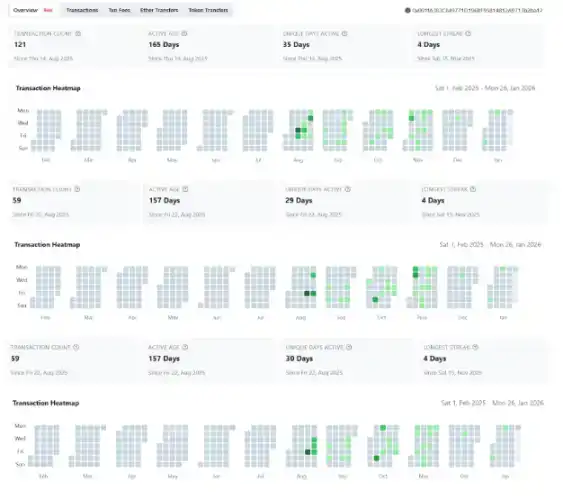
The most compelling evidence is the transaction heatmap comparison. The heatmaps of these wallets are strikingly similar, executing a similar number of LINK transactions on the same dates, following the same accumulation rhythm.

There are slight timing differences: wallets created later made larger initial purchases, while earlier ones were more gradual. But after the initial period, all wallets began making consistent purchases on the same dates each month.

For example, observing wallets 54, 55, and 56, the August data is slightly different, but the transaction behavior from September to January is almost completely synchronized. This pattern repeats across all 48 wallets, as if operating on the same schedule.
Why Did the Market Not React to the Accumulation of 10% of the Supply?

The answer is simple: the entity竭力 (strived) to avoid disturbing the market.

They used anonymous wallets with no public institutional links and structured their purchases in batches to avoid sudden spikes in demand. The goal was clear: accumulate LINK discreetly without triggering market follow-ups or speculation.

To achieve this, they leveraged a rare market event.

The Market Crash of October 10th

According to Raoul Pal, market makers were unable to access APIs at that time, causing a severe imbalance in the crypto market. Simultaneously, tariff concerns triggered panic selling, flooding the order books with sell orders. With a lack of buyers to absorb them, the market went into a free fall.

To prevent a complete collapse, trading platforms were forced to intervene, placing a significant number of buy orders to absorb the selling pressure, thereby accumulating a large inventory of crypto assets.

In the weeks following the crash, these assets were gradually released back into the market throughout October and November, creating sustained selling pressure and unusually abundant liquidity.

This was the perfect timing for discreet accumulation.

The entity behind these wallets used this liquidity window to heavily absorb LINK while avoiding pushing up the price. It is worth noting that 39 of the 48 wallets were created precisely in October and November, the period of highest liquidity.

Two Possible Motives

First, opportunistic accelerated accumulation. The entity saw the market crash as a rare chance to speed up its accumulation progress, a process that might otherwise have taken many more months.

Second, an emergency strategic reserve. The entity may have had an urgent need to acquire LINK and used the liquidity to complete its position discreetly, avoiding price volatility. Whether this urgency stemmed from strategic needs or external pressure is currently unclear.

Impact on Exchange Balances

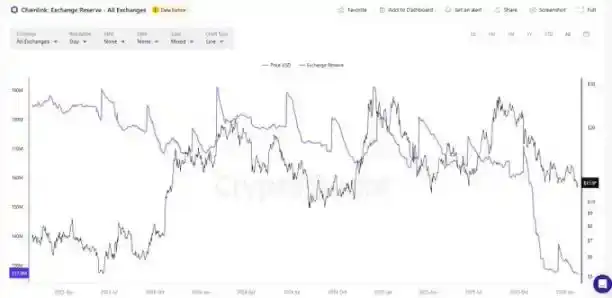
The buying spree from the new wallets highly coincides with the sharp drop in LINK balances on exchanges shown by CryptoQuant data from October to November.

This decline corresponds exactly to the creation of 39 new wallets, each accumulating about 2 million LINK during this period.
Who Could Be the Entity Behind This?

The range of possibilities for an entity accumulating 10% of the LINK supply is significantly narrowed.

Chainlink Labs

Low probability. Chainlink officially holds about 300 million LINK as non-circulating supply, which is publicly labeled and accounted for in planning. Furthermore, Chainlink has publicly announced weekly buybacks of $1 million worth of LINK; secretly hoarding nearly $1 billion worth of LINK simultaneously would contradict its public stance.

However, the timing is noteworthy: accumulation began on August 11, 2025, just 4 days after the announcement of the Chainlink reserve mechanism, which might have signaled long-term optimism to the outside world.

BlackRock

This is one of the more plausible speculations. With $14 trillion in assets under management, BlackRock has repeatedly stated that tokenization is the future of financial markets. Its BUIDL fund, exceeding $3 billion, heavily relies on Chainlink's CCIP, Proof of Reserve, and data services.

Holding 100 million LINK could help it secure a strategic position in tokenization infrastructure. Relative to its size, this allocation is not large but is significant. Secret accumulation also makes sense; announcing a large purchase upfront would significantly drive up the price.

JPMorgan Chase

Also a strong possibility. This trillion-dollar asset bank is rapidly expanding its blockchain division (Kinexys, formerly Onyx) and has become one of the most active traditional institutions in the field of tokenized assets and cross-chain finance.

Its tokenized money market, fund flow projects, and multiple public chain settlements in 2025 all rely on Chainlink's CCIP, runtime environment, and oracle data streams. Holding 100 million LINK could help establish a strategic position in interoperability and oracle infrastructure between its permissioned chains and public chains, ensuring priority access, staking rewards, and reducing dependency risks.

Interestingly, JPMorgan's actions around the October 10th crash are worth pondering. Just days before the crash, the bank issued a bearish report, warning of the vulnerability of crypto-related stocks amid geopolitical risks. Although the crash was primarily caused by external factors, the combination of the bearish report and the subsequent liquidity vacuum leads to speculation that large institutions might have taken the opportunity to build positions discreetly.

Financial Infrastructure Institutions (e.g., DTCC, SWIFT)

Low probability. Such institutions typically do not hold strategic token reserves. More importantly, if Chainlink is to become a core part of their future infrastructure, it is unlikely that DTCC or SWIFT would tolerate an unknown entity controlling 10% of the LINK supply—this would pose an unacceptable systemic risk.

Another detail is worth noting:

All 48 wallets were created between August and November 2025, with the last one established on November 20th—just two days before SWIFT's activation of the new ISO 20022 standard, a project in which Chainlink is a participant.

The coincidence in timing, while not conclusive evidence of causality, is hard to ignore. If LINK is to play an important role in future financial communication, settlement, or interoperability infrastructure, establishing a strategic reserve beforehand is undoubtedly a reasonable long-term布局 (layout).

For institutions aiming for long-term integration rather than short-term speculation, locking in supply early reduces execution risk, mitigates price impact, and lessens dependence on future market liquidity.

High-Net-Worth Individuals

Extremely low probability. 100 million LINK is worth over $1 billion. The number of individuals who can mobilize capital of this magnitude is极小 (extremely small), and concentrating it into a single crypto asset without a clear strategic purpose is even rarer.

My View

I believe this is almost certainly the work of a large institution. Without deep market knowledge and institutional-grade execution capability, it is impossible to accumulate 10% of the supply without moving the price.

Increasing purchases during the high-liquidity period following the October 10th crash particularly points to institutional behavior. They knew high liquidity allowed frequent buying without raising the price. This level of coordination is far beyond the capability of the average individual investor.

It is also noteworthy that the accumulation amount is exactly 100 million LINK, precisely one-tenth of the total supply. This shows the scale was intentionally set, not randomly accumulated, reflecting a long-term strategic intent for the project.

Accumulating 100 million LINK is unlikely to be for speculative purposes alone. It预示着 (suggests) the token may have practical application scenarios in the future. The entity seems to be preparing for a future where Chainlink underpins critical financial infrastructure and is building reserves accordingly.

Until the entity's identity is revealed, uncertainty remains. But the fact that a single entity may have accumulated 10% of the LINK supply for future use is significantly bullish in itself.

What Happens Next?

If the buyer is a large institution, the subsequent impact could be very positive. Other asset management companies and infrastructure providers might scramble to build their own LINK reserves, but replicating this slow, discreet accumulation process is almost impossible. Latecomers may be forced to buy at high prices, significantly driving up the price.

At the same time, concentration risk cannot be ignored. Controlling 10% of the supply implies significant influence, and with the entity's intentions unclear, its future actions remain a key variable.

The following points are clear:

· This accumulation is real.

· Its strategy is highly sophisticated.

· The scale involved is extraordinary.

Whether this is early positioning by a large institution or something else, it is one of the most noteworthy on-chain patterns in LINK's history.


Crypto di tendenza

Domande pertinenti

QWhat key evidence suggests that the 48 wallets are controlled by a single entity?

AThe key evidence includes: each wallet holds approximately 2 million LINK; all wallets were created between August and November 2025; all purchases originated from the same Coinbase hot wallet address (0xA9D1e08C7793af67e9d92fe308d5697FB81d3E43); and their transaction heatmaps are strikingly similar, showing nearly identical trading patterns and accumulation rhythms on the same dates.

QHow did the entity manage to accumulate 100 million LINK (10% of supply) without significantly impacting the market price?

AThe entity used anonymous wallets with no public institutional links and structured their purchases in batches to avoid sudden spikes in demand. They capitalized on the high liquidity window following the October 10 market crash, where panic selling and exchange interventions created abundant sell-side liquidity, allowing them to accumulate large amounts without driving up the price.

QWhich two major traditional financial institutions are considered the most likely candidates behind this accumulation, and why?

ABlackRock and JPMorgan are the most likely candidates. BlackRock, with its $14 trillion AUM, has emphasized tokenization as the future of financial markets and relies heavily on Chainlink's services for its BUIDL fund. JPMorgan, a trillion-dollar bank, is rapidly expanding its blockchain division and uses Chainlink's CCIP and oracle services for tokenized assets and cross-chain finance. Both have the resources, strategic interest, and need to accumulate LINK discreetly to avoid price impact.

QWhat was the significance of the October 10 market crash in relation to the accumulation strategy?

AThe October 10 crash created a rare liquidity event due to API failures at market makers and panic selling, resulting in a flood of sell orders and minimal buy-side support. Exchanges intervened by placing large buy orders to absorb the selling pressure, accumulating crypto inventory. This inventory was gradually released over October and November, providing sustained selling pressure and abundant liquidity, which the entity used to accelerate its accumulation without affecting the price.

QWhy is it unlikely that this accumulation was done by a high-net-worth individual or for purely speculative purposes?

AAccumulating 100 million LINK (worth over $1 billion) requires immense capital and institutional-grade execution to avoid price impact. The coordinated, structured approach across 48 wallets, the precise timing to exploit market liquidity, and the strategic scale (exactly 10% of supply) suggest long-term strategic intent for future utility in financial infrastructure, not short-term speculation. Few individuals have both the resources and the expertise to execute such a operation.

Letture associate

As Consensus Accelerates, What Are Young Investors Betting On?

Title: As Consensus Forms Faster, What Are Young Investors Betting On? In the rapid evolution of tech investment, a new generation of young investors is navigating a landscape where AI, robotics, commercial aerospace, and quantum computing are advancing simultaneously. Traditional investment logic based on financial models is giving way to a need for deep technical understanding and the ability to act before industry consensus forms. An analysis of trends from the "WAIC FUTURE TECH" list of young investment leaders reveals key shifts in focus. The first major trend is the movement of AI from the digital screen into the physical world. Investment is shifting from large language models and chatbots towards embodied AI, robotics, AI hardware, and edge computing. While demonstrations generate excitement, the real challenge lies in achieving scalable, reliable, and cost-effective delivery in complex real-world environments like factories and logistics. Success depends not just on algorithms but on the integration of sensors, actuators, and control systems. Second, the competitive focus for large models is moving beyond raw capability toward building an "intelligence flywheel." The goal is to create self-reinforcing systems where user interaction generates data, improving the model, which in turn enhances the user experience and attracts more engagement. Companies that successfully embed AI into workflows to create these closed-loop systems can build lasting value that isn't easily erased by the next model upgrade. Third, facing a potential bottleneck in high-quality human-generated data, investors are looking at new underlying technologies. Reinforcement learning and self-play, as demonstrated by AlphaGo Zero, offer paths for AI to generate its own experience. Scientific foundation models, which aim to build general AI capabilities for fields like life sciences and materials discovery, represent a non-consensus direction that could unlock new frontiers of knowledge and data. Finally, in deep-tech areas like quantum computing, commercial aerospace, and space-based infrastructure, patient capital is essential. These fields have long, uncertain development and validation cycles involving complex engineering, supply chains, and regulations. Investment here requires a long-term view, focusing on foundational team capabilities and the eventual emergence of market demand, even if commercial returns are distant. Collectively, these trends illustrate how young investors are adapting to a new era. They are learning to make earlier, technically-informed judgments, balance hype with real-world viability, and provide the patient capital needed to build the deep-tech foundations of the future.

marsbit5 min fa

As Consensus Accelerates, What Are Young Investors Betting On?

marsbit5 min fa

Can Japan Buy Growth with AI? Will the Bond Market Believe It?

Japan's cabinet has introduced the 2026 Basic Policy on Economic and Fiscal Management and Reform, shifting its primary fiscal target. The new framework moves away from the traditional annual primary balance goal and instead prioritizes a stable reduction of the debt-to-GDP ratio. This change is tied to a strategy of increased "responsible proactive fiscal" spending, aiming to boost long-term growth through investments in strategic sectors like AI, semiconductors, energy, and robotics. The government estimates total public and private investment in 62 key technologies could exceed 370 trillion yen by 2040. The market reaction has been mixed and cautious. While equity markets may respond to policy signals, bond markets are focused on fiscal credibility. Concerns center on whether the weakening of the clear primary balance anchor could lead to looser fiscal discipline. If investors doubt that these strategic investments will generate sufficient productivity gains, tax revenue, and nominal growth to outpace rising interest costs, they may demand higher yields on Japanese Government Bonds (JGBs). Recent volatility in the yen and JGB yields, with the 10-year yield briefly reaching 2.9%, reflects this skepticism. The success of this new framework hinges on two factors: whether Japan can achieve a nominal growth rate consistently higher than its long-term interest rates, and whether future budgets demonstrate disciplined control over bond issuance. The government's narrative is that strategic investment is essential to break Japan's cycle of low growth, aging, and labor shortages. However, the bond market will continuously assess the credibility of this plan, pricing the risk that it may represent fiscal expansion rather than a viable growth strategy.

marsbit42 min fa

Can Japan Buy Growth with AI? Will the Bond Market Believe It?

marsbit42 min fa

Misjudged A-Shares: Resilience, Expectations, and Confidence

China's A-share market recently faced selling pressure, especially in tech sectors, initially triggered by a global tech sell-off that began in South Korea. However, the article argues this is a case of "mistaken injury" and highlights the market's underlying resilience. This resilience stems from three main pillars: **1) Tech Sector Fundamentals:** Unlike Korea's market dominated by a few memory chip stocks, China's tech sector is diversified across computing, communications, electronics, and semiconductors, supported by dual narratives of global AI supply chains and domestic substitution. Core areas like optical modules and fiber optics continue to show strong earnings growth. **2) "National Team" Support:** State-backed institutions and large corporations have made significant market purchases and announced buybacks, providing liquidity and signaling confidence. This is seen as a stabilizing policy signal, often associated with market bottoms. **3) Broader Market Pillars:** Other major sectors are showing endogenous recovery momentum. Consumer stocks benefit from stabilizing CPI and signs of sector recovery (e.g., liquor price hikes). Cyclical sectors like aluminum have high earnings, potential price increases due to tight supply, and low valuations. The financial sector offers stable dividends and low valuations. The conclusion is that the sell-off was driven by external contagion, not a collapse in fundamentals. With strong policy support and recovering momentum across key sectors, the A-share market possesses the toughness to regain stability.

marsbit1 h fa

Misjudged A-Shares: Resilience, Expectations, and Confidence

marsbit1 h fa

Trading

Spot

Articoli Popolari

Come comprare LINK

Benvenuto in HTX.com! Abbiamo reso l'acquisto di ChainLink (LINK) semplice e conveniente. Segui la nostra guida passo passo per intraprendere il tuo viaggio nel mondo delle criptovalute.Step 1: Crea il tuo Account HTXUsa la tua email o numero di telefono per registrarti il tuo account gratuito su HTX. Vivi un'esperienza facile e sblocca tutte le funzionalità,Crea il mio accountStep 2: Vai in Acquista crypto e seleziona il tuo metodo di pagamentoCarta di credito/debito: utilizza la tua Visa o Mastercard per acquistare immediatamente ChainLinkLINK.Bilancio: Usa i fondi dal bilancio del tuo account HTX per fare trading senza problemi.Terze parti: abbiamo aggiunto metodi di pagamento molto utilizzati come Google Pay e Apple Pay per maggiore comodità.P2P: Fai trading direttamente con altri utenti HTX.Over-the-Counter (OTC): Offriamo servizi su misura e tassi di cambio competitivi per i trader.Step 3: Conserva ChainLink (LINK)Dopo aver acquistato ChainLink (LINK), conserva nel tuo account HTX. In alternativa, puoi inviare tramite trasferimento blockchain o scambiare per altre criptovalute.Step 4: Scambia ChainLink (LINK)Scambia facilmente ChainLink (LINK) nel mercato spot di HTX. Accedi al tuo account, seleziona la tua coppia di trading, esegui le tue operazioni e monitora in tempo reale. Offriamo un'esperienza user-friendly sia per chi ha appena iniziato che per i trader più esperti.

877 Totale visualizzazioniPubblicato il 2024.12.13Aggiornato il 2026.06.02

Come comprare LINK

Discussioni

Benvenuto nella Community HTX. Qui puoi rimanere informato sugli ultimi sviluppi della piattaforma e accedere ad approfondimenti esperti sul mercato. Le opinioni degli utenti sul prezzo di LINK LINK sono presentate come di seguito.

活动图片












