Lens and Farcaster "Change Hands": Can the Second Venture of On-Chain Social Break Through?

比推Pubblicato 2026-01-23Pubblicato ultima volta 2026-01-23

Introduzione

Two leading decentralized social protocols, Lens and Farcaster, have both undergone significant leadership changes this week. Lens, originally developed under Avara (Aave’s parent company), has transitioned to Mask Network, which aims to usher in a “product-centric” era for the protocol. Shortly after, Farcaster’s co-founder announced that infrastructure provider Neynar is acquiring Farcaster’s apps, protocol, and tech stack, with a renewed “developer-first” focus. While both Mask and Neynar possess deep expertise in their respective protocols, the broader challenge remains: achieving mass adoption and sustainable user engagement. Ethereum co-founder Vitalik Buterin commented on the shift, emphasizing the need for social tools that serve long-term user interests rather than short-term engagement. He advocates for decentralized social networks built on shared data layers with diverse clients and cultures. The success of these platforms hinges on creating overlapping “public squares” that foster innovation, community, and user agency. The new stewards now face the task of turning decentralized social ideals into engaging, daily-use realities—moving from theoretical potential to practical, culturally-rich ecosystems.

Source: Bankless

Author: William M. Peaster

Compilation and arrangement: BitpushNews


The landscape of Web3 consumer applications is undergoing dramatic changes.

Over the past few years, the two flagship on-chain social projects—Farcaster and Lens—both experienced a change in "leadership" this week.

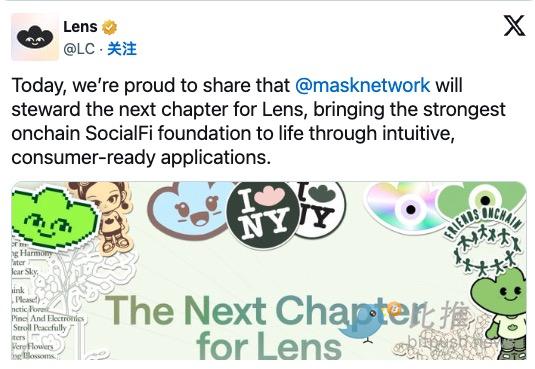
A New Chapter for Lens

Avara (the parent company of Aave and Lens) just announced the transfer of the Lens protocol's management rights to Mask Network. The Mask team, with its rich experience, has previously developed on-chain social applications like Firefly and Orb. Avara will now focus entirely on DeFi business, while Mask's goal is to usher in a "product-centric" new era for Lens.
Farcaster Follows Suit

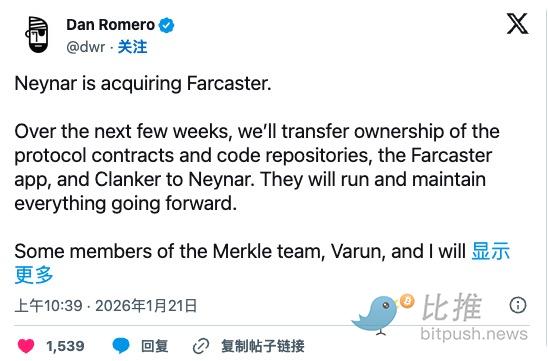
Just a day after the Lens news broke, Farcaster co-founder Dan Romero announced that Neynar, an infrastructure provider for Farcaster, is acquiring Farcaster's applications, protocol, and the Clanker tech stack. The original startup leadership team of Farcaster will not be joining the new company, but Neynar stated they are committed to reshaping the project into a "developer-first" social network.
Weighing the Pros and Cons

Mask knows Lens inside and out, and Neynar understands every detail of Farcaster. These two teams are undoubtedly among the top developers and thinkers in the on-chain social space. In the long run, Lens and Farcaster seem to be in the most capable hands.

However, the road ahead is far from smooth.

So far, on-chain social projects have struggled to become mass social networks with "gravitational mass." If this goal had been achieved, today's change of hands wouldn't have happened. Clearly, there are still some elements missing in the underlying structure, making some degree of "reboot" inevitable. Whether these changes can break through the bottlenecks and achieve lasting user retention remains to be seen.

Regarding the news of Lens's change of hands, Ethereum founder Vitalik Buterin (V God) shared his perspective. He wrote:

"What we need are social tools that serve the long-term interests of users, not just extract short-term engagement. [...] Decentralization is the way to achieve this: through a shared data layer, anyone can build their own client on top of it."

"But crypto social projects have tended to go the wrong way in the past. [...] Mixing 'money' and 'social' isn't inherently wrong: Substack has proven it's possible to build an economic system that supports high-quality content. But Substack's core is about subscribing to creators, not creating price bubbles around them."

"Decentralized social should be run by people who deeply believe in the essence of 'social' and are primarily driven by solving social problems. [...] I'm excited about Lens's development next year because I think the new team taking over is genuinely interested in 'social' itself."

"I encourage everyone to invest more time this year in Lens, Farcaster, and the broader decentralized social world. We need to move beyond the state where everyone is constantly tweeting in a global 'information war zone' and enter a reopened frontier where better, more novel forms of interaction become possible."

The Bigger Picture

For Lens and Farcaster, the key to this game lies in cultivating multiple overlapping "public squares"—connected by shared data but differentiated by different clients and cultures.

This diversity can foster innovation, innovation leads to more social interaction, social interaction attracts more users, which in turn drives more innovation, creating a virtuous cycle. Getting this "flywheel" spinning remains the core challenge.

Mask and Neynar seem ready to take on this task, and I am optimistic about their performance in their new roles. If you want to support their second launch and heed Vitalik's call, a great starting point is to try the Firefly application developed by Mask. It allows you to access platforms like X (Twitter), Farcaster, and Lens simultaneously without manually republishing content.

Looking Ahead

Crypto social is not dead. However, for the leaders of this new phase to successfully open a second chapter, they need to reflect on what worked and what didn't in the first chapter and iterate continuously based on that.

Overall, we have moved from the "what if" stage to the "what now" stage. In this sense, what Mask and Neynar have taken over is not just protocols, but also a mission: to transform decentralization from an abstract ideal into something many people are truly willing to spend time immersed in.

This is no easy task. But if these teams can continue to nurture lasting communities with unique cultures while empowering users with more agency in new ways, they have a chance to go far. Now, let's wait and see if they can truly realize this vision.


Twitter:https://twitter.com/BitpushNewsCN

Bitpush TG Discussion Group:https://t.me/BitPushCommunity

Bitpush TG Subscription: https://t.me/bitpush

Original link:https://www.bitpush.news/articles/7605336

Domande pertinenti

QWhat major changes occurred in the management of Lens and Farcaster this week?

AAvara, the parent company of Aave and Lens, transferred the governance of the Lens protocol to Mask Network. Simultaneously, Farcaster's infrastructure provider Neynar acquired Farcaster's applications, protocol, and the Clanker tech stack, with the original founding team stepping down.

QAccording to Vitalik Buterin, what is the core problem with past crypto social projects?

AVitalik Buterin stated that past crypto social projects often went wrong by mixing 'money' and 'social' in a way that created price bubbles around creators, rather than focusing on building an economic system that supports high-quality content, similar to Substack's subscription model.

QWhat is the key challenge for Lens and Farcaster in their new phase of development?

AThe core challenge is to get the 'flywheel' effect spinning: cultivating multiple overlapping 'public squares' connected by shared data but differentiated by different clients and cultures, which can drive innovation, more social interaction, user growth, and further innovation.

QWhich application is recommended as a good starting point to support the new initiatives of Mask and Neynar?

AMask's Firefly application is recommended, as it allows users to access platforms like X (Twitter), Farcaster, and Lens simultaneously without manually reposting content.

QWhat overall shift in phase does the article describe for crypto social projects?

AThe article describes a shift from the 'what if' phase to the 'what now' phase, where the new leaders must reflect on what worked and what didn't in the first chapter, iterate continuously, and transform decentralization from an abstract ideal into something people genuinely want to immerse their time in.

Letture associate

The Entire Internet Hails Noam's Joining, But OpenAI's Loss Bill Just Got Thicker

While the AI community celebrates Noam Shazeer, co-author of the "Attention Is All You Need" paper, joining OpenAI as Head of Architectural Research, the company's audited financials reveal a starkly different reality. In 2025, OpenAI reported $13.07 billion in revenue but a massive $20.92 billion operating loss. Even excluding a one-time accounting charge, the cash burn is severe, with $3.7 billion consumed in Q1 2026 alone. This high-profile hiring occurs against a backdrop of significant internal research talent drain, with key founders and researchers departing as the company's focus shifts from exploratory research to product iteration. Meanwhile, OpenAI's fundamental business model faces a deep crisis. It paid Microsoft $10.59 billion for compute in 2025, while its vast user base of 9 billion weekly actives includes only 50 million paying customers, making growth a direct driver of escalating costs. The article argues Shazeer's recruitment is less about technical necessity and more about crafting a compelling narrative for OpenAI's upcoming IPO, aiming to justify a rumored $1 trillion valuation to future public market investors. It contrasts OpenAI's strategy with Anthropic's reported path to profitability, which relies on a strong enterprise customer base and cost control, rather than star-powered narratives. Ultimately, the piece concludes that while Shazeer's architectural work may take 1-2 years to materialize, OpenAI's financial clock is ticking much faster, with its massive losses undercutting the celebratory headlines.

marsbit1 h fa

The Entire Internet Hails Noam's Joining, But OpenAI's Loss Bill Just Got Thicker

marsbit1 h fa

Market Trend (June 19): US-Iran Deal Drives Out Geopolitical Premium; Chip Stocks Soar to New Highs; Energy Sector Leads Declines

U.S. Market Trends (June 19): U.S.-Iran Deal Eases Tensions, Chip Stocks Soar, Energy Sector Leads Declines. U.S. stocks rallied on Thursday as the signing of a temporary U.S.-Iran deal in Geneva de-escalated Middle East tensions, with Saudi oil tankers transiting the Strait of Hormuz. This geopolitical relief helped markets recover from recent Fed-driven volatility. The S&P 500 rose over 1%, the Nasdaq gained nearly 2%, and the Dow Jones Industrial Average closed at another record high. The Philadelphia Semiconductor Index surged over 6% to a historic peak. Chip stocks were the standout performers. Reports of an Apple-Intel design and foundry deal for certain products, alongside mentions of potential Nvidia and SpaceX collaborations with Intel, propelled the sector. Intel surged ~10.5%, while memory chip makers like Micron also saw significant gains, highlighting sustained confidence in long-term AI capital expenditure. In contrast, the energy sector was the day's sole loser, with the S&P 500 energy sub-index declining as WTI crude fell ~2% to around $74.29/barrel. The reopening of key shipping routes erased prior geopolitical risk premiums. SpaceX extended losses for a second day on news of a potential large bond offering. Market volatility (VIX) dropped sharply, indicating a swift reversal of post-Fed jitters. Treasury yields dipped slightly but remained elevated. The focus now shifts to upcoming economic data, including next week's PCE inflation report and Micron's earnings, which will serve as a key test for the AI trade's durability.

marsbit2 h fa

Market Trend (June 19): US-Iran Deal Drives Out Geopolitical Premium; Chip Stocks Soar to New Highs; Energy Sector Leads Declines

marsbit2 h fa

Trading

Spot
Futures
活动图片