The foundation of JEPA world models is Self-Supervised Learning (SSL), advocated by Yann LeCun since 2017.
SSL can learn general representations from massive amounts of data without manual annotation, but it commonly faces a core challenge—representation collapse: the model tends to map different inputs to the same or very few vectors, seemingly completing training without actually learning discriminative representations.
To suppress collapse, mainstream methods mostly rely on a series of heuristic techniques (EMA, teacher-student networks, stop-gradient, freezing layers, etc.). These techniques make training fragile, difficult to tune, and also weaken the method's interpretability and scalability.
Another approach is to directly constrain the representation distribution through regularization terms.
VICReg, proposed by LeCun's team, decomposes the learning objective into three terms: variance, invariance, and covariance, using covariance to constrain correlations between dimensions; but covariance only captures second-order statistics, unable to distinguish between two representations with "the same mean and variance, but drastically different distribution shapes."
Subsequently proposed SIGReg, based on the Cramér–Wold theorem, aligns the entire embedding distribution to a standard Gaussian using sketching techniques, thereby constraining the complete distribution shape.
However, SIGReg still has two key flaws:
- Gradient Vanishing upon Collapse: When representations start to collapse, SIGReg's gradient decays accordingly—the more severe the collapse, the weaker the correction signal, making it difficult for the model to recover on its own;
- Coupling of Scale and Shape: It does not separate the two independent attributes of "magnitude (scale)" and "distribution morphology (shape)". They interfere with each other during optimization, leading to poor adaptability on long-tailed, low-quality, low-rank data.
In other words, when the model most needs gradient signals to escape the collapsed state, SIGReg's gradient tends to vanish.
This is precisely the core problem that VISReg aims to solve.
Recently, the new SSL work VISReg (Variance-Invariance-Sketching Regularization) has been continuously endorsed and highly recognized by Turing Award winner Yann LeCun—he commented on the repost, "VICReg begat SIGReg which begat VISReg," succinctly outlining the technical lineage of this regularization route.

To gain such recognition from LeCun, what makes VISReg so strong?
The answer lies in the fact that it precisely targets the core challenge of JEPA world models that LeCun has long bet on—representation collapse.

Paper Link: https://arxiv.org/abs/2606.02572
Code / Pre-trained Weights: https://github.com/HaiyuWu/visreg
Project Page: https://haiyuwu.github.io/visreg/
VISReg decouples the collapse-preventing regularization term into two independent objectives: "scale" and "shape." Without relying on any heuristic training tricks or massive data, it outperforms 7 mainstream SSL methods on a comprehensive evaluation across 15 datasets; using only about 1/10 of the training data, it matches DINOv2 on out-of-distribution (OOD) benchmarks.
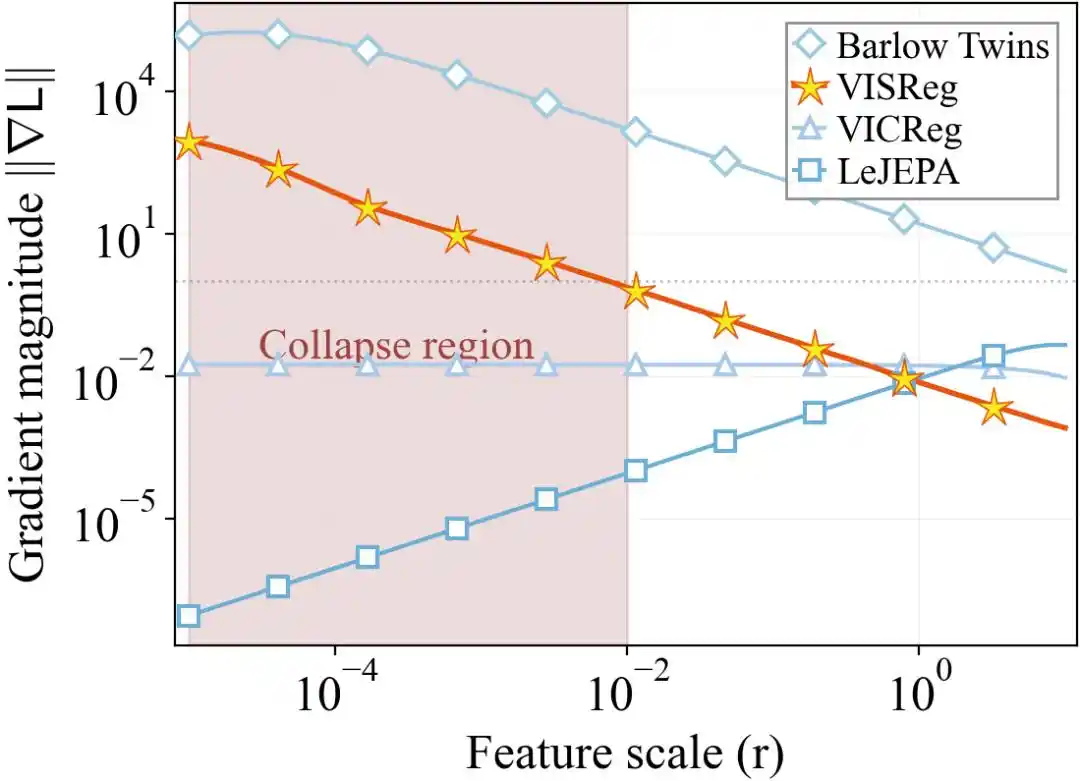
Figure 2: Simulation of gradient magnitude ‖∇L‖ for different regularization methods at various stages of representation collapse. VISReg maintains strong gradients even in collapsed states, while SIGReg's gradient almost vanishes.
Core Method
VISReg combines the strengths of VICReg and SIGReg: it retains VICReg's variance term to control scale, while replacing the covariance term with a sketching objective based on Sliced Wasserstein Distance (SWD) to control shape, and completely decouples the two via stop-gradient. The entire regularization objective consists of three parts.
1. Scale Regularization
The first part constrains the variance of each dimension to prevent amplitude collapse:
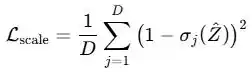
Its key property is: when the model collapses, the gradient of this term approaches a constant, ensuring the model can recover stably—this exactly compensates for SIGReg's gradient vanishing flaw.
2. Shape Regularization
The second part first normalizes to eliminate scale influence, then constrains shape separately. The crucial step is normalization with "stop-gradient" (sg):
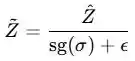
Here, stop-gradient is applied to the standard deviation σ, ensuring that optimizing the shape loss does not conversely alter the scale—this is the mechanism enabling true decoupling and non-interference between the "scale" and "shape" objectives.
After normalization, the geometric shape of the distribution is aligned to an isotropic Gaussian using the Sliced Wasserstein Distance:
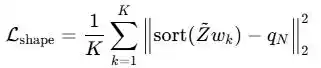
where

is the standard Gaussian quantile, and

is the random projection direction (i.e., "slice / sketching").
The theoretical basis is the Cramér–Wold theorem (Lemma 3.1 in the paper): two distributions are equal if and only if all their one-dimensional projections along directions on the unit sphere are equal. Therefore, by slicing the high-dimensional representation along sufficiently many random one-dimensional directions and aligning each to a Gaussian, we equivalently align the entire distribution in the high-dimensional space—this allows us to characterize the complete distribution shape using cheap one-dimensional sorting operations, rather than just second-order statistics.
3. Combined Objective
The third part is a centering loss that pulls the batch mean μ towards the origin:
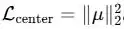
The three regularization terms are combined with weights:

The predictive loss follows the invariance objective of JEPA / LeJEPA—aligning embeddings from each view (global + local, total V views)

to the mean of the global view

:
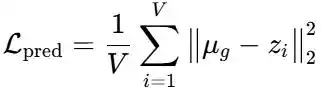
Finally, a single hyperparameter λ balances prediction and regularization, yielding the full objective:

Comparison with VICReg: VICReg also decouples regularization into variance + covariance, but covariance only captures second-order statistics; VISReg uses a sketching objective based on Sliced Wasserstein to fully characterize the distribution shape while retaining the variance term for scale control—preserving VICReg's flexibility while gaining distribution-level rigor.
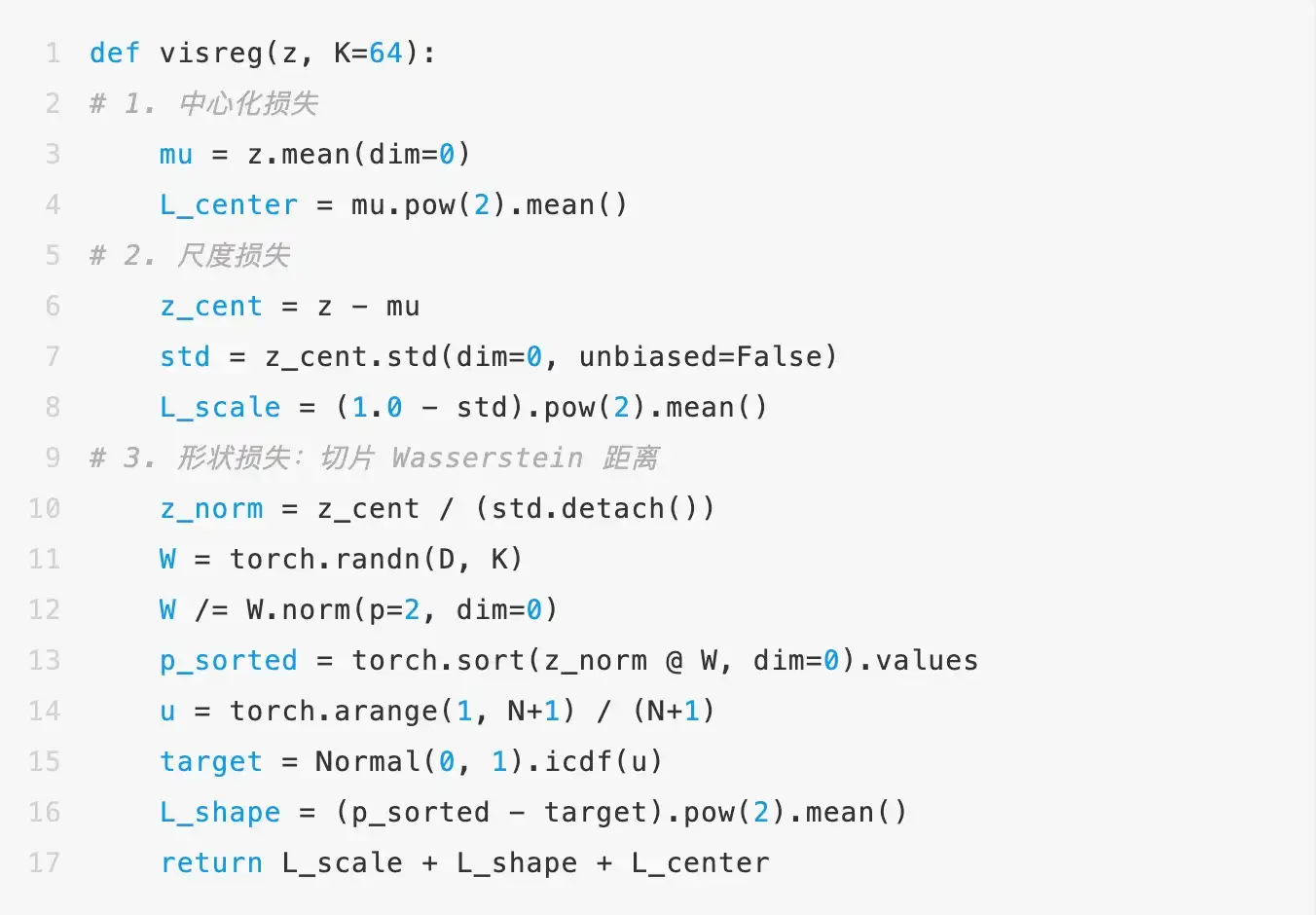
Requires Only About 15 Lines of PyTorch Code
This regularization objective is very lightweight to implement; the core logic takes only about 15 lines:
Computational Complexity and Scalability
In terms of computation and scalability, VISReg also has advantages. The computational complexity of its regularization part is
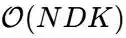
(N is batch size, D is dimension, K is number of slices), which is linear for all scaling factors; in contrast, VICReg's covariance term is
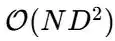
, scaling quadratically with dimension.
Under the same batch size, VISReg's runtime speed and GPU memory usage on a single H100 GPU are superior to SIGReg.
More importantly, the K random slices can be distributed across multiple GPUs: each of M GPUs generates K/M slices, achieving an effect equivalent to a single GPU generating all K slices.
In experiments, when the number of slices per GPU was insufficient, switching to 8 GPUs, each with 128 slices (total 1024), reduced the accuracy gap with "single GPU 1024 slices" from about 2.4% to 0.22%. This means that K can remain constant when scaling up training, adding almost no per-GPU burden.
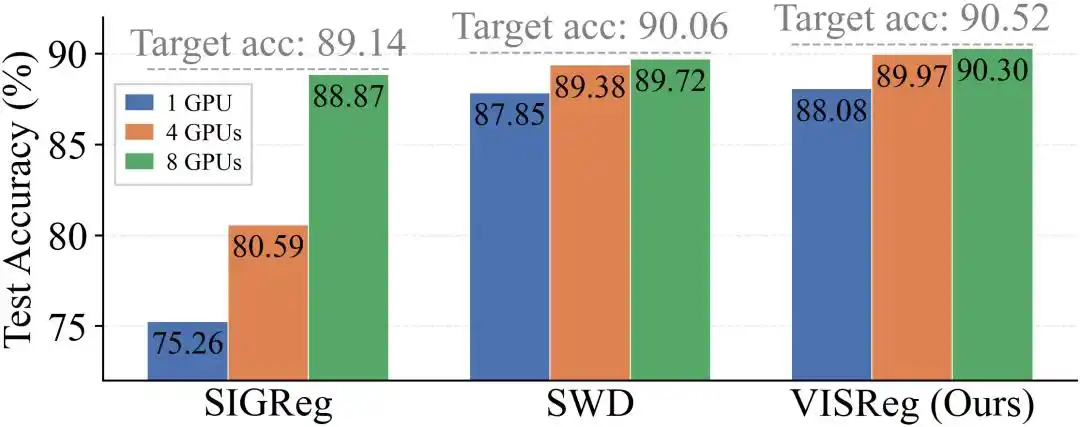
Figure: Change in linear probing accuracy when increasing GPU count with fixed K and D. When K is insufficient (K = 1⁄4D), using 8 times the number of GPUs can raise accuracy to the level of K = 2D—making it possible to keep K constant during large-scale training.
Experimental Results
Back to the question in the title—where exactly is VISReg strong? The research team compared VISReg with 7 mainstream SSL methods—MoCoV3, DINO, iBOT, I-JEPA, MAE, data2vec—on 15 datasets (8 in-domain + 6 out-of-distribution + ADE20K dense prediction), covering domains such as astronomy, medical, remote sensing, texture, flowers, etc. The answer manifests across multiple dimensions from recognition to segmentation and generation.
1. In-Domain Linear Probing
To ensure a fair comparison, experiments are divided into two groups based on whether heuristic techniques are used. In the group not using any heuristic techniques, VISReg leads: ViT-B/16 achieves in-domain linear probing accuracy of 75.7%, higher than MAE (75.1%); ViT-L/14 further improves to 77.0%, higher than LeJEPA (75.6%). Compared to iBOT and DINO which use heuristic techniques, VISReg is only slightly lower on conventional datasets, but surpasses all methods on the texture dataset DTD—indicating its cross-domain generalization ability stems from the method itself, not stacking manual tricks.
2. Out-of-Distribution (OOD) Generalization: Comprehensive Superiority
OOD generalization is a stricter test than in-domain accuracy: methods relying on heuristics are often finely tuned on the ImageNet in-domain but may not transfer well to significantly different new distributions. The team evaluated on 6 OOD datasets covering medical (ChestXRay, RetinaMNIST, OrganAMNIST), astronomy (Galaxy10), remote sensing (AID), texture (DTD), which are completely unrelated to the ImageNet training domain. Results show VISReg achieved the best average OOD accuracy across all methods and all backbone sizes, even surpassing some methods using heuristic techniques with larger backbones.
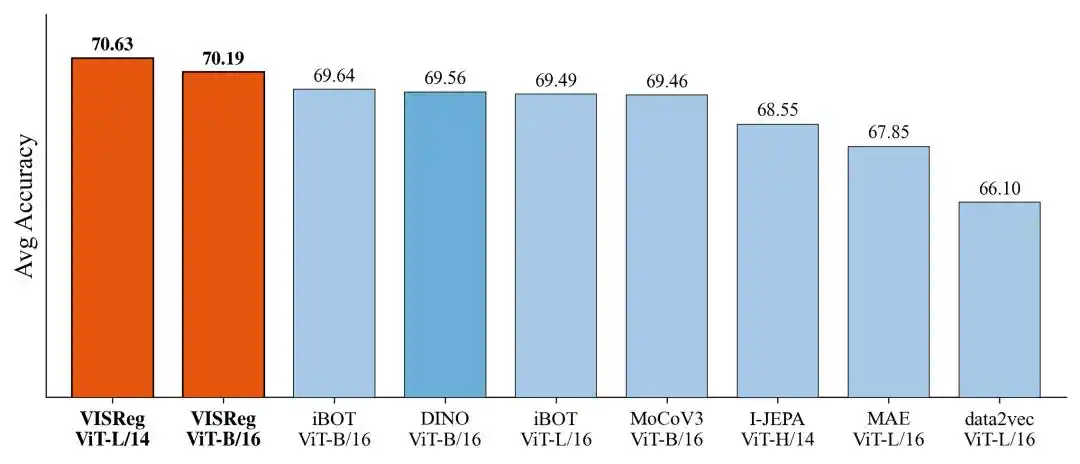
Figure 4: Average OOD linear probing accuracy. VISReg comprehensively outperforms iBOT, DINO, MoCoV3, I-JEPA, MAE, data2vec, etc.
As shown in Figure 4, ViT-B/16 VISReg average OOD accuracy is 70.19%, ViT-L/14 is 70.63%, significantly higher than MAE (67.85%), and better than MoCoV3 (69.46%), DINO (69.56%), I-JEPA (68.55%), etc.
3. Data Efficiency: Matching DINOv2 with 1/10 the Data
After pre-training VISReg (ViT-L/14) on ImageNet-22K (~14 million images), its average accuracy on 6 OOD datasets reaches 72.94%, essentially on par with DINOv2 (72.93%) trained on 10x larger scale LVD-142M (142 million images). In other words, VISReg achieves comparable performance using about 1/10 of the data. (As a control, VISReg with ViT-L/14 pre-trained only on ImageNet-1K has an average accuracy of 70.63%.) This indicates its learned representations have strong generality.
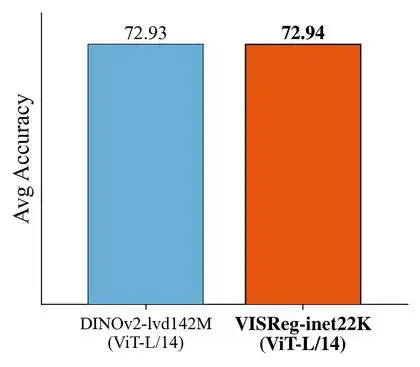
Figure 5: VISReg pre-trained on ImageNet-22K matches DINOv2 trained on 10x more data (LVD-142M) on OOD benchmarks.
4. Transfer Fine-tuning: Comprehensively Surpassing DINO
Although VISReg's linear probing accuracy on some in-domain datasets is slightly lower than DINO, after fine-tuning, it surpasses both DINO and supervised pre-training on all five tested datasets—CIFAR-10, CIFAR-100, Flowers, ImageNet-1K, Galaxy10—indicating its representation distribution is more uniform, less redundant, and more transferable.
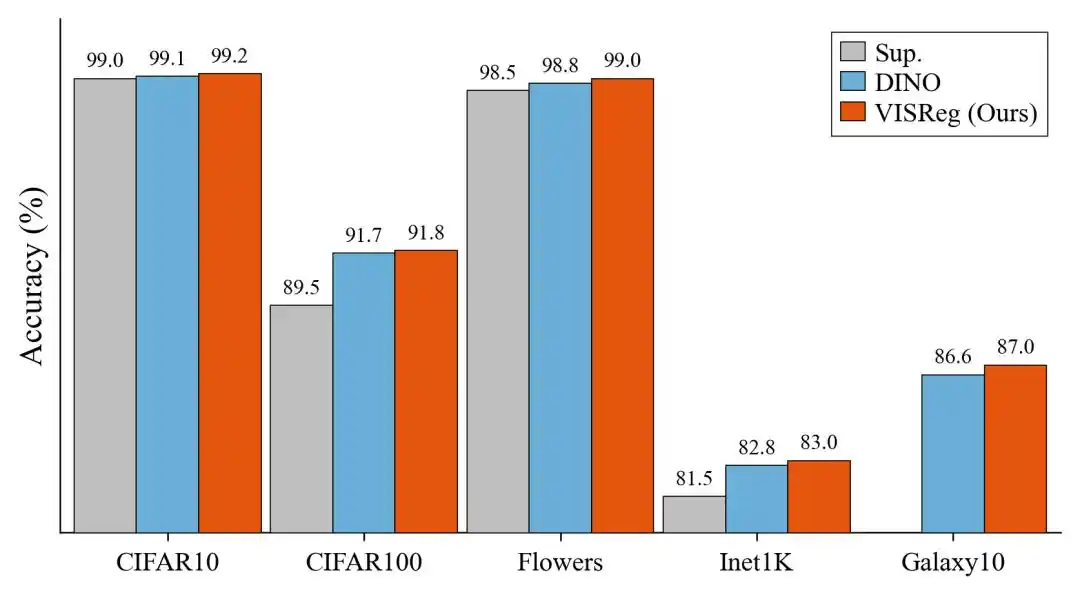
Figure: Transfer learning comparison. After fine-tuning, VISReg outperforms DINO and supervised pre-training on all tested datasets (CIFAR-10, CIFAR-100, Flowers, ImageNet-1K, Galaxy10).
5. Dense Prediction and Generation Guidance
VISReg's advantages are not limited to classification. On ADE20K linear semantic segmentation (ViT-B/16), its mIoU is 30.16, higher than DINO (29.40) and MAE (23.60), second only to MoCoV3 (31.69); this result is competitive without using any heuristic tricks. The paper also acknowledges that there is still a gap with the best methods in dense prediction, a focus for future optimization.
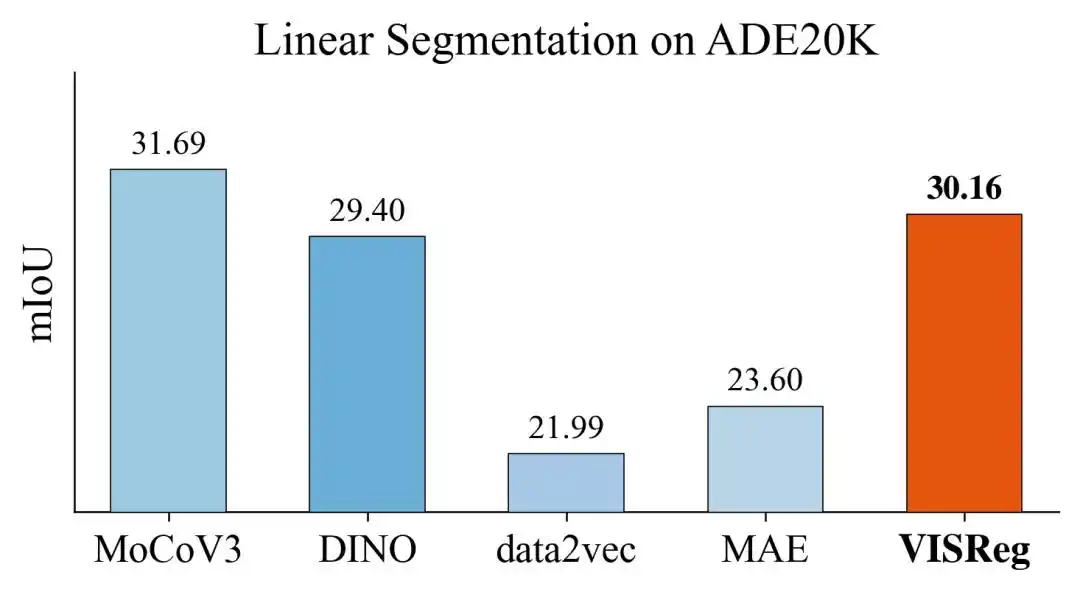
Figure 7: Linear semantic segmentation on ADE20K. Without any heuristic tricks, VISReg achieves competitive mIoU, second only to MoCoV3.
In generation guidance (SiT-B/2, iREPA framework, 100k training steps), generation guided by VISReg features outperforms DINO on three out of four metrics: gFID 40.36 (DINO 41.15), Precision 51.38 (DINO 50.51), Recall 61.26 (DINO 60.70), IS essentially tied (33.48 vs 33.47). This shows VISReg's learned representations are also superior as generation guidance signals.
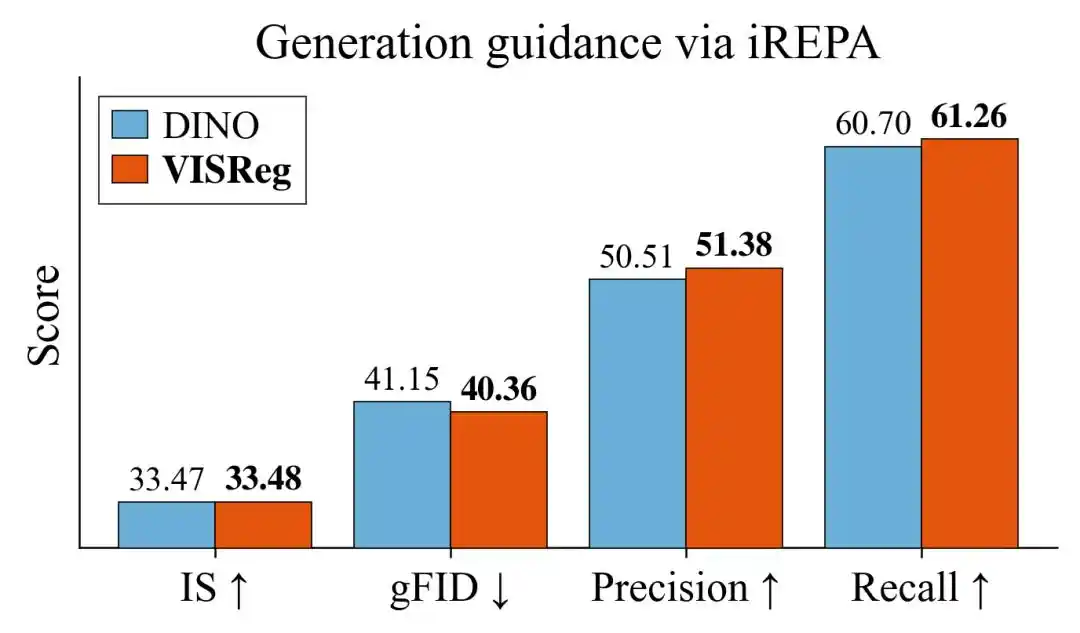
Figure 8: Image generation guided by VISReg vs. DINO features using SiT-B/2. VISReg provides better guidance on most metrics (lower gFID, higher Precision and Recall).
6. Robustness on Low-Quality Data
On low-quality datasets such as long-tail distribution (ImageNet-LT) and low-rank (Galaxy10), VISReg can stably prevent collapse and learn meaningful representations, while DINO fails directly without fine-tuned hyperparameters.
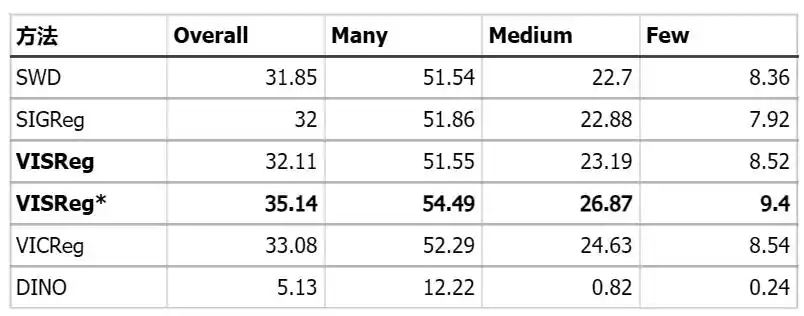
Table 1: Linear probing accuracy on ImageNet-LT

Table 2: In-domain linear probing accuracy on Galaxy10
Conclusion
VISReg demonstrates that by decoupling representation regularization into two independent components, "scale" and "shape," one can obtain an SSL method that is more stable, efficient, and has stronger generalization than existing methods.
Without using any training heuristic tricks, it achieves leading or near-leading results across multiple dimensions including image recognition, segmentation, and generation guidance, and matches DINOv2's OOD performance with about 1/10 of the data. This provides a new regularization-based solution to the long-standing representation collapse problem in JEPA world models.
References:
https://arxiv.org/abs/2606.02572
This article is from the WeChat public account "Xin Zhi Yuan," author: LRST