Larry Fink Says Tokenization Will Transform Markets in 2026 Investor Letter

TheNewsCryptoPubblicato 2026-03-24Pubblicato ultima volta 2026-03-24

Introduzione

In his annual investor letter, Larry Fink emphasized that tokenization will transform financial markets by 2026, addressing inefficiencies and lack of accessibility in traditional systems. He highlighted that tokenization can enable faster, more transparent transactions and broaden global participation in investment markets. Fink noted that expanding access is crucial for equitable wealth distribution and long-term economic growth. He also pointed out that tokenization could increase asset liquidity, improve market transparency, and bridge traditional finance with digital assets. This shift is expected to create new opportunities, especially in private markets, and marks a fundamental evolution in how assets are traded worldwide.

In the annual letter to investors, Larry Fink emphasized the importance of tokenization in transforming the financial markets. He explained that the traditional financial systems are based on an outdated infrastructure that lacks the required level of efficiency and accessibility for investors worldwide. He emphasized that the traditional financial systems can be transformed by the process of tokenization, which will help investors to make faster and more transparent transactions worldwide.

Fink highlighted the fact that tokenization can play a role in promoting broader participation by helping people access investment markets more easily. He noted that access to investment markets remains an important issue, considering that a majority of people still lack access to such markets. Fink noted that long-term investment remains a key aspect in helping people benefit from economic growth over a long period.
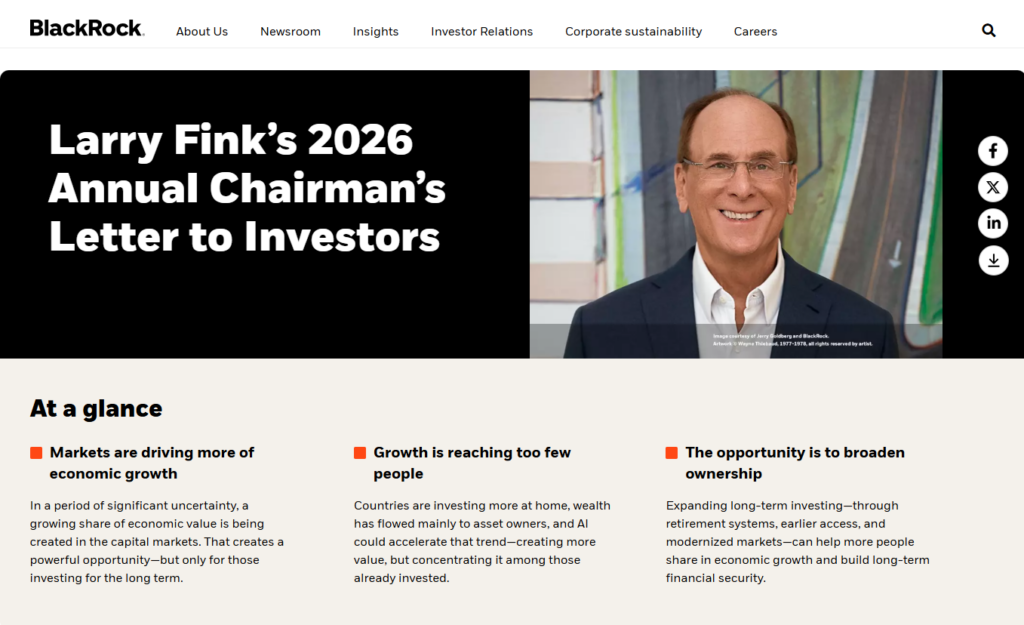
Source: Blackrock

Broader Participation and Financial System Evolution

Fink noted that financial markets need to evolve to ensure more people can access wealth creation opportunities in global markets. He noted that technology, such as tokenization, can play a role in helping people access investment markets. Fink noted that technology, such as digital wallets and blockchains, may one day enable people to invest as easily as making payments. He said that ensuring access to financial markets remains an important aspect in ensuring people benefit from economic growth.

Fink also warned that economic growth may result in asset holders benefiting disproportionately. He stressed that there is a need to expand asset ownership opportunities around the world. He explained that the expansion of asset ownership in capital markets around the world is essential to ensure the equitable distribution of economic growth in societies around the world.

Implications for Investors and Market Structure

Fink emphasized that tokenization has the potential to change the way assets are traded in financial markets around the world. He explained that assets may become more liquid and facilitate transparency in financial markets around the world. The letter explained that financial infrastructure has the potential to facilitate the interaction between traditional finance and digital asset markets.

Fink found that access to private markets may provide new investment opportunities to groups of investors who were previously unable to invest in private markets. Fink concluded that tokenization marks a fundamental shift like markets. This shift will provide long-term benefits to investors and economies. This message reflects a trend toward increased integration between traditional finance and blockchain technology.

Highlighted Crypto News:

Circle Urges Clarity in EU Market Integration Package to Strengthen Crypto Regulation

Tags#crypto investorsblackRockBlockchainBTCCryptocurrencyInvestorstokenization

Domande pertinenti

QWhat is the main topic of Larry Fink's 2026 investor letter?

AThe main topic is the transformative potential of tokenization in financial markets.

QAccording to Fink, what problem does tokenization help solve in investment markets?

ATokenization helps solve the problem of limited accessibility and inefficiency in traditional financial systems, enabling faster and more transparent transactions.

QHow does Fink suggest tokenization can promote broader participation in financial markets?

AFink suggests that tokenization, along with technologies like digital wallets and blockchains, can make investing as easy as making payments, thereby expanding access to wealth creation opportunities.

QWhat potential impact does tokenization have on asset trading and market structure?

ATokenization can make assets more liquid, increase transparency, and facilitate integration between traditional finance and digital asset markets.

QWhy does Fink emphasize the need to expand asset ownership worldwide?

AFink emphasizes expanding asset ownership to ensure equitable distribution of economic growth benefits and prevent disproportionate gains for existing asset holders.

Letture associate

The Verdict in Choi Tae-won's Divorce Case: Revealing the Inheritance Undercurrent Behind SK Hynix's Trillion-Won Empire

SK Group Chairman Chey Tae-won's high-profile divorce case, involving a record 1.38 trillion won settlement, has drawn attention to the succession plans for Korea's second-largest conglomerate, especially its crown jewel, SK hynix. Unlike traditional chaebol scripts centered on the eldest son, Chey's three children from his marriage to former President Roh Tae-woo's daughter, Roh Soh-yeong, are carving distinct, non-traditional paths. Eldest daughter Chey Yun-jung (b. 1989) is seen as the most evident successor. With a scientific and consulting background, she holds executive roles at SK bioscience and SK Inc.'s growth support department, focusing on future strategy and biopharma. Her marriage is to an AI infrastructure entrepreneur, not a traditional business alliance. Second daughter Chey Min-jung (b. 1991) took a unique route, voluntarily serving as a South Korean naval officer, including an anti-piracy deployment. She later worked on policy and strategy for SK hynix in Washington D.C. before co-founding an AI-driven healthcare startup. She married a former U.S. Marine Corps officer, connecting her to U.S. defense and policy circles—networks crucial for a global semiconductor giant. The only son, Chey In-geun (b. 1995), who studied physics like his father, worked briefly at SK E&S before joining McKinsey. Despite fitting the traditional "heir" profile as the eldest son, he remains silent and holds no public position or shares in SK, suggesting the old succession playbook is obsolete. As SK hynix's valuation soars, becoming a geopolitical asset in the AI era, the heirs' legitimacy is no longer automatic. They must prove themselves in fields like AI biotech, global policy, and strategic consulting. Their marriages also reflect new elite networks in tech and defense, not old political alliances. Their inheritance is the complex challenge of navigating a globalized, tech-driven world, not just a corporate throne.

marsbit3 h fa

The Verdict in Choi Tae-won's Divorce Case: Revealing the Inheritance Undercurrent Behind SK Hynix's Trillion-Won Empire

marsbit3 h fa

From OpenSea to OpenRouter: Is Alex Atallah Repeating His 'Exit at the Peak' Playbook?

From OpenSea to OpenRouter: Is Alex Atallah Repeating His "Exit at the Peak" Playbook? According to the Wall Street Journal, payments giant Stripe is in talks to acquire the AI model aggregation platform OpenRouter in a potential deal valuing the company near $100 billion. This would mark founder Alex Atallah's second creation of a company reaching a $100 billion valuation, following his co-founding of NFT marketplace OpenSea. OpenRouter, founded just over three years ago, has grown rapidly by acting as a unified gateway for developers to access over 400 AI models. It currently has about 10 million users and processes over 200 trillion tokens monthly. While the platform's annualized revenue is around $50 million, its valuation has skyrocketed from $1.3 billion in March 2026. The potential acquisition by Stripe, a company OpenRouter's founder once likened it to, represents a major expansion into AI infrastructure for the payments leader. This move echoes Atallah's previous timing with OpenSea, where he departed before the NFT market's significant downturn. For OpenRouter, selling now may be strategic. Despite its scale, its business model—charging a 5-5.5% fee on AI inference calls—faces pressure from competition, open-source models, and potential price wars among model providers, limiting its profitability narrative for an IPO. A key asset for potential acquirers like Stripe is OpenRouter's vast repository of real-world AI usage data, which offers unique insights into model performance and developer preferences that are difficult to replicate. Whether this potential deal signifies a new valuation benchmark for AI infrastructure or another market peak signal remains to be seen.

链捕手3 h fa

From OpenSea to OpenRouter: Is Alex Atallah Repeating His 'Exit at the Peak' Playbook?

链捕手3 h fa

Trading

Spot
活动图片





