L1 Native Tokens' Final 'Monetary Premium' Is Collapsing!

比推Pubblicato 2025-12-08Pubblicato ultima volta 2025-12-08

Introduzione

The monetary premium on Layer 1 (L1) native tokens is rapidly fading as stablecoins increasingly dominate as the preferred medium of exchange (MoE) in on-chain economies. While L1 valuations historically incorporated a monetary premium derived from their use as a store of value (SoV) or MoE, data shows a clear shift. On Ethereum, ETH is no longer the primary MoE; stablecoins like USDC and USDT now lead in on-chain transaction volume and top Uniswap pools. A similar trend is observed on L2s like Arbitrum. On Solana, SOL remains the primary MoE due to platforms like Pumpfun and Raydium using it as a quote currency, but USDC is gaining significant traction, especially with new launchpads like MetaDAO adopting it as the default pairing asset. On BNB Chain, USDT has overtaken BNB in trading volume, which had previously been the dominant MoE. The author argues that the market has chosen stablecoins as the superior on-chain MoE. Attempts by ecosystems to enforce their native token as a quote currency add friction and costs for users with minimal price impact. Improved on-chain UX and liquidity are reducing the historical necessity of using volatile native tokens for transactions. The next wave of users will likely use stablecoins, not native tokens, for everyday exchange, further eroding this monetary premium.

Author: Silvio (@SilvioBusonero)

Original Title: The monetary premium on L1s is fading

Compiled and Edited by: BitpushNews


The valuation of L1 blockchains is a comprehensive reflection of multiple factors: including cultural narrative (Memetics), network fees, security, and the development of upper-layer applications. Among these, the most underestimated is the so-called "Monetary Premium".

The monetary premium stems from the demand of market participants to use assets as a Store of Value (SoV) or a Medium of Exchange (MoE).

  • Store of Value is directly related to the robustness (lindiness) and degree of decentralization of an asset, so it is not an easy market entry strategy.

  • In contrast, acting as a Medium of Exchange may be easier to achieve. Tokens can serve as the primary method for value exchange and measurement within the blockchain economy.
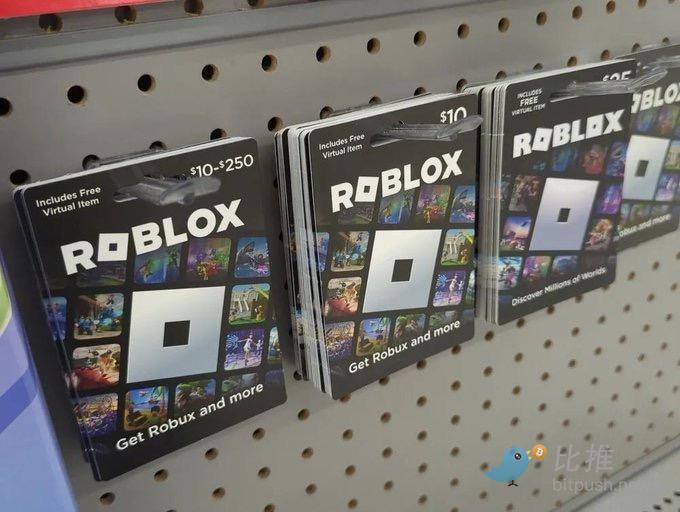
This is similar to the role of tokens in the Web2 economy:

  • Roblox's in-game token Robux, has strong exchange value.

  • When Meme coins started to grow, people bought SOL to enter and exit Meme trades. As SOL was the default currency on Pump platforms, most traders did not convert assets back to dollars but kept some SOL ready to "ape". A similar situation occurred with ETH during the 2021 NFT boom. A large number of users began using the native asset for transactions, effectively creating the utility of a Medium of Exchange (MoE).

Does the Premium Still Exist?

The answer is: No, this premium is rapidly disappearing. Users are increasingly inclined to use stablecoins for transactions.

Ethereum — Stablecoins Have Become the Medium of Exchange

  • Judging from the on-chain transaction volume of mainstream tokens, Ethereum's native token ETH is no longer the primary medium of exchange it once was.

  • ETH's dominance as an MoE is declining, while USDC and USDT are rising in popularity on transaction volume charts and in top Uniswap liquidity pools.

The situation is similar for L2s like Arbitrum.
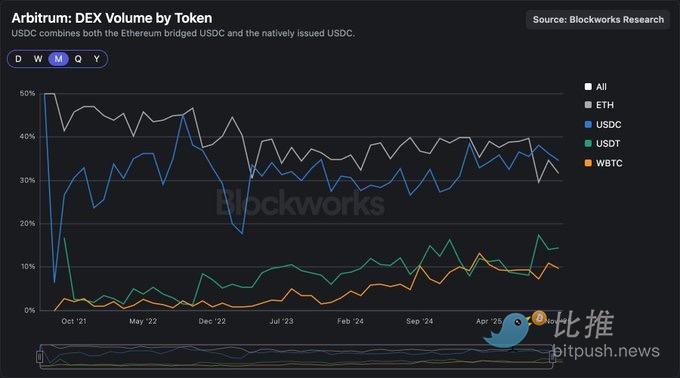
Solana — SOL Maintains the Lead, but USDC is Catching Up
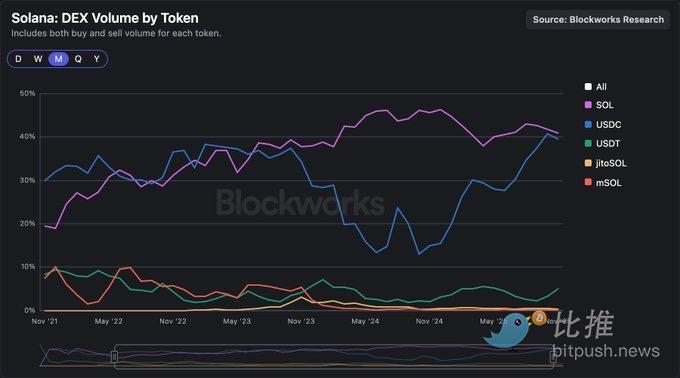
  • SOL remains the primary medium of exchange and the highest volume asset on Solana (but USDC is catching up). This is mainly because platforms like Pumpfun and Raydium tend to use SOL as the quote currency, while other platforms (like Meteora) have a mixed situation.

  • However, new launch platforms like MetaDAO are setting USDC as the default paired trading asset.

BNB and USDT Go Hand in Hand
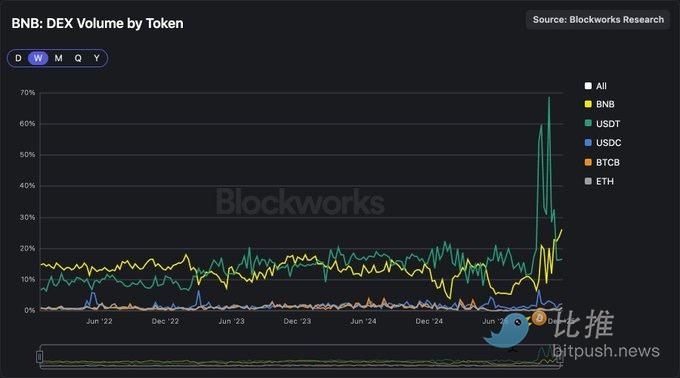
  • From 2021 to 2022, BNB absolutely dominated the role of medium of exchange, but then USDT gained market share and surpassed BNB.

The Market Has Chosen the Medium of Exchange — And It's Stablecoins

There is no such thing as "Onchain Legal Tender" in the on-chain market.

Some projects use a "quote asset" strategy, making their native token the medium of exchange, such as Zora and Virtuals. But in reality, this increases transaction costs for both users and projects, while having minimal impact on the token price itself. Ecosystem tokens can attempt a similar strategy through asset issuance platforms, i.e., requiring quotes in a specific token, but this may not be worth it.

The user experience (UX) and liquidity of the on-chain market are improving: the past monetary premium was also partly due to a lack of alternatives and lower liquidity.

The next batch of billions of users will use the same medium of exchange as in real life (USDC, Euros, etc.).


Twitter:https://twitter.com/BitpushNewsCN

Bitpush TG Discussion Group:https://t.me/BitPushCommunity

Bitpush TG Subscription: https://t.me/bitpush

Original article link:https://www.bitpush.news/articles/7594034

Domande pertinenti

QWhat is the 'monetary premium' in the context of L1 blockchains, and what two primary needs does it stem from?

AThe 'monetary premium' refers to the portion of an L1 blockchain's valuation that comes from its use as a form of money. It stems from the market's need to use the asset as a Store of Value (SoV) and as a Medium of Exchange (MoE).

QAccording to the article, which type of asset are users increasingly preferring to use for on-chain transactions instead of native L1 tokens?

AUsers are increasingly preferring to use stablecoins, such as USDC and USDT, for on-chain transactions instead of native L1 tokens like ETH or SOL.

QOn the Solana blockchain, what is a key reason why SOL remains a primary medium of exchange, and what new trend is challenging this?

ASOL remains a primary medium of exchange on Solana largely because platforms like Pumpfun and Raydium use it as the default quote currency. However, this is being challenged by new launch platforms, such as MetaDAO, which are setting USDC as the default trading pair.

QThe article states that the monetary premium is 'fading'. What two reasons are given for the past existence of this premium?

AThe past existence of the monetary premium was partly due to a lack of other options for users and lower liquidity on-chain. The improving user experience (UX) and liquidity in on-chain markets are contributing to its decline.

QWhat does the author suggest about the next billion users entering the crypto space regarding their preferred medium of exchange?

AThe author suggests that the next billion users will use the same mediums of exchange they use in real life, such as USDC or the Euro, rather than the native tokens of L1 blockchains.

Letture associate

In Jinjiang, Fujian, a Storage Super Unicorn Lies Quiet

In Fujian's Jinjiang, a city known for sportswear, lies a quiet semiconductor giant: Fujian Jinhua Integrated Circuit Co. (JHICC). Once a promising domestic DRAM manufacturer alongside Yangtze Memory and ChangXin Memory Technologies (CXMT), its journey was derailed in 2018 when the U.S. placed it on an Entity List and filed criminal charges for alleged trade secret theft. This halted production for years. A turning point came in February 2024 when a U.S. federal court found JHICC not guilty. However, it had lost crucial time. While CXMT soared to become a top-valued A-share company in 2024, JHICC, with an estimated valuation of 80 billion RMB, was just restarting. Its current output is primarily customized DDR4 chips, not the advanced DDR5/HBM demanded for AI, but it still benefits from the broader memory chip upcycle. JHICC's story is tied to Chen Zhengkun, a veteran engineer who left Micron to lead the venture. Founded in 2016 with state-backed funding, JHICC partnered with Taiwan's UMC to develop DRAM technology. Rapid progress was cut short by the U.S. actions, which Micron initiated, partly due to its heavy reliance on the Chinese market. Post-sanctions, Chen's team worked to rebuild the production line with reduced reliance on U.S. technology. According to its records, JHICC achieved small-scale production and revenue growth under immense pressure. It now focuses on the stable "niche" DRAM market (e.g., TVs, routers) with a monthly capacity of ~40,000 wafers, aiming for 60,000 by 2026. It holds over 1,000 patents but remains on the Entity List. For Jinjiang, investing in JHICC was a bold industrial leap. The local government provided unwavering financial and logistical support during the crisis, helping the company survive. JHICC has become the anchor for a growing local semiconductor cluster. Though its scale lags behind domestic peers, JHICC's persistence symbolizes a hard-won foothold in a global market long dominated by Samsung, SK Hynix, and Micron. Having missed one boom, it seeks a place in the new AI-driven memory supercycle.

marsbit14 min fa

In Jinjiang, Fujian, a Storage Super Unicorn Lies Quiet

marsbit14 min fa

Must-Watch Events Next Week|CLARITY Act Could Face Senate Vote; SpaceX, Circle to Report Earnings (8.3-8.9)

**Summary: Key Events and Developments to Watch (August 3-9)** The upcoming week is marked by significant financial disclosures, key legislative deadlines, and notable product updates. **Major Financial Events:** Several companies are scheduled to release their Q2 2026 earnings. American Bitcoin (ABTC) will report on August 3, followed by SpaceX and Hut 8 Mining Corp. on August 4, and Circle on August 5. Notably, a significant portion of SpaceX shares (up to 12% of total shares) will be unlocked on August 6 following their earnings release. **Key Legislative Deadline:** The U.S. Senate faces an August 7 deadline to secure 60 votes for the CLARITY Act, a bipartisan bill aiming to establish a federal regulatory framework for cryptocurrencies. The Senate may hold a full vote on the bill during the week. **Economic Data:** The U.S. July Non-Farm Payrolls report will be released on August 7, providing crucial labor market data. **Technology & Product Updates:** * **Shutdowns:** DeFi portfolio tracker Zapper and wallet app Ctrl Wallet will cease operations on August 3. * **Upgrades:** LayerZero will deprecate its v1 relayers on August 3. XRP Ledger's new version 3.3.0, featuring five new functions, is expected next week. * **AI:** Elon Musk announced that the advanced Grok 4.6 AI model is set for release around August 7. * **Bitcoin:** The BIP-110 forced signaling for a potential Bitcoin network change is scheduled to begin around August 8. **Other Notable Events:** Chinese robotics firm Unitree Tech has set its preliminary price inquiry for its IPO for August 5. South Korean exchange Upbit will delist AQT and AERGO tokens on August 3.

marsbit2 h fa

Must-Watch Events Next Week|CLARITY Act Could Face Senate Vote; SpaceX, Circle to Report Earnings (8.3-8.9)

marsbit2 h fa

Trading

Spot
活动图片





