Kraken Partners With Nasdaq In New Tokenized Stocks Move

bitcoinistPubblicato 2026-03-10Pubblicato ultima volta 2026-03-10

Introduzione

Kraken's parent company Payward has partnered with Nasdaq to develop an "equities transformation gateway," a new infrastructure layer connecting regulated tokenized equity markets with permissionless blockchain networks. The collaboration centers on Kraken's xStocks product, which has surpassed $25 billion in transaction volume with over $4 billion settled on-chain. Scheduled to become operational in H1 2027, Nasdaq's equity token design will use xStocks as its permissionless infrastructure layer, maintaining issuer control and regulatory compliance while enabling interoperability with DeFi environments. The gateway will allow seamless movement of tokenized equities between traditional markets and blockchain networks, with Kraken handling KYC/AML requirements. Payward's co-CEO Arjun Sethi emphasized that tokenization transforms equities into programmable instruments capable of serving as cross-platform collateral for trading, margin, derivatives, and lending—significantly enhancing capital efficiency beyond traditional brokerage limitations.

Kraken parent Payward has partnered with Nasdaq to build what the companies describe as an “equities transformation gateway,” a new infrastructure layer designed to connect regulated tokenized equity markets with permissionless blockchain networks. For crypto markets, the significance is clear: one of the largest traditional market operators is now working directly with a crypto-native tokenization framework to move equities between institutional rails and DeFi environments.

The partnership centers on xStocks, Kraken’s tokenized equities product, which Payward said has surpassed $25 billion in total transaction volume less than a year after launch. More than $4 billion of that volume has been settled on-chain, and the framework now counts over 85,000 unique holders across supported networks, giving Kraken a sizable footprint as tokenized stocks move from concept toward market structure.

Nasdaq And Kraken Join Forces

Under the proposed setup, xStocks will power the permissionless infrastructure layer for Nasdaq’s upcoming issuer-sponsored equity token design. That design, which Nasdaq expects to become operational starting in the first half of 2027, is meant to preserve issuer control, existing regulatory frameworks, and the rights attached to the underlying shares while still allowing those assets to interact with blockchain-based financial systems.

In practical terms, the gateway is supposed to let eligible users swap tokenized equities between a regulated, permissioned market environment and open on-chain ecosystems. Payward said this would allow assets to move “fluidly” between institutional trading infrastructure and decentralized financial networks, while Payward Services handles KYC and AML onboarding for participants accessing the bridge through Kraken.

Arjun Sethi, co-CEO of Payward and Kraken, framed the effort as a structural change to how equities can be used once they are placed on programmable rails. “Tokenization upgrades market infrastructure at the asset layer by allowing equities to exist as programmable financial instruments that can operate across both regulated capital markets and open blockchain networks,” he said. “Today most equities sit inside brokerage systems where their utility is largely limited to directional exposure and, in some cases, broker-specific margin arrangements.”

He argued that the current model leaves capital trapped inside siloed venues. “That structure fragments liquidity across venues and leaves a meaningful amount of capital static relative to its potential utility,” Sethi said. “With xStocks, our goal is to make equities natively interoperable across trading venues, financial applications and blockchain networks while preserving issuer rights, regulatory protections and price integrity.”

Sethi went further, tying tokenized equities to a broader capital-efficiency thesis that will be familiar to crypto derivatives traders. “Bringing equities onto programmable infrastructure expands how they can function within a portfolio,” he said. “Instead of simply representing exposure to a company, tokenized equities can operate as collateral within unified trading systems that support spot markets, cross-margin trading, derivatives, perpetual futures, and financing environments.”

That point sits at the heart of the announcement. Payward is not pitching tokenized stocks merely as wrappers for traditional shares, but as collateral that can move across trading, lending and hedging systems under a unified margin framework. In jurisdictions where xStocks are already available, Payward will also serve for an initial period as the primary settlement layer for transactions tied to Nasdaq’s equity token design.

At press time, the total crypto market cap stood at $2.32 trillion.
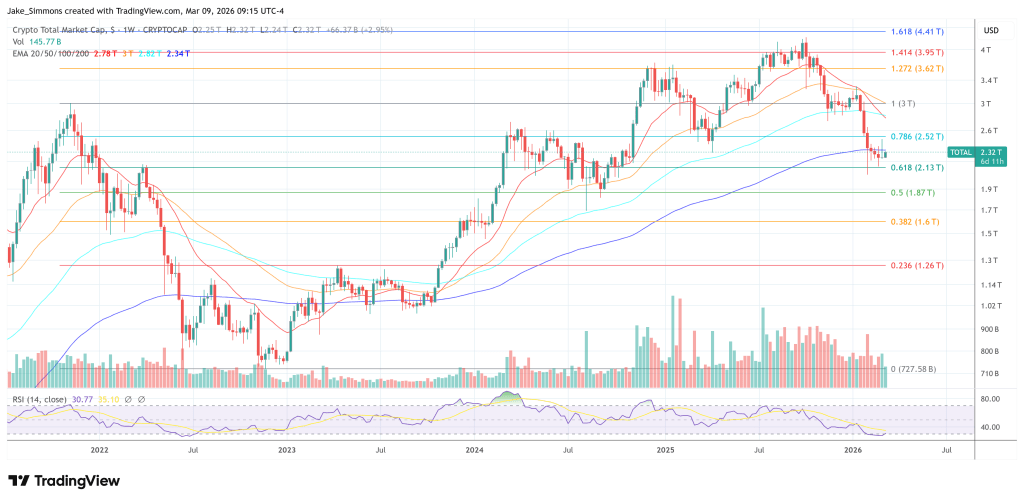
Total crypto market cap, 1-week chart | Source: TOTAL on TradingView.com

Domande pertinenti

QWhat is the main purpose of the partnership between Kraken's parent company Payward and Nasdaq?

AThe partnership aims to build an 'equities transformation gateway,' a new infrastructure layer designed to connect regulated tokenized equity markets with permissionless blockchain networks, allowing equities to move between institutional rails and DeFi environments.

QWhat is xStocks and what milestone has it achieved according to the article?

AxStocks is Kraken's tokenized equities product, which has surpassed $25 billion in total transaction volume less than a year after launch, with over $4 billion settled on-chain and more than 85,000 unique holders.

QWhen does Nasdaq expect its issuer-sponsored equity token design to become operational?

ANasdaq expects its issuer-sponsored equity token design to become operational starting in the first half of 2027.

QHow does Arjun Sethi describe the current limitation of traditional equities in brokerage systems?

AArjun Sethi states that in traditional brokerage systems, equities' utility is largely limited to directional exposure and some broker-specific margin arrangements, which fragments liquidity and leaves capital trapped in siloed venues.

QWhat broader function does Payward envision for tokenized equities beyond being wrappers for traditional shares?

APayward envisions tokenized equities functioning as collateral within unified trading systems that support spot markets, cross-margin trading, derivatives, perpetual futures, and financing environments, enhancing capital efficiency and interoperability.

Letture associate

DeepSeek Funding: Liang Wenfeng's 'Realist' Pivot

DeepSeek, a leading Chinese AI company, has initiated its first external funding round, aiming to raise at least $300 million at a valuation of no less than $10 billion. This move marks a significant shift from its founder Liang Wenfeng’s previous idealistic stance of rejecting external capital to maintain independence. Despite strong financial backing from its parent company, quantitative trading firm幻方量化 (Huanfang Quant), which provided an estimated $700 million in revenue in 2025 alone, DeepSeek faces mounting challenges. Key issues include a 15-month gap in major model updates, delays in its flagship V4 release, and the loss of several core researchers to competitors offering significantly higher compensation. The company is also undergoing a strategic pivot by migrating its infrastructure from NVIDIA’s CUDA to Huawei’s Ascend platform, a move aligned with China’s push for technological self-reliance amid U.S. export controls. However, DeepSeek lags behind rivals like智谱AI and MiniMax—both now publicly listed—in areas such as product ecosystem, multimodal capabilities, and commercialization. The funding round, though relatively small in scale, is seen as a way to establish a market-validated valuation anchor, making employee stock options more competitive and facilitating talent retention. It also signals DeepSeek’s transition from a pure research-oriented organization to a commercially-driven player in the global AI ecosystem.

marsbit29 min fa

DeepSeek Funding: Liang Wenfeng's 'Realist' Pivot

marsbit29 min fa

Solana Q1 Report: Revenue Plunges 68% Year-on-Year, Developers Decrease by 30%

Solana Q1 2026 Report: Key Metrics Show Significant Decline Amid Market Reset Solana experienced a substantial downturn in Q1 2026, with key performance indicators reflecting a broader market cooling. Total network revenue (REV) fell to $89.9 million, down 68% year-over-year (YoY) and 1.4% quarter-over-quarter (QoQ). This decline was driven by reduced speculative activity, which had previously fueled the network during the 2024/2025 bull market. Key revenue components saw mixed results: base fees dropped 8.7% QoQ, Jito tips (MEV) fell 19.7%, priority fees rose 23%, and vote fees declined 44.5%. The annualized real yield for stakers was just 0.17%, down 67% YoY. Network GDP, generated by top applications, fell 7% QoQ to $451 million. Pump Fun emerged as a standout, generating $103 million (up 3% QoQ), surpassing Solana's L1 revenue. However, daily active addresses averaged 2.4 million, down 4.8% YoY. Stablecoin supply on Solana reached $15.9 billion, down 2.7% QoQ but up 18% YoY. USDC and USDT remained dominant. DEX volumes averaged $3.2 billion daily, with private DEXs now accounting for 60% of all volume. The network's net dilution rate was 4.38%, while the cost to produce $1 of REV was $8.10, up 93% YoY. The number of new tokens created on launchpads grew 42% QoQ to 3 million, with Pump Fun dominating 85% of this market. Despite the downturn, Solana's core strengths remain: its position as a hub for retail trading apps, potential in perpetual markets, and growing use in stablecoin-based fintech applications, particularly in Latin America. However, developer activity declined 32% YoY, slightly worse than Ethereum's 29% drop. The network must now focus on attracting traditional finance, competing in perpetual markets, and sustaining developer ecosystem growth to drive the next expansion cycle.

marsbit1 h fa

Solana Q1 Report: Revenue Plunges 68% Year-on-Year, Developers Decrease by 30%

marsbit1 h fa

Trading

Spot
Futures
活动图片