Korean Stock Market Plunge Deterring Retail Investors? Upbit Trading Volume Soars 436% in a Single Day, Funds Accelerate Backflow to Crypto

marsbitPubblicato 2026-07-13Pubblicato ultima volta 2026-07-13

Introduzione

South Korean stock market turmoil drives retail investors back to crypto. On July 13th, the KOSPI index triggered a circuit breaker, with key semiconductor stocks like Samsung Electronics and SK Hynix plunging over 7% and 12% respectively. The index has fallen more than 20% from its June peak. As investors exit equities, capital is flooding into cryptocurrency. Data from Coingecko shows a dramatic 436% surge in 24-hour trading volume on Upbit, South Korea's largest crypto exchange, reaching $4.12 billion. The top traded assets were Bitcoin, XRP, Ethereum, Threshold (T), and BLAST. This pattern of capital shifting from stocks to crypto during KOSPI sell-offs is a recurring trend in South Korea. Analysts point to SK Hynix's post-ADR-listing profit forecast downgrade as a key trigger for the latest stock slump. With over 32% of the population holding crypto accounts, South Korea remains a major market where retail funds actively move between traditional and digital asset classes. However, history suggests this crypto trading frenzy may subside quickly if the stock market finds stability.

Author: Claude, TechFlow Shenchao

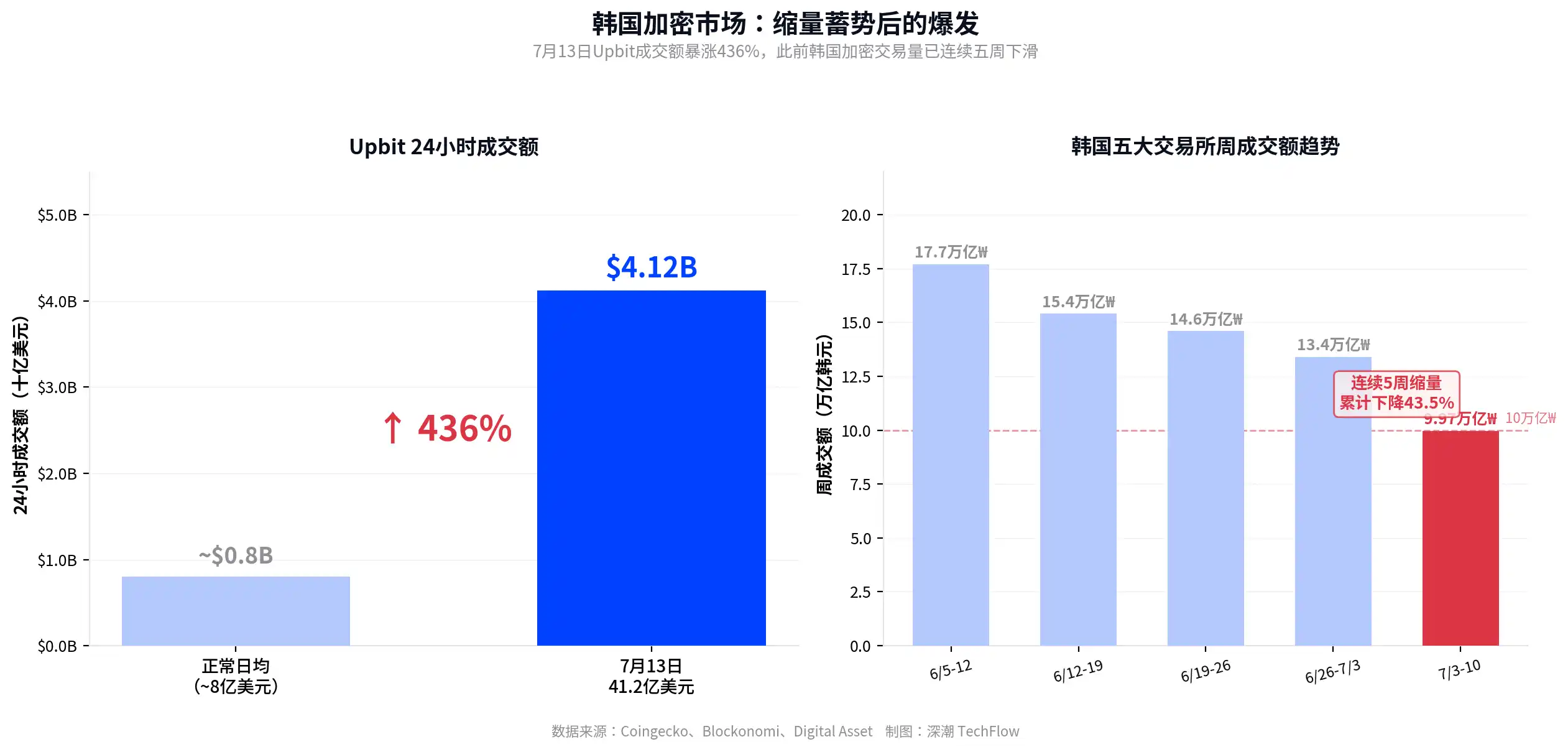
Deep Tide TechFlow Introduction: The Korean KOSPI index triggered the circuit breaker mechanism again on July 13. Samsung Electronics and SK Hynix plunged over 7% and 12% respectively, with the index having retracted more than 20% cumulatively from its June 19 peak. Retail investors are starting to vote with their feet: according to Coingecko data, the 24-hour trading volume on Upbit, South Korea's largest exchange, surged to $4.12 billion, a single-day increase of 436%. The top five cryptocurrencies by trading volume were BTC, XRP, ETH, T, and BLAST.
Nearly a week of consecutive stock market plunges in South Korea is driving retail funds towards the cryptocurrency market.

On July 13, the KOSPI index opened down 63.91 points to 7,412.03. Losses continued to widen during the session. At 10:34 AM, KOSPI 200 futures fell more than 5%, triggering this year's 18th sidecar (seller temporary halt). When triggered, KOSPI was at 7,162.21, down 4.20% from the previous trading day.

Samsung Electronics fell over 7.72% on the day, while SK Hynix plunged more than 12%. SK Square (the largest shareholder of SK Hynix) dropped 15%, and Samsung Electro-Mechanics fell 17%.

KOSPI Retraces Over 20% from Peak, Semiconductor Supercycle Faces Trust Crisis

The KOSPI has entered a technical correction from its June 19 intraday high of 9,385 points, with a cumulative retracement exceeding 20%.

The volatility of the Korean exchange in 2026 has already surpassed that of the 2008 financial crisis. Up to that point, the Korean exchange had triggered nearly 30 sidecars and multiple circuit breakers this year, breaking the historical record of 26 sidecars for the entire year of 2008.

Samsung Electronics and SK Hynix together account for about half of KOSPI's market capitalization, essentially determining the index's direction of movement. eToro market analyst Zavier Wong previously pointed out that these two stocks had a weighting of about a quarter in the index at the end of last year, which has now risen to about half. Any significant fluctuation in either stock drags down the entire index before the remaining nine hundred-plus listed companies have time to react.

SK Hynix 'Sell the News' Combined with Profit Expectation Downgrade Drags Down Entire Semiconductor Sector

SK Hynix just listed ADRs on the Nasdaq on July 10, surging 12.8% on its first trading day, raising approximately $26 billion for the company. However, just three days later in the Seoul market, the stock experienced a classic 'buy the rumor, sell the news' correction.

Korea Investment & Securities analyst Chae Min-suk released a report on July 13, forecasting SK Hynix's second-quarter operating profit at 60.4 trillion won, about 8% lower than the market consensus of 65 trillion won. She explained that SK Hynix's sales proportion of HBM (High Bandwidth Memory, a high-speed storage technology core to AI chip support) is higher than its competitors, leading to slower growth in its average selling price compared to the industry average.

This expectation downgrade is particularly damaging in the current environment. Daishin Securities analyst Lee Kyung-min noted that due to excessive concentration in semiconductors, leveraged investment liquidation, and supply-demand shocks, KOSPI's forward P/E ratio has fallen to levels seen during the 2008 global financial crisis. However, he also mentioned that current valuations have entered undervalued territory, and even a slight positive catalyst could trigger a rapid rebound.

But the market has other, more cautious voices. KOSPI's 'Buffett Indicator' (market capitalization to GDP ratio) reached 221% in June, far above the 70.2% average between 2000 and 2025, suggesting there is still room for valuation adjustments.

Upbit Trading Volume Soars 436%, Funds Flow Back from Stocks to Crypto Market

According to Coingecko data, Upbit's 24-hour trading volume reached $4.12 billion, a 436% increase. The top five cryptocurrencies by trading volume were: Bitcoin, XRP, ETH, T (Threshold Network), and BLAST.
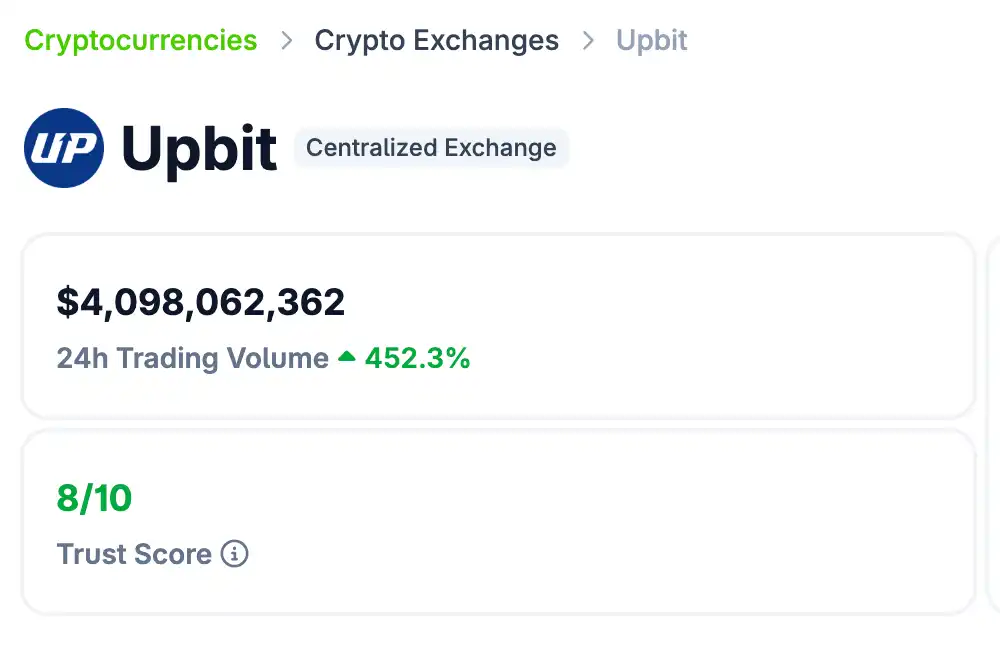
Korean retail investors migrating funds from stocks to crypto is not new. This round of flow-back follows a highly consistent script with several previous rounds of KOSPI plunges. During the KOSPI decline in May, XRP had already become the highest-traded crypto asset on Upbit and Bithumb, with daily trading volume surpassing Bitcoin and Ethereum.

Tiger Research analyst Ryan Yoon attributes this phenomenon to the group of Korean retail investors aged 40 to 50, who are withdrawing funds from domestic Korean stocks and U.S. stocks and transferring them into the crypto market, with XRP being the preferred target.

Prior to this surge in trading volume, the Korean crypto market actually experienced five consecutive weeks of shrinking volume. From July 3 to 10, the combined trading volume of South Korea's five major won-based exchanges (Upbit, Bithumb, Coinone, Korbit, Gopax) was 9.9676 trillion won, a 25.75% decrease from the previous week, falling below 10 trillion won for the first time since September 2023.

The trading volume explosion on July 13 can be seen as a concentrated release after this period of accumulation. Looking at the trading pairs, the appearance of Threshold (T) and BLAST in the top five reflects Korean retail investors' habitual preference for speculating in mid- and small-cap altcoins. According to Bitcoin Sistemi data, T's 24-hour trading volume on Upbit reached $68.27 million, with its total trading volume on Korean exchanges approximately $76.75 million.

The See-Saw Effect Between Korean Stocks and Crypto: A Continuously Validated Trading Logic

South Korea is one of the few global markets where retail funds switch between the stock market and the crypto market on a large scale. To date, over 16.2 million people in South Korea own crypto accounts, accounting for about 32% of the population. The number of crypto holders has surpassed the number of stock investors. According to Chainalysis data, South Korea has cumulatively received over $722 billion in crypto asset value, making it the world's second-largest recipient of crypto assets after the United States.

Public data shows that from July 13 to 19, stablecoin trading volume on South Korea's five major exchanges reached 2.226 trillion won (approximately $1.62 billion). Korean investors' high trading enthusiasm had already begun to show when they frantically bought XRP on July 11.

Following previous patterns, Korean retail investors' aggressive crypto buying typically concentrates within 1 to 3 trading days after a KOSPI plunge, after which trading enthusiasm gradually subsides as the stock market stabilizes. What investors need to watch is: if KOSPI finds support at current levels, the 'spillover effect' funds in the crypto market may retreat just as quickly.


Domande pertinenti

QWhat was the trigger for the significant increase in Upbit's trading volume according to the article?

AThe sharp decline in the Korean stock market, specifically the KOSPI index, which fell over 20% from its peak and triggered multiple trading halts, drove retail investors to move funds into the cryptocurrency market.

QWhich two major companies were highlighted as driving the KOSPI index's movement, and how much did their stocks fall on July 13th?

ASamsung Electronics and SK Hynix. Samsung Electronics fell over 7.72% and SK Hynix fell over 12% on July 13th.

QWhat are the top five cryptocurrencies by trading volume on Upbit mentioned in the article?

AThe top five cryptocurrencies by trading volume on Upbit are Bitcoin (BTC), XRP, Ethereum (ETH), Threshold Network (T), and BLAST.

QWhat reason did an analyst give for the popularity of XRP among Korean retail investors during market shifts?

ATiger Research analyst Ryan Yoon attributed it to Korean retail investors aged 40-50 years old who are moving funds from domestic and US stocks into the crypto market, with XRP being their preferred asset.

QWhat does the article suggest about the relationship between the Korean stock market (KOSPI) and the cryptocurrency market in Korea?

AThe article suggests a 'seesaw effect' or inverse correlation, where significant declines in the KOSPI index often lead to a surge in trading volume and fund inflows into the Korean cryptocurrency market, and vice-versa.

Letture associate

Must-Watch Events Next Week|CLARITY Act Could Face Senate Vote; SpaceX, Circle to Report Earnings (8.3-8.9)

**Summary: Key Events and Developments to Watch (August 3-9)** The upcoming week is marked by significant financial disclosures, key legislative deadlines, and notable product updates. **Major Financial Events:** Several companies are scheduled to release their Q2 2026 earnings. American Bitcoin (ABTC) will report on August 3, followed by SpaceX and Hut 8 Mining Corp. on August 4, and Circle on August 5. Notably, a significant portion of SpaceX shares (up to 12% of total shares) will be unlocked on August 6 following their earnings release. **Key Legislative Deadline:** The U.S. Senate faces an August 7 deadline to secure 60 votes for the CLARITY Act, a bipartisan bill aiming to establish a federal regulatory framework for cryptocurrencies. The Senate may hold a full vote on the bill during the week. **Economic Data:** The U.S. July Non-Farm Payrolls report will be released on August 7, providing crucial labor market data. **Technology & Product Updates:** * **Shutdowns:** DeFi portfolio tracker Zapper and wallet app Ctrl Wallet will cease operations on August 3. * **Upgrades:** LayerZero will deprecate its v1 relayers on August 3. XRP Ledger's new version 3.3.0, featuring five new functions, is expected next week. * **AI:** Elon Musk announced that the advanced Grok 4.6 AI model is set for release around August 7. * **Bitcoin:** The BIP-110 forced signaling for a potential Bitcoin network change is scheduled to begin around August 8. **Other Notable Events:** Chinese robotics firm Unitree Tech has set its preliminary price inquiry for its IPO for August 5. South Korean exchange Upbit will delist AQT and AERGO tokens on August 3.

marsbit1 h fa

Must-Watch Events Next Week|CLARITY Act Could Face Senate Vote; SpaceX, Circle to Report Earnings (8.3-8.9)

marsbit1 h fa

Stocks Are Plummeting More Sharply Than Cryptocurrencies. Where Has the Money Gone?

Stock Markets Plunge Deeper Than Cryptocurrencies: Where Did the Money Go? In late July, Seoul's Kospi index triggered circuit breakers for two consecutive days, plummeting over 40% from its June high. The collapse was led by heavyweight stocks like SK Hynix, whose record profits still disappointed investors, and devastating leveraged ETFs, with one major product losing over 83% of its value. This signaled a global, forced deleveraging targeting the most crowded trades. Interestingly, while stocks exhibited extreme volatility akin to crypto markets, Bitcoin rose nearly 15% in July after a prior steep drop. Analysis shows the money fleeing equities did not flow into Bitcoin. Instead, Bitcoin had already absorbed its sell-off in May-June, when U.S. spot Bitcoin ETFs saw historic outflows. The true safe-haven beneficiary was gold, whose price rose over 20% year-on-year, highlighting a decoupling between Bitcoin and gold as "digital gold." The sell-off was a targeted unwinding of leveraged positions in tech and semiconductors, accelerated by broker-dealer risk management and shifts in the AI narrative, including new competition from Chinese memory chipmakers. The retreat path was clear: from high-valuation tech stocks to cash and U.S. Treasuries, then to gold. For Bitcoin to attract sustained institutional inflows, conditions like eased global liquidity pressure, a "soft-landing" Fed rate cut, and U.S. regulatory clarity via legislation like the stalled CLARITY Act are needed. Currently, Bitcoin is not a safe haven but an already-cleared asset. Its low correlation with tech stocks, however, makes it a potential diversification play for institutional portfolios once the storm passes. The money isn't here yet, but the positioning is underway.

marsbit1 h fa

Stocks Are Plummeting More Sharply Than Cryptocurrencies. Where Has the Money Gone?

marsbit1 h fa

In Conversation with Ray Dalio: We Are Currently in an AI Bubble, with 1% of My Portfolio in Bitcoin

Ray Dalio, founder of Bridgewater Associates, warns in an interview that the current AI boom shows classic bubble characteristics, which could lead to significant economic downturns as seen in past cycles like 1929 or 2000. He explains that speculative enthusiasm, fueled by debt and overvaluation, often precedes a crash when rising rates or taxation force asset sales, causing widespread losses and recession. Dalio also outlines his "Big Cycle" theory, describing an approximate 80-year pattern where widening wealth gaps, massive government deficits, and shifting geopolitical power (like China's rise) create internal conflict and global instability. He emphasizes that we are in a late-cycle, transitional phase where traditional powers like the US and UK face decline. For personal wealth protection, Dalio advises diversification beyond cash into assets like stocks, bonds, real estate, and particularly gold, which he prefers over Bitcoin. While he holds about 1% of his portfolio in Bitcoin as a non-printable hard asset, he views gold as more secure from technological or governmental threats. Regarding AI's impact, Dalio believes it will disproportionately benefit capital owners, worsening inequality by replacing both physical and cognitive labor. He suggests that human intuition and emotional intelligence, combined with AI, will be key for future workers. On taxation, Dalio argues that wealth taxes are impractical and risk triggering asset sell-offs, reducing productive investment. He points to the UK as a cautionary example of debt, low productivity, and political strife. Geopolitically, Dalio foresees a more regionalized world, with the US showing weakness in prolonged conflicts like with Iran, akin to past imperial declines. The ideal outcome, he suggests, is coexisting powerful blocs (e.g., Americas, China-Asia Pacific) without major war.

marsbit5 h fa

In Conversation with Ray Dalio: We Are Currently in an AI Bubble, with 1% of My Portfolio in Bitcoin

marsbit5 h fa

Trading

Spot
活动图片




