Korean Stock Market Crashes, Are Koreans Rushing into Crypto Again? This Project Team Got Slammed...

比推Pubblicato 2026-03-05Pubblicato ultima volta 2026-03-05

Introduzione

Amid a significant downturn in the South Korean stock market, there is growing discussion about Korean retail investors shifting heavily into cryptocurrency as an alternative. Observers note that Koreans have a strong cultural tendency toward leverage and speculative investment, which may be driving renewed interest in crypto assets like Bitcoin, seen as a potential safe haven during economic instability. Bitcoin’s price recovery and increased institutional buying are also highlighted, with price targets such as $87,000 and even $100,000 being discussed. Some attribute Bitcoin’s strength to its perceived reliability during times of geopolitical tension. Additionally, former U.S. President Donald Trump is mentioned as pushing for clearer cryptocurrency regulation, which could bring more certainty to the market—though some express skepticism about his motives. The article also covers controversy around the project "Opinion" on the BSC chain, which has drawn criticism for its handling of user rewards and airdrops, leading to broader discussions about the sustainability of airdrop models and the need for genuine user engagement rather than speculative farming. The content is compiled from social media platforms and does not constitute investment advice.

Hello dear readers~

What were the crypto KOLs talking about in the past 24 hours?

Note: The following content is compiled from the X platform and represents personal opinions. It does not represent the stance of this platform and certainly does not constitute investment advice.

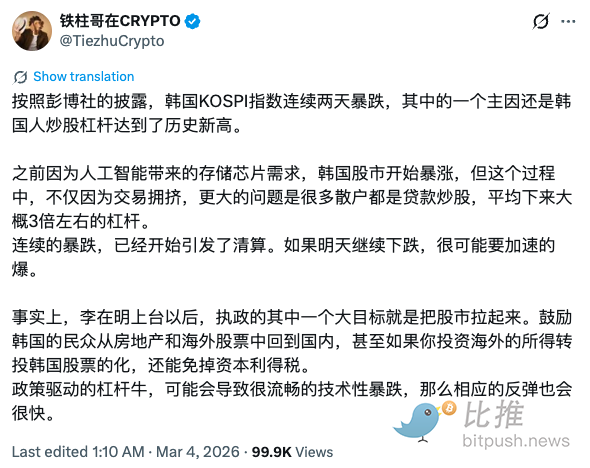
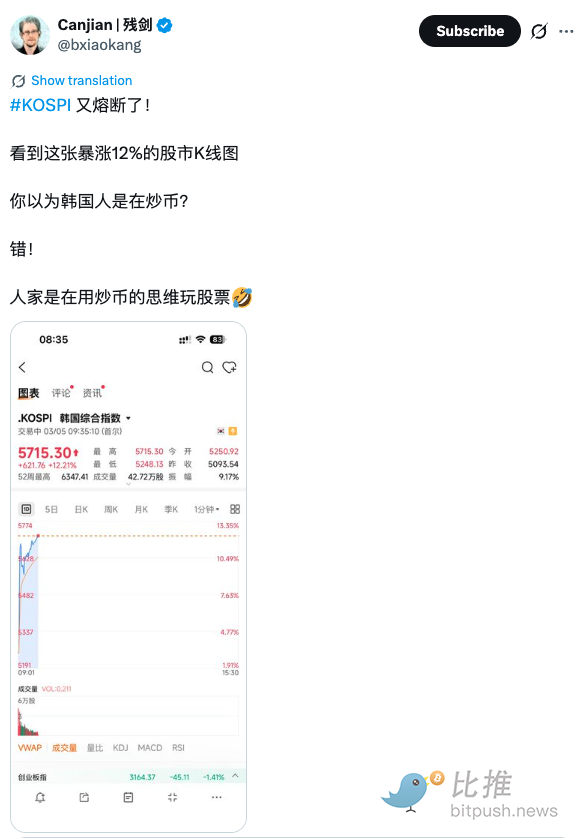
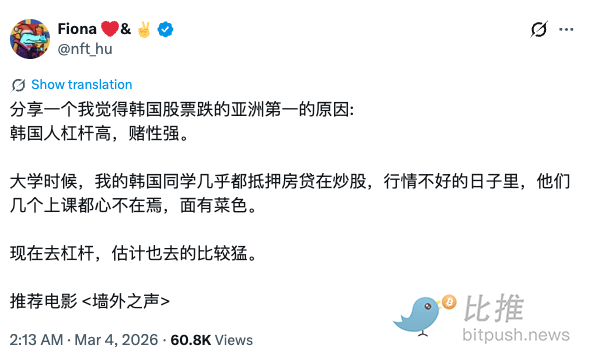
Koreans' Love for Leverage is in Their DNA
Popular Replies:

Koreans' love for leverage is in their DNA. The stock market crashes, the crypto market picks up the slack.

Addicted to gambling. Koreans' speculative nature is number one in Asia.

South Korea's household debt level has always been high. The impact of the past few major deleveraging operations has been very significant.

This wave of Korean Won depreciation + stock market爆仓 (liquidation), BTC's safe-haven属性 (attribute) has been verified again, Koreans are rushing in.

Koreans should already be on their way, Upbit trading volume is about to explode, right?

FOMO indiscriminately, classic Korean retail investor style.

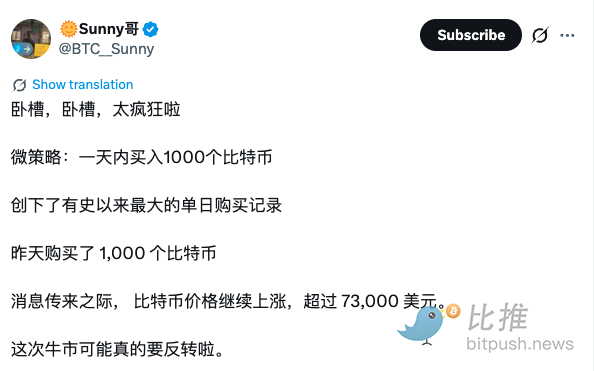
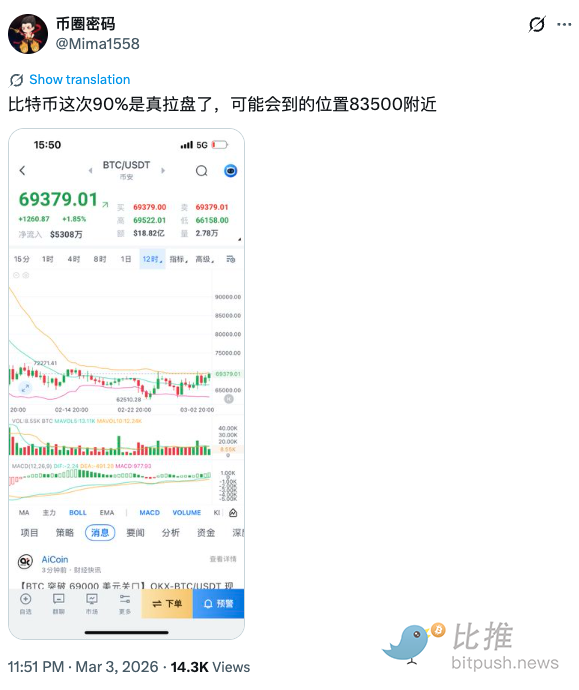
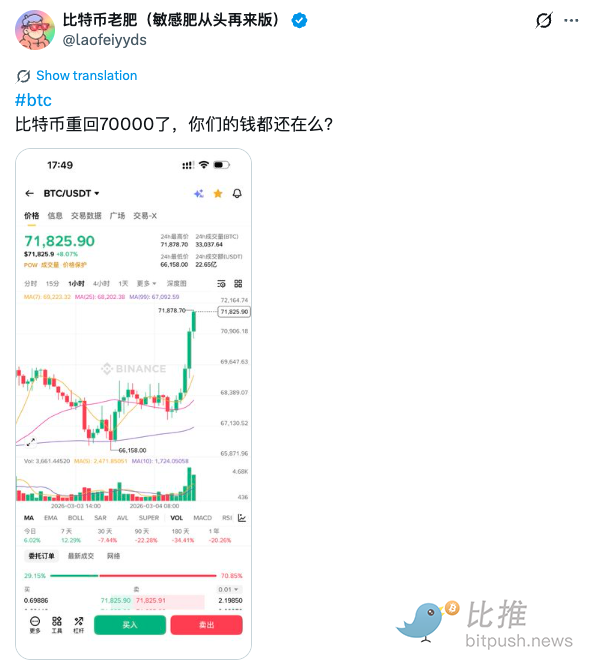
BTC Price Rebounds, Institutions Buying
Popular Replies:

71000—78000—87000, these are all key points if it rallies.

First break 73500, if that happens, next is 83300.

Money in, people in, target $100k,绝对不提前下车 (absolutely not getting off early this time)!

War has made people understand that Bitcoin is reliable.

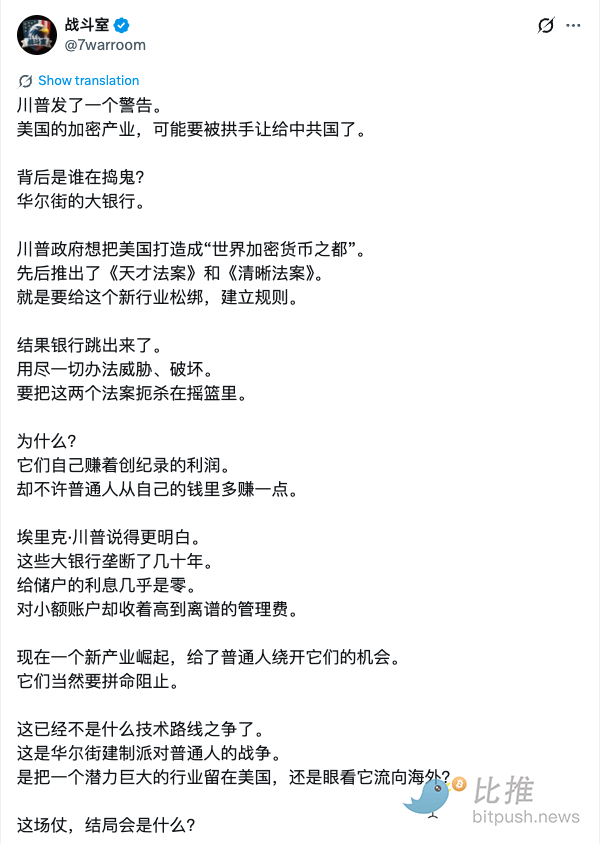
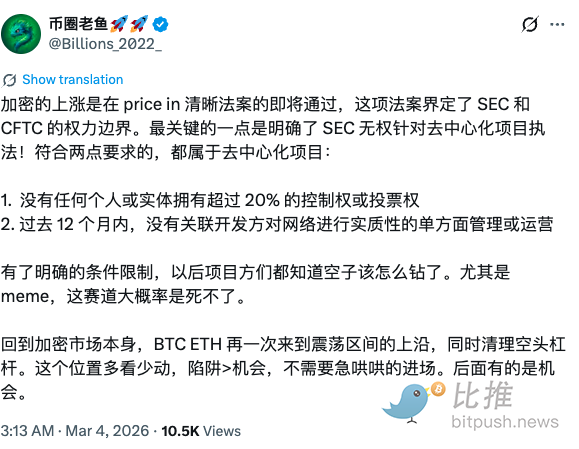
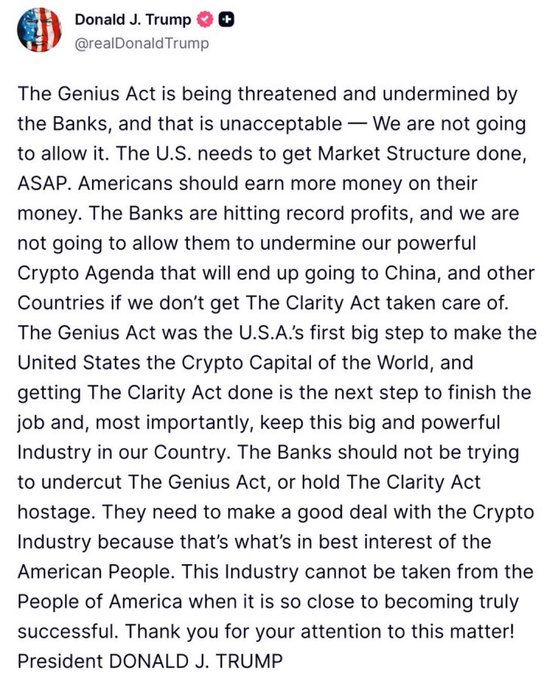
Trump Personally Pushing Crypto Bill!

Popular Replies:

If a clear bill isn't pushed forward, the market might徘徊 (linger) for a long time again. The crypto industry is actually welcoming the most friendly president now. If it's not pushed during Trump's term, there's a high probability of getting beaten up again later.

Feels like Trump's tweet means the talks broke down, seems like a negative?

不会是缺军费,再来收割一波把? (Could it be lacking military funds, coming to harvest another wave?)

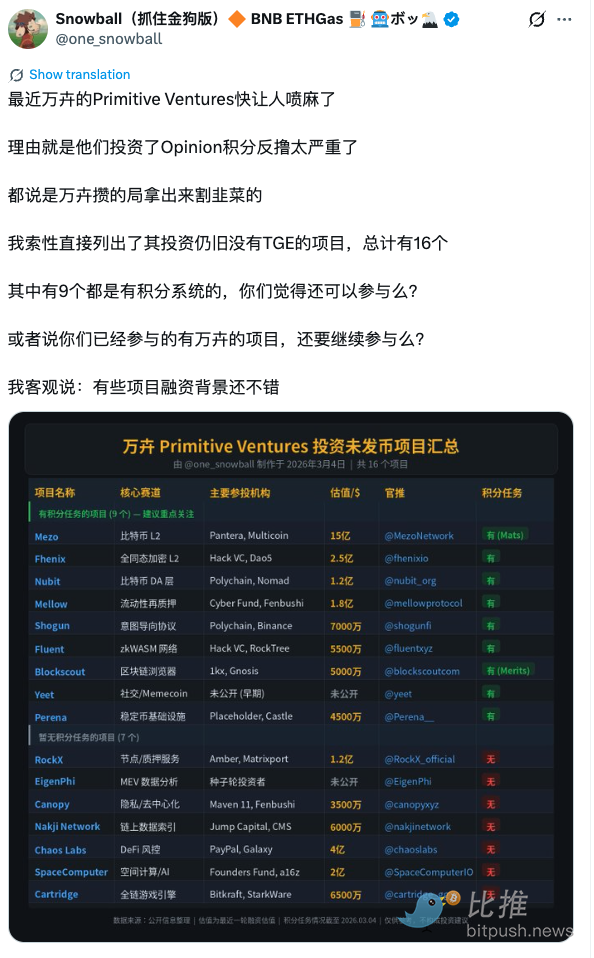
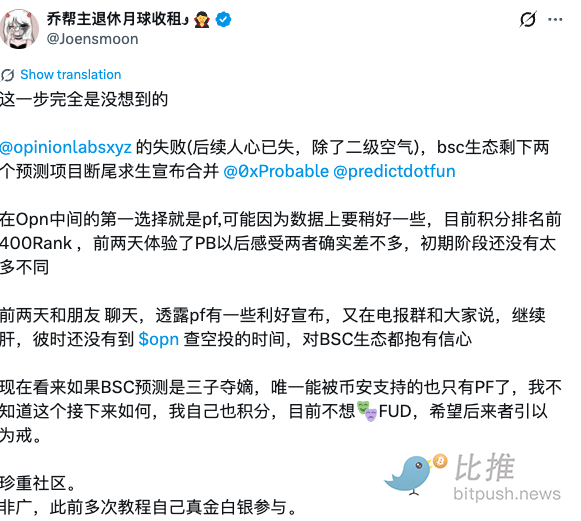
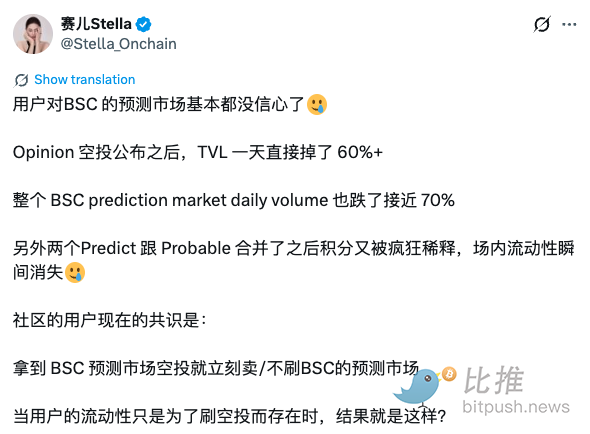
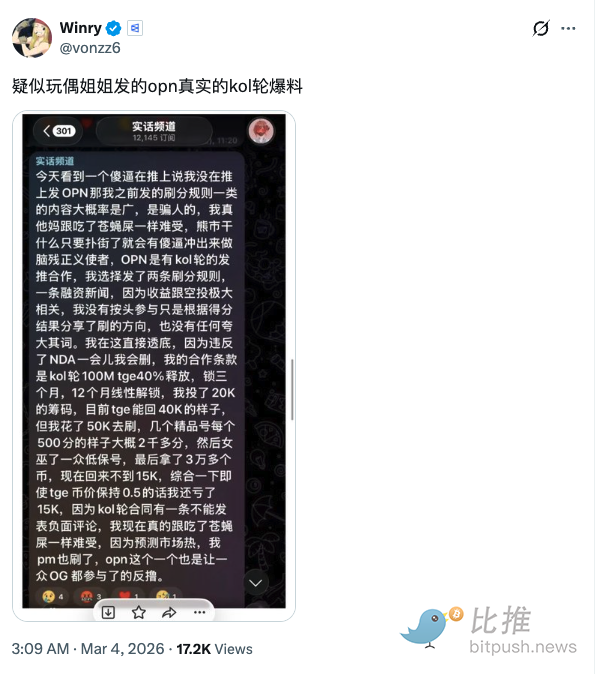
Opinion Controversy
Popular Replies:

Opinion ruined the prediction track on BSC, who dares to touch BNB Chain prediction projects in the future;

Learn from River, they compensated for二级 (secondary market) losses, Opinion directly反撸 (screwed people over);

I actually think there's no need to骂 (curse) the investment institutions:

  1. These were all the project's decisions

  2. Couldn't get on bn without前期数据 (early data)

  3. Tokens given out were basically picked up by the secondary market, no one is picking them up now

  4. The logic of airdrops has changed, those bringing data without real cash flow will be淘汰 (eliminated), and no one will use them either

  5. The farming era has ended, what's next is real payment for tokens


Twitter:https://twitter.com/BitpushNewsCN

Bitpush TG Discussion Group:https://t.me/BitPushCommunity

Bitpush TG Subscription: https://t.me/bitpush

Original article link:https://www.bitpush.news/articles/7616877

Domande pertinenti

QWhat is the main reason discussed in the article for Koreans turning to the cryptocurrency market?

AThe article suggests that Koreans are turning to the cryptocurrency market as a safe haven after the Korean stock market crash, leveraging their inherent tendency for high-risk investments and speculation.

QHow did the community react to the Opinion project mentioned in the article?

AThe community criticized the Opinion project for mismanaging the BSC prediction track, accusing it of exploiting users without compensation, unlike other projects that offered reimbursements for losses.

QWhat role is former President Trump playing in the cryptocurrency space according to the article?

AThe article states that former President Trump is personally advancing cryptocurrency legislation, which is seen as a positive development for the industry, though some speculate it might be a tactic to raise funds.

QWhat are the key Bitcoin price levels mentioned by traders in the article?

ATraders identified key Bitcoin price levels at $71,000, $78,000, and $87,000, with $73,500 and $83,300 being critical resistance points to watch for further gains.

QWhat is the article's perspective on the changing dynamics of airdrops and token distribution?

AThe article notes that the era of meaningless airdrops is ending, and future token distributions will require genuine user engagement and financial contributions, rather than just data farming.

Letture associate

Dan Koe: The Counterintuitive Truth—You Don't Need to Remember Everything You Read

Dan Koe: The Counterintuitive Truth — You Don't Need to Remember Everything You Read The central idea is that deliberately trying to remember information is often misguided. True learning isn't about memorizing facts but about having important knowledge surface naturally when needed through use. Most forgetting is normal, not a failure. The article reframes learning using a control theory framework—a four-step feedback loop: having a clear Goal, accurately Sensing your current state, Comparing the gap, and Acting to close it. Most learning stalls because people only do step 2 (blind input) without a goal to create the necessary "error signal" for focused action. The most effective method is to start with output, not input. Begin a meaningful personal project first, and learn only what's necessary to complete it. This project-driven, "just-in-time" learning ensures knowledge is contextual and retained. The concept of a "Second Brain" often fails because it becomes a digital graveyard—over-collected and under-utilized. The goal should be building a "Second Subconscious"—a dynamic system that proactively surfaces relevant ideas during creation, not a static storage vault. Tools like Obsidian+Claude or Eden can help by automating organization and enabling semantic search, but their value depends on linking knowledge to active projects. Ultimately, what matters is not what you store, but what you filter and internalize. Focus on ideas that shape your worldview, use projects as filters, and transform collected material through writing and sharing. AI should be used to reduce friction in research and editing, not to formulate your core views. In conclusion, remembering is a byproduct, not the goal. Knowledge that sticks comes from pursuing personal goals, applying it in real projects, and digesting it through creation. The tools are merely aids; the crucial step is to start doing meaningful work and let the necessary knowledge find you.

marsbit49 min fa

Dan Koe: The Counterintuitive Truth—You Don't Need to Remember Everything You Read

marsbit49 min fa

A New Era: The Fundamental Transformation of China's Entrepreneurs

A profound generational shift is underway among Chinese entrepreneurs. The wealth and influence once dominated by real estate and internet giants is now being claimed by a new wave of founders driving breakthroughs in AI, semiconductors, and robotics. This change is vividly reflected in 2026's wealth rankings. Figures like Zhang Yiming (ByteDance), Liang Wenfeng (DeepSeek), Chen Tianshi (Cambricon), and Wang Xingxing (Unitree Robotics) are ascending. Their wealth stems not from traditional business models but from market expectations for future technological competitiveness, with AI, chips, and smart hardware becoming the primary engines of wealth creation. Their common trait is a foundational focus on technology, often starting from the laboratory rather than a business plan. Examples include Chen Tianshi's decade-long push in AI chips, Liang Wenfeng's core algorithmic innovations at DeepSeek with a compact team, and Zhu Yiming's "no salary until profitable" 9-year journey to build Changxin Memory into a global DRAM player. This transition marks a fundamental shift in China's economic imperative: from commercial expansion and learning to indigenous innovation and deep industrial capability. While the previous generation built the foundational market and infrastructure, this new cohort is tasked with achieving global leadership in core technologies, moving China from "keeping pace" to pioneering original, breakthrough innovations that are industrialized at scale. The baton is being passed to those competing on the world stage through technological originality.

marsbit50 min fa

A New Era: The Fundamental Transformation of China's Entrepreneurs

marsbit50 min fa

Once-Popular Web3 Enters Wave of Layoffs

The once-hot Web3 industry is experiencing a severe wave of layoffs. While many companies attribute job cuts to AI-driven restructuring, the primary reason is often financial pressure. The Web3 sector, at the intersection of tech and finance, has been hit particularly hard. Employees at major cryptocurrency exchanges report sudden, impersonal layoffs—often with system access revoked overnight—and minimal or no severance. Common tactics include setting impossible performance targets or terminating employees for minor policy violations. The working atmosphere has become toxic, marked by intense monitoring, excessive meetings, and management obsessed with control and internal politics rather than product innovation. The industry's core business model is collapsing. Exchange revenue from trading fees and listing charges has plummeted due to a decline in quality projects and retail investor exodus. Events like the massive forced liquidation on October 10th further shattered confidence. Competition from on-chain derivatives platforms and prediction markets is intensifying the downturn. As layoffs continue, displaced workers struggle to find new opportunities. Many transition to the AI sector, but face significant bias from traditional finance and even some AI firms, which view crypto industry experience with suspicion. The current downturn appears more structural than cyclical, driven by unsustainable practices, internal strife, and a failure to innovate, raising questions about the industry's future trajectory.

marsbit1 h fa

Once-Popular Web3 Enters Wave of Layoffs

marsbit1 h fa

Trading

Spot
活动图片